Marie Severin’s Due

Click on images to enlarge

There can be no doubt that Marie Severin deserves a book about her lifelong efforts in comics. More recognition than that would be appropriate even if she wasn’t one of the few well-known female practitioners in the last century. One would think that for her essential role as E.C.’s colorist alone, Severin should at least have previously had an issue of Squa Tront dedicated to her, since a special edition of that beautifully-produced E.C. fanzine is thus far the only significant acknowledgement that her brother the late John Severin has recieved from the American comics industry to which he dedicated decades of consistently high-quality, naturalistic work. But so far, the only publisher to undertake the rightful honoring of Severin is TwoMorrows, the imprint that fan John Morrow grew from the humble beginnings of his first thin issue of The Jack Kirby Collector in 1994.

Not only is coloring a particularly misunderstood aspect of comics, but the efforts of women have been traditionally discouraged in the medium. And though there is now occurring an explosion of comics scholarship, those scholars are often more interested in analyzing printed comics than they are in talking to the humans who made them. Since the higher-end critical forums such as Fantagraphics’ Comics Journal and Todd Hignite’s Comic Art are now published annually or otherwise infrequently, the bulk of in-print documentation and discussion of previous generations of cartoonists has been left to such publishers as J. David Spurlock’s Vanguard Productions and Morrow’s TwoMorrows, which also puts out Roy Thomas’ zine Alter Ego, the primary venue for many elder cartoonists’ only (or final) interviews.

So, TwoMorrows has published a book about Marie Severin and for that I am grateful. Nonetheless, this book, which features interviews by Dewey Cassell and Aaron Sultan with the artist and her contemporaries, shows the best and worst tendencies of the explosion of unapologetically fannish tomes that TwoMorrows has been releasing in the last few decades. The bad is overshadowed by the good, so let me get the few outstanding deficiencies out of the way immediately. The most heinous offense committed here is that the book is subtitled The Mirthful Mistress of Comics.
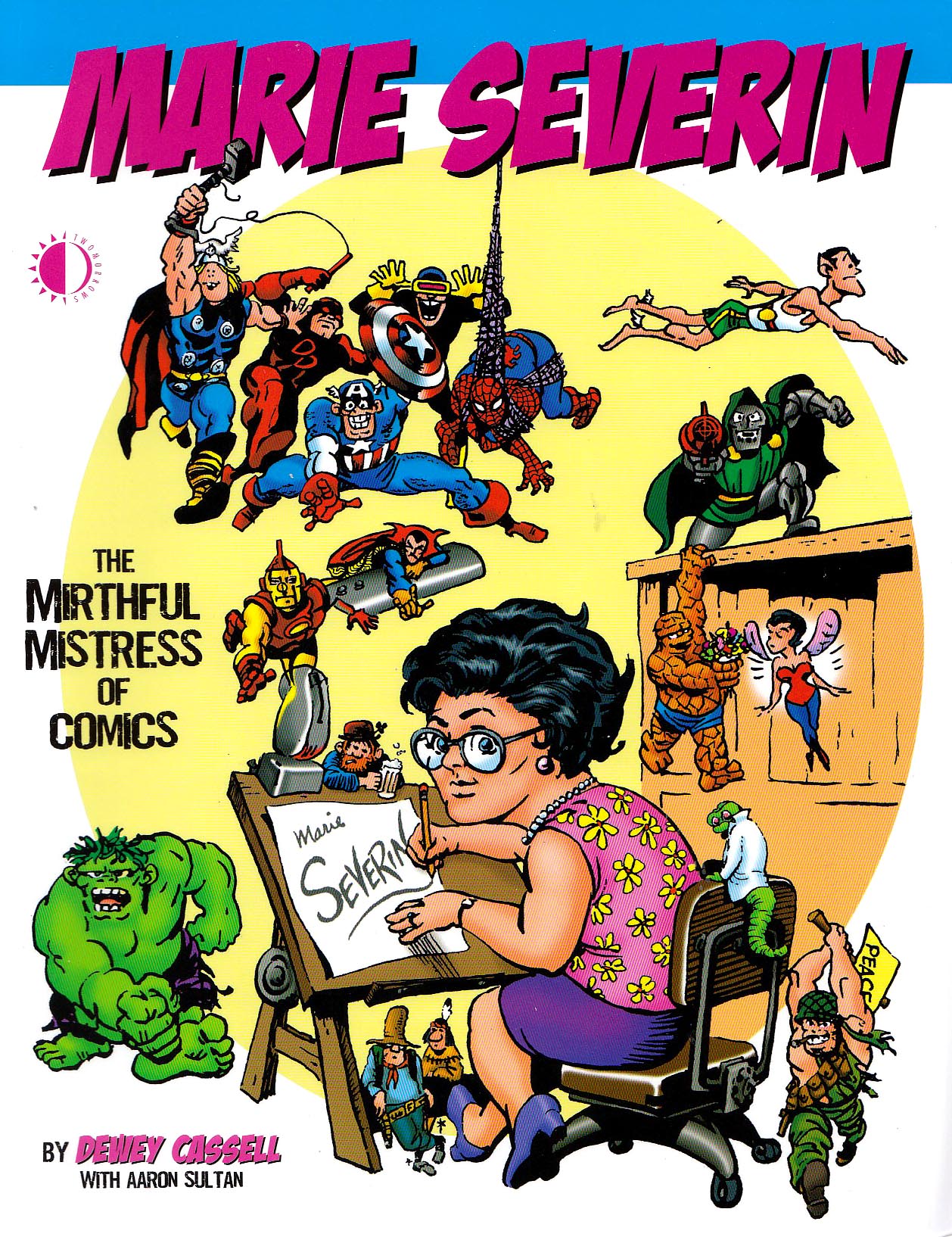
 

Severin is known for having a clever and cutting sense of humor. However, in utilizing Marvel overlord Stan Lee’s nickname for Severin (“Mirthful Marie”) and adding the usually pejorative feminine descriptive “Mistress,” the artist’s versatility and the essential nature of her many and varied contributions to comics history are diminished, even as images of a sort of cackling floozy ensconced seductively in the predominantly male confines of the bullpen are conjured.

One is relieved that other books about Marvel’s artists don’t all similarly utilize Lee’s corny alliterations; that, for instance, the many books about Jack Kirby have in their titles avoided Lee’s appending of “Jolly” to the artist’s name, since it is an even less appropriate description of Marvel’s founding dynamo than the unbecomingly anti-democratic royalism of the more familiar “King”. Speaking of Kirby, a bizarre prejudice rears up when co-interviewer Sultan asks Marvel mainstay John Romita, “What about Marie and Jack Kirby? Did she ever resent his ego at all?” Romita sets Sultan straight in short order, telling him of Severin’s (and his other contemporaries’) absolute admiration of the humble and accessible Kirby.

The other drawbacks here are lackluster book design and the counterintuitive use of the color section. For an artist known primarily if dismissively as a colorist, the decisions regarding color here are hard to fathom. Of 16 pages allotted for color reproduction, the equivalent of five of those pages are taken up by reproductions of original art, i.e. black and white linework and the other pages do not well represent  Severin’s best work. Her important and exemplary early E.C. coloring is shown in 4 small reproductions on a single page. Perhaps Cassell and TwoMorrows were unable to get the rights to use larger reproductions by those who hold the copyrights to her work for E.C., and so this specific disservice to Severin is not their fault. But as can be seen in the covers below, Severin added significantly to the art of such luminaries as Graham Ingels, Wally Wood and George Evans.
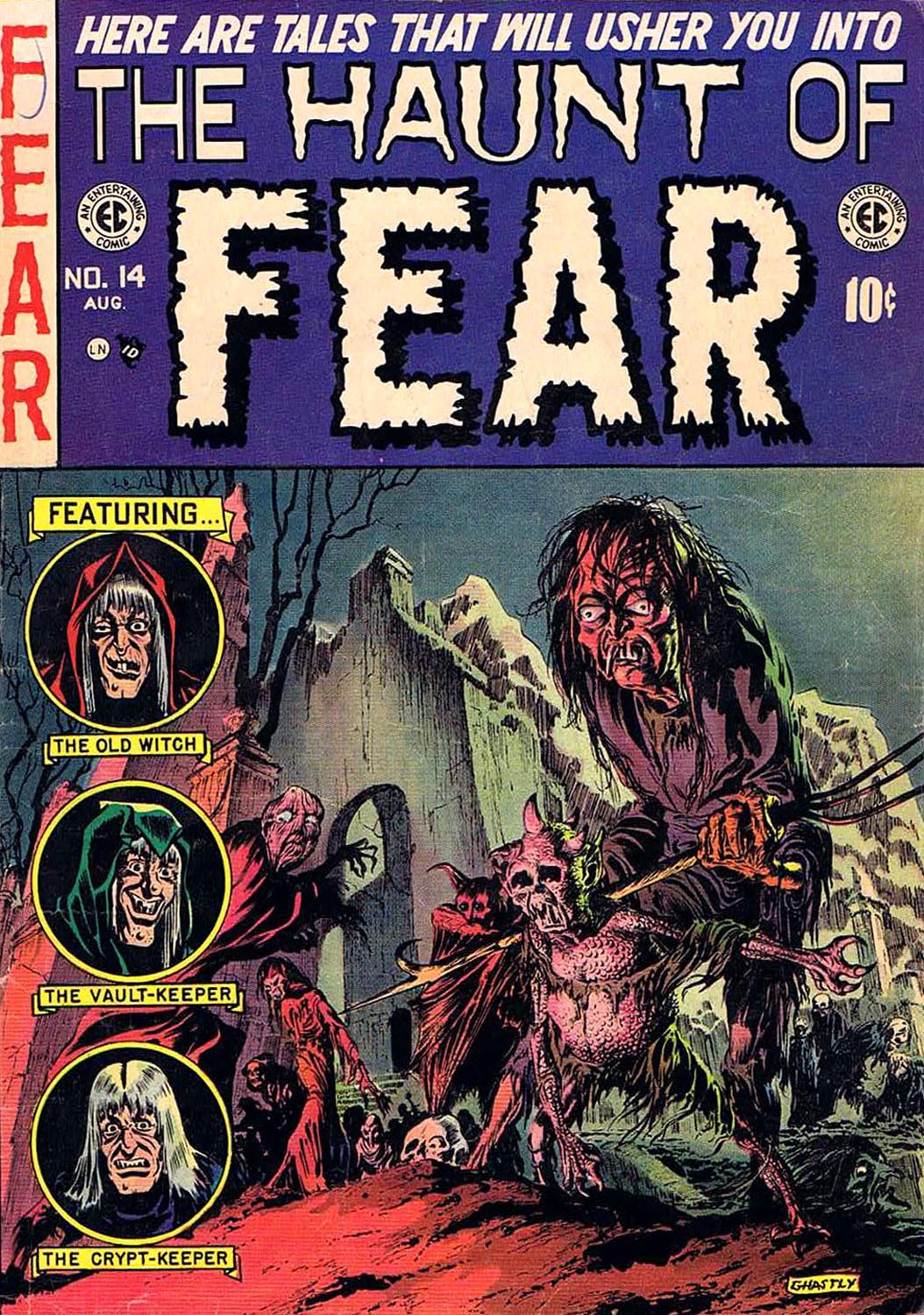
Graham Ingels, cover for Haunt of Fear #14, color by Marie Severin
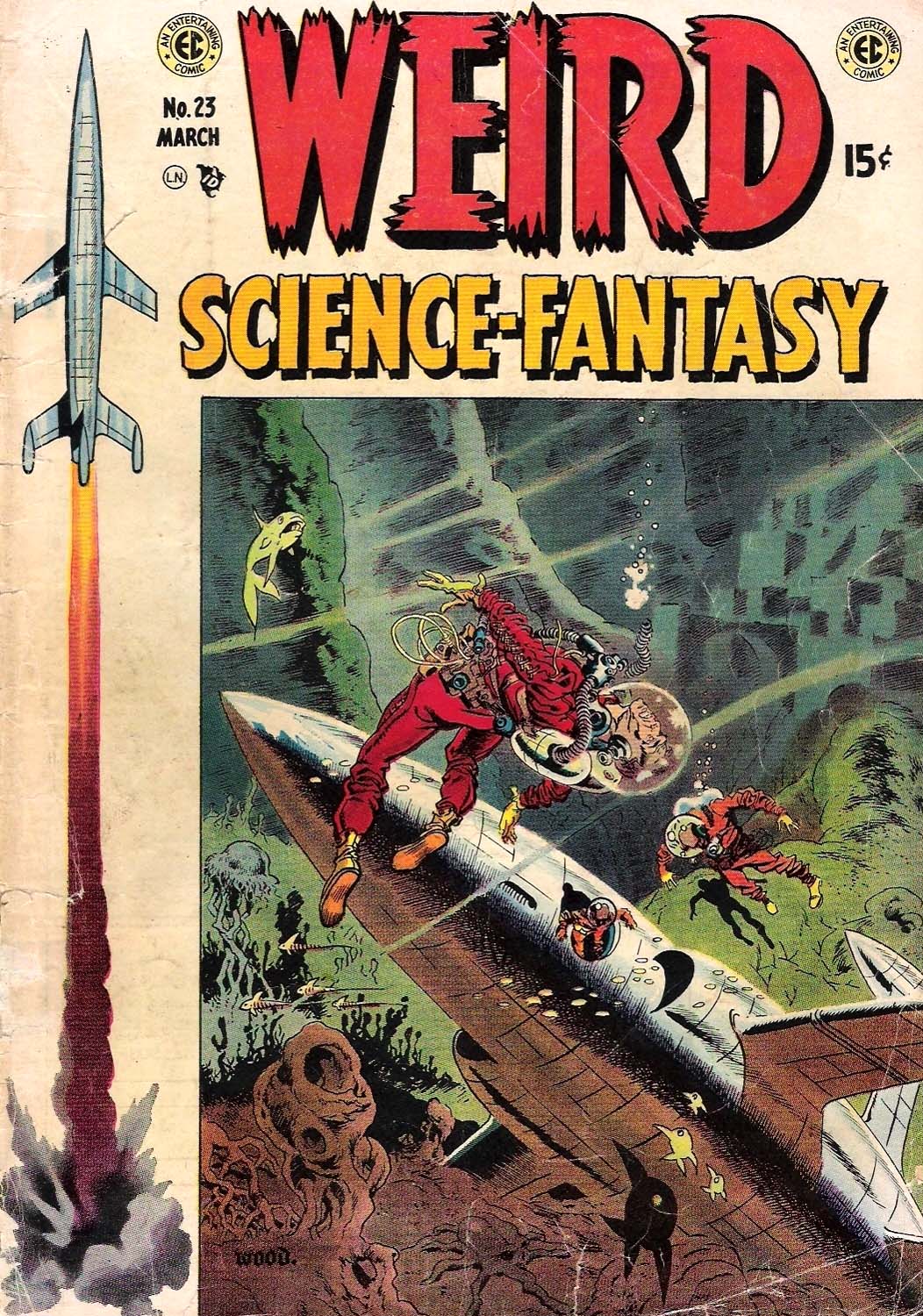
 

Wallace Wood, cover for Weird Science-Fantasy #23, color by Marie Severin
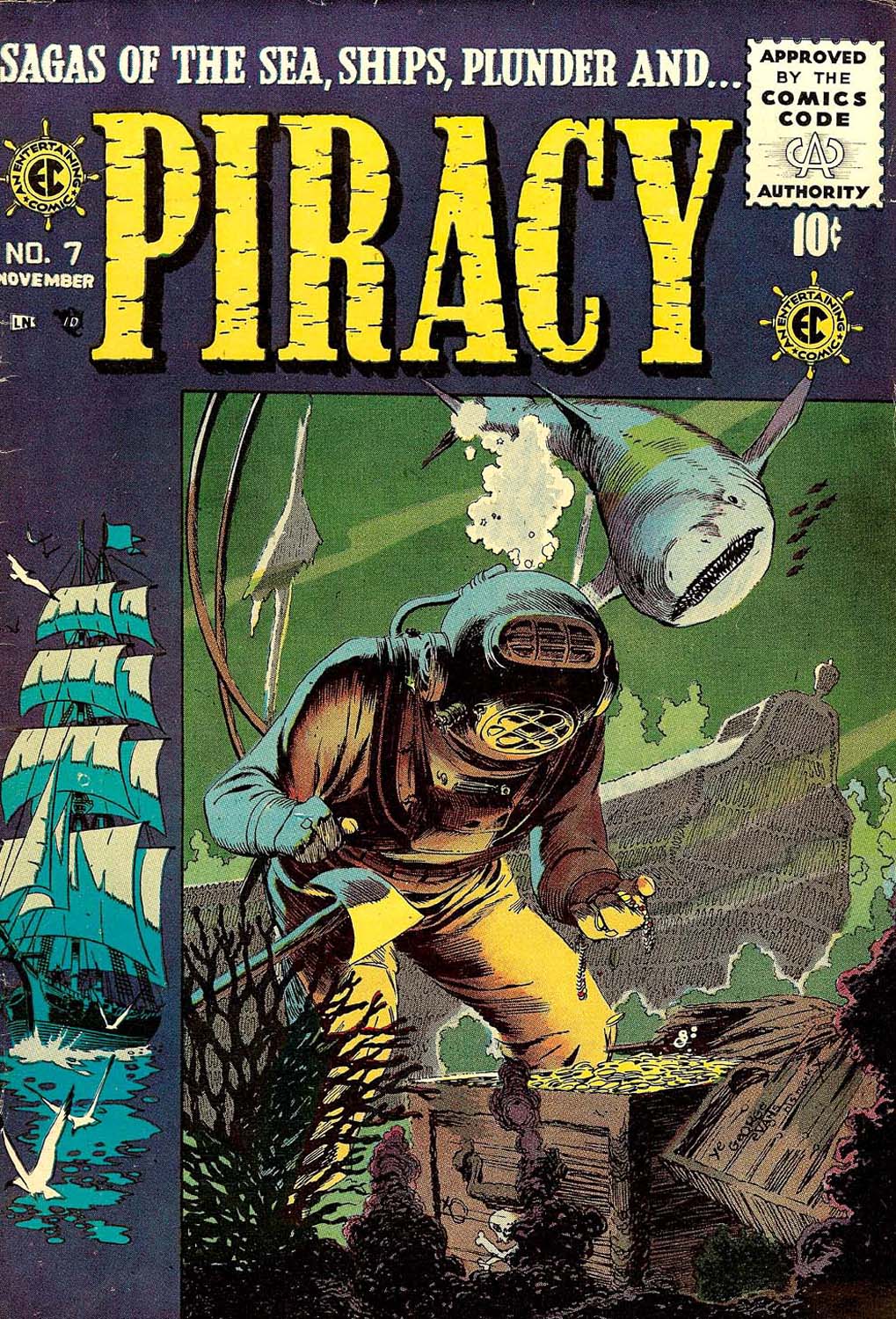
 

George Evans, cover for Piracy #7, color by Marie Severin

The strength of TwoMorrows’ books is usually in the varied interviews and such is the case with Marie Severin: the Mirthful Mistress of Comics. The authors speak to her brother, to her childhood friends and to her surviving co-workers at E.C. and Marvel. I wish that there were comments by more of the now-deceased artists that Severin colored over the years and who respected her efforts such as Kirby and that her employers such as Stan Lee had graced the book with more than perfunctory tribute. However, there are substantial contributions by such reputable sources as Al Feldstein, Jack Davis, Jack Kamen, John Romita, Roy Thomas, Flo Steinberg, Herb Trimpe, Linda Fite, Ramona Fradon, Trina Robbins, David Anthony Kraft and Mark Evanier.

The E.C. section is particularly well done. Severin began coloring for them when editor Harvey Kurtzman wanted to upgrade the look of the books, in Severin’s words “to look more like Prince Valiant in the newspaper.” For the next few years she colored first Kurtzman’s war books, then the entire line, with the exception of some covers and stories colored by the perfectionist Kurtzman, as well as a few stories colored by the similarly autonomously-minded Bernard Krigstein (both of whom Severin typically characterizes as “artsy-fartsy”). When Cassell tells Severin, “you’ve been credited with a lot of the success of EC because of those vibrant covers,” she effaces herself to credit instead the quality of the “content,” but truly, covers are the primary selling factors on the newsstand and the color is the more significant part of the initial impact of the visuals on the reader. And, Severin’s interior coloring is no less sensitive and considered. Still, assisting Kurtzman on his comprehensive research, drawing caricatures on the fly of her co-workers and coloring were the art Severin was able to do at E.C.

She was always capable of more, but it wasn’t until the 1960s and she had been working at Marvel for a while that she was given the opportunity to draw comics herself. It wasn’t the usually canny Stan Lee who realized her talents, either; instead it was Marvel’s publisher Martin Goodman that noticed how good she was when she did some superhero drawings for Esquire and so Severin began to draw sporadically for the company: a few episodes of Dr. Strange here, issues of The Hulk and Sub-Mariner there. Severin understands the comics medium well and her work can be as energetic and muscular as that of any male superhero artist, even on her many strips for the Marvel humor titles Not Brand Echh and Crazy.
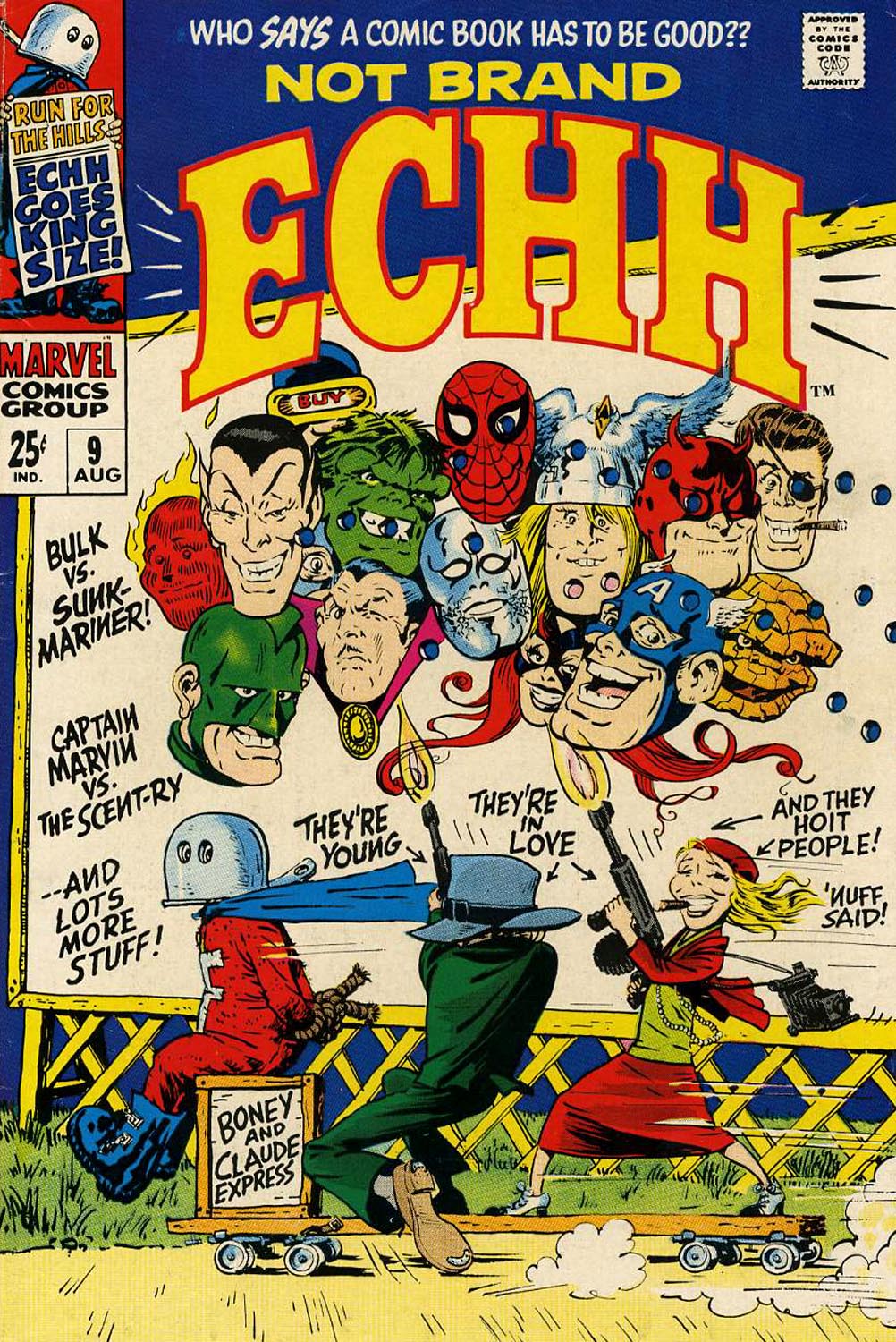
Marie Severin’s cover for Not Brand Echh #9.
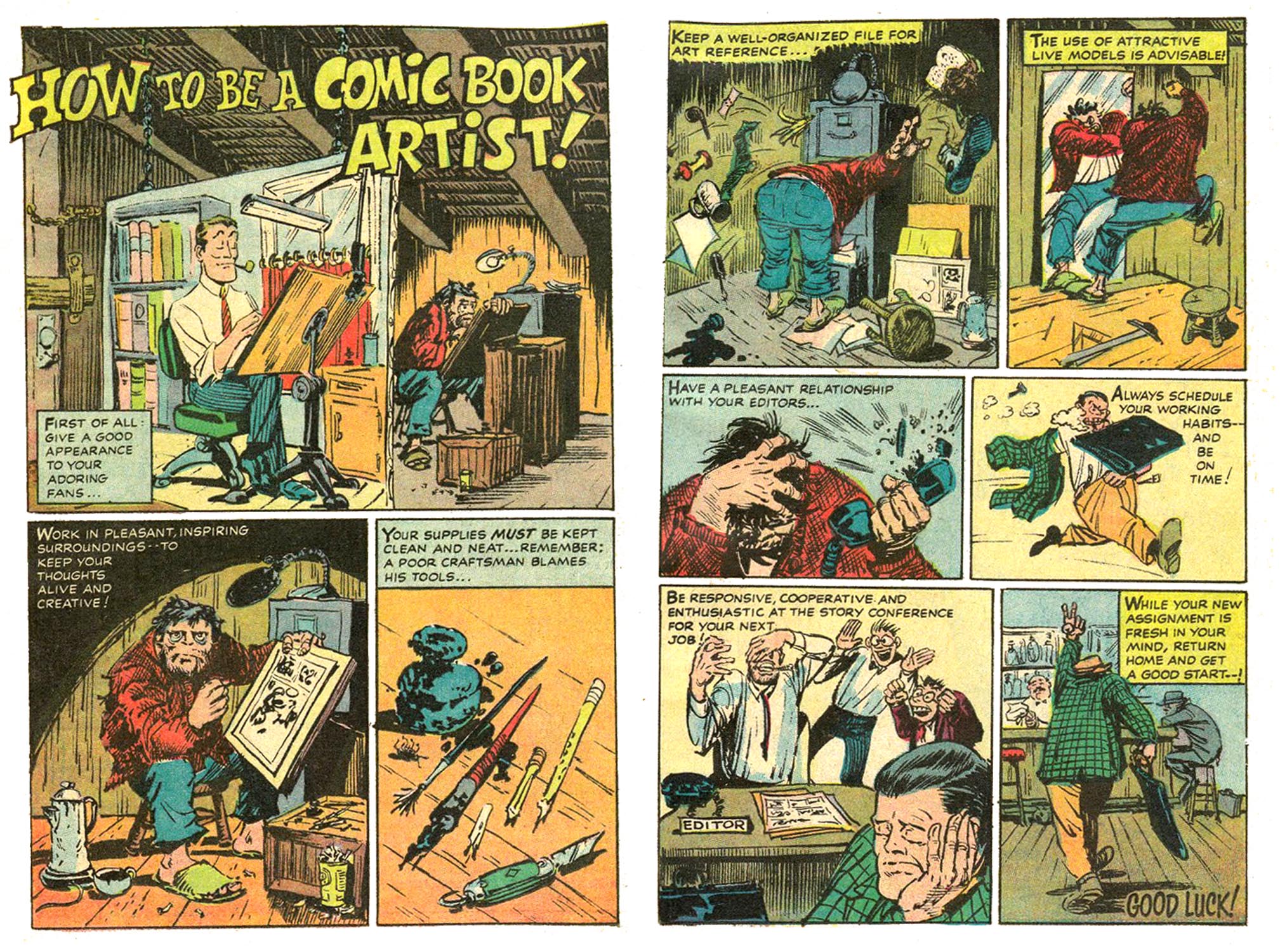
Marie Severin, from Not Brand Echh #3.

Perhaps her best known Marvel Comics work is her early-seventies tenure on their adaptations of the Robert E. Howard hero Kull the Conqueror; these stories are beautifully inked by her brother John. Their collaborative run is considered to be a classic of adventure comics and both siblings certainly deserve credit, but it is Marie’s great storytelling skills that drive the narratives. And, she is one of the few artists in comics who can match Kirby for compositional thrust, which is why she became the chief cover designer for Marvel for the next few decades.
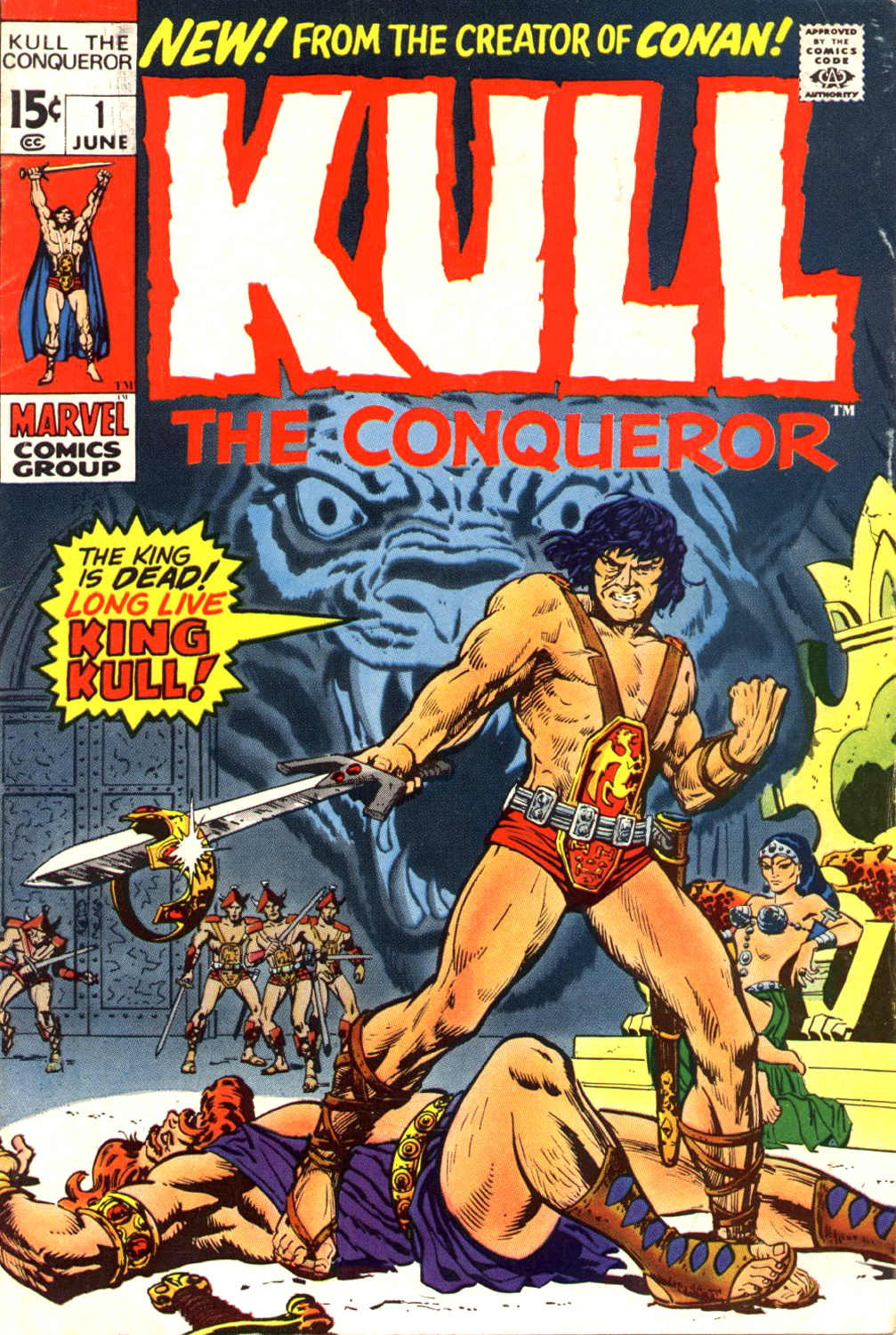
Marie Severin solo cover for Kull #1.
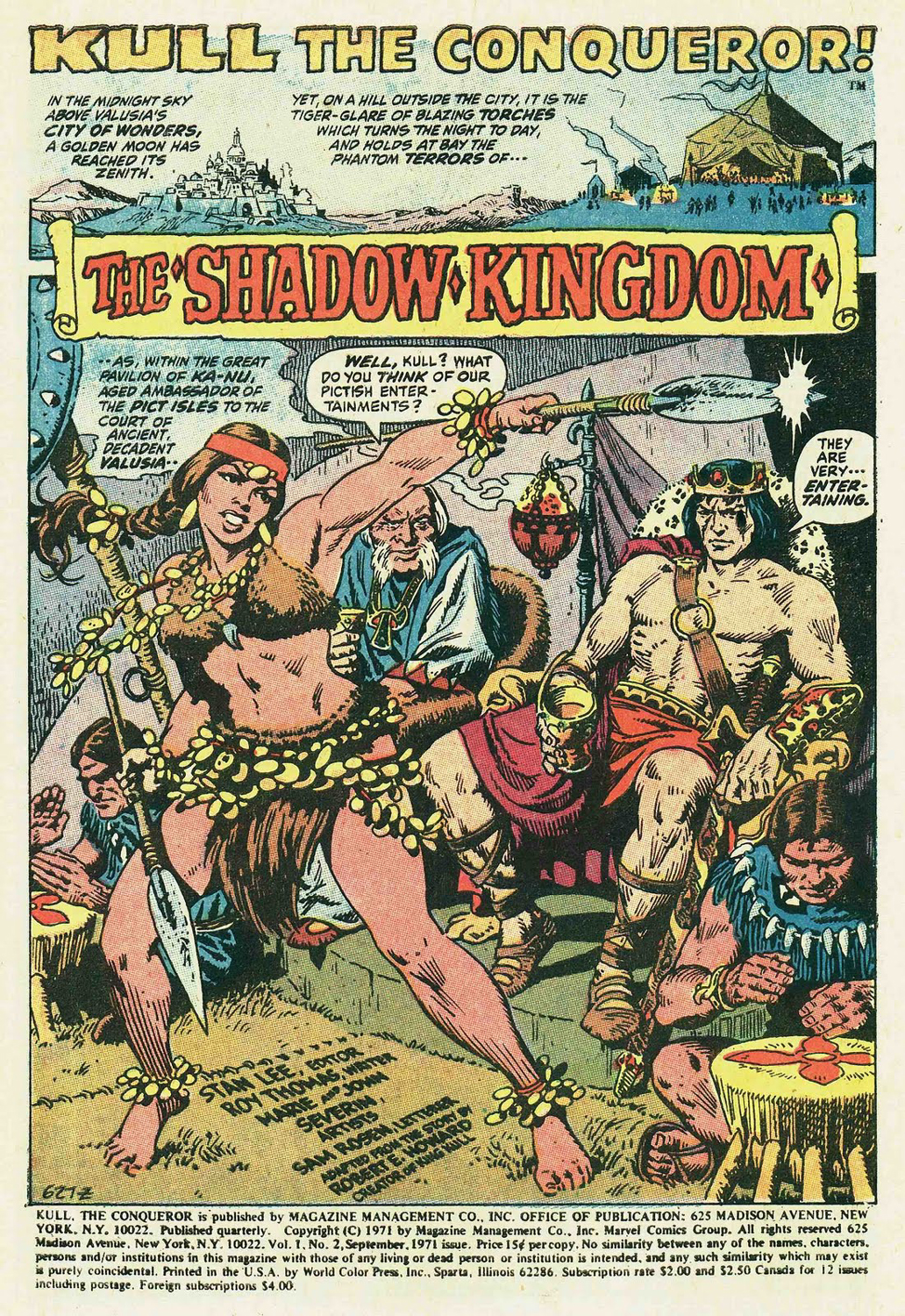
Splash page for Kull #2 by Marie and John Severin.

The interviews in the book give a remarkable account of Severin’s career and personality, but one gets the sense that Cassell and Sultan don’t truly comprehend how difficult and abusive the workplace was for women in the last century. That may be in part because Severin herself tends to diminish progressive issues that might be seen to be about political correctness, but it is sometimes only by reading between the lines that a fairly full picture of what her life in comics was like emerges. There can be little doubt that the sexual innuendos in the office went beyond simply “forgetting” about the presence of women in the room, that unwelcome comments and physical advances were directed to them. And Severin definitely faced a glass ceiling.

She succeeded John Romita to operate as a virtual art director for Marvel, but the position was unheralded as well as unpaid. In the present volume, Romita actually details how in order to gain points with Goodman, Stan Lee took credit for the substantial extra work that he and Severin did in that capacity. This seems typical of Lee’s manipulative treatment of even his most stalwart workers (and there is even mention here of Lee claiming as his property substantial amounts of original artwork, a questionable provenance at best given the subsequent troubled legal status of those pages). Neither Romita nor Severin hold anything against their “fearless leader”—it seems that Lee casts a sort of magic spell of obvious bullshit to make the people he uses, but never sticks up for, still somehow love him. Later, when Jim Shooter  cut a vicious swath through Marvel’s  elder talent, he also disrespected Severin’s art directorship, calling her instead “head artist” and she had no choice but to endure; as usual, there was no one in upper management to take her side.

Flying against Severin’s conservative nature, Trina Robbins hails her as a true feminist and she surely is an example of a woman excelling in a male-dominated field through sheer perseverance. Severin had a career in comics, but was not facilitated as she should have been; it was with her sense of humor that she was able to shine.
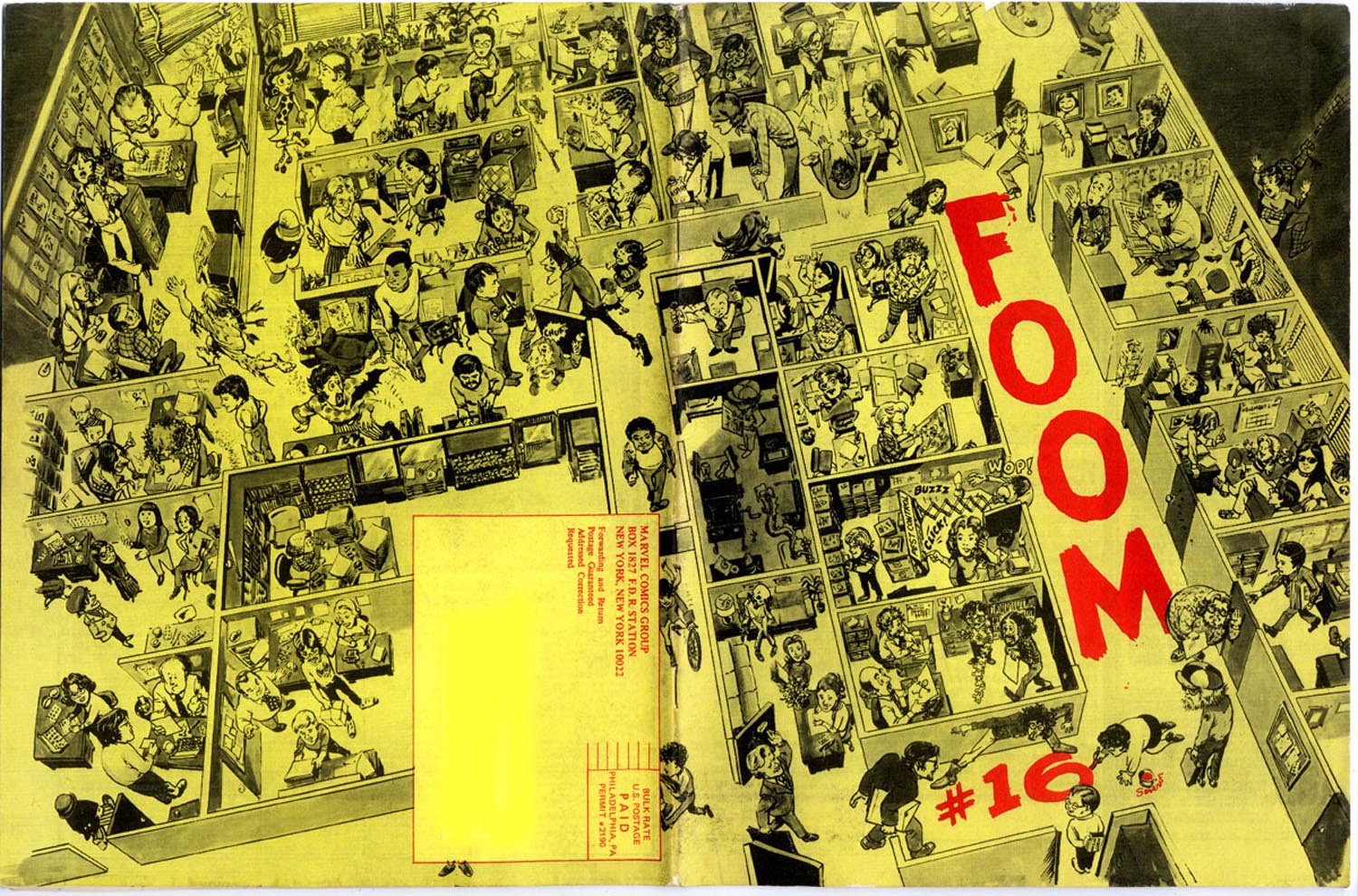
Marvel editor David Anthony Kraft on Marie Severin’s cover for the in-house fanzine FOOM #16: “That is exactly how the office looked….She’s got everyone in character, in the place where they were in the office, doing what they did.”

Severin’s ability to effectively nail her contemporaries is impressive, but these rare skills are unfortunately easy for some to underestimate; in the end she had to take what she was given and put a smiling face to it. Perhaps the most telling testimony to Severin’s skills and the misuse of her talents by the comics companies she worked so faithfully for is provided here by Mark Evanier. Firstly, in reference to MAD magazine, begun under the banner of her first employer E.C. and more recently published by DC Comics:

“People used to always say, ‘Marie belongs in MAD magazine.’ And she did…And I hate to think it’s true, although it possibly is, that the reason that she wasn’t was that she’s a woman. If you noticed, while Bill Gaines was running MAD magazine, they never had a woman artist there…Every so often, they would tap her for a coloring job, or a production job, but they never thought of her as somebody who could actually draw, say, a movie parody. And she would have drawn a better parody than a lot of other people they used. She obviously could do likenesses and at that time, MAD was paying ten times what a Marvel artist was getting paid for a page. It would have been fascinating to have seen her spend two days drawing a page of comics, as opposed to three hours. I would have loved to have seen what she would have done because it would have been amazing…she was considered family up there and they loved her, but she was family for production…I think she should have been drawing for MAD, because she was so good, and if a guy had been doing that same quality of work, probably would have been a regular in MAD. She probably would have had the job that Angelo Torres ended up getting…(doing) movie parodies up there.”

—and at Marvel:

“…I always thought she was an amazingly talented artist. She probably should not have been doing super-hero or adventure comics, but when she did, she always did a very fine job of them. I just thought she had this wonderful sense of humor…it is a shame, to me, that Marvel never really did a project where they let Marie Severin work exclusively on humor material, and develop her style more, and encourage her, and let her be as wonderful as she could be, because she had the skills, obviously, she had the sense of humor, and she had a unique viewpoint.”

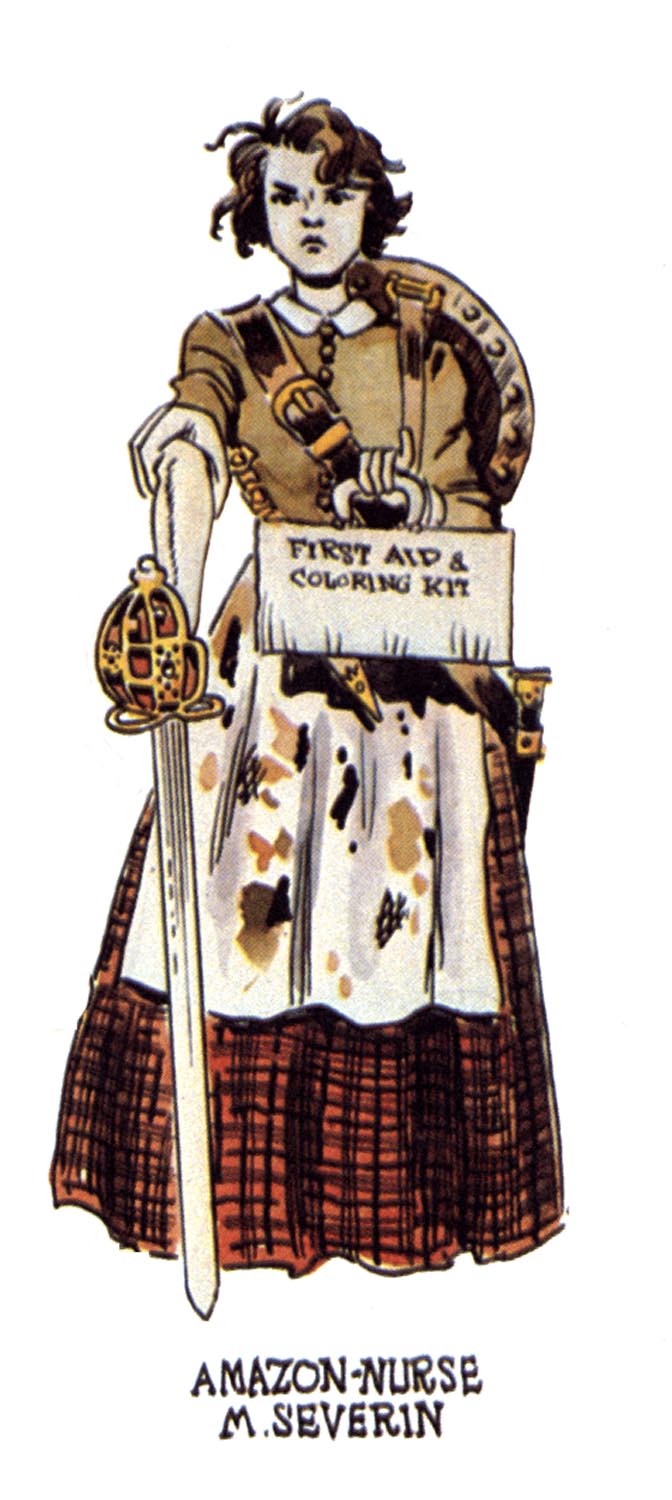
Marie Severin by her brother John, detail of a watercolored drawing of Harvey Kurtzman’s E.C. war comics staff, from Squa Tront #9.
Small As Life

I saw Cameron Crowe’s Say Anything again for the first time in years — and it’s still really good! Easily the best movie of Crowe’s I’ve seen…which maybe isn’t saying all that much, but still.

A big part of the film’s appeal is that both of its protagonists — John Cusack as Lloyd Dobbler and Ione Skye as Diane Cort — are likable and charming. This may seem like faint praise, but it seems to be an immensely difficult thing for modern romantic comedies to pull off. Maybe it’s because writers feel they need conflict and can’t figure out how to get it if somebody isn’t despicable; maybe it’s a misplaced effort at realism. Whatever the reason though, there are just an awful lot of romantic comedies where the guy is broken and repulsive and we’re supposed to cheer as the manic pixie dream girl saves him (as in Eternal Sunshine of the Spotless Mind) or in which all the characters are fairly repulsive (Pretty Woman), or in which the guy sleeps with someone else and you’re/she’s supposed to forgive him…or what have you. You’d think the baseline for a successful romantic comedy would be a couple who, when they get together at the end, it’s actually a happy ending. And yet, for the most part, when I see romantic comedies, I either can’t actually believe the protagonists will be happy, or wish they weren’t because I hate them.

But, like I said, that’s not a problem in Say Anything. Diane Cort, high school valedictorian, Rhodes scholar (or the equivalent), and Daddy’s girl, is super smart and shockingly good looking (the “body of a game show hostess” as one of Lloyd’s friends puts it), but she’s also sweet and shy and awkward, and (in part because she’s taken so many college classes off campus) disconnected from her classmates. Lloyd is goofy and unambitious — but he’s also caring and gentlemanly and (as his numerous female friends demonstrate) ready, willing, and able to treat woman with respect. There’s a lovely scene, in fact, where several of those female friends are sitting around, and one asks, skeptically, “Come on, if you were Diane Cort, would you fall for Lloyd?” And they all think about it for a minute, and decide that, in fact if they were her they would — because Lloyd’s great, and why wouldn’t she?

The low key rightness of the romance is perhaps what I like most about the film. Neither Lloyd nor Diane is broken; neither is miles out of the others’ league. Their romance is made up mostly of small moments; Lloyd kicking glass out of the way so Diane doesn’t step on it, or the two of them giggling as they scramble over each other to switch drivers in Diane’s car…or Diane pulling a blanket over Lloyd on the first night they have sex together because he’s cold. Instead of love as salvation, the movie presents love as a series of small intimacies and kindnesses — as caring rather than as transformation (and yes, I’m talking to you Edward and Bella.)

Of course, the iron genre rules declare that small-as-life isn’t good enough. Instead, there has to be conflict and turmoil, break-up and tears and sadness and make-up. Say Anything has all of that…but it cleverly places the blame for it all on Diane’s overprotective and single dad, played with a convincingly unsettling blend of charisma and smarm by John Mahoney. Since Dad’s the one who pushes for the break up, Lloyd and Diane don’t have to cheat on each other or mistreat each other to provoke the drama — which means that when they get back together, it’s a good thing rather than a terrible decision that has you pulling your hair out.

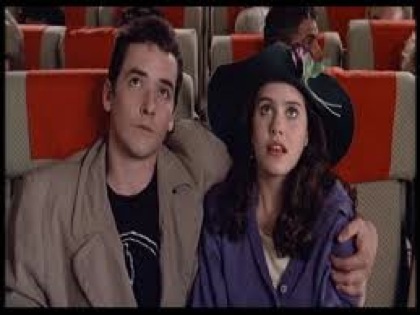
The last scene in the film is one of my favorites. Diane and Lloyd are going to England for Diane’s scholarship, but Diane’s terrified of flying. She sits radiating tension as Lloyd babies her along, assuring her that the bump is natural, the wings always deploy like that, as soon as the no-seatbelt light dings they’ll be safe. She nods tightly and holds on to him and looks up to where the light is. “Any minute now,” he says. “Any minute now.” And then the light dings and the film ends. It’s not so much “happily ever after” as “small reassurance now” — which is perhaps what you build happily ever afters out of.
 

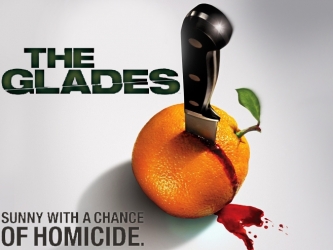
By your jawbone, shall we know ye: The Glades

Gators.  Caymans.  Smuggled newts.  Stolen generators. Ex-cons.  Cons.  Moonshine.  Diamonds.

This is a strange little show.  It’s another of Netflix’s recommendations, and I’m not sure why I’m so enchanted with it.

Maybe because I believe Florida is basically one dangerous, violent swamp?

Anyway, the premise is quite straightforward.   Jim Longworth, snarky Chicago homicide detective, decides to move to Florida.  He teams up with the resident Chief Medical Examiner (aka coroner), Carlos Sanchez, and, after a bit of wrangling, he also teams up with a nurse, Callie Cargill.  Callie is a single mom–her husband’s in prison for armed robbery, she has a teenaged son, and she’s paying the bills and going to medical school to become a doctor.  The team is rounded out by Daniel, a hardworking and geeky young grad student.

The episodes are a mix of ‘ripped from the headlines’ hot topics and strangely endearing, cracked out Florida-specific crimes.

Fer instance, in the pilot, they identify the victim by finding the gator (excuse me, cayman) who ate her.  The Detective shoots the cayman and hauls it into the coroner’s office.  Dr Sanchez, hilariously cranky and appalled, initially refuses to autopsy a gator.  But it’s lying there on the slab, little lizardy arms stuck out T-Rex-like, so Carlos gives in.  The grad student, Daniel, happens to be a herpetologist, and when Carlos initially pulls out only a box turtle and some trout, Daniel explains about the long digestion time.

So Carlos digs around in the innards and eventually finds the (partially digested) jawbone.

Which is how they identify the victim, and thereby, the killer.

You gotta admit, that’s kind of awesome.

It’s usually semi-plausible, in an insane kind of way, but sometimes the plots are a bit too recent news headline for me.  I skipped the episodes about kids getting guns on the black market (and yes, shooting someone by accident–too damn depressing) and I bailed out of the ‘chronic pain clinics are a drug haven’ because it was mostly just wrong.  (I have a chronic pain condition, so I know a lot about it.  Most pain clinics don’t prescribe narcotics at all, and those that do are extremely strict about it.  Yes, there is a booming black market in pain drugs, but the show got all the details wrong.  If they wanted to have a doctor in a clinic over proscribing, they could’ve tried botox injections (yes, really) instead of talking about the black market trade in fentanyl.  Fentanyl comes in patch form only, outside hospitals, and it’s nearly impossible to misuse because of it.  You can’t drink it, smoke it, or ingest it to get ‘high’, although if you do put it on and then take a hot bath you can OD and croak.  This has been yet another nitpicking brought to you by the resident cranky person.)  Ahem.  Where was I?

Oh yes.  The Florida specific episodes.  See, there’s a lot of nice worldbuilding in this series.  One episode is about a mermaid who washes up on the beach.  In Florida, there’s apparently a booming business in mermaid shows.  Attractive young women dress up in latex mermaid tails and swim around.  One of these women shows up on a beach, in a tail, dead.

The plot involves synchronized swimming practice (harder than it looks–I used to do synchronized swimming), the strange things people do for love, and the intricacies of a sibling relationship.

Another episode covers a Papa Hemingway contest/festival, complete with moonshine subplot, and a very attractive black sable German Shepherd named Bo.  (What?  You don’t see black sables very often, and they’re my favorites.)   It also involves a hipster with a degree in marketing from Tulane.

My favorite episode is the one about NASCAR.  I don’t actually follow NASCAR, but we have a track here, and it’s a highly specialized fandom with its very own rules, royalty, and fans.  I thoroughly enjoyed all the car chases and the details of how the villains did what they did and why. I’d tell you more, but it would be a spoiler.

Some of my other favorites are about the famous Florida town of psychics, the exotic bird (and newt!) smuggling ring, the town of circus freak descendents, the guy who believed in aliens, and a private island.

The characters are all well-rounded, and sometimes individual episodes focus on a particular character.  There’s a relationship between the main male lead, Jim, and the main female lead, Callie.  Unlike most shows, the two don’t tumble into bed first thing.  She’s married and while yes, her husband is in prison, she’s too moral for that.  So they wait!  Until she gets a divorce!  Weird, huh?  Weird, but cool.

There’s some complications to the love life that bored me (just leave them together and get on with the show already!) but I can put up with that.  They’ve got a habit of including implausible beach-bunny super-high heels on people who, in my experience, would not wear them, but whatever.  I’m mostly in it for the gators.  Who wouldn’t be?


The Dark Knight Self-Actualizes

A little bit ago, Peter Little wrote an essay for this site in which he argued that Dark Knight Rises was the fever dream of a ruling class in crisis:

Although Bruce Wayne has developed a revolutionary source of, “sustainable,” nuclear energy, he has hidden it from the outside world for distrust of the existing social structure’s ability to manage it. It is this very technology which Bane steals and transforms into the nuclear device which threatens Gotham’s annilhation. The ruling class’ implicit understanding of the limits and failures of their dreams of a technocratic solution to the crises of ecology, economy, and culture, are vivid, however, in the moments when Bane’s insurgency takes control of Batman’s arsenal of weapons and toys, employing them against the former ruling order in Gotham City.

The ruling classes’ terror is vividly painted; the possibilities of liberation are more confused.

I finally saw the Dark Knight Rises myself, and I don’t think I agree with this. Specifically, DKR doesn’t feel like a terrified film to me. And certainly, I think saying that the ruling classes’ terror is vividly painted is giving way too much credit to Christopher Nolan, whose imaginative powers, at least in his Batman work, are almost uniformly pedestrian. We never get to “mildly striking,” much less “vivid.”

Peter does a good job limning the ideological positions and tensions of the film, about which I think he’s broadly correct. Nolan is riffing on the financial collapse and the Occupy movement (as I think he’s said in interviews.) Bruce Wayne’s position as beneficent billionaire and technocratic expert is questioned, and the dangers of populist revolt are raised.

But they’re raised only in the most perfunctory manner, and then dismissed via half-assed genre conventions that are, at best, marginally competent. Just as one example, consider the police.

The real terror for a ruling class is always that its own security forces will join the opposition — that the order will be given to shoot the perpetrators of the mass uprising, and instead the police will give them guns. The police are, after all, basically workers in shitty blue collar jobs; they’re definitively not part of the 1%. They’re even (horrors!) unionized. If the ruling class is running scared, one of the things they should be running scared of is the possibility that the police will betray them.

But this is never even hinted as a possibility in DKR. Oh, sure, the police are dumb, ambitious, occasionally venal, at times cowardly, and, at times, too meticulous in the execution of their orders. But they never consider joining their fellow citizens in an assault on the Gotham elite. For that matter, Bane never considers the possibility that the police might betray their masters; on the contrary, he locks the officers up underground, and hunts them down when he can. For Nolan, for Bane, and for the police themselves, the police are always going to be on the side of order. That doesn’t strike me as the vision of a terrorized ruling class. It strikes me as the vision of a ruling class so comfortable that worst case scenarios haven’t even occurred to it.

Of course, part of the reason that the police can’t join the mob is that there isn’t actually a mob. Maybe I blinked and missed it, but as far as I could tell, all the on-screen violence in the film is perpetrated by Bane and his cronies. There are some show trials which I guess are ambiguous…but even those come off pretty much as directed by Bane, and the judge is not some pissed off derelict, but the Scarecrow, a supervillain. Bane does make some speeches in which he urges the people of Gotham to attack their betters, and we see some trashed apartment which seems like it may have been looted by citizens rather than Bane’s thugs (though again it’s unclear.)

But what we never see is actual members of the Gotham 99 percent rioting on their own behalf. The police, in their final showdown, are fighting Bane’s men, it looks like — the battle is against folks armed with machine guns who know how to use them, not against a random crowd with knives and clubs. Of course, there’s some suggestion that Bane’s recruits are from the Gotham underclass…but the underclass is filled with criminals and losers anyway, you know? A ruling class which thinks its foes are the lumpen is not a ruling class that is looking down the barrel of despair. It’s only when you can imagine that even imperial retainers like that lawyer Robespierre are out to get you that you can really start to talk about terror.

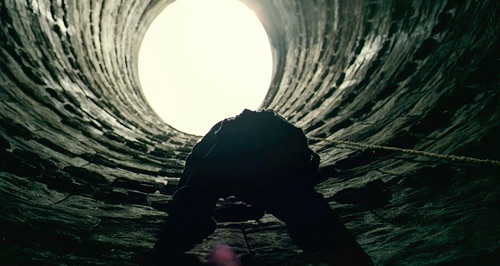
Nolan is exploiting the rhetoric of class war because it’s timely and gives his film a patina of contemporary meaningfulness. But I see no indication that he actually cares about the issues he raises, or that they have troubled his sleep for even a moment. The emotional center of his film is not the fear of rebellion against the ruling class. It’s the truly preposterous sequence in which Bruce Wayne climbs out of a foreign gaol pit while his fellow prisoners cheer him on. The 1% will be saved by their love of extreme sports. That’s a profoundly stupid vision…but its stupidity seems born of snug obliviousness, not desperation.

If Christopher Nolan has one rock-bottom belief, it’s that everyone — Michael Caine, Morgan Freeman, Catwoman, random incarcerated Arabic-speaking ethnics — loves billionaire playboys and wants to see them self-actualize. And, hey, if tickets sold are any indication, Nolan’s absolutely right…which means that the 1% have little if anything to worry about.
 

Just a Dull Thing In His Dream

This first appeared on Splice Today.
______________

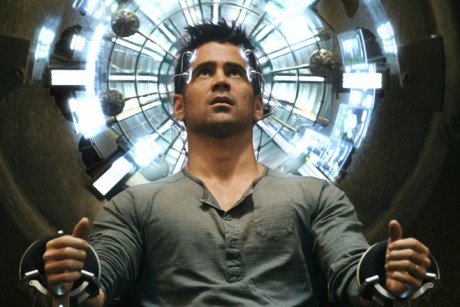
The Total Recall remake is almost Platonic in that it’s pristinely superfluous. Remakes always feel more than a little pointless, but at least when you watch something like The Thing remake, or the I Spit On Your Grave remake, you get a sense that the people making the film actually liked the original… or at least saw it. Director Len Wiseman, though, has no discernible affection for his source material, nor anything to say to it.  The film is one long, uninvolving chase sequence, through which Colin Farrell (Douglas Quaid) wanders like a mildly confused puppy; in comparison with his bland performance, Arnold Schwarzenegger in the 1990s original comes across like Laurence Olivier.  Jessica Biel (Melina) is even less involving, if such a thing is possible. Only Kate Beckinsale as Quaid’s “wife” Lori makes any pretense to watchability, throwing herself into the Queen Bitch/assassin role with welcome relish.  She still doesn’t have anything like the vindictive charge that Sharon Stone did in the original—but in this turkey, every flicker of adequacy counts.

What’s odd is that Total Recall‘s utter awfulness is, in some ways, true to its roots—not the 1990 movie, but the 1966 Philip K. Dick short story “We Can Remember It For You Wholesale.”  Dick’s story was not awful in itself, exactly. Rather, it was meta-awful, a semi-parody, dealing explicitly with the crappiness of its own genre.

In the story, loser clerk Douglas Quaid wants to go to Mars, which is to say, he wants to be in a science-fiction story. He clings to this dream even when his wife suggests a real-life vacation. “A dream, I bet,” his wife sneers at him, “you’re always full of them.”

Quaid is indeed full of dreams… and those dreams are all real. This is true in the narrative: when Quaid goes to Rekal, Incorporated to have memories of a Mars trip implanted, he discovers that he has in fact already been to Mars as a mind-wiped secret agent. But Quaid’s vision is true more broadly as well. He imagines that he is a character in a genre narrative—and he is, in fact, a character in a genre narrative.

These are, moreover, idiotic, and are specifically referred to, and thought of within the story, as idiotic. Quaid’s desire to go to Mars is presented as infantile silliness. But even worse is the end of the story, where Quaid sits for another memory implant, this one based on his deepest desires. He apparently has long had a fantasy in which, as a child, he meets an alien race which declares that its plans to destroy the earth. Quaid treats them with such kindness that they decide to wait to destroy the world until he dies. This fantasy of a pious savior is, as one character remarks, “the most grandiose fantasy I ever ran across”—a quintessence of preposterous self-centeredness.  And within the story his self-centeredness turns out to be entirely validated. Quaid really is the center of the universe; he really did meet those aliens, and when he dies, so does the world. Which, again, is not just true, but meta-true: Quaid is the main character, and Philip K. Dick built the story, and the universe, for him and around him.

“We Can Remember It For You Wholesale,” then, doesn’t so much reveal hidden depths as it flips open to pull the outside in. The title is a promise, not just to Quaid, but to the person flipping the pages. What it promised, specifically, is dreams, and in this case the dream that is promised is a dream of a dream. The story is a fantasy about having a fantasy, which means it’s in some sense not a fantasy at all.

The 1990 movie replaced the story’s recursive puzzle-box structure with camp, but the end effect is not dissimilar. Sharon Stone’s performance, in particular, is a masterpiece of self-referential cheese. She plays Quaid’s wife Lori as a perfect saccharine romantic glob of gush, all kittenish blonde affirmation and vacuous sex appeal—until the moment Quaid leaves for work, when her face goes blank and dull, like a performer after the camera’s turned off. After Quaid discovers that Lori’s a killer spy… she still keeps up the performance, assuring him that he was the best assignment ever and urging him to tie her up (“I never knew you were so kinky,” Schwarzenegger deadpans.) She tells him that their whole marriage is a fake, and it takes a moment to register that she’s speaking the absolute truth. The marriage isn’t real; it’s a staged performance—and so her artificial staginess, rather than undercutting verisimilitude, enacts it. When Stone “appears” on Mars to tell Quaid that he’s in a psychotic fugue state and his whole adventure is happening in his head, she’s acting the part of acting a part. The whole adventure really is in the audience’s head; the performance really is a performance, and Stone’s weirdly context-less over-sincerity, pleading earnestly with Quaid as if they’re both on a soap opera soundstage, rather than on Mars only underlines the truth that they are, in fact, on a soundstage, not on Mars. Genre, in this case, is the lie that tells the truth; if you have a transparent trope, the transparency, at least, is solid.

The half-assed 2012 remake, then, is a fitting addition to the series. It’s nothing but a third-rate genre exercise, but Dick’s story is precisely about the embarrassing appeal of third-rate genre exercises. As the memory programmer comments in Dick’s story:

“Programming an artificial memory of a trip to another planet —with or without the added fillip of being a secret agent—showed up on the firm’s work-schedule with monotonous regularity… ersatz planetary travel has become our bread and butter.”

The remake doesn’t actually involve interplanetary travel, but the point stands. People’s deepest fantasies aren’t individual desires; they’re repetitive genre product which can be purchased wholesale. Quaid’s fantasies are the most real things about him, and they are as generically tedious as the reality from which they are a putative escape. For Philip K. Dick, or some iteration of him, we are just bad remakes of someone else’s dream.

Purchase Pleasurable Venus Girdle, Repeat

A few weeks back I wrote about Dara Birnbaum’s video art piece, Technology/Transformation: Wonder Woman. Corey Creekmur mentioned in comments that there was an entire book on the piece written by T.J. Demos.


Dara Birnbaum – Technology/Transformation… by merzboy


So now I’ve read the book…which confirms my thoughts in some ways, and raises some other issues as well.

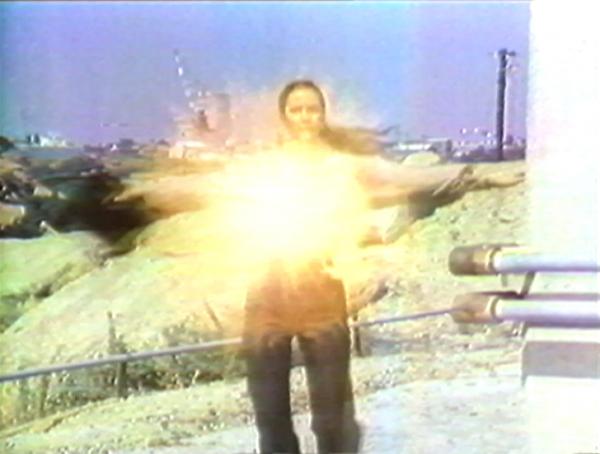
Demos basically divides critical reception of the work into two waves (analagous to my two takes on the video in my earlier piece). The first reaction — which is close to the intention of Birnbaum herself — views the work as a project of feminist and Lacanian deconstruction. The narrative of the Wonder Woman TV show is broken apart, images are repeated, and the special effects are decontextualized so that they register as studio trickery. Finally, a disco song at the end comments directly on Wonder Woman’s sexuality, showing that she is not an empowered subject but a fetishized object. The video’s purpose in this reading, then, is to defamiliarize the narrative, and to show the artificiality of the transformation from secretary to hero. The effect is iconoclastic, lambasting an oppressive image foisted on women by capitalism and patriarchy.

Again, this is how Birnbaum saw the video herself. Demos quotes her saying that her work was meant to push against “the forms of restraint and near suffocation imposed through this current technological society.” She adds.

all the works completed from 1976-85 are ‘altered states’ causing the viewer to re-examine those ‘looks’ which on the surface seem so banal that even the supernatural transformation of a secretary into a ‘wonder woman’ is reduced to a burst of blinding light and a turn of the body — a child’s play of rhythmical devices inserted within the morose belligerence of the fodder that is our average television diet.

Demos notes that this was in part dependent on the context of the time, when most people did not have access to tools to manipulate video. In a world where you had to take what the studio doled out, repurposing or reshaping the image seemed subversive.

Today, of course, things are somewhat different — and, indeed, over time, the critical take on Birnbaum’s video has changed. Instead of focusing on its deconstructive critique of television, more recent viewers have tended to see it as celebratory. Instead of alienating viewers, Birnbaum’s video itself becomes a source of visual pleasure. The video has, for example, been played in dance clubs…and, as I pointed out in my earlier post, there are video montages of Lynda Carter spinning on YouTube which look a lot like Birnbaum’s video. As Demos argues, late capitalism has “commodified the process of consumerist participation.” (84-85) Mash-ups aren’t critique; their marketing. In this context, Birnbaum’s video looks less like a stinging deconstruction of television, and more like a potentially viral advertisement for it.

Demos acknowledges this…but goes on to insist that while affect is manipulated by capitalism, it still “remains indeterminate”, and he adds that this is especially true because “unlike emotion, it is unstructured by social meanings.” (101)

Which, to me, seems like blatant bullshit. Why isn’t affect structured by social meaning? And if it isn’t structured by social meaning, if pleasure and power don’t have anything to do with each other, then how exactly can pleasure resist or affect power? The whole thing just seems like special pleading; a way to have your shallow media rush and still call yourself a revolutionary. (Or to paraphrase Tania Modleski, “I like Dara Birnbaum, I am a radical, therefore Dnra Birnbaum must be a radical.”) You can try to wriggle and dodge, but I don’t see how you get around the conclusion that Birnbaum’s work has been completely co-opted. She thought she was critiquing, and instead she’s complicit. As Demos says, she’s part of the long history of the avant-garde being assimilated by capitalism — almost as if the avant-garde is a branch of capitalist R&D, rather than some sort of alternative to it.

Of course, the baseline assumption here is that capitalism is evil,and that art which is complicit with capitalism is therefore meretricious. Demos doesn’t question this, but it seems like it might be worthwhile to do so. Specifically, Wonder Woman’s creator, William Marston, believed that new, capitalist modes of reproducible entertainment could be used to change society for the better — specifically by providing new images of powerful, loving women who could challenge conservative ideas about patriarchy and dominance. For Marston (who Demos mentions only briefly), capitalism could be used progressively to change the gendered way in which society functioned.

Marston linked Wonder Woman’s persuasive power to her “allure” — a connection which, as Demos notes, has been controversial with feminists…not to mention with Marxists, for whom the pleasures of capitalist consumption are to be avoided rather than exploited. Yet, in the end, whatever radicalism Birnbaum’s video manages is, at this point, predicated on the libidinous, capitalist, iconic charge that Marston gave to the character. The deconstruction of television tropes has been thoroughly deconstructed by capitalism. All that’s left is the pleasurable thrill of seeing a woman repetitively changed into a sexy hero — and perhaps the rush of creating and controlling that change, manipulating the tools of capitalism not so much for one’s own liberation as for one’s own pleasure. Always presuming that, in capitalism, it’s possible to tell the difference.
 

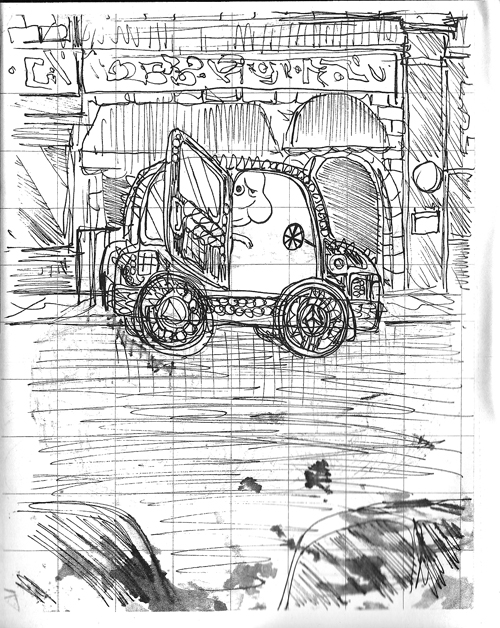
Michael DeForge’s Sketchbook

Michael DeForge destroys his sketches. He finishes his sketchbooks and then throws them away. This is a different approach to art than I am used to. For me, the sketchbook has always been a personal object. The closest approximation to an artist’s brain without telepathy. Personal letters to oneself. Sketchbooks are the work behind The Work. Many artists keep all of their sketchbooks, whether they look at them again or not. DeForge tosses his when he is finished. So I rethink what it is a sketchbook is for.

Michael DeForge publishes a lot of work. He has comic books from Koyama Press and Drawn & Quarterly. He self-publishes minicomics. He has comics in various anthologies. He posts things on his blog. He does commercial illustration. I would imagine that for him, the work itself in its final form is the personal journal of his progress. It could be that the sketchbook is merely practice. Raw, unsentimental practice.

If an artist uses sketchbooks for practice and not as some sort of defacto art project in and of itself, perhaps that artist no longer has use of the preliminary work. After all, we cartoonists think nothing of erasing our pencil lines after the ink is dry. What is the difference, now that I think of it? Why should the bound book of rough drawings be fetishized? When the final project is published, the rough work is… ?????

________________________

My conception of sketchbook use was largely based around the idea of something between a diary and a catalogue of ideas. One problem for me is the struggle between practicing artcraft in a sketchbook and allowing the sketchbook to become the artwork itself.

I had a class in art school called Sketchbook Creation. The course was inspired by Alan Gordon, the professor’s travels across the country in which he made his paintings on the go in a bound book. His idea for the course was to help the students open up their imaginations through particular exercises and controlled free-associations. In the end most of us sort of ended up making work that looked like his. Some of us continued for years after graduation, making finished art in books of heavy paper. Portable, but shackled to a relatively restrained format. Sketchbooks weren’t practice anymore. They were the art itself.

Imagine having a sketchbook for your sketchbook.

Imagine sitting in front of the tool which is designed to be an outlet for experimentation and being unable to experiment because it has been recontextualized as yet another Grand Canvas. Sketchbook Creation was my best class in art school but it also shackled me and ruined me in some ways. I hardly doodled anymore. Every drawing had to be good enough to show people. To be fair to Alan, the film “Crumb” had previously contributed heavily to this tendency for me.

Things got better when I started talking to people who use their sketch books only to practice for projects that they were working on. It took a while to overcome the pressure that I had internalized about making “showpieces” in my sketchbooks but I feel as though I’m turning a new corner now.

________________________

As I get older I have been growing more acclimated to the idea of impermanence. Not simply the idea that things change but more the idea that things are never fixed to begin with. Age gives perspective. We see a larger picture as we get older because events and phenomena take up a smaller percentage of our perspective as our years of existence increase. Six years means “since forever” when you are six years old. Six years means “as long as you’ve lived in this city” when you are thirty. Six years probably means very little when you are eighty-six. Your view cannot help but change as you take in more and more life experience. Things were never as “stable” as I thought they were when I was a child, I just lacked the experience to notice the movements.

In many ways an artist’s work has a life cycle as well. It’s “conceived,” no pun intended, it grows as the artist pours more work into it. The work matures and is sent into the world. At this point, we consider the tangible remnants of an art work’s youth. Do we save it in a drawer as humans do with their children’s baby clothes, perhaps in hopes of some future use? Or do we discard the husk as insects do?

I’m neither seeking nor am I suggesting an answer. Ultimately it’s a personality and lifestyle choice. As I stand amid the chaos of my bedroom, I would do well to cast away my preliminary drawings like a snake’s old skin. Being unsentimental about these things could probably spur me forward into being much more productive, as I tend to clutch things I’ve made, things I own. On the other hand, there are artists such as my old professor for whom “sketches” and cast off ideas are as treasured and valued as gallery paintings. Of course there isn’t a right or a wrong answer. The question itself is rhetorical.
 

Drawing by Michael DeForge