Surface Pleasures

In her recent post on the postmodern sublime in comics, Marguerite Van Cook paraphrases Frederic Jameson on our crazed cultural landscape.

Jameson points out that the sublime of postmodern is not the dark and brooding place of the high romantics; it is not the depressed world of brooding heroes. Somewhere along the line, all of that angst and personal introspection has been replaced by another world of bright shiny surfaces, replicas and fragmented visions in a world now experiencing another kind of psychic onslaught. Jameson talks about the postmodern sublime as a type of container for all this madness, which he describes as a type of schizophrenia.

Marguerite goes on to look at various comic-book chroniclers of the post-modern sublime, concluding with Al Columbia.

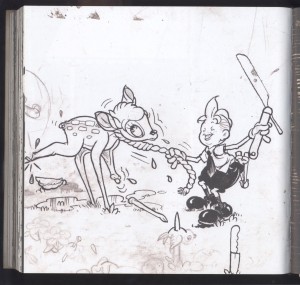
Al Columbia’s Pim and Francie perhaps sums it all up. They run not walk to the sanatorium. Columbia’s characters are no longer in revolt, they are beyond that cognitive choice. Rather they live in a world that does not differentiate morality and feelings. Columbia draws snatches from various artists styles. They hover ghostlike, pulled back from our collective memory as they sit on pages that are torn, fragmented and abused in a confrontation of what it means to be a new product. Jameson suggest that nothing is left to shock us, but I’d suggest that Al Columbia does just that. In this final image the boy takes a straight razor to Bambi. He eschews the choice of Mickey and assaults us in the soft spot. Bambi, the sacred lamb, the sacred cow, the holy sanctified symbol of innocence, is offered to the madness of the postpostmodern. Bambi’s limbs lie dismembered in the grass and we are oh so close by, to see them.

Jameson, Marguerite, and Columbia are all presenting us with a postmodernism as hell; a shiny, emotionless strobing of patterns whose only meaning is an ersatz copy of meaninglessness. The real has vanished utterly, and all that’s left are images of images, a cardboard graveyard of stale tropes through which wander wayward consumers, robbed of even the dignity of despair.

That is certainly one face of postmodernism…but I wonder if it’s really the most insidious one. To me, anyway, the focus on the postmodern schizophrenic apocalypse can obscure maybe the most obvious thing about our current cultural moment — which is that postmodernism is really pleasurable. Gliding out on those ever-shifting shallows, with the real and its hierarchy of earnestness vanishing like the afterimage of that web page you just left, while every song in the world is simultaneously uploaded to your cortex — who can resist such blithely excessive dreams?

Comics is so rooted in nostalgia that it maybe makes sense that it sees the post-post-everything as an impetus mostly to gnash and mourn and re-reject decades old funny animals and the now irrelevant sentiments they inspired. Other cultural forms, though, have embraced the zeitgeist with more eagerness.

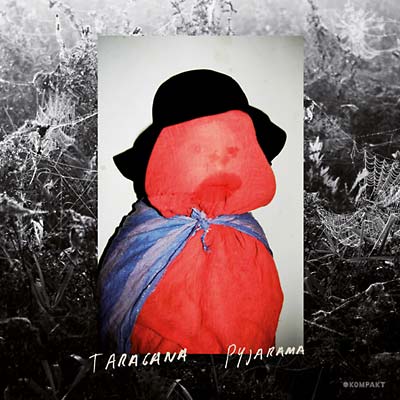
Electronica is perhaps a too-obvious example. Listening to the recent release Tipped Bowls by Taragana Pyjarama, you aren’t dumped into a schizophrenic void. On the contrary, the first track, “Four Legged,” orchestrates the future-synth automatons of our overdetermined dreams into a rising symphonic rush of exaltation, panning and swooping over digitized fijords like tiny joyful digitized tourists. “Growing Forehead” takes that most human of sounds, an inhaled breath, and cuts and reiterates it until it’s just another computerized meme afloat in ecstatic programmable melody; transcendence as binary conversion. “Pinned (Part 1),” is a staggering agglomeration of beats and bloops, like a video game caught in a spin cycle, while “Pinned (Part 2) is a funkier but still inner-ear-disturbed strut, stochastic patter resolving and threatening to dissipate, resolving and threatening to dissipate, all with a catchy tunefulness, as if we’ve wandered into a world where even the busted appliances spit out pop.

That world is our world, of course; high culture and low culture and random furniture and passing cats (especially passing cats!) all sliding across one endless screen. It’s nauseating and soul-destroying, certainly. But it’s also vertiginous and, in a song like “Ballibat,” such a lovely, smoothed-out mash-up of timeless futurism that you wonder if, in this post-present, you even need a soul.

This Is…SPOILERAMA!!!!

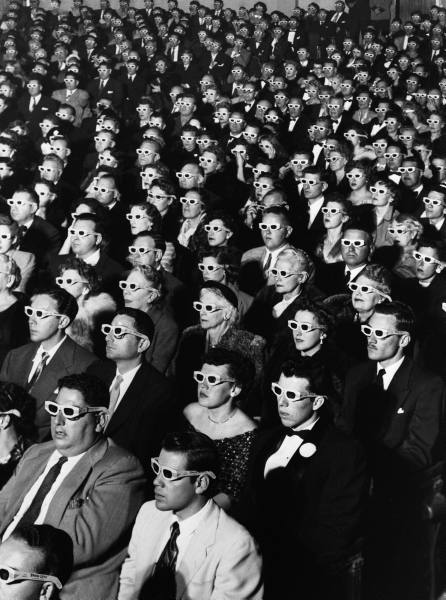
“Volunteer” Utilitarians testing Spoil-O-Vision at the Hooded Institute of Technocracy


A Manhattan couple take a taxi to Broadway, where they are set to see the latest whodunnit theater play. As they exit the cab, the driver notes:
“Hey, you haven’t given me a tip!”
“So sue me, asshole,” the man wittily ripostes.
Then the driver leans in, and proclaims:
“THE BUTLER DID IT.”
—old New York joke, and the essence of spoiling

In my recent review of the megaflick Prometheus for this blog, I was bedevilled by the usual pesky need, out of courtesy for the innocent reader, of avoiding “spoilers” — those nuggets of information that can drain away all surprise and suspense from the viewing experience.
When did this obsession with shunning spoilers begin? When Sophocles wrote Oedipus the King, complete with twist ending, his ancient Greek audience was perfectly aware that the sought-for culprit turns out to be the King himself. Didn’t faze them a whit! And children don’t mind at all being told a story to which they already know the end. In fact, they insist on being told their favorites over and over again.

Yet I can’t deny that a spoiler can do just as its name implies, spoil the pleasure of a tale. I still can’t forgive the moronic Newsweek critic who gave away the twist in the film Jacob’s Ladder. Thanks a lot, motor-mouth.

There has to be a way to reconcile the critic’s need to discuss a story and the reader’s expectations of surprise.

In search of a solution, I hied myself off to the forbidding Mt.Berlatsky fortress-like headquarters of the secretive Hooded Institute of Technocracy. There, H.IT.’s semi-deranged genius boffins spent a million man-hours perfecting the answer to my prayers.

The result was Spoil-O-Vision, a technological marvel that is the final coffin for story spoiling!

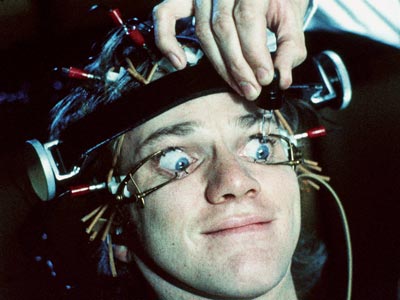
Your humble servant, Alex, testing Spoil-O-Vision in its beta version.I don’t, I, I do not want to talk about it.

How does it work? Simply drag your mouse’s cursor over the blank space, as you do when you cut ‘n paste text for a plagiarised term paper. Below, for instance, is a spoiler for the aforementioned Jacob’s Ladder:

At the end, we learn that the main character has been dead for years, and the entire movie is his ghost’s delusion of life. A premise ripped off from Ambrose Bierce’s An Occurrence at Owl Creek Bridge, as the Newsweek asshole helpfully pointed out… uh, you HAVE read that Bierce story already, right? No? Oops.

Now I can discuss, say, Agatha Christie’s The Murder of Roger Ackroyd without revealing that

the murderer turns out to be the book’s first-person narrator

And now I can finally disclose those Prometheus spoilers!

Ha! Made you look!!!

At the end of the movie, the surviving crew members penetrate to the heart of the alien citadel of the Engineers, only to find an arena where synthetic life-forms based on characters from ancient Ridley Scott movies fight . Thus darkness from Legend grapples with the Alien, Marcus from Gladiator duels with Feraud from The Duellists, Thelma and Louise trade gunfire with Lucas from American Gangster, while the Blackhawk Down helicopter pursues Deckard in his Blade Runner hovercar. The spectacle is presided over by a 200-year-old Scott, who reveals to the crew that they are also synthezoids, but won’t be needed until the sequel.

But Spoil-o-Vision does have its dark side. Consider the following:

You have just downloaded and activated a copy of the HellHound 3000 virus. If you can read this text, it means your computer has been taken over and your files have been corrupted.
Thank you for having volunteered for this experiment.

Our ..heh, heh…head of research would REALLY like…heh, heh…
to get to know you even better than he already does

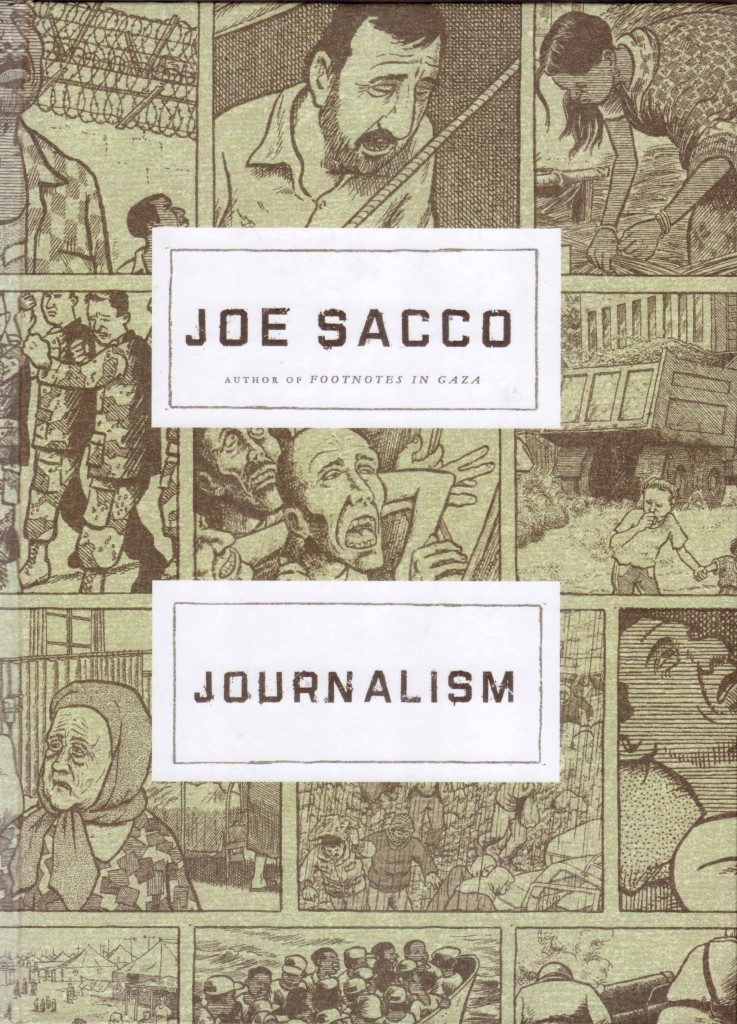
Joe Sacco’s Journalism


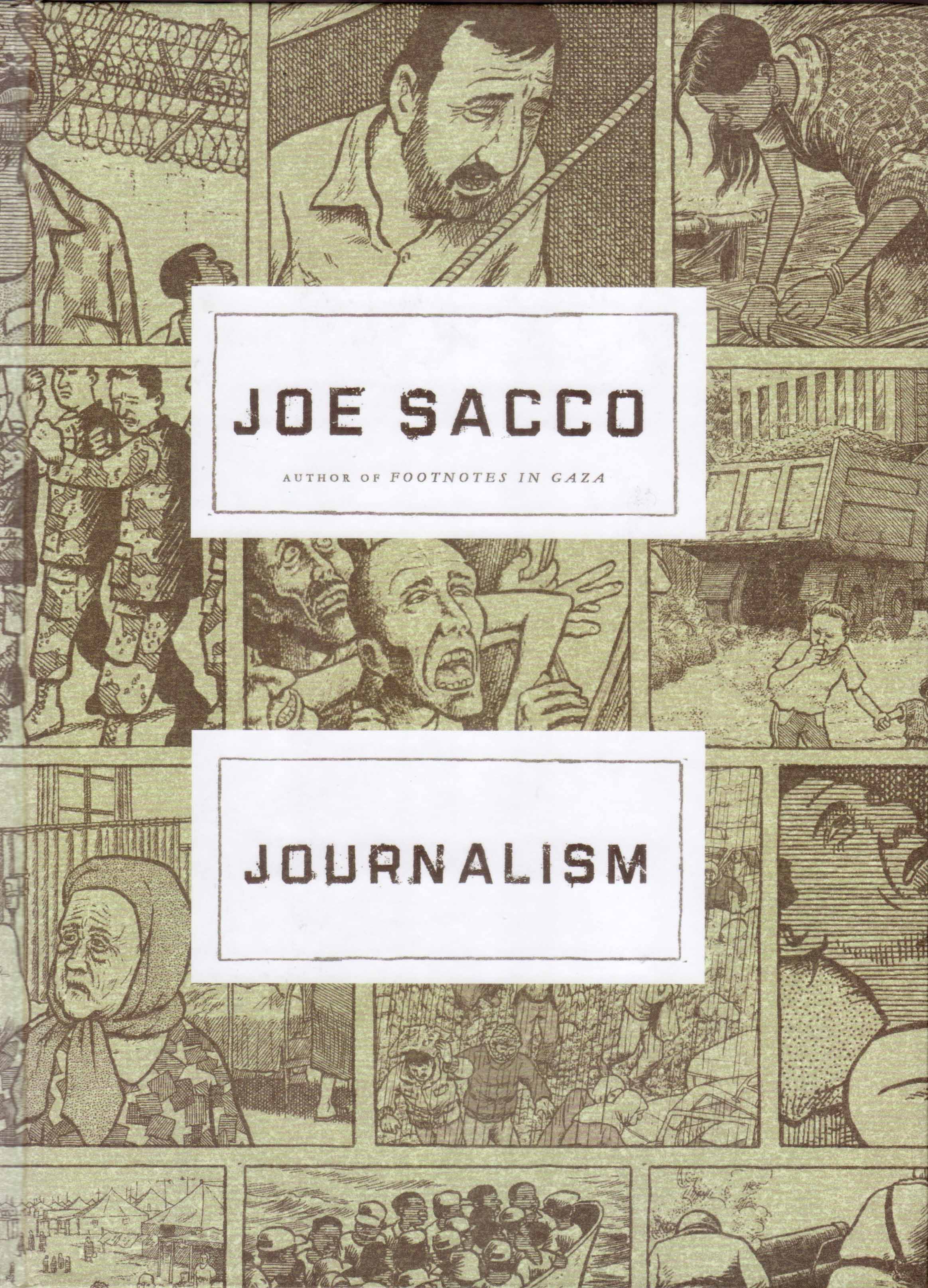
Joe Sacco’s Journalism collects some of the author’s shorter work which first appeared in various magazines, newspapers, and books. Only those utterly devoted to Sacco’s output are likely to have seen every one of these stories and even in that instance, their compilation in one ready volume should be most welcome.

While Sacco isn’t exactly coasting, he seems to have settled into a certain groove over the past decade—a sure-footed method of attack and transcription that ensures a minimum level of quality. Despite the title of this new book, Sacco’s work here can be more precisely described as reportage which focuses on persons as opposed to the grand scheme of things. This label should not obscure the fact that he does steer his stories in fairly predictable directions while infrequently providing direct opinion (in contrast to the prose form afterwords found in this anthology). He almost never offers up solutions to the problems he encounters and purposefully shuns overt editorializing.

Sacco’s preface (“A Manifesto Anyone?”) clearly articulates the selling point of his comics: the personal touch; the tabletalk; the stray details which betray the messy art of journalism; the fulsome embrace of subjectivity. All these and more present themselves as essential parts of Sacco’s journalistic toolset; his art singling out telling moments in the course of an interview away from the oppressive and quieting glare of a video camera, adding to the stark description of mere prose.

Even so, the comics form presents a number of problems for would be cartoon journalists quite apart from their labor intensiveness and lengthy gestation periods. One of these problems is highlighted by Sacco in his preface:

“Aren’t drawings by their very nature subjective? The answer to this last question is yes…Drawings are interpretive even when they are slavish renditions of photographs, which are generally perceived to capture a real moment literally. But there is nothing literal about a drawing.”

One might say that journalistic drawings inhabit that (un)happy land between the reader’s imagination (in pure prose) and concrete reality (in photography). The former can never be countermanded while the latter—a potent source of “easy” empathy—is beholden to Cartier Bresson’s Decisive Moment.

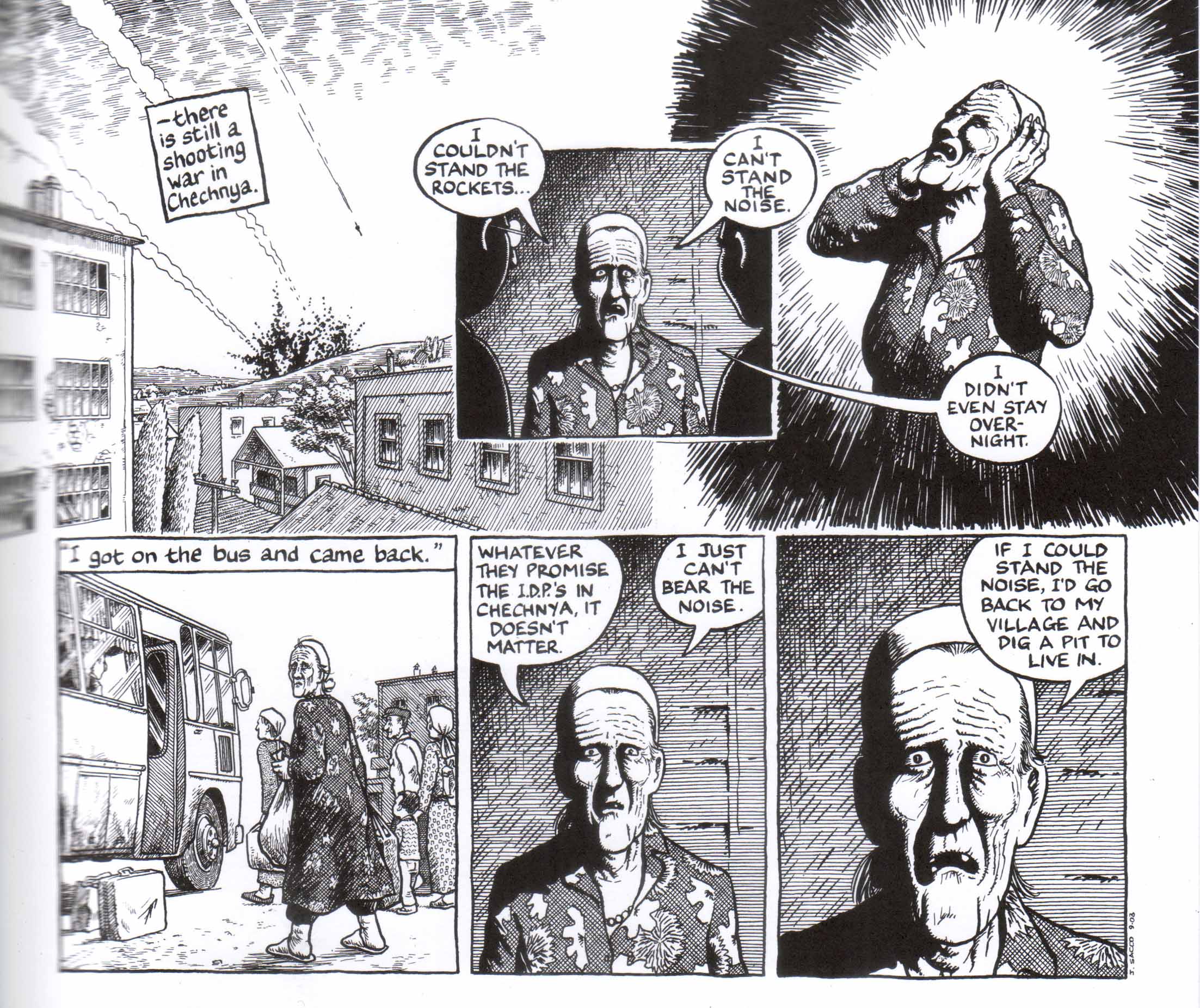
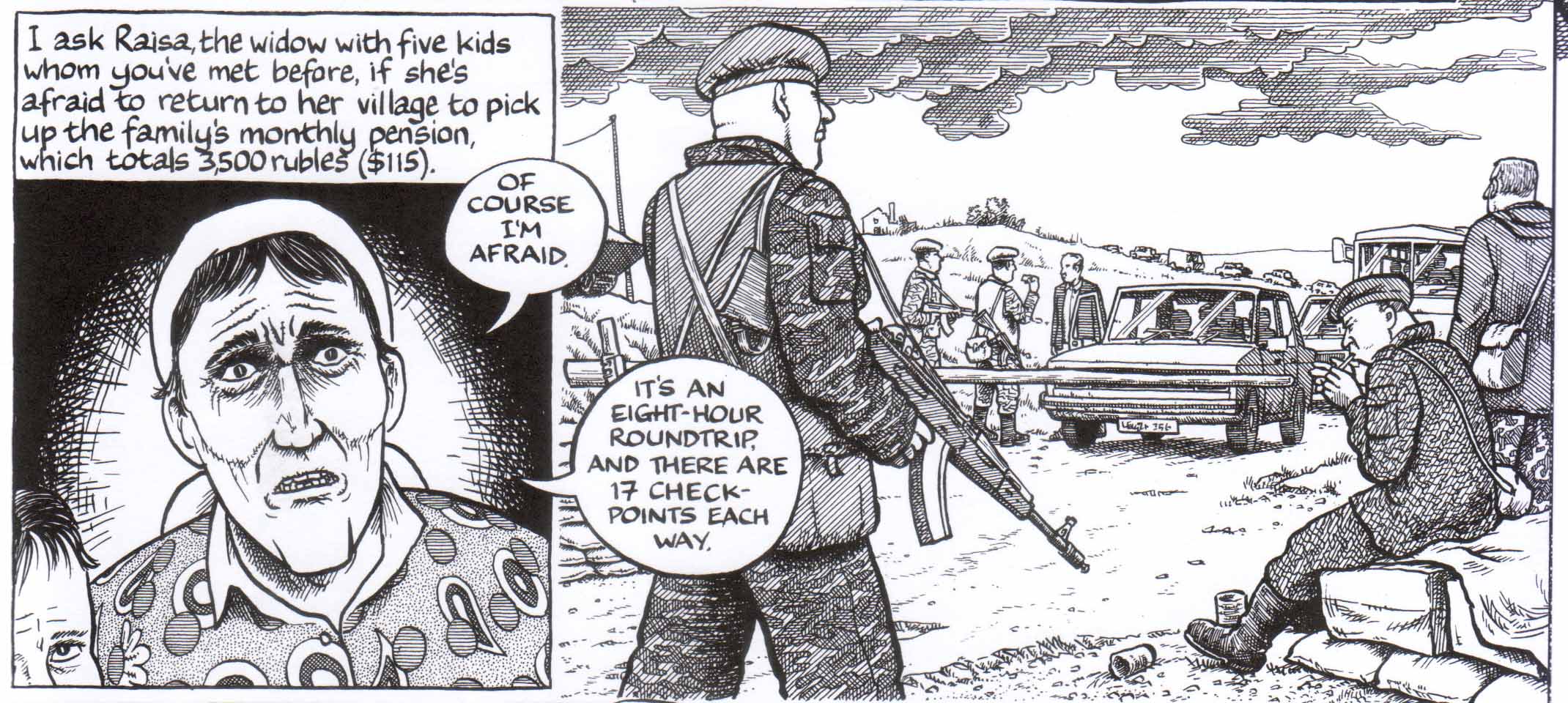
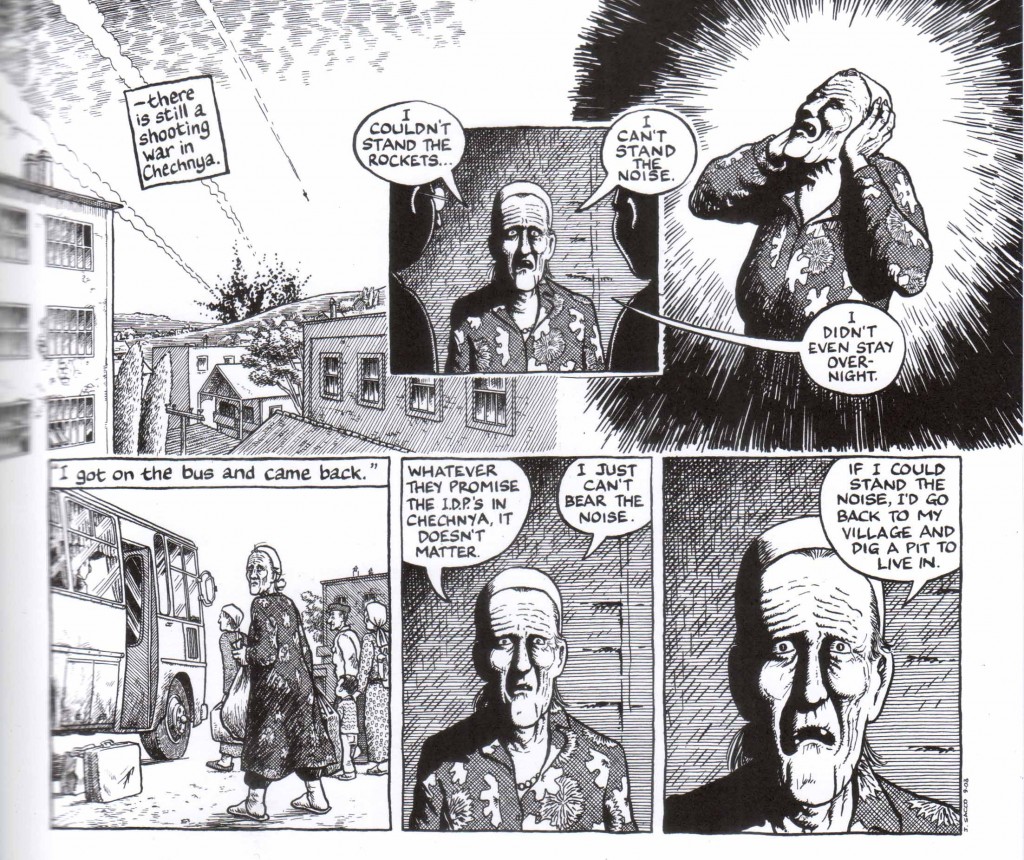
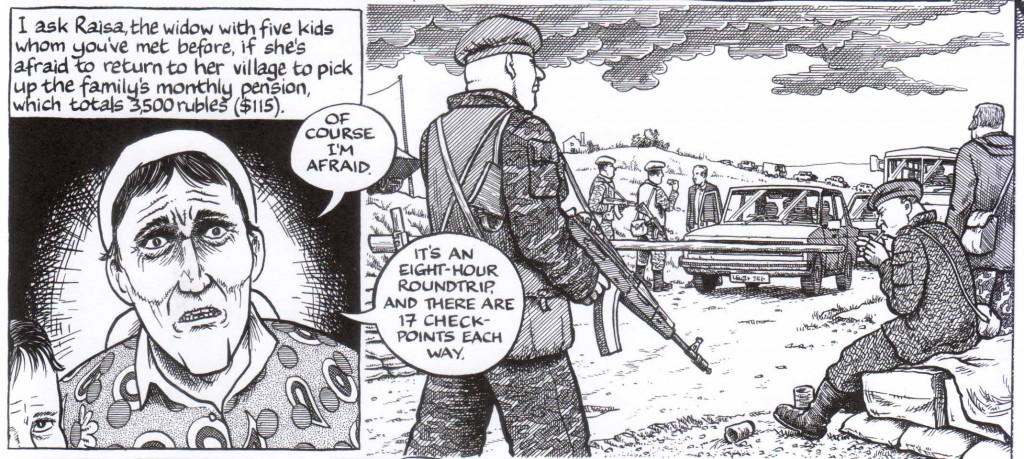
With comics, the abilities of the artist are paramount, and here far more than in most other cartooning genres. While the emotions in Sacco’s stories are communicated with skill and the faces of his characters reasonably distinct, they are still removed from the direct human connection of photo portraiture. What is often lost in translation is that sense of connection to reality and someone real, an affinity which cannot be adequately conveyed through his stylized cartooning which in the early days broached on caricature. Sacco compensates for this with various forms of artifice. Thus Zura and Raisa (from “Chechen War, Chechen Women”) though separated by 30 pages seem almost indistinguishable, the artist reinforcing that element of despair and the commonality in their suffering by means of repetition.
 

%r2 width=


That same tortured face is seen again on page 70 of the collection and a story about Chechen refugees. It is up to the reader to decide if this represents the artist’s persistence of vision or the limitations of his style.

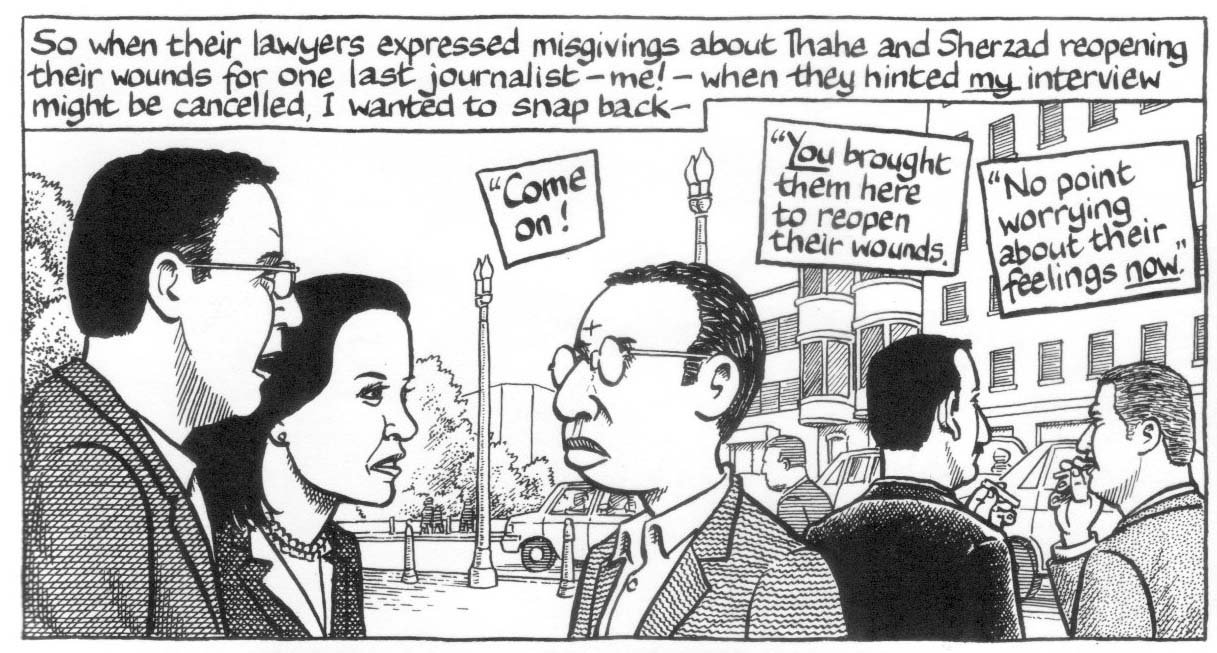
Sacco is of course nothing if not self-critical, these feelings frequently manifesting themselves in the form of self-derision. In Journalism, Sacco can be seen prodding his mercenary journalistic instincts—that cultivated ambition which must surely be a part, however small, of every reporter’s motivation and which just as surely must be quashed in those who have any level of conscience. In “Trauma on Loan”, we find Sacco champing at the bit when he is almost denied an interview with two victims of torture:

You brought them here to reopen their wounds. No point worrying about their feelings now.”
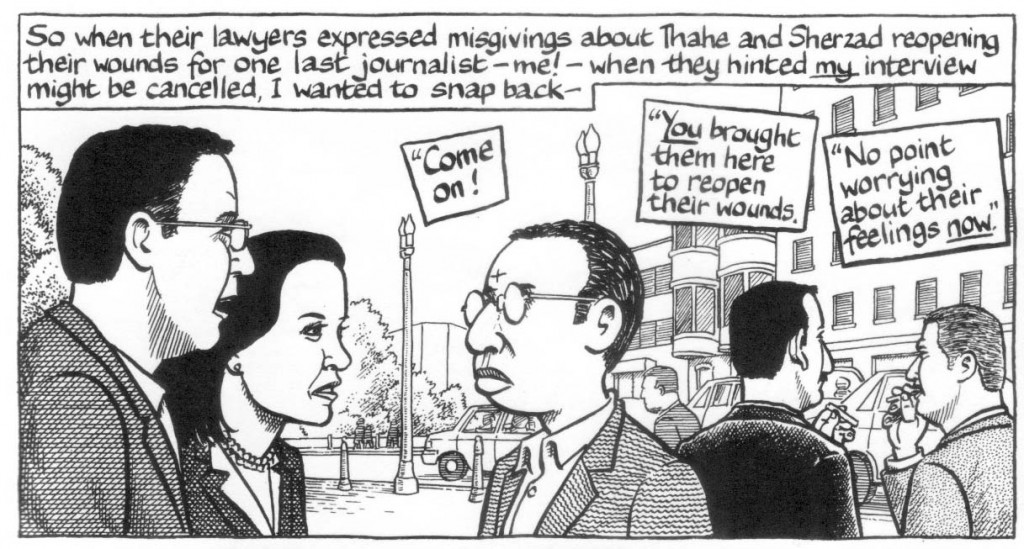
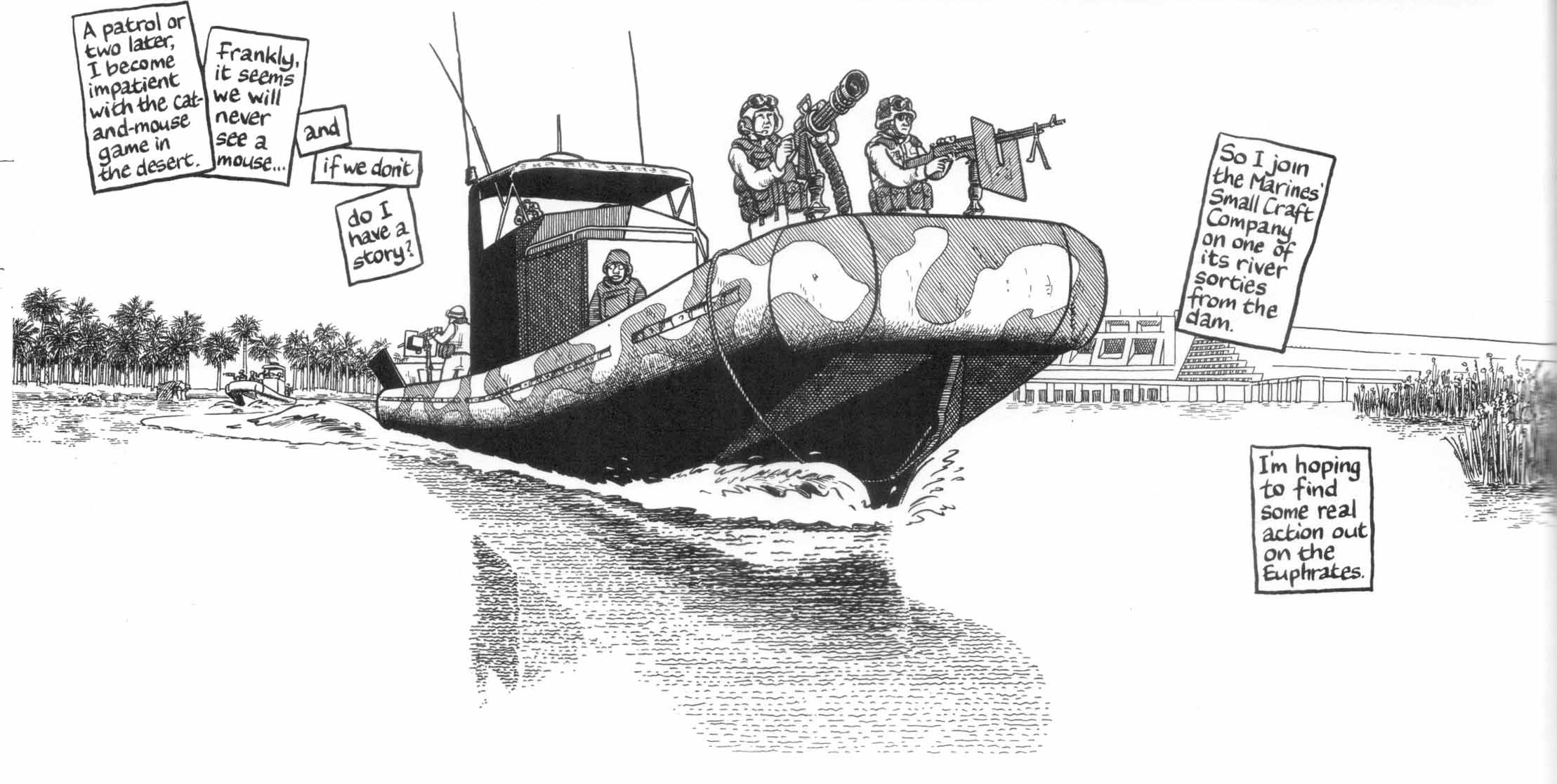
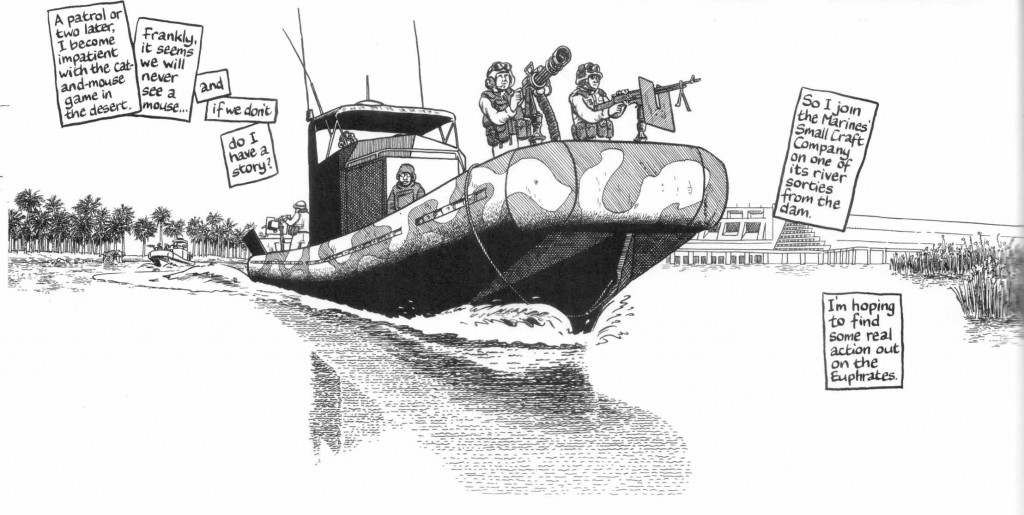
At other times, it is simply a case of a journalist’s bread and butter, the search for some “real action” to spice up a story. The kind of story which most soldiers want to avoid.
 

He is similarly unerring in pointing out his weakest stories. In this case, he singles out “Hebron: A Look Inside” (2001) which he describes as his “least successful piece of comics journalism.”

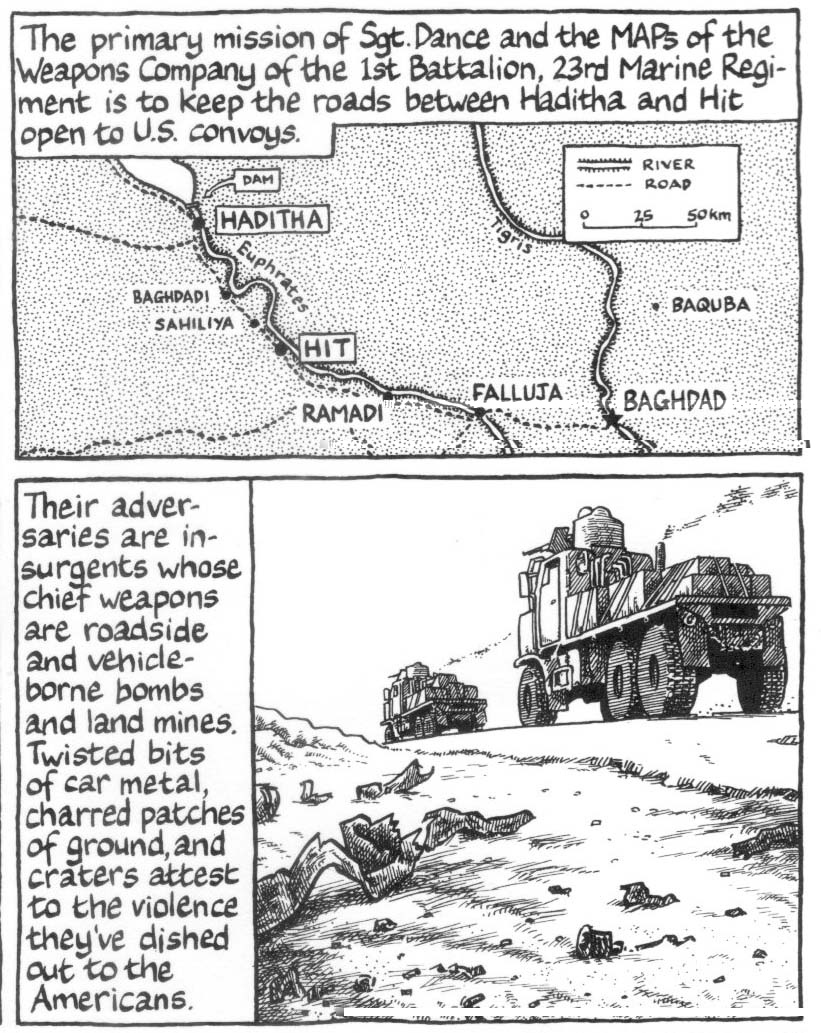
While Sacco’s tropes will be familiar to long time readers, his comics on Iraq do seem somewhat distinctive within the context of his oeuvre. Not because they are unquestionably the best stories in this anthology. Far from it—that accolade might be better directed at his deeply felt portraits of the most wretched peoples of this earth (his encounter with some Dalits in “Kushinagar” for example). The author is also quite right when he suggests that the first story in his Iraq triptych (“Complacency Kills”) doesn’t “[add] anything new to the immense literature of ‘men at war’.” That story does, however, stand out because of its novelty in tone: the journalist now no longer mining the same vein he’s been chipping at since the days of Palestine; no longer fleshing out the sympathetic and distorted faces filled with hunger and despair; no longer solemnly depicting the genocidaires and unremitting faces of evil but here presenting a more genial portrait of the brutalization of his fellow Americans assigned the task of patrolling the highway between Haditha and Hit.
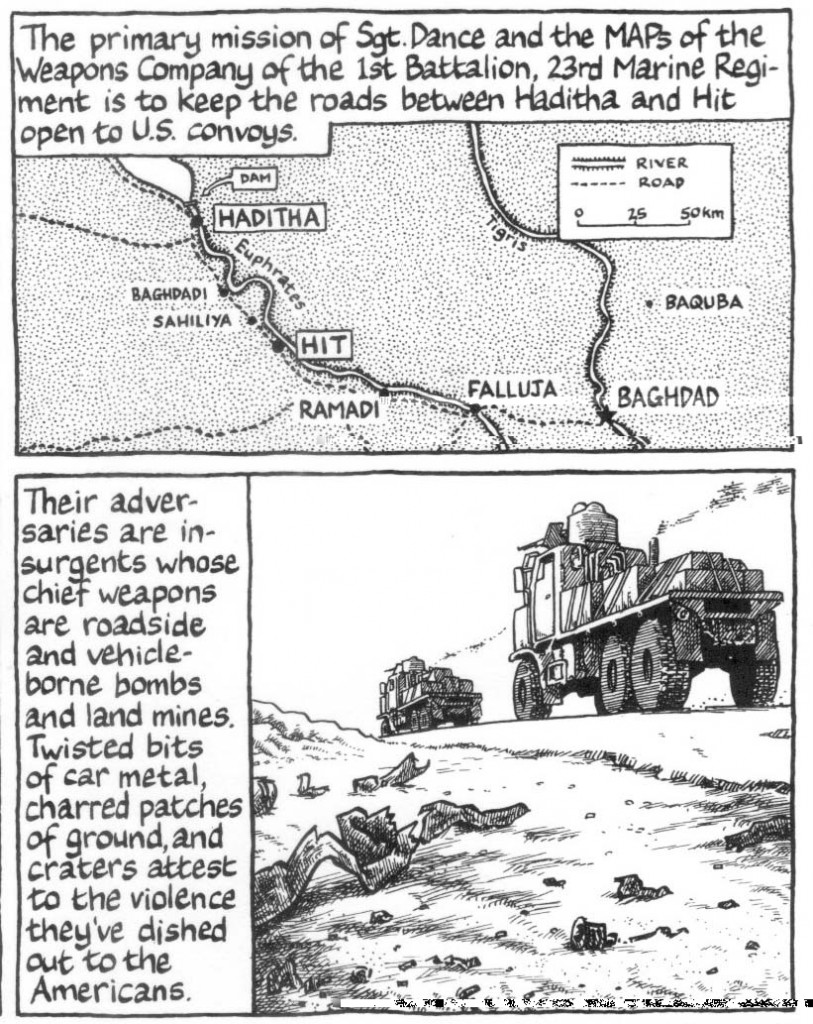
The philosophical conflicts of these fighting men are put on display, their essential humanity conveyed, and their deaths filled with a sadness which is never maudlin. All this perhaps a side effect of embedded journalism—strangely forgiving of the tormentors but still finding a kind of balance in the middle of the rest of this collection. Sacco is patently opposed to the war, yet he gently skirts the immense futility of the soldiers’ deaths. The reader never gets that sense of waste littered throughout Tardi’s comics on the Great War; all that incipient fury held in check by the dictates of reportage which, in this instance, eschews the imagination (the piece was first published in The Guardian) and the even greater suffering of the resident non-combatants—the shadowy figures traversing the highways patrolled by the American forces.

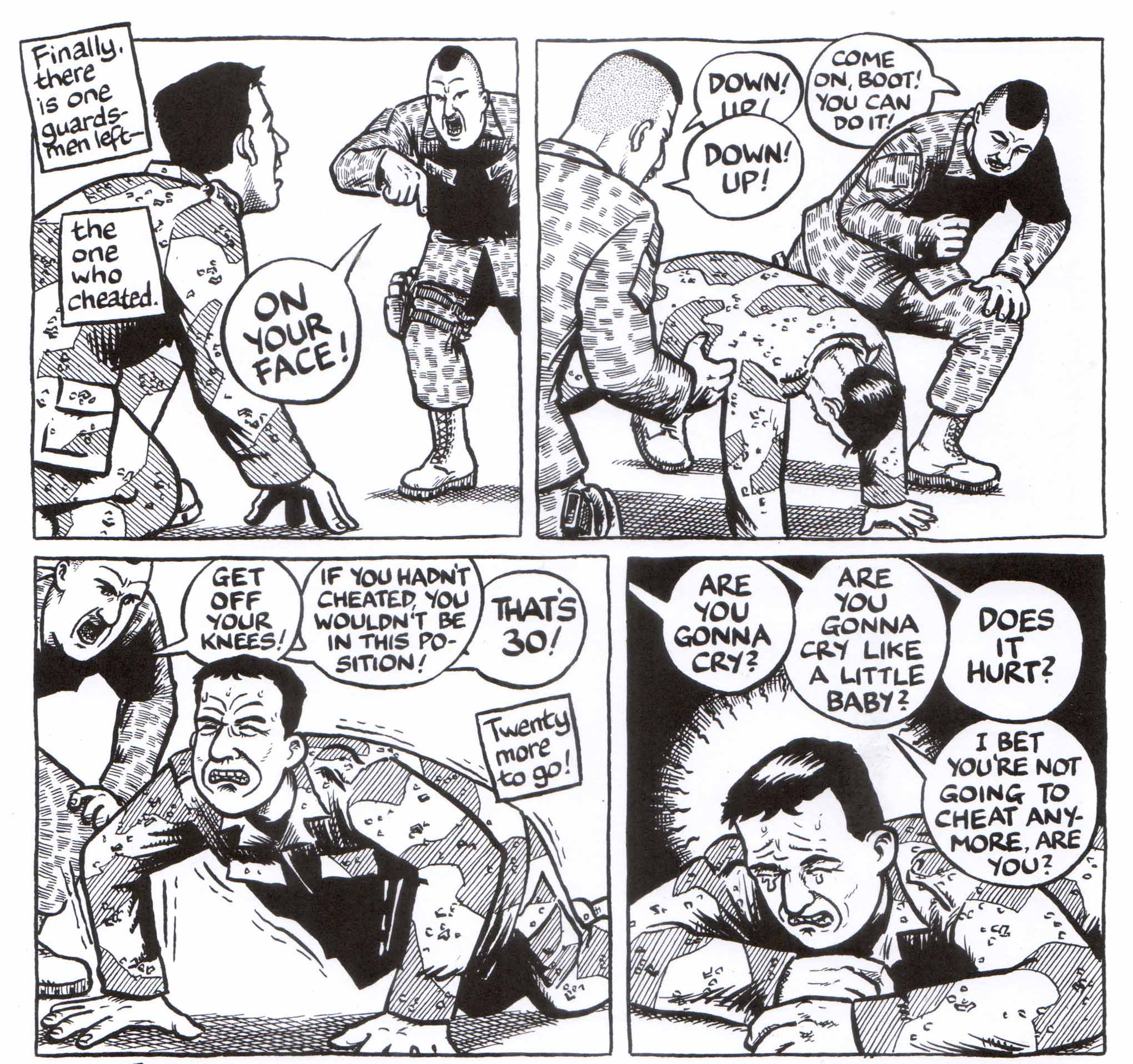
These anonymous figures get names in the story that follows (“Down! Up!”). While aesthetically less impressive, this piece does suggests that Sacco’s skills are best demonstrated not by his stories of the tortured and maimed but by more mundane subjects. This is an extended piece on trainees attached to the Iraqi National Guard (ING) and their interaction with their liberator-colonizers; the captors and their captives secreted away to some mysterious training destination; the actors playing at master and slave in the comics equivalent of a confined space of undescribed backgrounds; the plot bending the knee to the dictates of human interaction, the faces of every individual contorted into extremes.
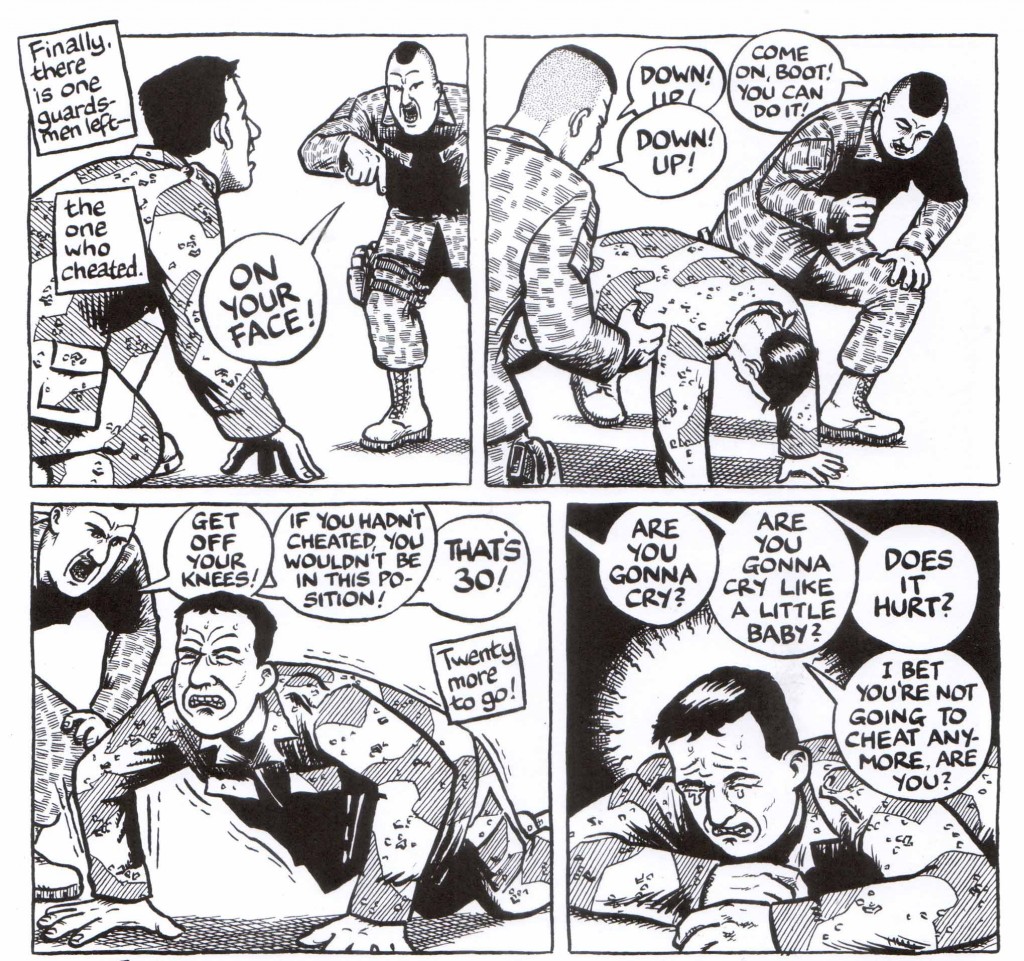
So much passion on display and yet, Sacco is clearly wrong in suggesting that it is the comics medium which hasn’t allowed him “make a virtue of dispassion.” This may be the case on a personal basis (and perhaps that is all he means) but it seems excessive to shower blessings on the “inherently interpretive medium” of comics. The truth is that comics are quite capable of conveying facts with dispassion as evidenced by the vast majority of comics non-fiction. Just like authors who cast their words firmly in the direction of human cost stories, it is Sacco’s personal proclivities (and not any comics essentialism) which is responsible for the shape and tone of his comics. The decisions in comics journalism are perhaps more obvious than those in video or photography, yet it should be clear from controversies like those surrounding the depictions of Bosnian Serb concentration camps that even photo journalism is also open to interpretation and partisanship.

“Another trap promoted in American journalism schools is the slavish adherence to “balance.” …Balance should not be an excuse for laziness. If there are two or more versions of events, a journalist needs to explore and consider each claim, but ultimately the journalist must get to the bottom of a contested account independently of those making the claims. As much as journalism is about “what they said they saw,” it is about “what I saw for myself.” The journalist must strive to find out what is going on and tell it, not neuter the truth in the name of equal time.” – Joe Sacco (from his preface)

Similarly, Sacco’s disavowal of “balance” seems overstated if not a deliberate misunderstanding. The pursuit of balance has little to do with not taking sides, coming down in the middle, or pissing off both sides as he caricatures in his preface. Rather it suggests a dedication to teasing out the intricacies of any given situation and recognizing the limitations in human understanding. His advocacy of the journalism of “what I saw myself” obscures the essential mystery of “truth.”

The clarity and concerted purpose of Sacco’s work often elides the complexities of each flashpoint he visits—the very reasons for the insolubility of their problems. Only in “The Unwanted”, his report on the Maltese-African immigration problem, do we get some sense of this intractability. While Sacco’s sympathies lie firmly with the political refugees, he describes keenly the Maltese sardine can of fear, economic hopelessness, and easy racism. The predicament presents itself as a microcosm of the problems faced by Europe as a whole.

In this sense, his extended examination of the African migrant issue can be seen as “balanced” (an insult in Sacco’s book), allowing us to apprehend the dilemmas while preserving his consistent sympathy for the downtrodden

Not so the familiar and lengthy reportage on the Israeli-Palestinian conflict and the former Yugoslavia. The stories from these war zones present us with an almost Manichean world of the oppressed and oppressors, a long tradition in comics as it happens. A mild-mannered challenge in the Hague by a Serb-American defense attorney fizzles out pretty quickly. The Israelis are represented by a recalcitrant Zionist in “Hebron: A Look Inside.” The powerful, as Sacco puts it, “are excellently served by the mainstream media or propaganda organs.”

“I don’t feel it is incumbent on me to balance their voices with the well-crafted apologetics of the powerful.”

A perfectly sensible view which only leaves the reader the task of deciding which side is the more powerful and which has the greater voice in the mainstream media.

Without any furrowing of the narrative, genuine understanding can hardly be realized. Where one approach might convince us of the righteousness of our aid, our charity, and perhaps our armed intervention, the alternative might give us reasonable pause to consider our moral reflexivity. The former approach lulls us into complacency, the latter challenges all received ideas and sympathies. Sacco’s frequent advocacy of an unwavering crystallized truth suggests that he is not primarily a journalist and reporter but a political activist; one who has consumed the facts, the scholarship, and the primary sources and sees himself as an evangelist, giving voice to those who have none and presenting himself and his works as one of several rallying points in the journalistic sphere.

Hence his protestations against journalistic “balance”, the practice of which must seem hollow and self-serving in the face of taking sides and championing the needy. This is a noble endeavor but like all messages from the pulpit, one that must be tested thoroughly before acted upon. And if we agree with Sacco when he holds to Robert Fisk’s adage that “reporters should be neutral and unbiased on the side of those who suffer”, we should first consider being “neutral and unbiased” on the side of tangled truth.


* * *

Further Reading

(1) Kathleen Dunn’s review at The Oregonian. This article contains a lot of basic background information on Sacco.

(2) David Ulin’s review at the LA Times.

“The rap on Sacco, of course, is that he is less a journalist than an advocate, who in such works as “Palestine” and “Footnotes in Gaza” blurs the line between observer and activist. That’s true, I suppose, in the narrowest sense, but it’s also reductive, and with “Journalism,” he convincingly refutes the argument.

Sacco is rigorous about telling both sides of the story, developing sympathy for the American soldiers even as he questions their presence in Iraq. The key is his attention to the human drama, which blows open in the final frames of the story, where he describes the fate of a river unit with whom he’d gone on patrol.”

 

“Ribbit” Means Goodbye

This piece first ran on Comixology.
_______________

Quentin Blake’s 1984 illustrated children’s book, The Story of the Dancing Frog, starts off innocuously enough. A young boy, Jo, asks his mother to tell him a story of their family. She obliges by launching into the story of Great Aunt Gertrude, who married a sailor “with a black beard and smart uniform.” The sailor (who is never named) is away often, which is sad, but, as the mother notes, “they were happy when they were together, and they had a house by the sea and Gertrude would watch for his ship returning.”

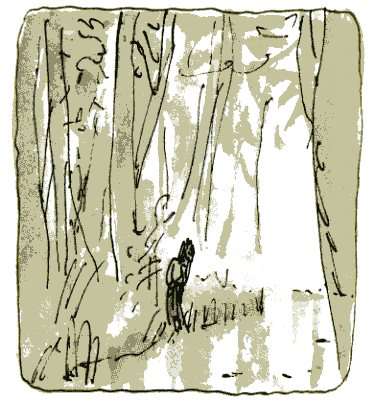
Then one day, as you’ve probably guessed, his ship doesn’t come back, and Gertrude receives a letter saying he has drowned. “You can imagine how awful it must have been to get a letter like that,” mom says. Gertrude goes out to the river to walk alone, and thinks about throwing herself in “so that she could be drowned too, like her husband, and finished.” Blake’s sketchy pen and watercolor illustration portrays that moment from some distance, as if Gertrude and the river around her are fuzzing out, preparing to dissolve.


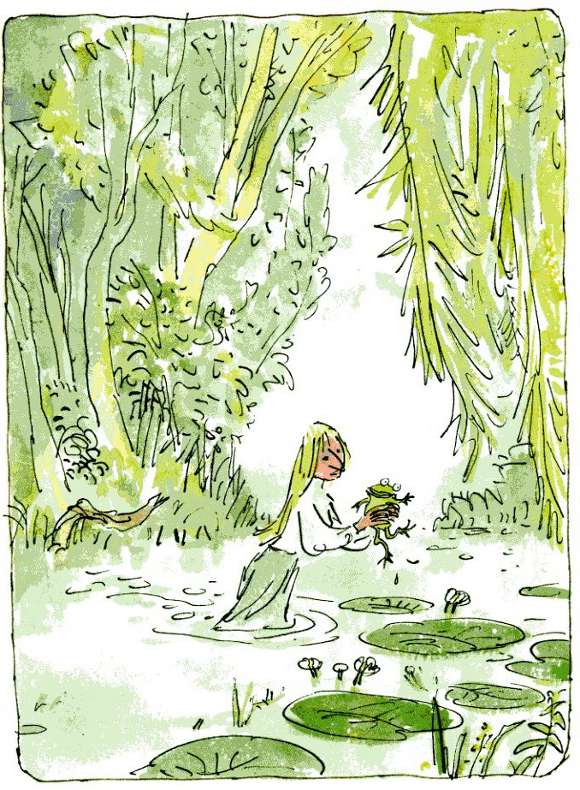
Instead, though, she looks up and sees a frog dancing on a lilypad. Without quite knowing why, “she walked into the water and picked up the frog and carried it home.”

The picture of Gertrude picking up the frog is both moving and goofy. Gertrude is half in the water, her facial expression hard to read. The trees form an arch overhead, and her dress is pulled back by the water. It’s a ritual and sensual scene, like a rebirth or a wedding. The frog, on the other hand, is clearly not quite up to the role of Prince — it looks helpless and bizarrely cheerful with its googly eyes and gangly body, no more aware of the affection it’s inspired than an infant. Its obliviousness, though, only makes the moment more poignant. Without knowing it, it is both lost husband and child that never was, a lifeline that cannot possibly bear the weight put upon it.

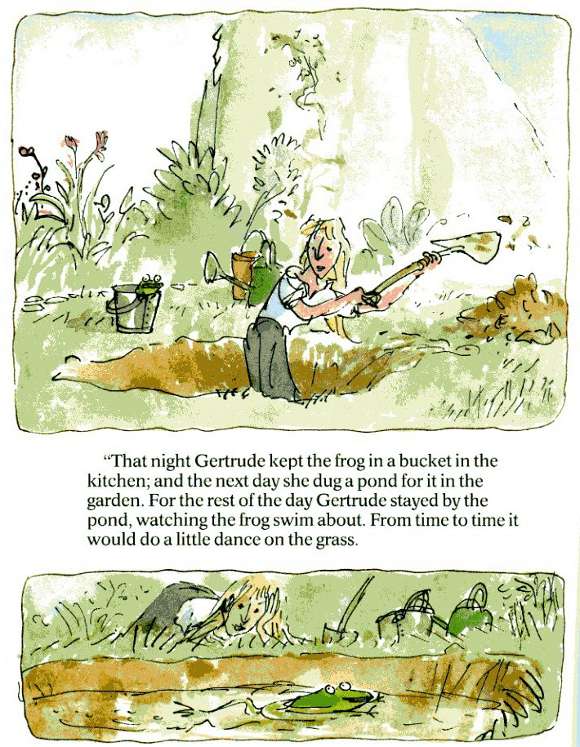
Or maybe it can. Gertrude goes back home and digs a hole in her backyard. The hole is a pond for the frog, but Blake’s drawing makes it look, also, like a grave. Then she fills the hole with water, so the frog can swim in it.

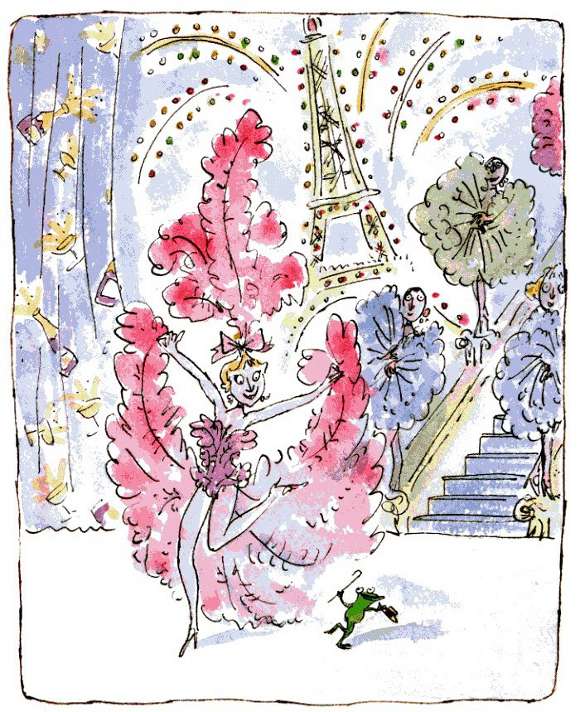
Quickly after that, the story moves away from grief, as well as from all semblance of realism. Gertrude and the dancing frog (whose name, or perhaps just his stage name, is George) go on the road, steadily growing more and more successful. George performs tricks and dances in glamorous settings, a dashing little blob of green.

There are some other incidents: Gertrude turns down an offer of marriage from a lord; George is caught in a hotel fire and must leap to safety into a bucket of water from the thirteenth floor. But basically that’s the story. Gertrude loses her husband and finds a frog and spends her life with it. When I read it to my son, he couldn’t for the life of him figure out why it made me cry.

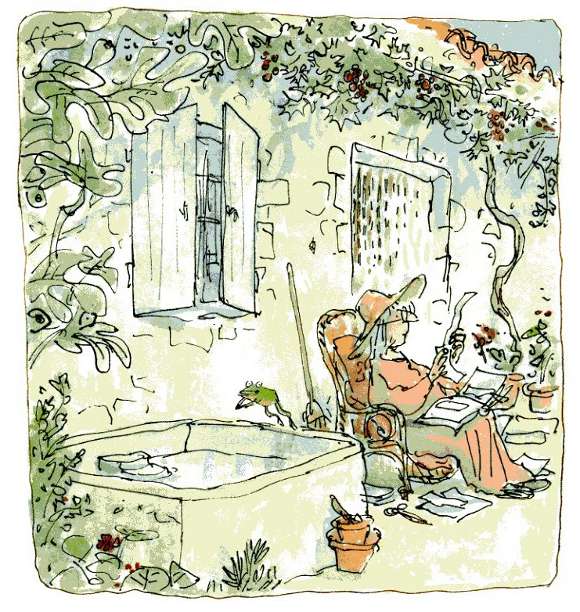
The reason, of course, is that (the possibly nameless) George both is the (nameless) husband, and is not. George comes out of the water that the husband went into, and takes his place — living the life with Gertrude that the husband lost. Gertrude, on the other hand, never comes out of the pond; her whole story is her grief, an impossible dream of happiness. And yet, at the same time, she does come out of the pond, holding a friend (a child?) around which she manages to build a life, not in spite of her grief, but because of it. When Jo wonders why Gertrude chose the frog over the Lord’s offer of marriage, the mother answers “Well, I suppose you could say they looked after each other over the years.” And, indeed, we see at the end scenes of an aging Gertrude and an (impossibly old at this point, surely) frog entering their twilight years in the south of France. They live amidst idyllic watercolors and beside an ever-present little pool, a reminder of where George came from and where someone else went.

At the end Jo has one more question.

“Was that a true story?”

“More or less.”

“But frogs don’t normally dance, do they?”

“Not normally, no.”

“And no one could really catch a frog and put it on the stage.”

“You can do all kinds of things if you need to enough.”

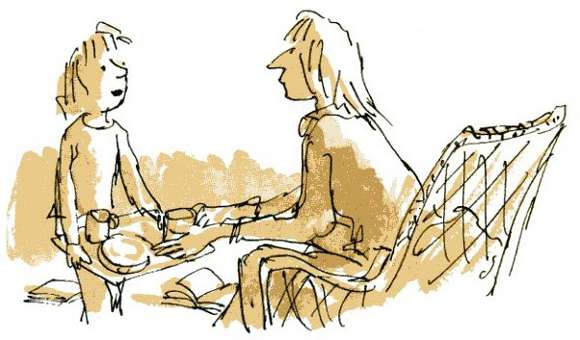
The fact that Jo and his mother never mention a father in the family gives the story an added, speculative resonance. This is intensified, perhaps by the sepia palette used to illustrate them, which is similar to the muted colors used on Gertrude after she hears of her husband’s loss. The book, as Quentin Blake has pointed out is called, not The Dancing Frog, but The Story of the Dancing Frog. Perhaps what came out of the river is not a frog, but a fairy tale — a dream to live out as life till one is ready to join one’s heart beneath the waters.

Everybody’s Daydream, Everybody’s Finder

Dreams seem like the most private of things, and yet in some ways they’re the parts of us that are least us. With consciousness sidelined, everything and everyone else takes their place in your head. Freud and Jung may not have been exactly right that you can unwind a person by unwinding their dreams, but I think they were correct to claim that dreams aren’t so much a window into the soul as a creepy acknowledgment that the soul you’d thought you’d kept in a safe place is always already in somebody else’s pocket.

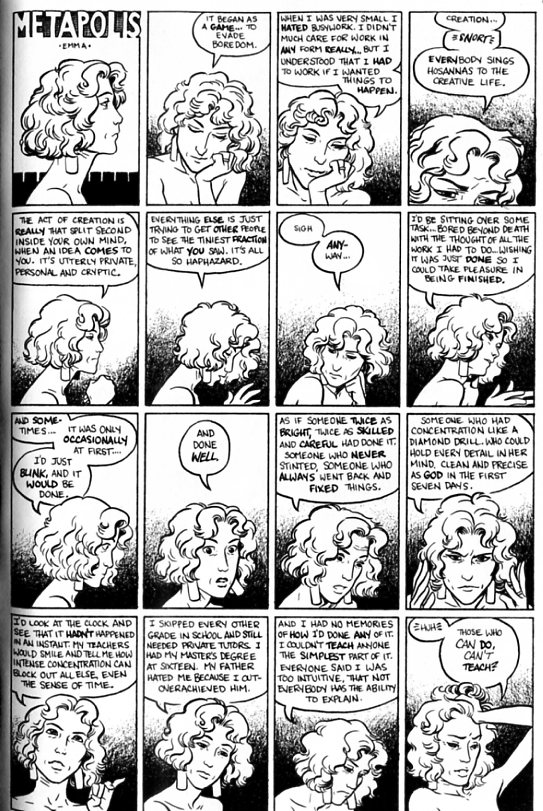
In “Sin-Eater”, Carla Speed McNeil’s first sci-fi Finder story, one of the main characters is a woman named Emma. Emma regularly has elaborate, disassociative dreams in which she imagines herself a fabulous princess in a distant realm. Sometimes when she’s gone, she lies as if asleep; sometimes she continues on with her life raising her kids and making her gardening eco-art without thinking or feeling or remembering how she did it.

Emma’s fantasy world is, obviously, a metaphor or analog for McNeil’s world which, like Emma’s, is elaborate and fantastical — a cyberpunk fantasy bricolage filled with talking animals and prophecies and even a venereal fey plague that gives people fox heads. Emma, then, is McNeil; a builder constructing a solipsistic interior castle, worlds within worlds, with emotions flickering across the page like carefully limned expressions across a mirror, the edifice an exercise in joyfully/painfully misrecognizing the self in its all its iterated containers.

But at the same time as Emma spirals inward, she spirals outward as well. The woman with the fantasy-world inside her is not exactly an original idea. I thought immediately of Neil Gaiman’s A Game of YOu, which could well have been an inspiration for McNeil (the timing’s about right, and Gaiman pops up in the copious notes at least once.)

Slightly further afield, I was reminded of Anna Freud’s 1922 essay Beating Fantasies and Daydreams in which she analyzes the fantasies of “a girl of about fifteen.” The girl is, of course, Anna Freud herself, and she traces her own rich fantasy life to a daydream she had as a five or six year old involving an adult beating a boy. Following in her own father’s footsteps, she interpreted these dreams as fantasies about father love; the father was beating someone else, which meant, according to Freud, that “Father loves only me.”

The daydreams were highly sexual, and in a guilty effort to suppress them and simultaneously enjoy them, Freud elaborated long, intricate narratives and worlds. Here’s her discussion of her main hero (she refers to herself in the third person.)

One of these main figures is the noble youth whom the daydreamer has endowed with all possible good and attractive characteristics; the other one is the knight of the castle who is depicted as sinister and violent. The opposition between the two is further intensified by the addition of several incidents from their past family histories-so that the whole setting is one of apparently irreconcilable antagonism between one who is strong and mighty and another who is weak and in the power of the former….

All this takes place in vividly animated and dramatically moving scenes. In each the daydreamer experiences the full excitement of the threatened youth’s anxiety and fortitude. At the moment when the wrath and rage of the torturer are transformed into pity and benevolence-that is to say, at the climax of each scene-the excitement resolves itself into a feeling of happiness.

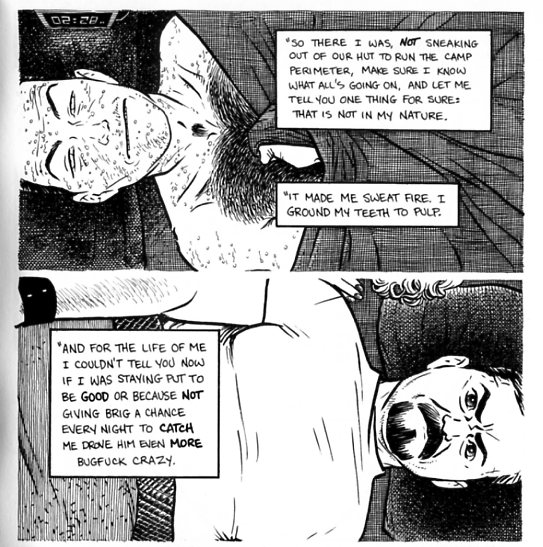
If you’ve read “Sin-Eater,” the connection between Anna Freud’s fantasies and McNeill’s fantasies should be apparent enough. Like Anna, McNeil’s story is obsessed with abuse — the main character, Jaeger, has a past which is basically one long series of fights, anchored by his decision to become a sin-eater, a sacrificial station that involves ritual beatings. As a sin-eater, Jaegar takes others’ wrath and rage and transforms it into pity and benevolence — a process aided by a mysterious healing ability which allows him to recover even from brain damage.

Moreover, “Sin-Eater,” like Anna Freud, has daddy issues up the wazoo. Emma’s former husband, Brig, psychologically abused her and her three children; Jaegar, who is Emma’s boyfriend, is a kind of substitute father figure — which is complicated by the fact that Brig served as a kind of substitute father figure for Jaegar himself. At one point, Jaegar actually builds a fake apartment for Brig to go to, fooling him into thinking his family is there rather than elsewhere. The displaced family obscures the fact that it’s not the wife and kids, but Brig and Jaegar who are constantly displaced, swapping one for another — as in this mirrored doubling.

Or another example:

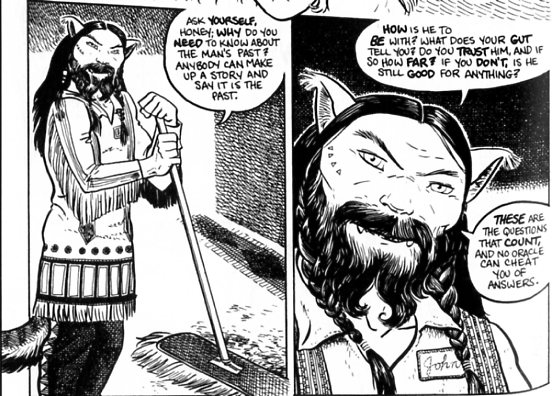
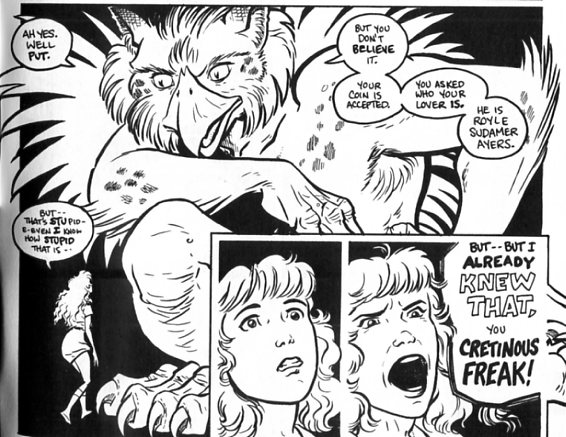
In the notes, McNeil says that this character is an early prototype of Jaegar. This early form is nonhuman, obviously — but it also has a beard not unlike Brig’s. And this dual Jaegar/Brig character is definitely an ambivalent father figure; it dispenses wisdom, but it is also connected to the oracle, which on the previous pages made Rachel (Emma’s oldest daughter) reveal her deepest fear. Rachel says her worst fear is “better the devil that you know” — an ambiguous statement that might be a little clearer if she’d said “better the daddy that you know.” Or, to put it another way, her greatest fear is the oracle, who towers over her as if she’s a small child and to which she reacts with a mixture of awe, fear, and petulance.

Again, this frightening oracle transforms into the proto-Jaegar, just as Jaegar takes Brig’s place in the family. The shuttling of father figures in and out puts a different twist on Anna Freud’s interpretation of her dreams. For her, the beating figure is the father, and those beaten are rivals for his affection. But if the father figure can shift from one place to another, why couldn’t he be the beaten as well as the beater? Couldn’t the point be vengeance upon the father by the (daughter identifying with) the father, a bid not for the father’s favor but for an economy which would grant power over the father to force him to identify with the (beaten) daughter? Father, then, becomes beaten and beater, and the happiness is from switching him from one to another, so that each punishes and then is punished for punishing, a cycle in which the powerful are humbled and the humbled empowered, so daughter is ever daddy and daddy is ever daughter.

Certainly in Sin-Eater the fathers take a massive and almost unending whupping. Brig is tricked, crippled, and finally rendered a howling, slobbering shell of himself; his son Lynn (who sometimes identifies as a girl, and sometimes as a boy), even injects him with battery acid. Jaegar, as we’ve mentioned, is constantly getting beaten up, falling from windows, mutilating himself, letting others mutilate him, and then healing and coming back. Ultimately he takes responsibility for the sins of Brig as well…spiritually changing the bad father to the good father, who apologizes and atones. (Plus there is the added bonus that Rachel can flirt with Jaegar unashamedly; he’s not her “real” father, after all.)

Which is to say, though the different clans and the background notes and the make it feel like a personal construction, “Sin-Eater” ends up as something very like idfic, pulling its power from the same well of chastened Daddy-lover fantasies as something like Twilight.

No wonder, then, that Jaegar is himself in many ways a drearily familiar archetype — the tortured tough-but-tender loner with heart-of, whose masculine ability to withstand pain functions as an excuse to subject him to hyperbolic and repetitive sensual violence, just as his mysterious outsider status turns him into a perpetually sexy invader of the quiet homes. Rachel accuses him at the end of the book of running out on the family because he fears that if he becomes less mysterious, they will reject him. But surely it’s McNeil herself who wants the outsider to be an outsider — she’s the one who made him in all his fascinating outsiderness after all. He’s a hyperbolic caricature of the bad boy who can’t commit; he gets physically ill when he’s cooped up too long, and then has to masochistically damage himself to regain equilibrium. Constantly disappointing and atoning, he’s forever attractively distant and adorably sorry for his distance; always that elusive first love, never the boring…well, daddy.

McNeill’s dreams, then, like Emma’s, are of genre — the most secret recesses of her heart are tropes. McNeill certainly knows that; she includes many wry allusions to other cultural touchstones (the Peanuts reference is a favorite especially.) Which would be fine…if I hadn’t run out of patience with the elusive, invulnerable Wolverine and all his sexily ambivalent loner brethren some time back. I don’t want to love him; I don’t want to enjoy his torment; I just want him to go away. But there he is, the angsty grain of sand at the center of the gloriously dreaming bivalve. Alas, I’m afraid that particular irritant’s been scraping my psyche too long already for me to really appreciate the pearl, however lovely its fashioning.

Classic and Not-So-Classic Superheroines: A Brief History in Covers and Panels

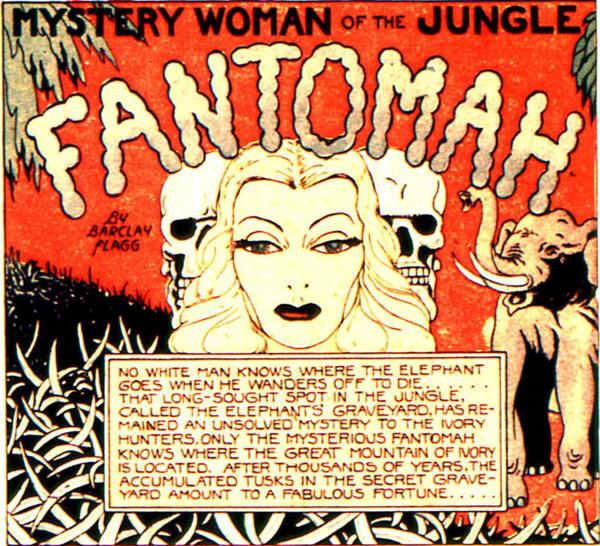
Fantomah

First Appearance: Jungle Comics #2 (Feb. 1940)
Created by Fletcher Hanks (a.k.a. Barclay Flagg)
Publisher: Fiction House

.

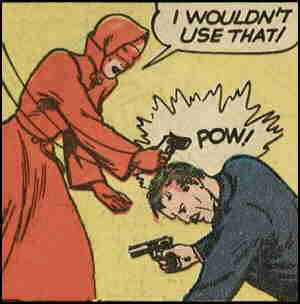
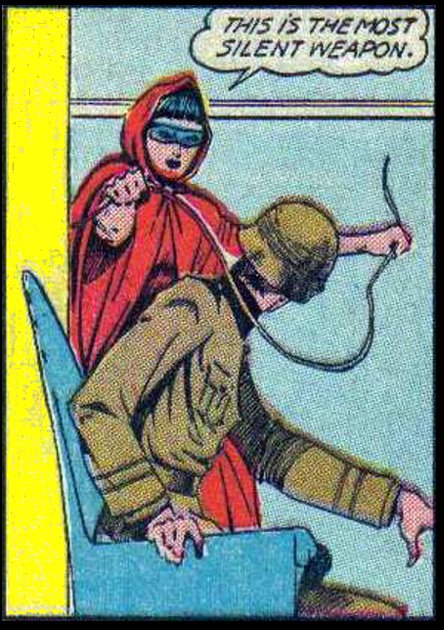
The Woman in Red (Peggy Allen)

First Appearance: Thrilling Comics #2 (Mar. 1940)
Created by Richard Hughes and George Mandel
Publisher: Nedor Comics

.

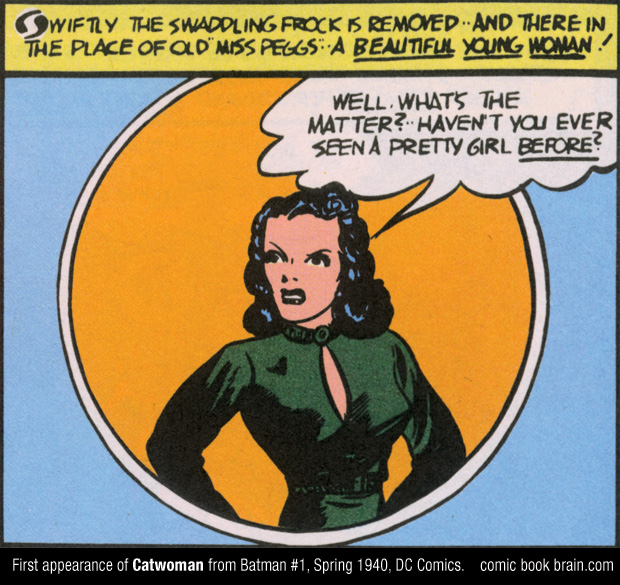
Catwoman (Selena Kyle)

First Appearance: Batman #1 (Spring 1940)
Created by Bob Kane and Bill Finger
Publisher: Detective Comics, Inc. (DC)

.

Lady Luck (Brenda Banks)

First Appearance: The Spirit (syndicated – June 2, 1940)
Created by Will Eisner and Chuck Mazoujian
Publisher: Register and Tribune Syndicate

.

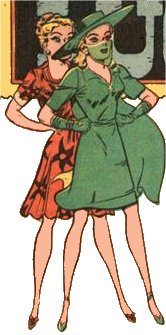
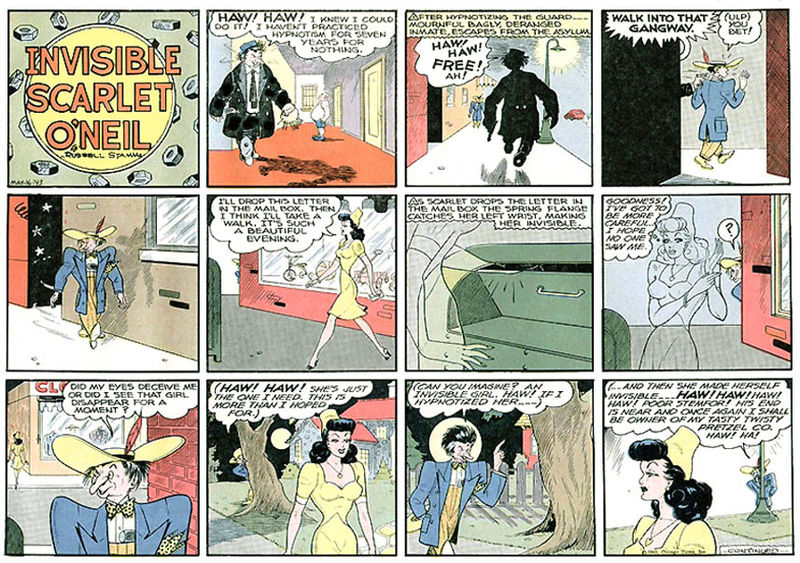
Invisible Scarlet O’Neil

First Appearance: Invisible Scarlet O’Neil (syndicated – June 3, 1940)
Created by Russell Stamm
Publisher: The Chicago Times

.

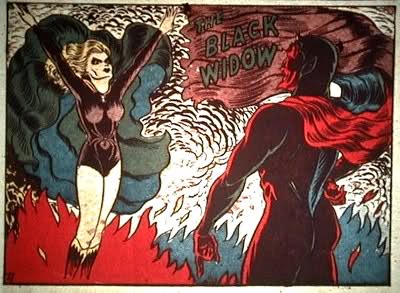
Black Widow (Claire Voyant)

First Appearance: Mystic Comics #4 (Aug. 1940)
Created by George Kapitan and Harry Sahle
Publisher: Timely Comics (Marvel)

.

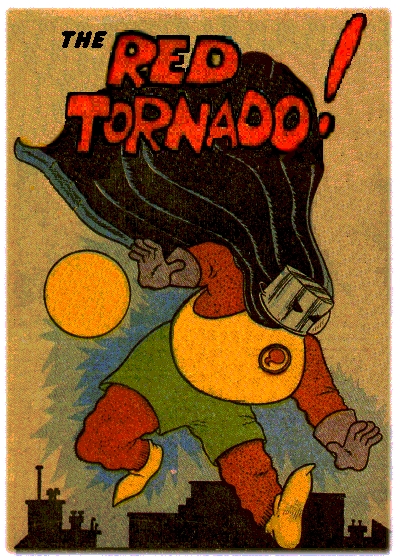
Red Tornado (Abigail Mathilda “Ma” Hunkel)


First Appearance (as Red Tornado): All-American Comics #20 (Nov. 1940)
Created by Sheldon Mayer
Publisher: All-American Publications (DC)

.

Miss Fury (Marla Drake)

 First Appearance: Black Fury (syndicated – April 6, 1941)
Created by Tarpe Mills
Publisher: Bell Syndicate, reprinted by Timely Comics (Marvel)

.

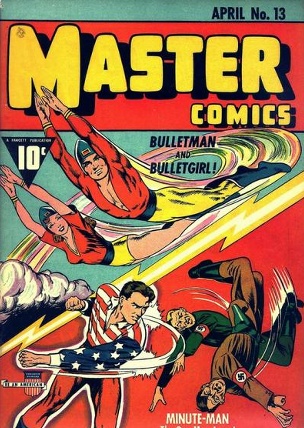
Bulletgirl (Susan Kent)

First Appearance (as Bulletgirl): Master Comics #13 (April 1941)
Created by Bill Parker and John Smalle
Publisher: Fawcett Comics

.

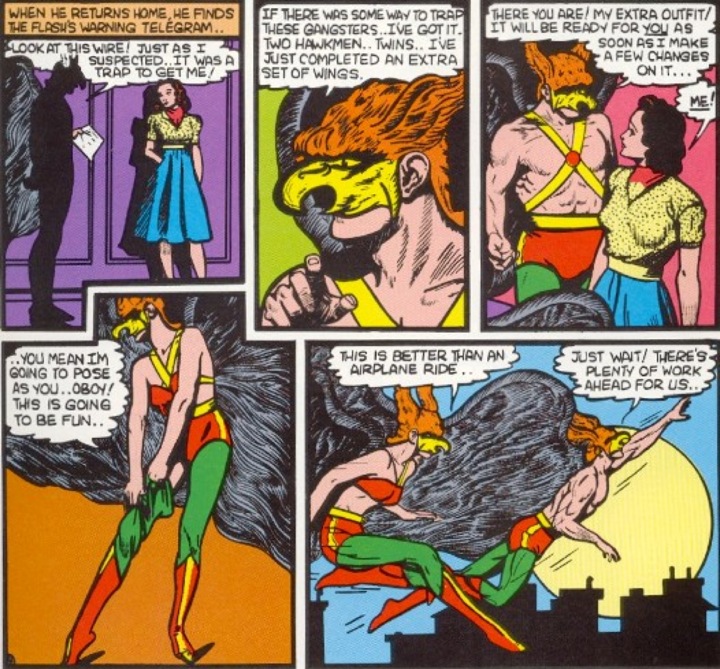
Hawkgirl (Shiera Sanders)

First Appearance (as Hawkgirl): All Star Comics #5 (July 1941)
Created by Gardner Fox and Dennis Neville
Publisher: All-American Publications (DC)

.

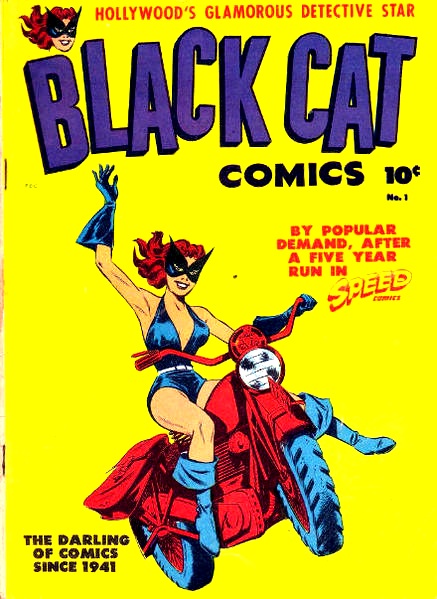
Black Cat (Linda Turner)

First Appearance: Pocket Comics #1 (Aug. 1941)
First Solo Title: Black Cat Comics #1 (Jun. 1946)
Created by Alfred Harvey with art by Al Gabrielle
Publisher: Harvey Comics

.

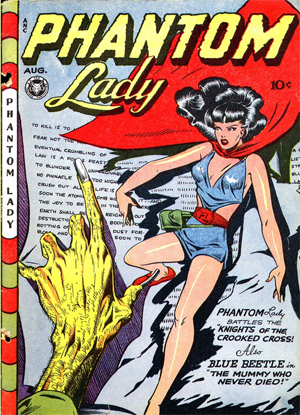
Phantom Lady (Sandra Knight)

First Appearance: Police Comics #1 (Aug. 1941)
First Solo Title: Phantom Lady #13 (Aug. 1947)
Created by Eisner-Iger Studio, re-designed by Matt Baker
Publisher: Quality Comics; Fox Features Syndicate

.

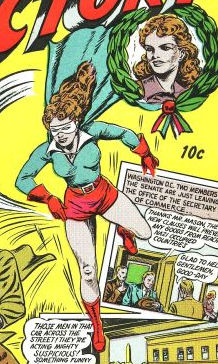
Miss Victory (Joan Wayne)

First Appearance: Captain Fearless #1 (Aug. 1941)
Created by Charles Quinlan and unknown writer
Publisher: Helnit Publishing Co.

.

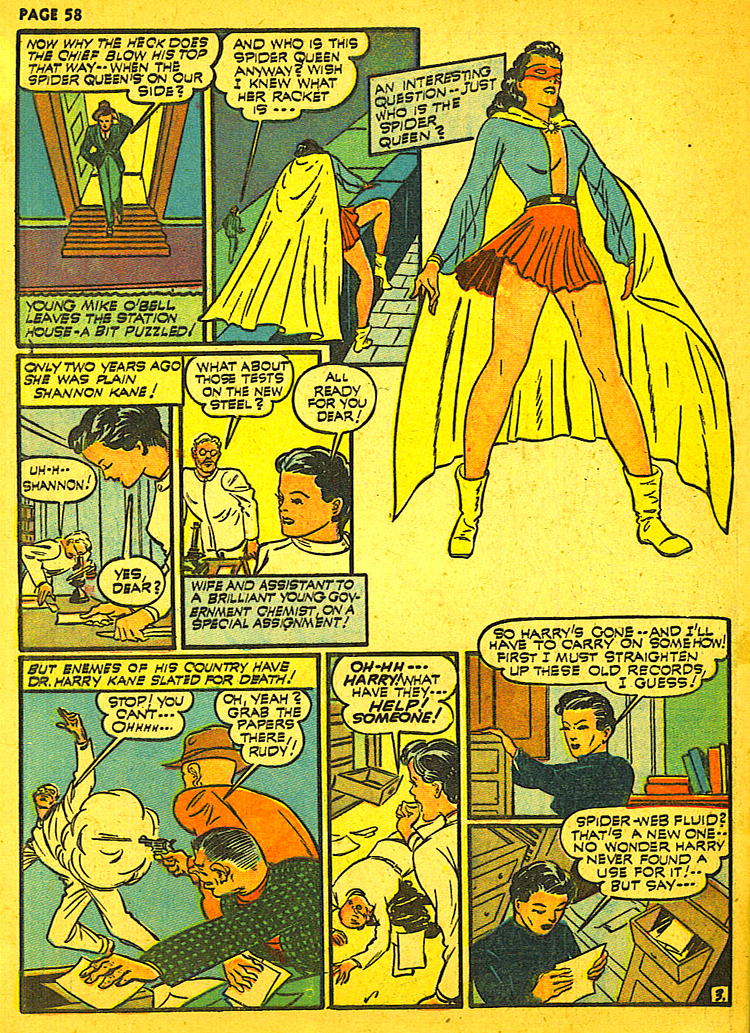
Spider Queen (Shannon Kane)

First Appearance: The Eagle #2 (Sep. 1941)
Created by Louis and Arturo Cazeneuve
Publisher: Fox Features Syndicate

.

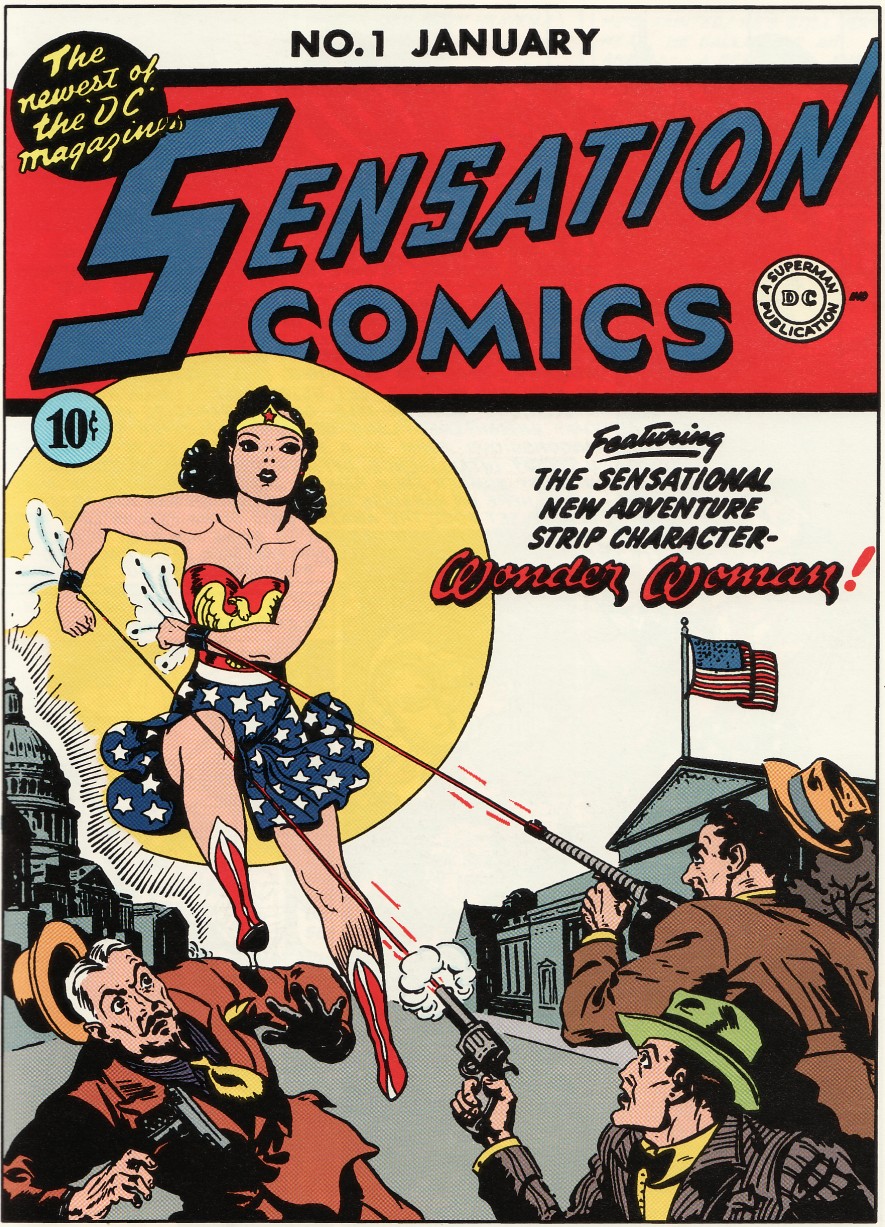
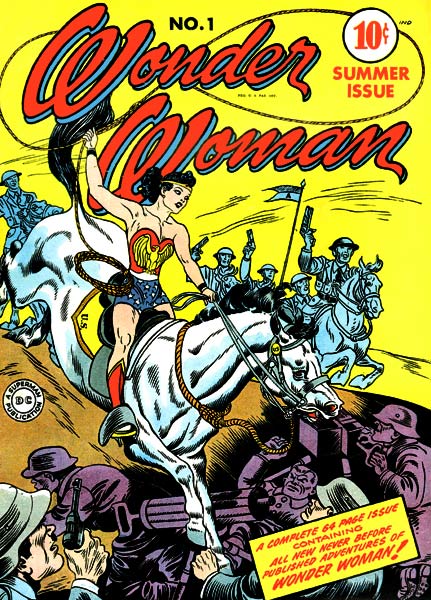
Wonder Woman (Diana Prince)

First Appearance: All Star Comics #8 (Dec. 1941)
First Solo Title: Sensation Comics #1 (Jan. 1942)
Second Solo Title: Wonder Woman #1 (Summer 1942)
Created by William Marston with art by Harry Peter
Publisher: All-American Publications (DC)

.

Lady Satan

First Appearance: Dynamic Comics #2 (Dec. 1941)
Created by unknown
Publisher: Harry “A” Chesler

.

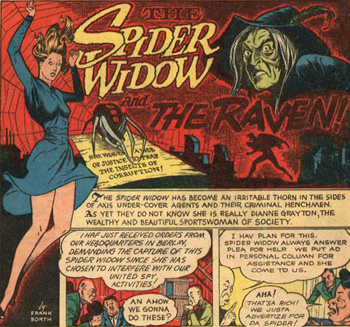
Spider Widow (Dianne Grayton)

First Appearance: Feature Comics #57 (Jun. 1942)
Created by Frank Borth
Publisher: Quality Comics

.

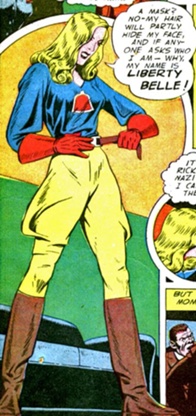
Liberty Belle (Libby Lawrence)

First Appearance: Boy Commandos #1 (Winter 1942)
Created by Don Cameron and Chuck Winter
Publisher: Detective Comics, Inc. (DC)

.

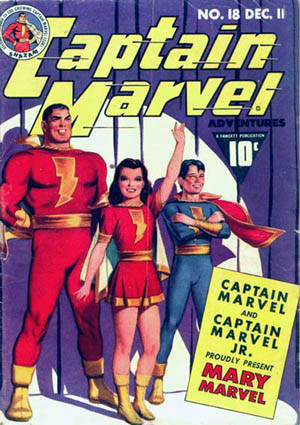
Mary Marvel (Mary Batson)

First Appearance: Captain Marvel Adventures #18 (Dec. 1942)
Created by Otto Binder and Marc Swayze
Publisher: Fawcett Comics

.

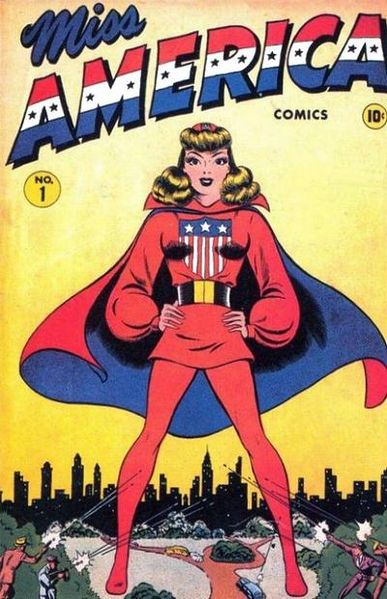
Miss America (Madeline Joyce Frank)

First Appearance: Marvel Mystery Comics #49 (Nov. 1943)
First Solo Title: Miss America Comics #1 (early 1944)
Created by Otto Binder and Al Gabrielle
Publisher: Timely Comics (Marvel)

.

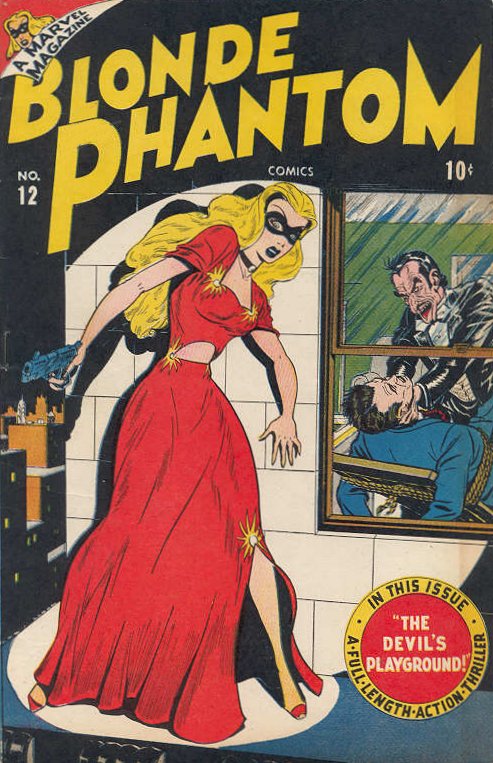
Blonde Phantom (Louise Grant)

First Appearance: All-Select Comics #11 (Sep. 1946)
First Solo Title: Blonde Phantom #12 (Jan. 1947)
Created by Stan Lee and Syd Shores
Publisher: Timely Comics (Marvel)

.

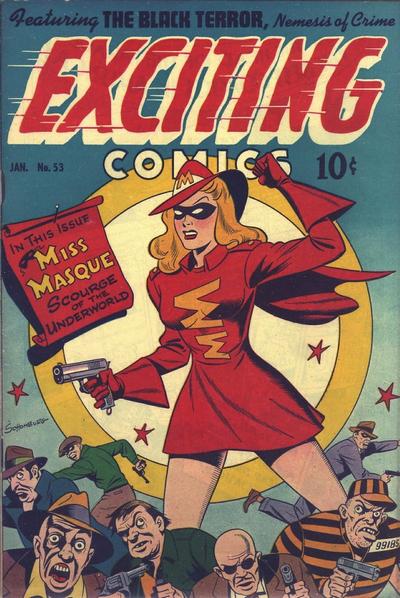
Miss Masque (Diana Adams)

First Appearance: Exciting Comics #51 (Sep. 1946)
Created by unknown
Publisher: Nedor Comics

.

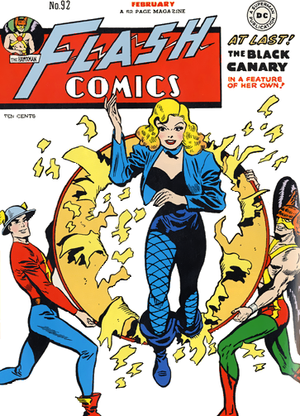
Black Canary (Dinah Drake-Lance)

First Appearance: Flash Comics #86 (Aug. 1947)
Created by Robert Kanigher and Carmine Infantino
Publisher: National Comics (DC)

.

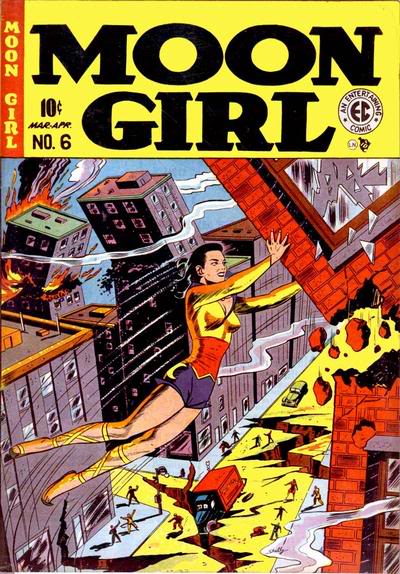
Moon Girl (Claire Lune)

First Appearance: Moon Girl and the Prince #1 (Fall 1947)
Created by Max Gaines, Gardner Fox, and Sheldon Moldoff
Publisher: EC Comics

.

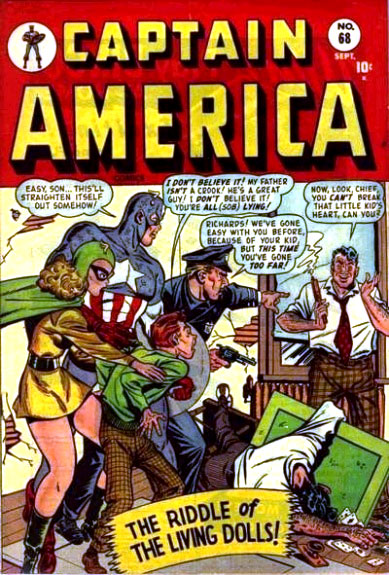
Golden Girl (Betsy Ross)

First Appearance (as Golden Girl): Captain America Comics #66 (Dec. 1947)
Created by Joe Simon and Jack Kirby
Publisher: Timely Comics (Marvel)

.

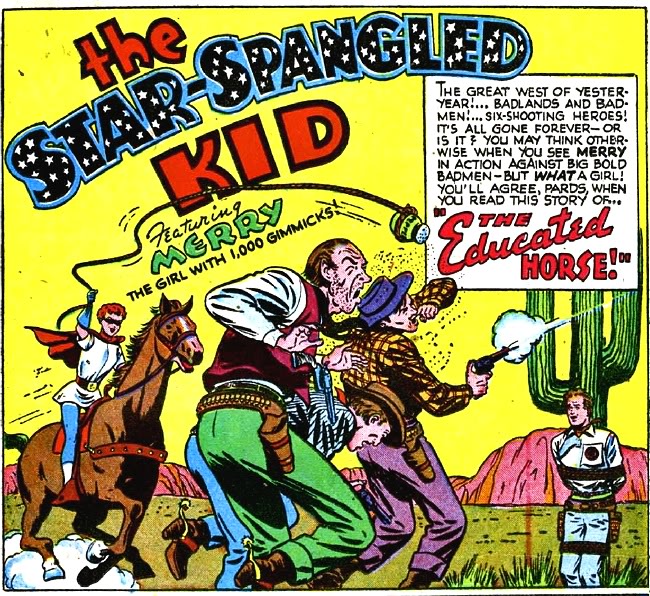
Merry, The Girl with 1,000 Gimmicks (Merry Pemberton)

First Appearance: Star Spangled Comics #81 (Jun. 1948)
Created by Otto Binder and Win Mortimer
Publisher: National Comics (DC)

.

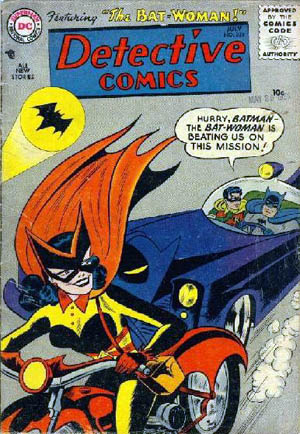
Bat-Woman (Kathy Kane)

First Appearance: Detective Comics #233 (Jul. 1956)
Created by Edmond Hamilton, Sheldon Moldoff, and Stan Kaye
Publisher: National Comics (DC)

.

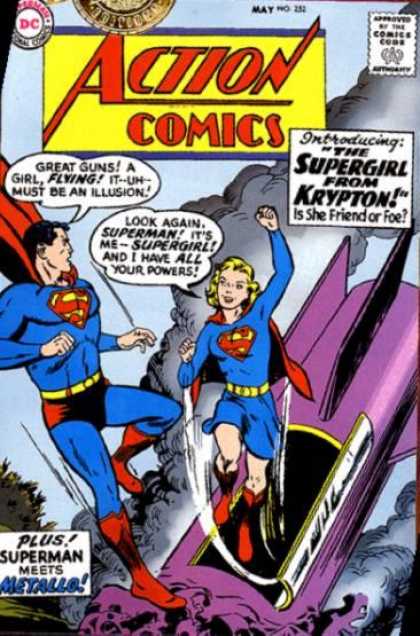
Supergirl (Kara Zor-El, Linda Danvers)

First Appearance: Action Comics #252 (May 1959)
Created by Otto Binder and Al Plastino
Publisher: National Comics (DC)

.

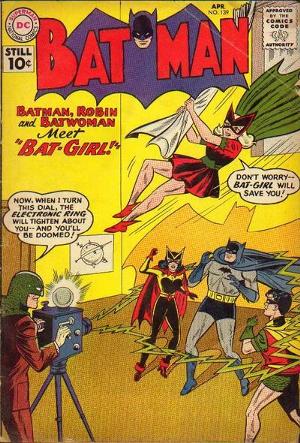
Bat-Girl (Betty Kane)

First Appearance: Batman #139 (Apr. 1961)
Created by Bill Finger and Sheldon Moldoff
Publisher: National Comics (DC)

Rogue Mirror

This first appeared on Comixology.
__________________
Superheroes are power fantasies. This is not in dispute.

The latest testament to this truth was provided to me by U Mass Lowell professor Susan Kirtley, one of the contributors to Craig Fischer’s Team Cul de Sac zine to benefit Parkinson’s research. The zine consists of a number of critics (including me!) discussing their favorite comics.

Kirtley’s piece starts by talking about one day in elementary school when she found an acquaintance, Sean Robinson, “huddled against the brick wall of the school.” Sean huddled over a piece of reading material “which was bright and colorful and quite possibly naughty.” Kirtley demanded to know what he was reading, at which point Sean declared, “‘girls don’t read comic books.'”
Thus encouraged, Kirtley headed over to the “spindly wire rack” the next time she was at the grocery store, got her mom to purchase some X-Men comics…and fell in love. She was especially taken with Rogue…and here’s where the power fantasy comes in. As Kirtley says:

As I began to read the exploits of Cyclops and the team I realized these were kindred spirits. Was I not like the tortured blue Beast, a genius hiding away from the world, unappreciated and misunderstood. I certainly longed to fry some of my classmates (including Sean Robinson) with laser beams that shot out of my eyes. But most of all I adored Rogue, the Southern belle with the green and yellow uniform and unflattering skunk-striped hair, who embodied all my tweenage anxiety…. Unable to touch others without harming them, Rogue was tragic and beautiful. I, with no desire to touch others, thought myself tragic and wished to be beautiful. When I pulled the X-Men comic off the rack at Safeway I did so out of spite, but as a lonely, awkward girl I found something in comics — excitement and adventure, of course, also hope that like Rogue, I could transcend the past and become something more, despite my flaws and a horrible haircut.

Kirtley saw herself in Rogue — not the self she was, but the self she could be, a self that could “transcend the past.”

Kirtley’s description of anticipating her future self through the image of Rogue finds an echo in the work of psychoanalytic theorist Jacques Lacan. In his 1949 essay “The Mirror Stage as Formative of the Function of the I as Revealed in the Psychoanalytic Experience,” Lacan discussed the mirror stage: the moment when the child first recognizes itself in the mirror.

This event [the child seeing itself in the mirror] can take place…from the age of six months, and its repetition has often made me reflect upon the startling spectacle of the infant in front of the mirror. Unable as yet to walk, or even to stand up, and held tightly as he is by some support human or artificial…he nevertheless overcomes, in a flutter of jubilant activity, the obstructions of his support, and, fixing his attitude in a slightly leaning-forward position, in order to hold it in his gaze, brings back an instantaneous aspect of the image. [translation by Alan Seridan]

Just as Kirtley sees Rogue and is joyous, so the child sees its future self and is “jubilant”. The mirror stage, the power fantasy, is tied to happiness.

Lacan says that “the important point is that this form situates the agency of the ego, before its social determination, in a fictional direction.” And he adds that, looking in the mirror, the child “anticipates in a mirage the maturation of his power.” In other words, the child looking in the mirror is not seeing and recognizing a real self. Rather, she is misrecognizing a fictional self — an anticipatory self. This false self is integrated, functional, whole — a self that is not yet but will eventually reach a “maturation of…power.” Thus, Lacan’s child is happily seeing in the mirror exactly what Kirtley happily sees when she looks at Rogue in the comic; a false future self.

For Lacan, then, every self is always already a power fantasy — every self is a fictional superself. The lonely, awkward Kirtley is as much a misrecognized image as Rogue. Indeed, Sean Robinson sitting on the ground with his comic and his sneering can himself be seen as a super-mirror-image; an anticipation by Kirtley of Kirtley. The main superpower we want, the superpower we are constantly pretending to have, is self itself; a coherent being. As Lacan says, the Gestalt, or spontaneous formation of the image, unites the I, or ego or self

with the statue in which man projects himself, with the phantoms that dominate him, or with the automaton in which, in an ambiguous relation, the world of his own making tends to find completion.

Indeed…the mirror-image would seem to be the threshold of the visible world.

Lacan is saying that the fictional self, or selves, is (or are) a trap. The images of your self you make turn you into a congealed statue, place you at the mercy of ghosts, turn your world into an automaton which grinds you up. Kirtley is Sean, is the awkward girl, is Rogue, and all these false self-images hold and haunt her.

But, at the same time, Lacan suggests, it is these images which allow, or open, the world. He uses the example of pigeons, which (he claims) can’t attain sexual maturity in isolation. An isolated pigeon will not mature normally — unless you show it its own image in a mirror. Fooled into thinking its self is another, it will grow gonads, and become the fully functional pigeon it was meant to be.

Similarly, the future, dreamed-of human self is not a real self, and is in some ways a dangerous myth…but still, without the power fantasy, where are you? Child-Kirtley would not become Rogue, of course. But without the dream of transcending a false self through a false self, she would have had no false self, which is the only self. Misrecognition is the only recognition; the only thing the child sees is the mirror.

If the child sees only a mirror, then what about Lacan? Surely the images of self he sees are also misrecognitions? Or, to put it another way, if the self is always false, then the self declaring that the self is always false is also a power fantasy. Lacan seems to acknowledge as much in this oddly worded sentence:

This event [the child seeing itself in the mirror] can take place…from the age of six months, and its repetition has often made me reflect upon the startling spectacle of the infant in front of the mirror.

Lacan says he has been made to “reflect” upon the spectacle of the infant in front of the mirror. Lacan, then, is reflecting on, or looking at the infant just as the infant looks at its own reflection. The mirror stage is itself an image; a vision of the self. Lacan’s integrated self, his superpower, is the image of a self split in two. His misrecognized self, which (joyfully?) startles him, is a misrecognized self.

I think you can see this reflected in Kirtley’s essay too. The “I” in Kirtley’s piece, the older-Kirtley, looks at her younger I misrecognizing a super-I that anticipates, but is not, the older-I. Kirtley looks into the past to see a split self, a divided not-her that provokes jubilation. Similarly, I think, what I get from reflecting on the essay is a look at myself looking at older-Kirtley looking at younger-Kirtley looking at Rogue, those beguiling images within images, the super-power that is the me I can’t touch.