The Color Question

Editor’s Note: This is part of a series of student papers from Phillip Troutman’s class at George Washington University focusing on comics form in relation to Scott McCloud’s theories. For more information on the assignment, see Phillip’s introduction here.
_______________________
 
Color remains a question rather than an answer in comics: Some artist’s embrace it, while others continue to ignore it. Whatever its use, color plays an important role in forwarding the message of the artist. Yet such a message is ambiguous. In his analysis Understanding Comics, Scott McCloud notes that color promotes comics by reaching toward reality, making a panel appear to be a much more relatable image to the reader, who lives in a world beyond black and white. Mirroring life itself, which is far from flat, colored images add an extra dimension to the page. But is this the true purpose of color in comics? McCloud suggests otherwise; however, due to the brevity of his designated chapter, he never explains why. Indisputably, comics serve to simplify life, easing the ability to communicate some sort of integral message to the reader. Breaking the fourth wall, color magnifies the author’s claim. Minute tidbits of otherwise unseen details reveal themselves through the additional lens of color.

The following image derives from Doug Murray and Russ Heath’s “Hearts and Minds: A Vietnam Love Story.” The panel displays the death and destruction caused by the detonation of a grenade during a battle in the Vietnam War.
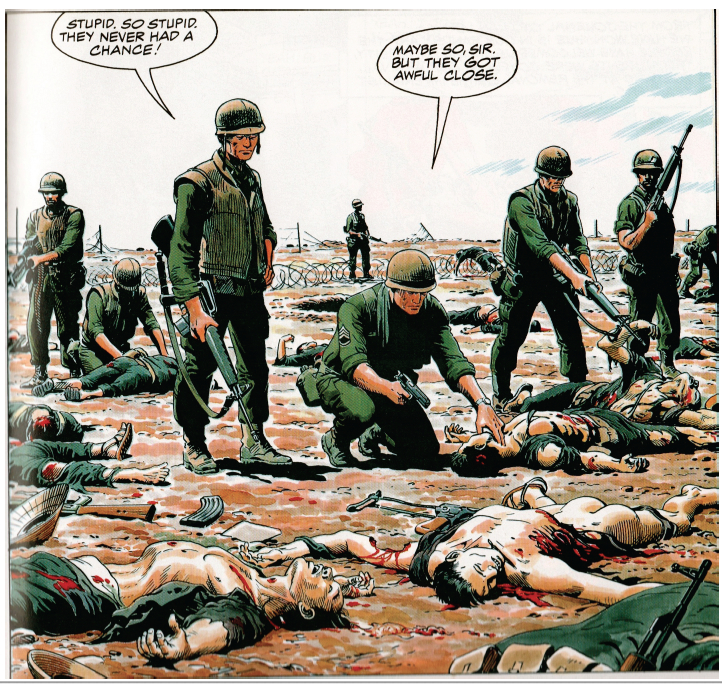
Throughout my analysis, I will revisit this image in order to touch upon the overlooked meanings that color specifically reveals.

Color magnifies important details that forward the cartoon’s claim. Though images may appear more realistic, the purpose of color remains for graphics to appear more simplistic. Noting the simplicity of cartoons, McCloud emphasizes that, overall, cartooning is a form of “amplification through simplification” (30). Comics pride themselves in exaggeration, which empowers a point rather than detracts from it. In this sense, color is yet another mouth for exaggeration. Heath’s image exhibits excessive exaggeration due to the use of color. Studying certain features of Heath’s panel, readers must digest uncomfortable truths that the artist is emphasizing. For instance, the two Vietnamese corpses expose gruesome depictions to readers.
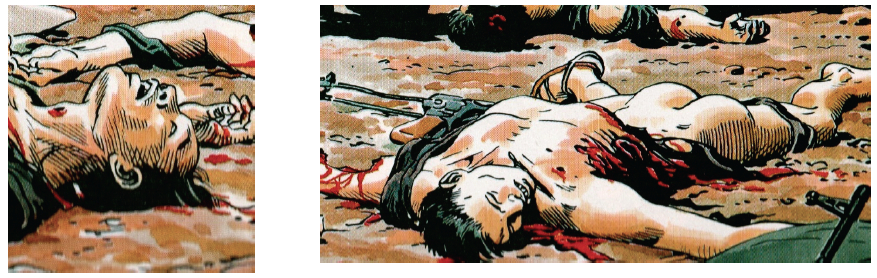
In the first image, color contrasts the white bone protruding from the dead man’s neck from the background. Clean and crisp, this bone appears as though it is out of place. Looking as though it were a plastic piece in the board game Operation, the bone could easily slide back into the dead man’s body. Though, in reality, this bone would be muddled with blood and dirt rather than in this immaculate condition. Instead of showcasing visual reality, color emphasizes a statement: Another man’s bullet pierced a bone through another man’s throat. The same argument is displayed in the second image. Here, color bolds the blood that pours from the man’s dislocated torso. Yet this blood is pure red. In reality, such blood would not beam from a corpse; it would be dirtied and dried. Color again simplifies reality, highlighting to readers what happens during war.
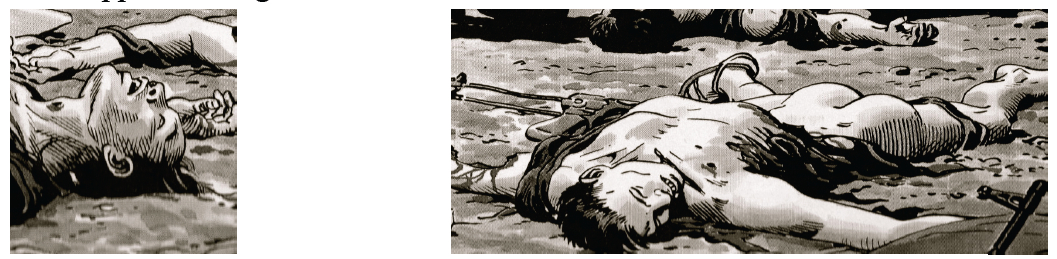
When the same images are displayed in black and white, such an effect is lost. Though readers may understand that the two men are dead, they do not see death’s marks etched in the corpses. The bone is barely visible, and the blood blends with the shading. The colored images are blatant to readers, who inherently understand what each detail represents. Such a technique attests to McCloud’s claim about drawing style: “By stripping down an image to its essential ‘meaning,’ an artist can amplify that meaning in a way that realistic art can’t” (30). Heath’s color truly “strips down” the panel to its bare essentials.

By simplifying a panel to its bare essentials, Heath presents color as an icon. As McCloud defines the term, an icon is an image that represents a person, place, thing, or idea (27). Cartoonists rely on icons to transmit a clear and obvious message to readers. In the case of this panel, the clearest example of an icon is the color red, which represents blood. Readers immediately connect the image of blood with its more powerful meaning: carnage. Heath chooses to depict such carnage through the visual device of an icon, and such an icon is displayed through color.

Beyond functioning as an icon, color breaks the flow of sequential art, emphasizing the subject matter of an image rather than the panel transitions on the page. Referring to the purposeful placement of juxtaposed panels, sequential art stresses the movement from one panel to the next, which, in turn, unconsciously forwards the plot. Looked at as an abridged filmstrip, sequential art carries readers from one important scene to the next. Yet, color seemingly cuts this artificial current.
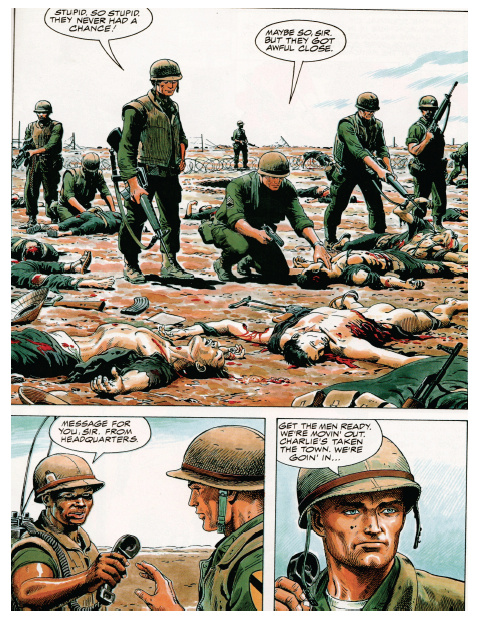
The selected image comes from a page with three separate panels. Despite the wholeness of the story, color slows the sequential flow of these transitions. The first panel encompasses over a half of the page, warranting some sort of inherent importance in its size. Obviously, the artist wants readers to not only look at this image, but to study it in detail. Despite its size, readers may easily browse from one panel to the next. However, Heath installs color to prevent such an easy transition. After reading this page in its entirety, readers are inclined to revisit the first panel due to its colorful graphic content. The secret to such a phenomenon lies in the highlighter-like quality of color.

For example, moving left to right in the first panel, the focus shifts from the line of soldiers to the sprawl of bloodied corpses. Bold outlines of blood and flesh segment each corpse from the next, hinting that each image has a different story to tell. In fact, each body could be a separate panel. In the panel, four separate Vietnamese bodies are macabrely drawn: An American soldier tests the pulse of a clearly lifeless Vietnamese shell; another American soldier picks at a mangled corpse with his gun; and the final two corpses, torn and shattered, lay brutally close to the reader at the front of the panel. Subject-to-subject transitions would individually highlight each corpse and its features; yet, Heath decides to include multiple scenes in one panel, separating them by color. By choosing this method, color simplifies four possible panels (one panel for each corpse) and gift-wraps them for the reader. Realistically, each corpse deserves its own panel in order to communicate its graphic content, but color simplifies such reality into a single cartoonish image.

By segmenting sequential art, color also simplifies the significance of McCloud’s illustrious gutter. McCloud defines the gutter as the space between panels where closure occurs in reader’s minds. Through closure, McCloud suggests that the message of the comic is conveyed to readers. Such a claim raises the possibility that closure could be misconstrued: Reader’s could interpret a different idea than the artist intended from the panels. Color counteracts such discrepancy. Creating its own sense of closure, color illustrates the artist’s message clearly to the reader. Revisiting the panel sequence, I have manipulated the colors to a black and white format.
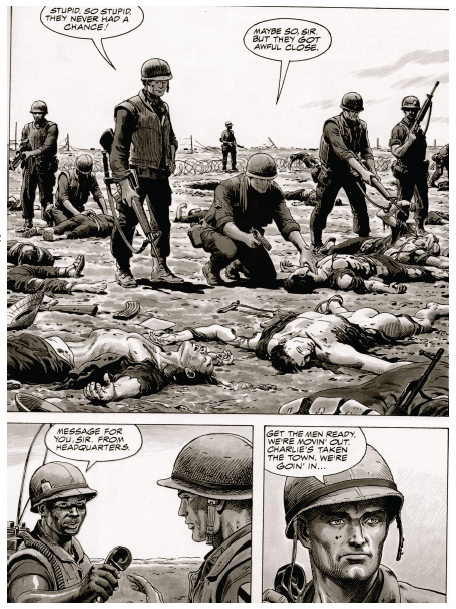
Reading the page, readers find that it is naturally much easier to follow the storyline in black and white. The first panel describes the recent conflict, and the gutter to the bottom left panel suggests to readers that such a massacre is a daily display for soldiers, as the sergeant plans to move out to another town. But, in color, such a transition is not so smooth. Color isolates the first panel, giving the gutter transition between the first and second panel a much different meaning. Studying the images in color, readers realize that the comic is exposing the absurdity of death through battles in war. The gutter seemingly empowers this statement, as it quickly introduces another future conflict that promises to be just as gruesome. Murray and Heath seem to be showing readers the horrifying realities of war. Graphic imagery, highlighted by color, communicates a “War as Hell” message to readers, who must digest an unnerving panel. Such closure can only be deduced when the panels appear in color. Without the red blood and displaced flesh, which are both only noticeable through color, the comic’s philanthropic message is lost in translation. Clarifying these important details, color simplifies Murray and Heath’s message. Rather than using words to communicate a difficult idea to readers, Murray and Heath rely on the simple but powerful effects of color.

Rather than making comics more realistic, color is highlighting the simple message of the images. Comic artists utilize color to highlight their ideas rather than bring them closer to reality. Magnifying minute details, colors strip down panels to their bare essentials, successfully forwarding the message of the artist. Manipulating the flow of sequential art, color simplifies complex depictions into a single panel. And, transforming the gutter, color clarifies a complex idea through universally understood graphics rather than confusing words. As viewed in a single page of Murray and Heath’s “Hearts and Minds,” a war related comic promises to introduce many ideas to readers. With so many themes floating throughout the comic, some sort of technique should aim to clarify and polish the author’s intended message. With that said, color in comics aims to simplify ideas so that readers better understand the artist’s message. Highlighting death and the absolute brutalities of war, color serves as a trail-marker for the artist, who only hopes to easily communicate some sort of message.

When an artist prepares to finalize his product, he must ask himself the color question: Could color simplify life more so than the comic already does? Heath’s artwork answers such a question. Indeed, even with color, simplification proves to be the root goal of comics. Color thereby is not so much an aesthetic choice to the artist as much as a literary tool.
Monthly Stumblings # 16: M. S. Bastian, Isabelle L.

Bastokalypse by M.S. Bastian and Isabelle L.

Is context everything? Maybe not, but it means a lot…

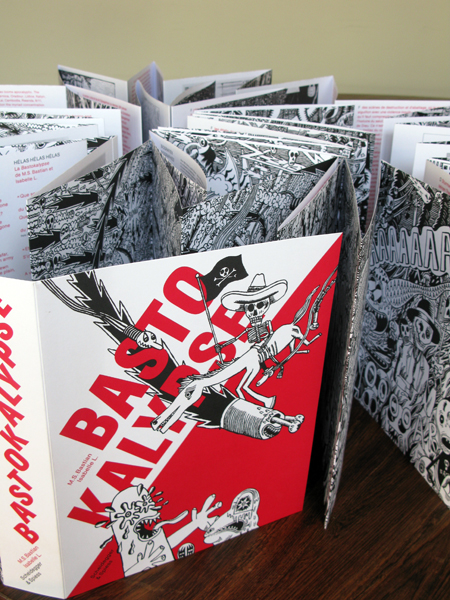
Simply put Bastokalypse is a book depicting genocide and war. So far so good (or not, of course… nothing is simple, as Sempé would put it…), the problem is that the authors, M. S. Bastian and Isabelle L., use the derisive ironic expression typical of comical comics as transformed by the Gary Panter, Mark Beyer ratty line aesthetic school (aka Art Brut).

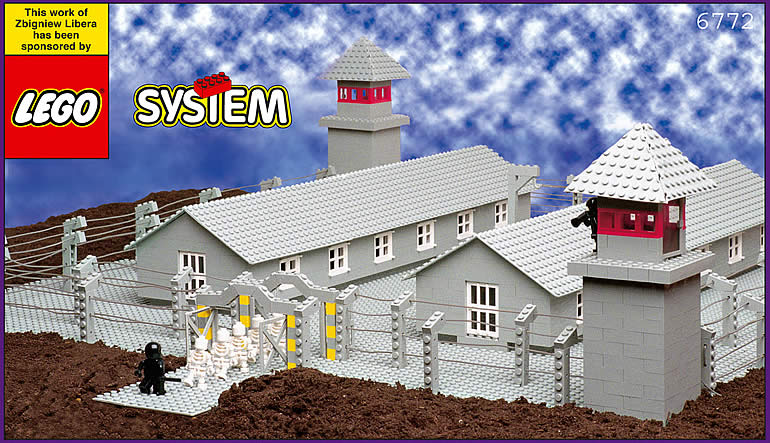
What’s the difference between Bastokalypse and Zbigniew Libera’s Lego Concentration Camp art piece, then? (The comparison is not mine: being a orihon, concertina bound book – see below -, Bastokalypse has a long drawn strip on one side and an essay about the iconography of violence by Konrad Tobler on the other; Libera’s toys are part of a long list of references summoned by Tobler; more about this later.)

Bastokalypse by M. S. Bastian and Isabelle L., Verlag Scheidegger & Spies, 2010.

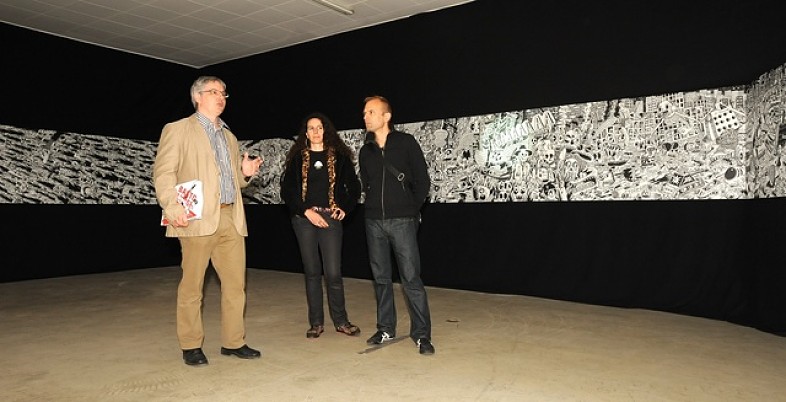
 From left to right: Goch Museum director Stephan Mann, Isabelle L., M. S. Bastian, 2010 (Bastokalypse is on display in the background). (See also here.)

 Zbigniew Libera’s Correcting Device: Lego Concentration Camp (1996).

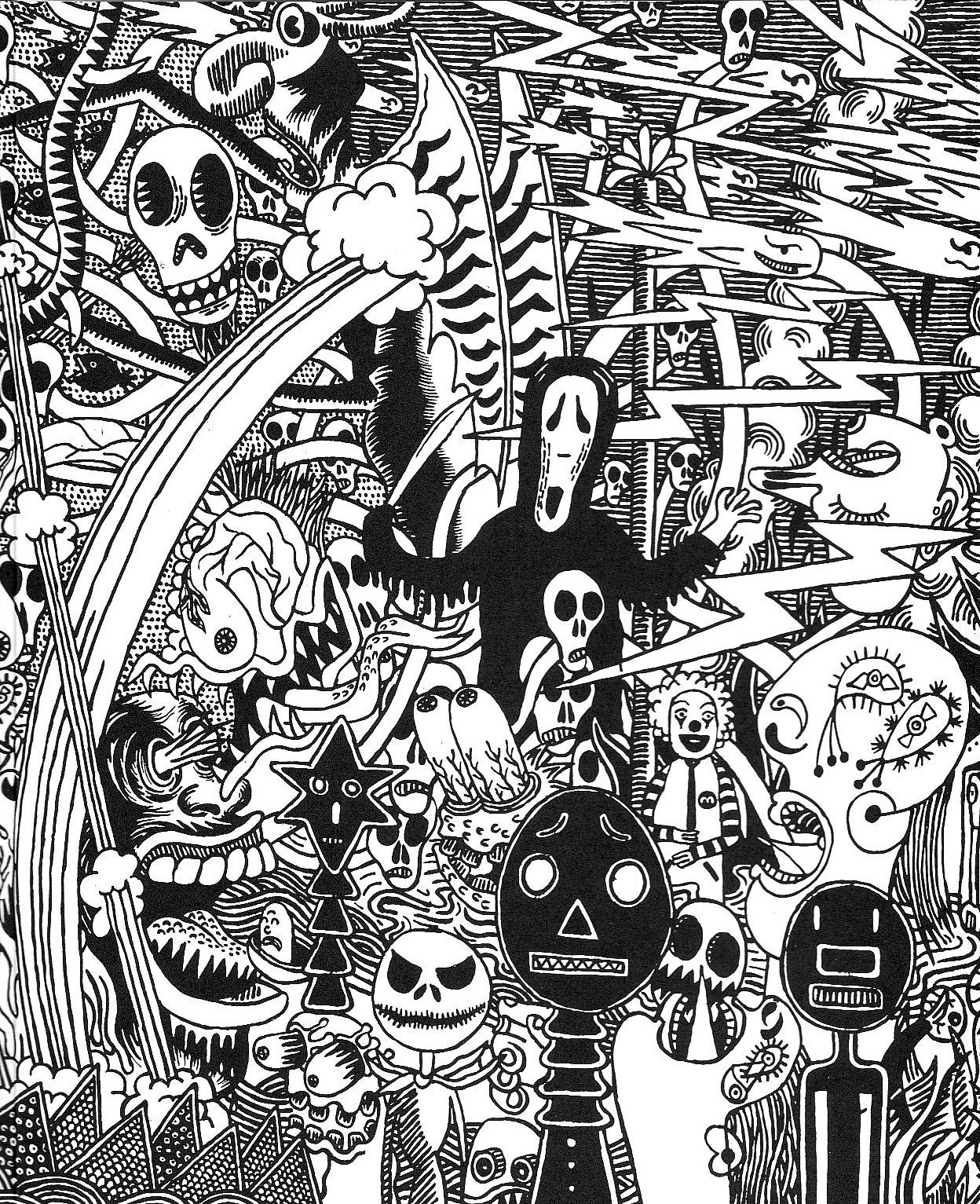
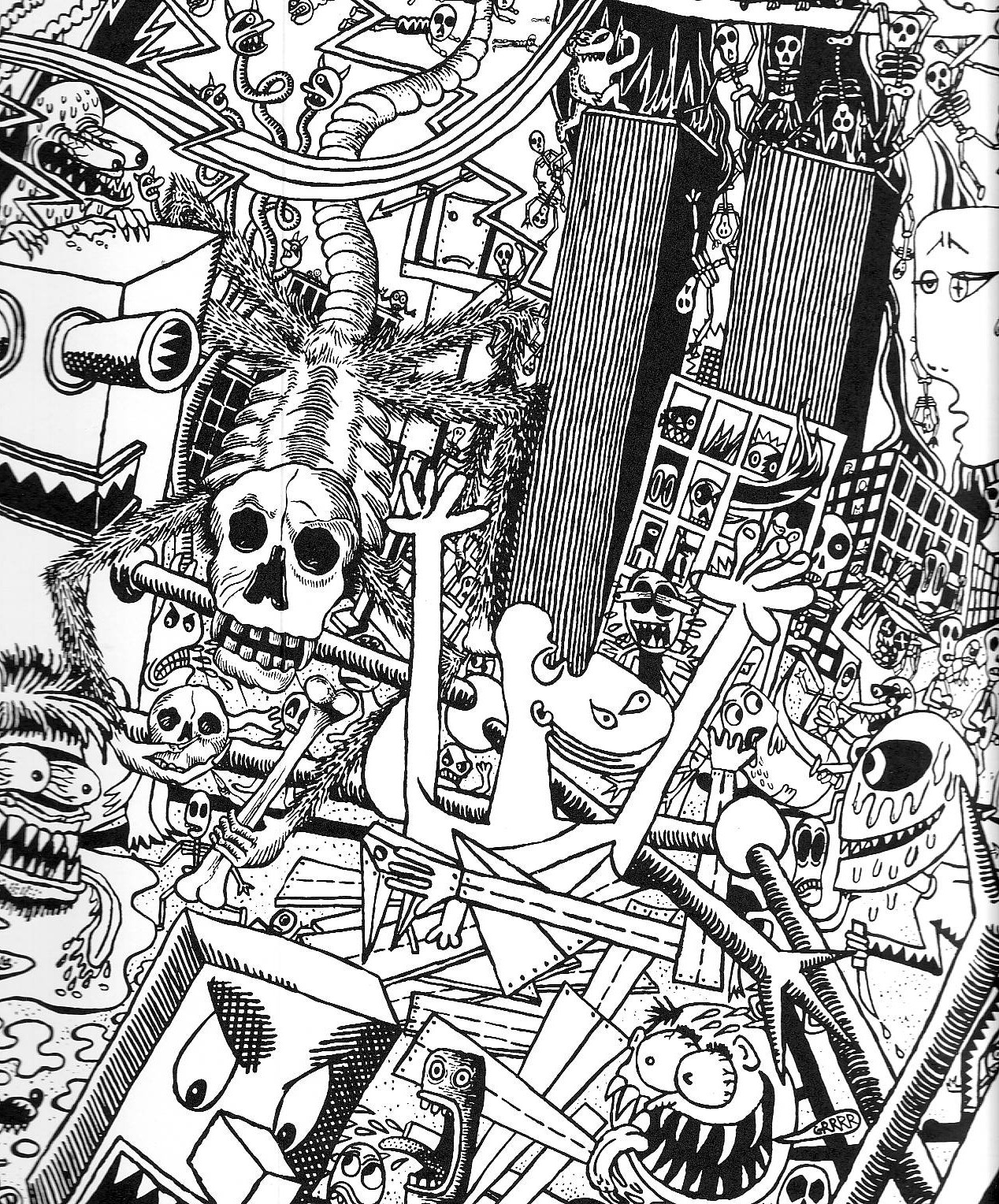
As a gallery comic Bastokalypse is a continuous sequence of black-and-white paintings: 32 canvases (3 ½ x 5 ½ feet each), forming a continuous 168 feet long drawn strip. The book has 32 action packed double-page spreads in baroque, claustrophobiac, horror vacui, nightmarish, compositions. Numerous cultural references  collapse the difference between high and low: from Ronald McDonald to Pablo Picasso’s Guernica, from Gary Panter’s Valise to Jacques Callot’s La Pendaison (The Hanging Tree) and Otto Dix’s Der Krieg (The War)…

Pablo Picasso, Mark Beyer, Ghost Face, Jack…

Picasso again, José Guadalupe Posada, 9/11.

On the other hand, here’s how Stephen C. Feinstein described Zbigniew Libera’s Correcting Device: Lego Concentration Camp:

Each unit of the seven-box set contained a different aspect of a concentration camp. The larger boxes showed the entire concentration camp, with buildings, gallows (one showing an inmate being hanged), and inmates behind barbed wire or marching in line in and out of the camp. An entry gate similar to the stylized “Arbeit Macht Frei” entry point at Oswiecim is included, although without the German inscription. The guards, in black shiny uniforms, came from the regular LEGO police sets. The inmates came from LEGO medical or hospital sets. A second box showed a crematoria belching smoke from three chimneys, with sonnderkammando [sic] or other inmates carrying a corpse from the gassing room. The smaller boxes depict a guard bludgeoning an inmate, medical experiments, another hanging, and a commandant, reminiscent of something more from the Soviet Gulag than the Nazi concentration camp system, as he is bedecked with medals and wears a red hat. Some faces on both inmates and guards are slightly manipulated with paint, to make mouth expressions turn down into sadness for the inmates, and upwards in some form of glee for the guards. The last box is one full of possessions, the type of debris painted by other artists and inspired by the vast array of loots collected by the S.S. in the Kanada warehouses at Birkenau.

Libera calls his Pop cum Conceptual Art projects (i. e.: toys) “Correcting Devices” because he supposedly wants to correct the wrong info given to children about the world. José Cardoso did a brilliant analysis (in Portuguese, though) of this particular Libera work. He did it using as theoretical framework the visual rhetoric findings of the Belgian mu group. He basically concludes that, with a few changes (the suppression of the vivid colors, typical of the Lego construction toys, for instance) Libera’s Lego Concentration Camp functions in the interpenetration rhetorical mode: two distant spaces meet in a third space where both may co-exist at the same time. This third space is constructed by the viewers according to their interpretation. Said rhetorical mode is often used to provoke laughter, for instance, in Monty Python’s famous Greek vs. German philosophers soccer match.

Interpenetration in Bastokalypse exists between all the aforementioned serious historical and cultural references and a tradition of comical caricature dating back to newspaper comics and animation during the first half of the 20th century.  This tradition was revived and transformed during the second half of the same century by the underground and alternative movements.

The way in which we represent the Shoah has been a matter of debate for decades, of course. Libera’s Correcting Device: Lego Concentration Camp was, as expected, polemical from the beginning. Stephen C. Feinstein:

During May 1997, Libera was invited to display his other pop art pieces in the Polish pavilion at the Venice Biennale, but was asked by Jan Stanislaw Wojciechowski, the curator, not to bring Lego. […]  He wound up withdrawing from the exhibition.

I don’t know the reasons why people found the Lego concentration camp offensive. Maybe they associate a toy with children’s puerile pleasure trivializing (and, in a way, mocking) the Holocaust? Anyway, nothing seems to shock people much these days. In more recent times a set was purchased by the Jewish Museum in New York and  the Museum of Modern Art in Warsaw acquired Libera’s concentration camp from a Norwegian art collector for $71,800. The consensus seems to be that Libera’s piece is a criticism of the manipulation of young people by educative systems. Also, the Lego connection is a criticism of corporate culture.

I’ll bring to the table another decisive factor, in my humble opinion, of course: Libera’s work is part of a high art tradition that legitimizes it and narrows the set of possible interpretations. In other words: it brings with it all the weight of what French sociologist Pierre Bourdieu called cultural capital.

Does Bastokalypse share the same privilege? The publishers and curators who support Isabelle L. and M. S. Bastian’s work surely try: galleries in Switzerland (Labo and Papier Gras) specialized in the exhibition and support of the comics avant-garde and graphic art in general function like other more mainstream gallery venues.  Konrad Tobler’s essay tries to give the work a theoretical frame that includes it among many illustrious and not so illustrious (in a post-modern mish-mash) forefathers.

Do they succeed? I’m not so sure. I, for one, view Bastokalypse as an interesting and impressive effort (ten years in the making), but also as a message that’s undermined by its own expression collapsing in the process. Is M. S. Bastian’s and Isabelle L.’s irony completely intended? If not, they delude themselves, if it is I can’t accept it. Call me square if you will or whatever, but I will say it just the same: in the name of the victims.  Comparing Bastokalypse with Francisco de Goya’s Los desastres de la guerra (The Disasters of War) or even with Jacques Tardi’s C’était la guerre de tranchées (It Was the War of the Trenches) doesn’t save it from being inconsistent (the comparison with Art Spiegelman’s Maus is more apt though: both books come from the same place; the difference is that Maus’ (in)expression is a lot more distanced). To end this post in a positive note: I don’t exactly dislike the Posadesque, dance of death, carnivalesque, derisive feel of it all. In the end we’re nothing: Bastokalypse blows up our feelings of self-importance. I may not exactly like it, but, with a few exceptions, that’s what comics have done best for decades…


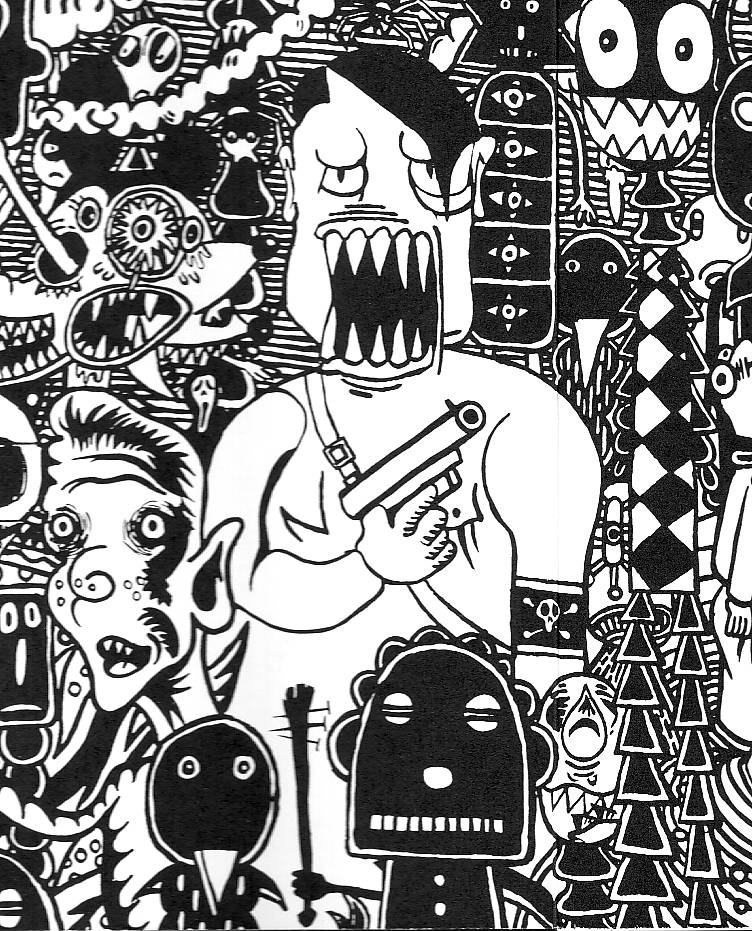
Adolph Hitler, Mark Beyer, a mutant Mickey Mouse, and one of Charles Burns’ goons (M. S. Bastian and Isabelle L. avoided the controversial depiction of the Shoah).

Rorschach, Superstar

A bit back, Sean Michael Robinson talked about a production of the Diary of Anne Frank that interpolated the music of the Carpenters. Sean noted that the production was wonderful, moving, inventive…and also illegal.

Anne Frank’s words, however, and the translation of her words on which we were relying for much of our text, were a different matter, as was the authorized play (Diary of Anne Frank), which provided much of the rest of the text. All of these elements are still under copyright, and will continue to be so for several years. (In fact, copyright in the theater is more restrictive than in almost any other field. You can, after all, read a book or listen to an album any way that you wish once you’ve purchased a copy–but to publicly perform a play one must conform to a dizzying array of limitations set out by the author or the author’s agents–usually, that every word of the play will be performed, i.e. no cuts or insertions without permission, and that the appearance, gender and even staging etc will honor the stated intentions of the author regarding the script and contract.)

Sean’s prescription — with which I agree, is that we need to rethink our insanely restrictive copyright laws in order to make it possible for people to reimagine older works, and create new ones, without having their asses sued off.

This does bring up a rather uncomfortable issue for me, though. Mainly…if I think that art is built out of other art, and that the copyright laws should reflect that, then what exactly is the deal with my recent article on Slate, where I discuss my deep disgust with DC’s Before Watchmen? After all, as Jones pointed out with his usual logician’s obsessiveness, Alan Moore has ripped off everybody from C.C. Beck to H.G. Wells, and probably other people whose names begin with A, X, Y, and Z as well. If I think high school kids should be able to mash up Anne Frank and the Carpenters, and I think that Alan Moore should be able to mash up Dorothy and Wendy and Alice (which is probably not the best word choice there, but onward), then what exactly is the problem with having DC put out a new! Watchmen! prequel! — or for that matter, a Watchmen toaster? Isn’t there some moral inconsistency here?

Possibly. But let me try to think through the differences.

— First, it’s useful to remember the purpose of copyright. According to our Constitution, the purpose is not to protect creators. The purpose is to encourage art. Copyright is supposed to give creators a monopoly on their own works so that they will have a financial incentive to create those works in the first place. If as soon as you write something, everybody else can publish it under their name, then you’re going to limit the people who will write to hobbyists who don’t need the money. (Not that there’s anything wrong with hobbyists, he says as he writes for free on his blog. The point is just that ideally you want to encourage other kinds of writing as well.)

However. Giving someone an infinite monopoly on their work also limits creation. It makes it hard to comment on older works, or to remix them, or to use them as inspiration for newer works. That’s why copyright is limited; so that works will eventually enter the public domain where they can be used by other artists with no strings attached to make things like League of Extraordinary Gentleman…or what have you.

The point is that there’s no particular contradiction between arguing that, on the one hand, Alan Moore is being screwed, or that, on the other hand, basing a work on Bram Stoker — or even on C.C. Beck — is okay. I’m personally in favor of a copyright of about 50 years from date of publication — which would mean Watchmen would still be under copyright, but that a lot of works Moore has lifted from would not be. A fifty year copyright would also put Anne Frank out of copyright…though not the Carpenters.

— Second, even when works are under copyright, I think there needs to be a vigorous fair use provision. Such provisions can include, for example, flat fees for using music (like the Carpenters) without giving the creator veto power over how or where that music is used (which, yes, would mean that idiotic republican presidential candidates could use Bruce Springsteen’s songs if they wanted even if the Boss objected. I think that’s a reasonable price to pay for a vigorous public domain, personally.) I also think that in situations where there is no profit, as in Harry Potter fan fiction, for example, most bets should be off.

Soooo…again, how is all of this different than DC publishing Before Watchmen…or than Marvel using Jack Kirby’s characters (which are certainly on the verge of my 50 year timetable) without paying him?

Which brings us to my last point.

—The issue with DC and Marvel is not that they are creating new work using somebody else’s characters. As I’ve suggested, artists do such things all the time; it’s a big part of how art is made. Without it, we wouldn’t have Shakespeare, much less Alan Moore.

So the issue with DC and Marvel isn’t use of the characters. The issue is, specifically, lousy business practices. Moore and Kirby never got to exploit the copyright for the characters they created; instead, Marvel and DC used crappy contacts, evil industry practices, and disproportions of power to gain the benefits of the law for themselves. So it’s not that Marvel and DC shouldn’t use those characters. It’s that they shouldn’t be able to reap a monopoly windfall for using those characters based on dubious business practices.

And, in a bitter but by no means isolated irony, the excessively insane draconian provisions of our copyright law mean that the creators are actually much more extensively screwed than they would be if copyright were reasonable. If copyright were only 50 years, Marvel would be in the process of losing its rights to its properties one by one — which would mean that anybody could make a Spider-Man movie or an Iron Man movie, which would make Marvel essentially worthless, which would mean it would go out of business — which wouldn’t benefit the Kirby family financially, of course. Still, you’d think his ghost would at least get a kick out of it.

In any case, the point is: the creators working on Before Watchmen are not despicable because they are using someone else’s art to make art, because that’s what all artists do. They’re despicable because they are knowingly helping DC exploit a monopoly that was obtained by fucking over the people who created it — and because one of those fucked over creators has verbally erected the equivalent of a picket line. Hughes, Straczynski, Cooke, et. al. are not thieves. They’re scabs. I hope that’s a comfort to them.
 

Odd Superheroine Out

This first ran on Comixology.
_____________________

Female super-heroes can be many things: Amazon warrior, out-of-control telepath, deadly ninja assassin. But whether in swimsuit, bodysuit, fishnets or boob window, they’re almost always cheesecake.

There’s no particular mystery as to why this is. Super-hero comics are male genre literature. Guys like to look at cheesecake. QED. There are some exceptions to the rule — but they’re usually built around genre exceptions as well. For example, the Claremont/Byrne X-Men made some effort to appeal to YA girl readers through the character of Kitty Pryde. Thus, Kitty got to mostly wear civies, rather than the skintight and/or improbably cut-out costumes that were the lot of her distaff teammates. (Not that the internets are above a certain amount of Kitty Pryde cheesecake of course.)

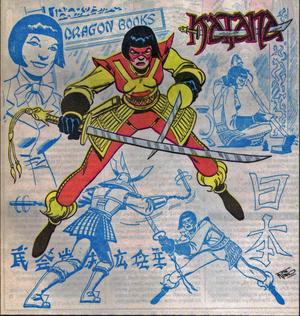
Still, there are a few inexplicable blips. Foremost among them, perhaps, is a minor DC early-80s super-hero who first appeard in Mike W. Barr and Jim Aparo’s Batman and the Outsiders. She was called Katana, and when Aparo drew her she looked, improbably, like this.

That’s a remarkably un-fetishy costume. She’s fully covered, and her blouse isn’t especially tight or revealing: no boob window here. Compared to her teammate Halo, who gets a standard curve-emphasizing form-fitting single piece, Katana seems distinctively to not have gotten dressed with the male reader in mind.

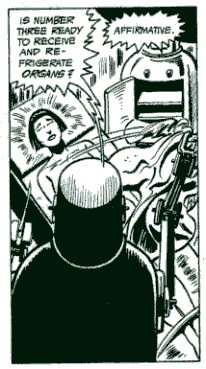
Throughout the series, too, Katana is basically never placed in cheesecake poses or situations. When she gets captured and tied up, for example, there’s none of the bondage imagery you get throughout Wonder Woman’s history. Instead, Katana (or Tatsu, since she’s out of costume in this sequence) is wearing a dowdy hospital gown. She does get stripped down later…but Jim Aparo makes sure we see almost nothing; just a head and shoulders shot from a bizarre ceiling angle, making her look like a twelve-year old boy.

Part of this might be chalked up to Aparo’s particular style; he’s always been more interested in panel composition and shading than in cheesecake for its own sake. But writer Mike W. Barr also played a part in the character’s resolute unsexiness. Katana played the part in the Outsiders that Wolverine played in the X-Men; she’s the bloodthirsty killer with the sharp pointy object, always wanting to dash into danger and slaughter something. While men like Wolverine who play that role are generally just aggressive, the standard script is for women of that type to also be sexually aggressive — a la Elektra, or really anyone else that Frank Miller has ever written. The fact that Katana is Japanese only makes the clichés all the more inevitable; she should be a dragon lady.

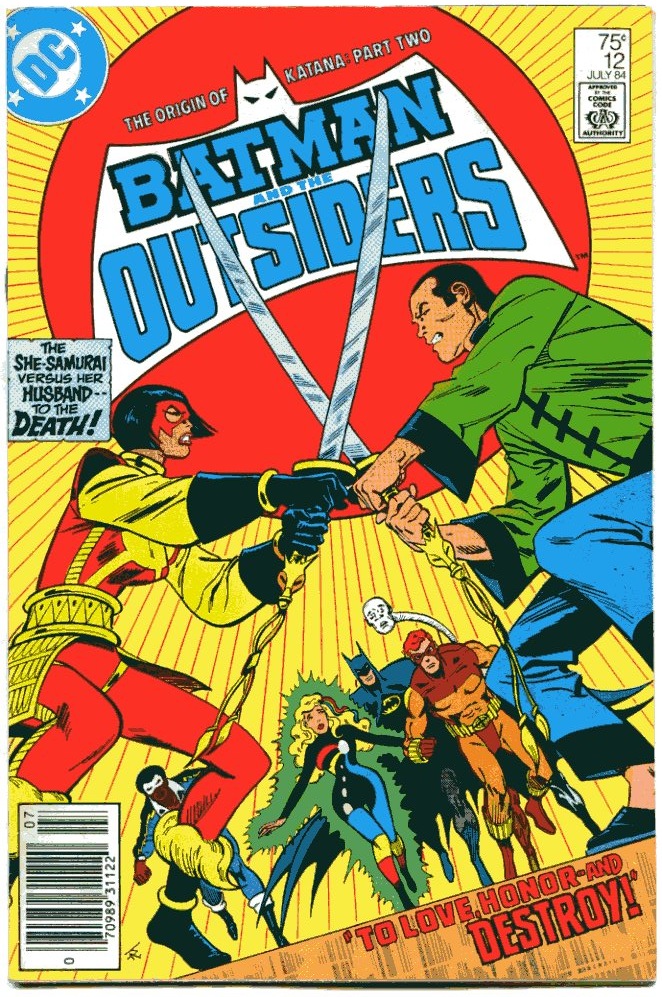
But she isn’t. True, she is, somewhat wearisomely, a samurai, since any superhero from Japan has to be either a samurai or a ninja. But she isn’t at all a sexual fantasy. On the contrary, Barr writes her not as a sexual predator, but as a mother. Her tragic backstory involved the death of her husband and two kids, and her closest relationship in the Outsiders is with the amnesiac, innocent Halo, who Katana treats very much as a daughter — going so far as to become her legal guardian. At least through the first couple of years of stories, Katana, still grieving her husband, has no romantic interest at all. In fact, in the two-part origin revelation where Katana’s husband comes back from the dead, Katana actually re-kills him herself in order to prevent him from hurting Halo. The ridiculous vicissitudes of the plot aren’t really worth describing in detail; the point is, Barr goes out of his way to make sure the reader understands that Katana’s primary emotional commitment is to her surrogate daughter first; any men in her life are decidedly secondary.

So, both narratively and visually, Katana deliberately denied the fanboys the flirty cheesecake they wanted. How did they respond?

As near as I can tell, they liked her fine. As everyone from Han Solo to Wolverine has demonstrated, a tinge of amorality does wonders for a hero’s popularity; Katana’s willingness to occasionally kill people certainly didn’t hurt her standing.In fact, in the letter columns, she quickly became a favorite figure; Mike W. Barr would often answer mail as Katana, threatening to show various letter-hacks their own lungs and/or other bits. Here, for example, she’s responding to Mr. Peckham, a correspondent who initially thought Katana was too much like Elektra, but then provisionally changed his mind.

“Dear Michael:
Tell Mr. Peckham he may rest easy, at least “for a few more issues.” When he arrives at a final verdict as to my role as Katana, I will arrive at a final verdict as to the disposition of his internal organs. Perhaps the next two issues will influence him favorably. In the meantime, it might be wise to lay in a supply of paper towels and sponges. Yours, Tatsu.”

Despite the positive fan reaction, though, Katana never became a major DC heroine. This was probably mostly due to the fact Barr’s letter-column joshing was by far the best writing he did for the series. His actual scripts were watered down versions of the Wolfman/Perez watered down Clarmeont/Byrne X-Men — and, of course, the Claremont/Byrne X-Men were not unwatery to begin with. Batman and the Outsiders was an uninspired teen book melodrama, stuffed with unmemorable villain teams, stiff character interactions, and final page plot twists that didn’t so much twist as sit there blinking feebly in the wan revelatory half-light. Jim Aparo’s art is always worth looking at…but eventually he backed out for a number of less engaging artists, and then there was really no reason to think about the series, much less read it. The Showcase reprint volume is a massive testament to the fact that DC is willing to reprint any damn thing in a Showcase reprint volume.

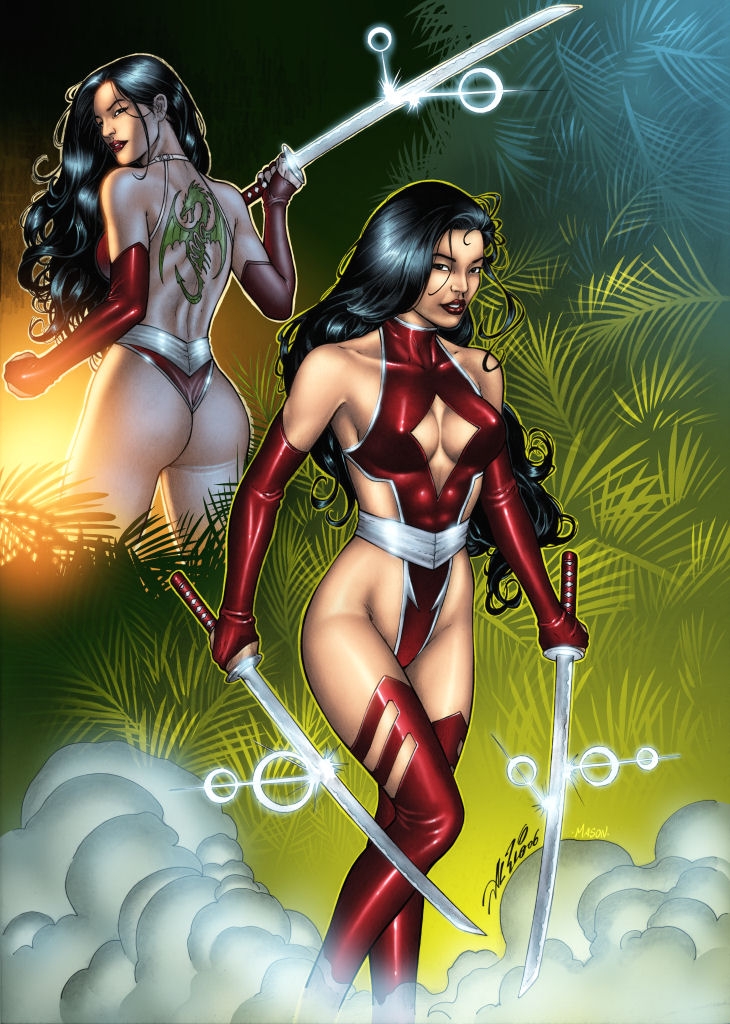
Katana still pops up on occasion — often with a costume redesigned for slightly more va-va-voom. Stil, that hasn’t made her a marquee character. On the contrary, and counterintuitively, she was most successful at the beginning of her run, when, perhaps through an accidental oversight, she looked nothing like a pin-up.

Al Rio reimagines Katana as fanboy wet dream.

The Origin of Roy Lichtenstein

In comics circles, Roy Lichtenstein is often condemned as a no-talent snob who condescended to comics artists even as he made millions by ripping them off. R. C. Baker in a takedown from last year, for example,not only nails Lichetenstein for his knee-jerk dismissal of his sources, but even sneers at him for his compositions, claiming that Lichtenstein’s “flabby lines, blunt colors, and graceless designs are invariably less dynamic than the workaday realism of the comic pros.” Lichtenstein took the vital, outsider pulp energy of comics and flattened it out into flaccid high-brow capitalist dreck. Rather than elevating commercial product into art, he turned art into commercial product.

This criticism, obviously, doesn’t erase the high-art/low-art binary so much as it flips it. High-good/low-bad becomes high-bad/low-good. Lichtenstein may be a transformative genius or a parasitic hack, but either way he’s defined through his relationship to something else; the thing that is not high art which he is blessing or debasing.

Seeing the current Lichtenstein retrospective at the Art Institute of Chicago calls that narrative into question in some interesting ways. Mainly, the show makes it clear that Lichtenstein didn’t copy pulp because it was pulp. He copied pulp because he copied everything. From his early AbEx experiments which look more like half-hearted imitations of AbEX than like the real thing; to his lifetime of imitating other high art painters from Picasso to Matisse; to a series of bizarre Chinese landscape images which include, for no apparent reason, Lichtenstein’s famous imitation Ben-Day dots; to a series of drawings of his own studio in which Lichtenstein imitates his own most famous imitations — the man was a compulsive aesthetic magpie.

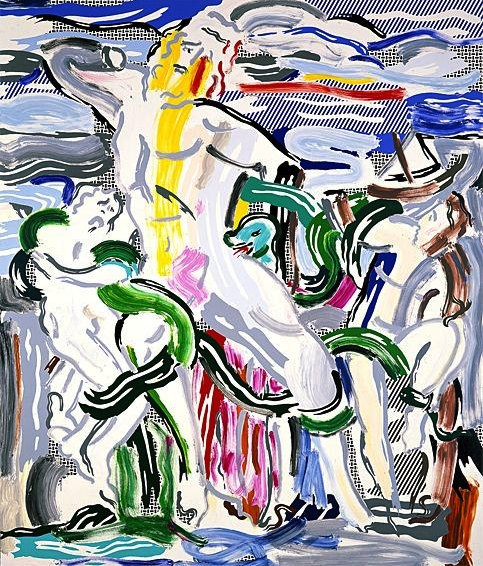
Moreover, the way he treated his non-pulp sources was in many ways similar to the ways in which he treated his pulp sources. For instance, here’s his version of the Laocoon:


I’m not sure that this really comes across in the reproduction, but in the massive original, there’s a stark contrast between the flat moire patterns Lichtenstein uses in the background and the AbExy swoops of paint that define the figures. Lichtenstein also, of course, obscures the characters’ expressions and blurs the narrative action. Some of the energy and pathos of the original are retained, but only in a deadened form. The emotion is presented as thin; a few slashes of paint against a surface that asserts itself precisely as patterned, meaningless surface.

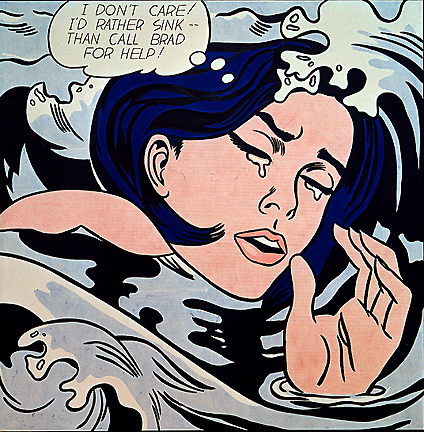
Of course, this is what happens in Lichtenstein’s comics, too. The romance and war panels are lifted out of their narratives. The larger than life emotions end up as merely transparent, flat signs of “larger than life emotions”.


Like Laocoon, the drowning victim here is abstracted from her predicament and inflated; the energy, concentrated and expanded, collapses under its own weight. The panel is just its surface, there is no Brad outside it, and the only thing to do (for good and ill) is to sink.

I think the usual way to read this is as a playful satire of authenticity; a repetition which parodies the original and mocks its melodrama. Often this is seen as a mockery of comics or pulp in particular, but pieces like Lichtenstein’s Laocoon suggest that his target is not so limited. Rather, he seems to be sneering at sincerity and vitality itself — not at melodrama per se, but at emotion. Whether low art romance comics or high art tragedy, both point to depths, and are therefore ridiculous.

I’m sure there’s some truth to that reading…but it’s not necessarily how I see what Lichtenstein’s doing. Rather, at least for me, his work is suffused not so much with contempt as with a kind of etiolated longing. Surely there’s something almost quixotic in those Ben-Day dots; the painstaking hand-crafted effort to replicate the incidental byproduct of mass production. It’s as if Lichtenstein is trying not to ridicule the melodrama, but rather to reclaim it. the replication in this reading is not playful mockery but compulsive failure. He’s trying to frame that originary energy, and is condemned to keep trying and trying until he succeeds, which he never can.

My wife, who is a Lichtenstein skeptic, commented that he’d just had one idea, and it wasn’t all that great an idea, and he’d just kept at it with a numbing regularity. There’s definitely truth to that, and you certainly can see his inability to bottle the energy he alternately/simultaneously mocks and covets as related to his own aesthetic limitations.

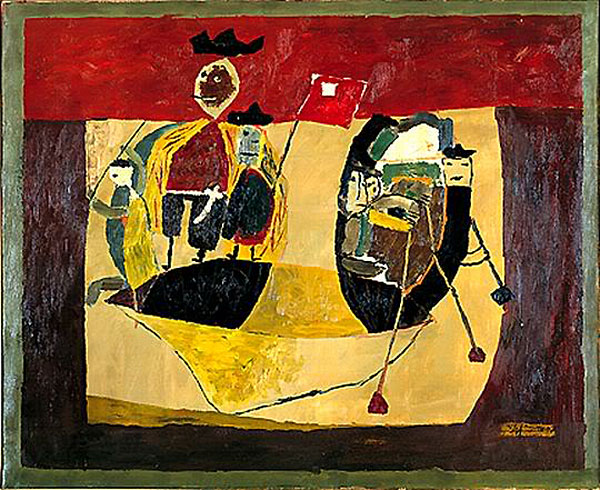
You can also see it, though, as part and parcel of the historical moment Lichtenstein was in…and which we’re still in, to a large extent. Late capitalism is not an ideology that cares much about origin myths. Social authority doesn’t come from the divine right of kings, but from the repetitive images of value and community that circulate endlessly without any necessary prototype. Even the Founding Fathers are little more than a subcultural marketing trope at this stage; George Washington is just a cutesy infantilized placemat distributed for fun and profit. Which, not coincindentally, is what Lichtenstein’s version of George Washington crossing the Delaware looks like.


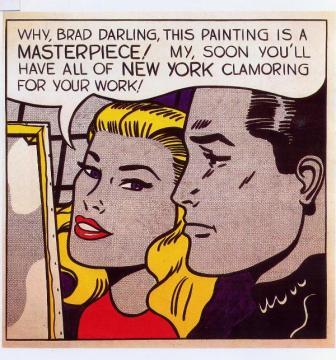
Lichtenstein is obviously a beneficiary and an exploiter of post-modernism…but he also can be seen, perhaps, as a victim of it. Imitation isn’t necessarily flattery, but it almost always has something to do with desire. When he has one of his cartoon women declare , “Why Brad, darling, this painting is a masterpiece!” it may be a sneer at pulp’s idea of high art, but it also seems like a nostalgia for that instantly recognizable work of genius, which that character, and that comic, may believe in, and so perhaps achieve — but which Lichtenstein himself can only wish for.


It’s tempting to see Brad’s sad frowny face as self-portrait; a depiction of that distance and that distress. But of course Lichtenstein is never in his paintings. At best, he’s on the surface.
___________

Folks may also want to check out Kailyn Kent’s recent discussion of Lichtenstein. Scroll down for numerous comments.

Respect my Hobby!

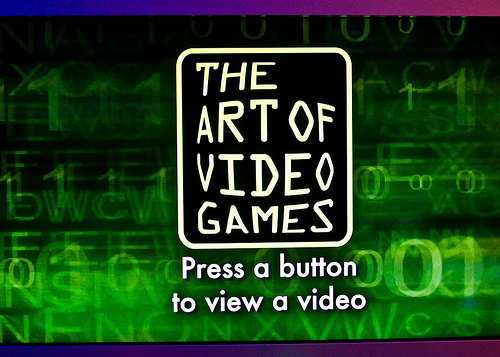
A few weeks ago I visited The Art of Video Games exhibition at the Smithsonian American Art Museum in Washington, D.C. The exhibition is relatively small, and if you don’t stop to play any games you can easily walk through all the rooms in about half an hour. It’s divided into three main sections: an introductory area, an “arcade” area where visitors can play famous games such as Pac-Man and Super Mario Bros., and a “best of” area where various gaming devices (consoles, PCs, etc) were on display along with video samples of well-regarded games. It was also completely free, which is the right price for me.

Setting aside the particulars, the basic idea of video games in an art museum is an odd one. Paintings and sculpture are designed to be viewed, but games are meant to be played (preferably while seated in a comfy chair). While the “arcade” section makes a certain amount of sense, the rest of the exhibition involves looking at games rather than actually playing them. The traditional manner of museum display (look but don’t touch) is inappropriate for the medium.

But a more significant problem is that the exhibitors never show how video games are art. To be fair, “art” is difficult to define even when discussing a more established medium. However, common definitions of art usually mention creativity, the unique expression of an idea, or an aesthetic accomplishment above mere craft. How does something like Pac-Man qualify as art? It was certainly unique when first released, but is there any underlying idea beyond cute ghosts and a chomping circles? How is Pac-Man more than mere craft? I suppose if you define art in the broadest possible terms – including Michael Bay movies, talk shows, and Superman dolls – then there’s no reason not to accept Pac-Man as well. But if art is simply a synonym for entertainment, then the entire exhibition is nothing but pretense. Displaying video games in an art museum is clearly a statement that video games are on par with the fine arts that usually appear in museums or galleries. But if any amusing diversion can qualify as art, then the only reason to put it in a museum is the “snob factor.” It’s in a museum/gallery, therefore it’s respectable.

On a more favorable note, the strongest feature of the exhibition is the evolution of graphics and visual design, with numerous examples from each decade. One of the earliest games, Pong (1972), is nothing more than a white square on a black background that bounces between two white lines on opposite sides of a television screen. Flash-forward to 2010, and games like Mass Effect 2 sport cutting-edge graphics, 3-dimensional environments, and a visual design that rivals any sci-fi blockbuster. The technological progress that allows for flashier visuals also allows for a full musical score and voice actors. While the exhibitors no doubt want to draw attention to the increasing sophistication of gaming narratives, that sophistication would not be possible without technological breakthroughs. In fact, no other entertainment medium has experienced such radical change in such a short time, and that was all driven by improvements in computing technology (film experienced several technological leaps, such as synchronized sound and the switch to color, but these changes were spread across a century, and many other aspects of filmmaking have changed little).

And yet the  actual  technology of gaming is mostly absent from the exhibition. There’s a small exhibit that explains some technical terms like the difference between 16-bit and 64-bit, but the attendees are never allowed to “look under the hood.” The wires, chips, processors, hard drives, and other do-dads are not on display. There are obvious reasons why this is the case. After all, this is an exhibition in an art museum, not a science and technology museum. But the science cannot be easily separated from the art (if we’re willing to call it that), so the exhibition feels incomplete.

The Art of Video Games exhibition reminds me of the similar effort by comic professionals to gain academic and institutional respectability. Comics have largely been successful in this regard, and scholars now refer to the medium as art without rolling their eyes.  Perhaps video games will find equal success, though it probably won’t happen any time soon. When comic creators made their bid for respectability they could at least point to a few works that were acclaimed by critics from outside the comics community (Maus, Jimmy Corrigan, and classic strips such as Peanuts). By comparison, few critics outside the insular gaming community speak of Pac-Man with reverence. And even the best video games are little more than addictive diversions (Angry Birds, Tetris) or solid genre product (Mass Effect, Grand Theft Auto).

But then again, who am I to argue with the Smithsonian? If they say shooting zombies in 1080p resolution qualifies as art, then I’ll go along with it. I’m an art lover.

The Sun Also Sits There

This first appeared on Comixology.
__________________

Ernest Hemingway is one of those writers I return to again and again, and each time I like him less. When I was an adolescent, I found the strong, silent protagonists mouthing stark declaratives profound, or at least engaging. The older I got, though, the less patience I had for the tired modernist schtick. “I cannot say what I feel. But it is deep. And potent. And involves fishing.” Yeah, whatever jack. I prefer authors who have thoughts complicated enough to require the occasional dependent clause, so I’ll be over here reading Jane Austen, if that’s okay with you.

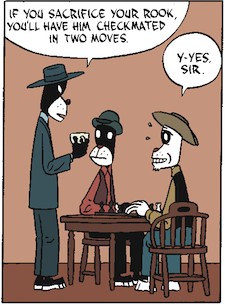
I certainly prefer Norwegian cartoonist Jason to Hemingway. For one thing, Jason doesn’t hate women, as far as I can tell. And for another, his new book of short graphic stories, Low Moon, has a bunch of clever touches that made me chuckle out loud. The story “Proto Film Noir,” for example, is “proto” because it’s about sexual jealousy and betrayal amongst cavemen (or cave-anthropomorphic –animals, to be more precise.) “Low Moon” features wild west desperadoes who settle their differences not by dueling, but by playing chess.

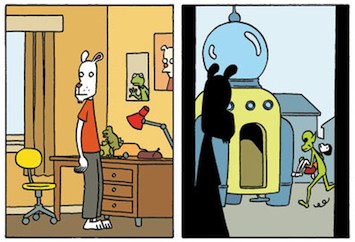
Still, it’s no accident that Ernest shows up as a character in one of Jason’s earlier graphic novels — the two definitely share some avant-garde common ground. Jason’s graphic style has a Hemingwayesque flatness. His animal protagonists lack both pupils and varied expressions; they’re all indistinguishably deadpan, all the time. The style overall is an approximation of Herge’s clear-line approach, but without Tin-Tin‘s detail or fantastic settings. Most of the backgrounds here are skillfully rendered, but sparse; some bushes, a horizon line, or, often, just a primary color. Even the flora of an alien land, in Jason’s hands, seems determinedly matter-of-fact; a space-flower is drawn as a simple, almost unadorned circle, which spits out plain, sperm-shaped seeds in a ragged, unassuming burst. One of Jason’s usual expressionless characters watches it — well, expressionlessly.

As this indicates, Jason’s stories, like his pictures, are resolutely stripped of filigree. There’s no text boxes, and often not a lot of words. Open to any page and you’re likely to find some blank-faced animal staring meaningfully at something or other. The narratives unfold with a bleak, unexplicated inevitability. In “Emily Says Hello,” a hit man reports to his female employer on a series of successful murders, in return for which he receives an escalating series of sexual favors. Then things end badly. In “Proto Film Noir,” guy and gal meet, fuck, and kill gal’s husband…repeatedly, because he keeps coming back form the dead to have breakfast. Then things end badly. In “You Are Here,” a woman is abducted by aliens; her husband spends the rest of his life building a spaceship while her son grows up, gets married, gets divorced, and eventually joins his dad seeking her in the vastness of space. Then things end badly. And also poignantly.

There’s no questioning Jason’s skill as a cartoonist; the seamless ease with which time telescopes in “You Are Here” is both lovely and impressive. Yet that mastery can also be alienating. My least favorite story is the most formally complicated: the cutely named “&”. It involves two narratives. In the first (on the left-hand pages) a man’s mother is dying. He has to pay for an operation, so he performs a bumbled, slaptick burglary, finally gets the money for the operation…and his mom dies anyway. In the second (on the right hand pages) a guy proposes to a woman, discovers she has another fiancée, and kills him. Then she gets another fiancée, and our anti-hero kills him too. And so forth, until she agrees to marry the anti-hero…but hangs herself on their wedding night. The last panel of the comic is the bereaved son and the bereaved husband sitting at a bar, where they exchange the requisite empty glance.

And, indeed, that’s where all the stories seem to end. In silence, gazing at the black absurdity of life. The smooth, empty surface is meant to evoke a deep profundity. But is it deep to reflexively gesture towards the modernist emptiness? Or is it just glib? Silence can contain meaning, certainly, but when it’s the same silence and the same meaning, it starts to get a little tiresome. Hemingway and Jason are laconic, in other words, not because they have a lot to say, but because they don’t.