I Flicker Therefore I Am

This article first appeared at Splice Today.
_________________________

A substantial portion of Descartes’ Discourse on Method is devoted to explaining why discussing his ideas with other thinkers would be useless. Instead, he concludes, his interlocutors could best contribute to the advancement of knowledge not by talking to him, but by “contributing to defray the expenses of the experiments that might be necessary.” Don’t criticize; just send money.

Which just goes to demonstrate that, from the beginning of modern Western philosophy, philosophers have not held a very high opinion of criticism, language, or philosophy. Descartes denigrated philosophical discourse in favor of experiments; Kierkegaard denigrated it in favor of faith; and now John Mullarkey denigrates it in favor of film.

Continue reading

There’s zombies in my yarn

Intro

A couple of years ago, I was in a van full of librarians, being whisked in air conditioned splendor to the convention hall at ALA. I got to talking to my seatmate, a public librarian, and she told me that the most interesting thing she’d heard so far was that zombies were going to be the next vampires.

(Proving yet again that librarians know everything.)

I frowned at her and said something like ‘No way’, and she said something like ‘I know, hard to believe but it’s coming’, and we went our separate ways, each armed with logoed bags to pick up enough sample books in the hall to weigh down a small truck. (ALA has so many sample books for free that they set up special mailing-home stations so people don’t have to keep hauling the books around; unfortunately, I didn’t notice these until later, so I only got two boxes worth of books.)

A small incident in a professional context, two years ago, but I was thinking of it recently as I was discussing some comics.

I’ve never been a big fan of scary horror. I enjoy the occasional foray into serious horror, as a genre, but mostly I prefer comedic horror. I only saw the Shining by accident. A roommate told me it was funny and talked me into going to see it on the big screen for a dollar. By the end, I was huddled under a coat, levitating with panic, jumping at noises and peering through my fingers. Funny my ass. (Bitter? Me? Never!)

But I loved Evil Dead, and I’ve seen not only Blacula, but Blacula 2 (bka Scream Blacula Scream), and all of the movies with the plucky German Shepherds who turn into vampire dogs (hey, it’s a mini genre, and they have cute ears, don’t judge me OK). I also enjoyed the early Anita Blake books, which were rather comedic in their zippy, plotty way, and I even sat through Howling: New Moon Rising, although I demanded that my hosts supply me with spirituous liquors if they were going to continue to subject me to it.

So I should be an ideal candidate to jump on the zombie train.

Except….

I’m burned out already.
Continue reading

One-Panelist Criticism: Likewise

If you’ve seen the tcj.com homepage recently, you know that we’ve been joined here by a spanking new blog called The Panelists, featuring Derik Badman, Charles Hatfield, Jared Gardner, Alex Boney, Craig Fischer and Isaac Cates (my apologies if I forgot anyone!)

To kick off their blog, The Panelists are doing a round-robin where each of them look at one panel from a comic of their choosing. It seemed like a fun idea, so I thought I’d flagrantly rip them off participate as well in the friendly spirit of interblog amity.

So here we go.

Continue reading

Form, Fetish, and Diastrophism

In our blog roundtable on Charles Hatfield’s Alternative Comics there was much discussion of Gilbert Hernandez’s Human Diastrophism. At the time of the roundtable, neither Caroline Small nor I had read the entire work. So we decided to do so, and then talk about it. Page references are to the 2007 Fantagraphics edition.
_______________________________________

Noah: So one of the discussions we had in the roundtable with Charles Hatfield was about the use of fetishization in Hernandez’s work. And after reading this book, I have to say that I”m more than ever convinced that fetishization is just absolutely central to his comics in a way which I often find both ugly and hypocritical.

As I said before, the fetishization is sometimes worked through in terms of pin-up art; the Dan DeCarlo zaftig curves on Luba, or Pipo or Tonantzin’s perfect proportions. But I think it touches all of his female characters. The cornucopia of body types he presents (tiny Carmen, body-builder Diana, va-va-voom Doralist) or his obsession with imperfections (characters without arms, or with scarring) — there’s just a very insistent emphasis on defining people by surfaces. And I think that ties in to the way Palomar works in general; it’s very much a world of surface; you very rarely get internal monologue or a sense of what’s happening inside character’s heads. Instead, you get caricature and theatrical gesture. And there’s also, as Charles pointed out in Alternative Comics, a insistent formalism — Hernandez leaping from time to time or character to character, fracturing the narrative so that you feel it as narrative construction. The result is for me that the characters don’t have independent life; that Hernandez is pushing them about the board hither and thither for his own amusement. All the frantic insistence on interconnectedness and infidelity and the wonderful variety of people and bodies — the point seems to be “Look at this wonderful web of life!” But to me it feels cynical and dead, the characters worn flat by his obsessive need to run his hands over them.

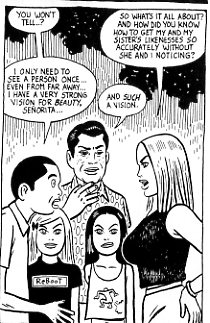
In that sense, there’s something queasily apropos about Humberto’s statues of all the townspeople sunk beneath the lake. In “Chelo’s Burden,” one of the later stories included in the “Human Diastrophism” Fantagraphics volume, Petra demands to know how Humberto can reproduce people if they haven’t sat for him, and he says he can instantly size people up. “I have a very strong vision for beauty, Senora” he explains, while his coconspirator Augustin agrees and checks out Petra’s chest. Basically, Humberto’s artistic process involves a facile empathy in the interest of creating a world of collectible, “beautiful” fetish objects. It’s condescending…and not the less so because Hernandez is also (perhaps self-reflexively) condescending to Humberto.

Continue reading

Jaime Hernandez for Sale

Early in 2010, The Art of Jaime Hernandez: The Secrets of Life and Death by Todd Hignite was published by well-known art book publisher Abrams. This monograph was beautifully designed, with page after page of original art, sketches, poster art, partially completed drawings, color guides and more. The text was incisive and sensitive. I suspect any comics artist would be thrilled to have a monograph like this one written about their work. I would love to see more books like this.

In addition to being a writer, Hignite is Consignment Director for Heritage Auctions. Heritage Auctions is an auction house based in Dallas, TX. It primarily sells work in internet auctions, although it does also have floor sales. To quote Heritage’s website, “Heritage Auction Galleries is the largest collectibles auctioneer and third largest auction house in the world. We are also the undisputed Internet leader in our field.” That field includes a lot of comics and comics art.

In the past, Heritage has been somewhat weak on alternative or underground comics. They seem to have been making an effort over the past year to correct this. There has been a good deal of high-quality underground comix artwork sold (including a lot of very expensive items by Robert Crumb), and since March of 2010, there has been more-or-less weekly sales of Jaime Hernandez pages.

Continue reading

Overthinking Things 1/2/11

First!

Okay, now that that little bit of juvenile Forum humor is out of my system, Happy New Year!

You may have noticed that I use very few images in this column. For a column that talks about comics (and especially given the detailed commentary of the other columnists on meaning and composition,) this might seem weird. As much as I love anime and even more so manga, images are not what I notice.

Sure, I like a pretty picture as much as the next person, but I’ve been describing myself as “graphically impaired” for many years. I can see the art, and when called upon to do so, I can describe the art. I have only some of  the vocabulary to critique the art,  and none of the critical vocabulary to compare and contrast the art to….whatever.  But, the reality is, I don’t *look* at the art all that often. Not until I already like a story. For me the story is about the words.

What do you get when you take the art out of manga?

Very often,the words alone are not enough to carry the story. Removing the art, or part of it, can turn a slice-of-life comic strip into a surreal experience, such as Garfield minus Garfield. But this doesn’t stop Japanese companies from finding a way to make it work. Which brings us to my favorite way to experience manga – Drama CDs.

I mentioned Drama CDs briefly last month in my discussion of Hana no Asuka-gumi. Drama CDs are the step between manga and anime; a dramatization of the story performed by voice actors and actresses, without the visuals of either still art or animation.  The best of these are original stories that give a fan more time to spend with beloved characters, many are performaces of an already-known story, much like BBC Radio Dramas.  I find them appealing on several levels – they give me a deeper relationship with the story, as I hear it “come to life,” they add a layer of understanding to the characters as scenes are acted out, and they challenge me to understand spoken Japanese, something that I’m much weaker at than I’d like to be. (The side effect, I should warn you, of practicing Japanese listening skills by listening to Drama CDs is that your vocabulary becomes irrevocably skewed. I can follow detailed conversations about certain technical things, but cannot follow a conversation about everyday average things overheard on a subway.)

Not all manga is profound and likewise, many Drama CDs may be entirely absurd. And yet, there are moments that make it all worthwhile. Sometimes, it’s the moment when Sid and Nancy finally make their appearance and get to blister our ears with their rendition of hardcore punk cursing (Hayate x Blade,) sometimes it’s in the moment when Touko’s voice drops down into thrillingly sexy tones (Hatsukoi Shimai) and sometimes it’s in the after moments, during the cast talk, when actors blur the lines themselves and the roles and we explode from an adorable non-canon moment. (Maria-sama ga Miteru: Parasol wo Sashite.)

The as-yet-untranslated series Yokohama Kaidashi Kikou (Yokohama Shopping Log) has, ironically, some of the most beautiful art I’ve ever seen. There is very little dialogue -whole chapters pass with no words at all. In the manga, android protagonist Alpha has developed a quiet lifestyle of her own. During the day, she runs a coffee shop (which rarely receives visitors, as she lives off the beaten path.) Alpha likes to craft whirylgigs, and and she likes things that are fished-shaped. She rides around on her scooter, taking pictures. And sometimes, when she’s in the mood, or when her friend and admirer Kokone (another android) visits, she takes the Moon-Lute down and plays, and sings. As a present to start off the new year, I offer to you a quiet moment with Alpha, a cup of coffee and the Moon Lute.

Humming to the Moon

Sometimes the best part of a manga are the moments when we stop thinking and just listen.