Ryan Standfest on Art Young, Faith, and Black Humor

Yesterday I posted an article about Art Young, faith, and humor. As I mentioned, the article was originally commissioned for Ryan Standfest’s upcoming anthology on black humor.

Unfortunately, Ryan decided he couldn’t use my essay in his book. I found his reasons, and his responses, interesting and thoughtful. I asked Ryan if he’d let me reprint his email discussion of the essay, of humor, and of Art Young, and he very gracefully agreed. Below are his most substantial emails to me on the subject. (I have not included my responses, which are unwieldy since they include revised versions of the essay. Instead I figured I could talk about our differences a little in comments if there seems to be an interest.)
____________________

Hello Noah–

Yes, I’ve read your article, and I’ve actually been wrestling with the direction it took. I must confess that as an atheist I am struggling with the connection you propose between faith and humor. The confusion for me lay primarily in the use of language, I think, that makes use of the concept of “faith” or “belief” in relation to theological matters, rather than finding a more secular use of such concepts in power structures– not necessarily in religion (or the concept of “god,” “evil” or “heaven.”)

At the start of the piece, you had me hooked with regard to the containment or reproach of power and power structures through the use of humor. I think the article is VERY STRONG up until the paragraph that begins with “Yet it wouldn’t be correct to say that Young eschewed faith.” It was with your juxtaposition of the words of the apostle Paul with an image of Young’s, where the piece heads into a territory that I find unconvincing. The juxtaposition feels a bit like an imposition to me, in order to arrive at a final paragraph that states positions that I am not sure I entirely agree with, nor see any evidence to support.

I think it is fair to say that humor may not prevent or deter tyranny (I am intentionally avoiding an abstract and far-ranging concept such as “evil” here), but it certainly puts it and abusive power structures into a context that weakens their position by means of the altering of perceptions. The statement “Humor is not anarchic liberation,” is of course a subjective and highly individualistic reading of humor that is contrary to what many others believe humor to be (see: Dada, Surrealism, the Marx Brothers). Alas, I am not convinced by the notion that you cannot have mockery without believing in something that is not mocked. I think a humorist or a satirist is perfectly capable of mocking something that he or she does not believe in and may in fact not have anything in mind to put in its place. The essence of Black Humor certainly brushes against the nihilistic concept that almost all power structures cannot be believed-in, or accepted. This is what makes it so black.

Continue reading

Emperor and Inferno

Laughter can topple tyrants. Or it’s nice to think so anyway. When the little child guffaws at the naked emperor, we like to believe that said emperor will blush, admit the error of his ways, and put some pants on, rather than, say, hanging the child from the nearest lamppost and covering his own royal unmentionables by bathing in the blood of anyone in the surrounding throng who happened to utter a sympathetic giggle. When John Stewart gets off a particularly pointed jibe, we like to think it matters to somebody, rather than that it’s just going on to dissipate affectlessly into the virtual ether. Philosopher Simon Critchley may say, “I…want to claim what goes on in humour is a form of liberation or elevation that expresses something essential to the humanity of the human being,” but in that initial nervous “I…want to claim,” and in the over-enthusiastic resort to italics he reveals, perhaps that this statement is as much hope as certainty. He adds, “By laughing at power, we expose its contingency”…and then, with fetching inevitability, he starts to talk about the emperor’s new clothes, that parable for skeptics which we are, of all parables, not to take skeptically. [Critchley 47-48]

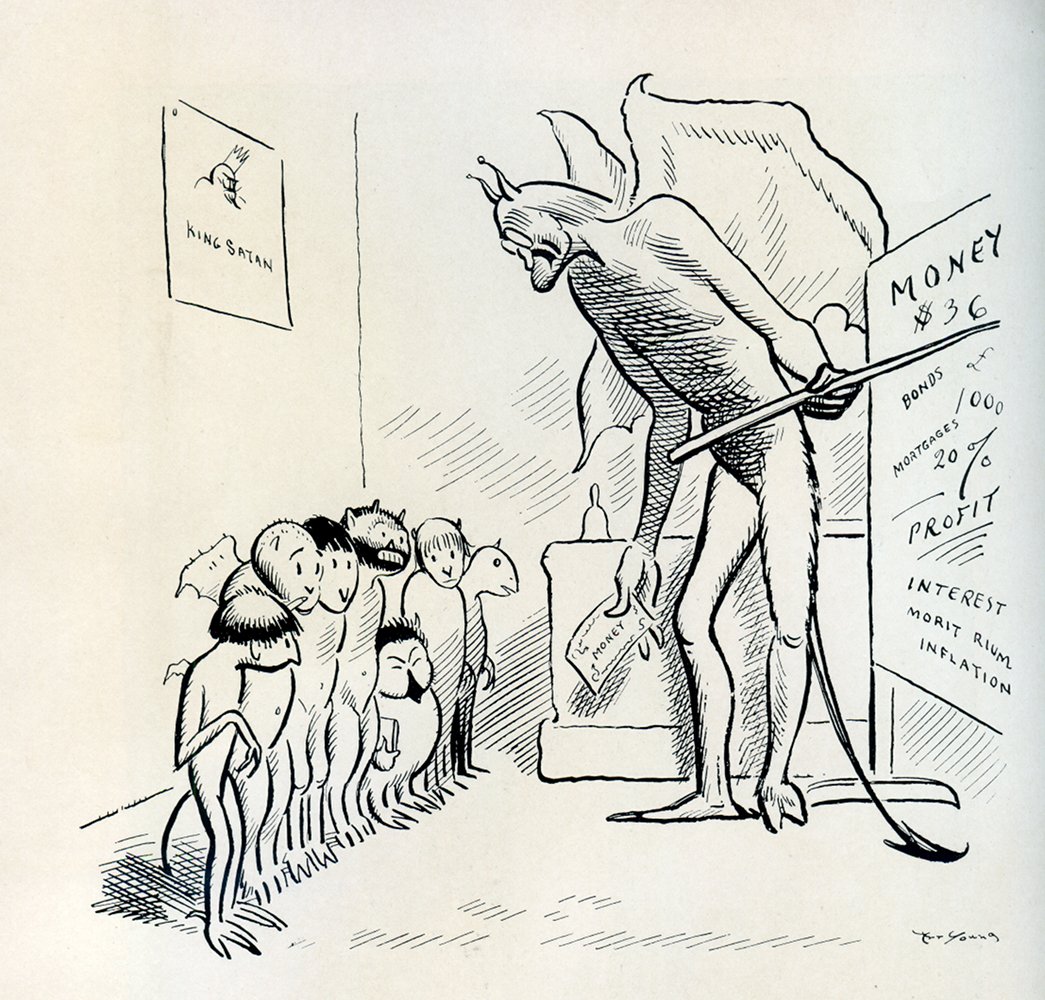
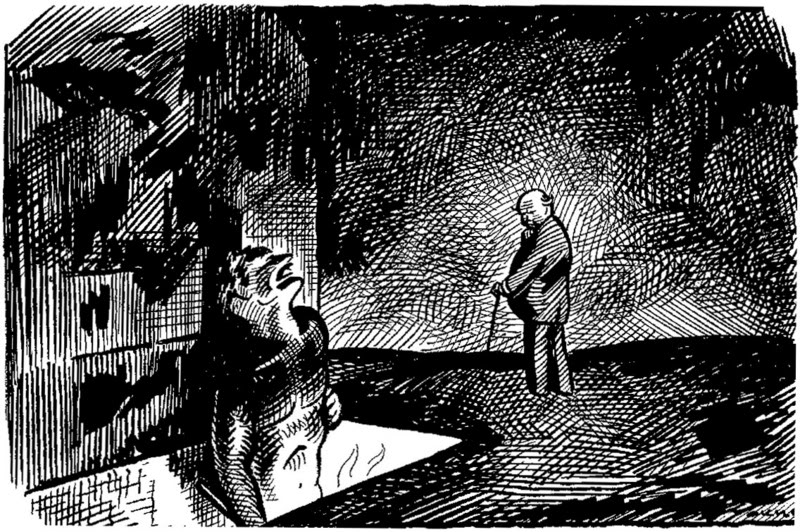
Art Young’s Inferno certainly participates in the hope that the jester might threaten the Khanate. Inspired semi-ironically by Dante and Doré, The Inferno is a description of Young’s journey through Hell, circa 1934. This was actually Young’s third book exploring the pit: the first two were Hell Up To Date from 1892; the second, Through Hell With Hiprah Hunt, from 1901. Both of these were cheerful and non-threatening, focusing on devising witty punishments for modern sins. Unfeeling editors are consigned to red-hot wastebaskets, unattentive husbands are dressed in drag, hobos are forced to bathe, and justice is more or less inoffensively dispensed.

In 1906, however, Young became a convert to socialism. The Inferno, written during the Great Depression, is, then, not a light-hearted fantasy about a just universe, but rather a Marxist panegyric, which explicitly uses its humor to castigate the status quo. As I wrote in a 2006 article for The Comics Journal:

Young reports that “Big Business organizers and Bankers” had been going to Hell in such numbers that they had managed to take over. Satan retains a ceremonial role, but the real power is now vested in an All-Hell Congress controlled by business interests. The new overlords have no interest in punishing the unjust; rather they want to “make money out of Hell.” To this purpose, they establish schools which are “operated like factories to produce standard size thought” and hospitals to which “poor sinners are sometimes grudgingly admitted.” The sophisticated Hellions have even, Young notes, “learned to use the word ‘sorry.’ A gentlemanly Hellion tears out the heart of his brother, spits on it and says, ‘I’m sorry.’” [Berlatsky 133]


Continue reading

Hard to See in the Dark

This was first published on Splice Today.
_________________________

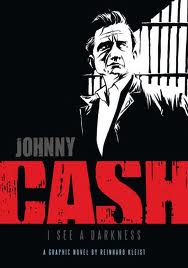
Johnny Cash has been my favorite performer pretty much as long as I’ve had a favorite performer. When I first heard those bleeps on the Folsom Prison album, I was young enough that I actually didn’t know what was being excised. I first learned what “curfew” meant when I asked my parents what Johnny Cash was getting arrested for in “Starkville City Jail.” I’m not certain at this late stage, but I think that same song was the occasion for my first introduction to the concept of controlled substances (“he took my pills and guitar picks/I said, “Wait my name is….”/”Aw shut up”/”Well I sure was in a fix.” And no, I didn’t look the lyrics up.)

As a kid I was, like lots of kids, given to some fairly abstract daydreaming, and Johnny Cash figured in those as well. Specifically, I spent a certain amount of time wondering why people thought musicians in general, and Johnny Cash in particular, were cool. Obviously, Johnny Cash sang about shooting people and getting into fights and getting thrown in jail, and at that time he was associated with the outlaw country movement. But I knew he wasn’t actually an outlaw — he was just a singer. He didn’t even always sing about being a tough guy; sometimes, for example, he sang about political squabbles among bandmates (and yes, “The One On the Right Was On the Left” was how I learned that left and right were ideological as well as directional.) So…if he was just a guy standing up there with a guitar, what was so mysterious or special about that? I turned it over in my head on long car trips while we listened to his cassettes in the back seat, thinking of him standing on stage (I didn’t know he wore black then) and of people watching him, and wondering what, exactly, they saw when they did.

Continue reading

On Exhibit: The Vorticists’ “Mad Modernity”

Nasher Art Museum at Duke University
Durham, NC
Through January 11

Peggy Guggenheim Collection
Venice, Italy
25 January – 15 May 2011

Tate Britain
London, UK
Tuesday 14 June – Sunday 4 September 2011
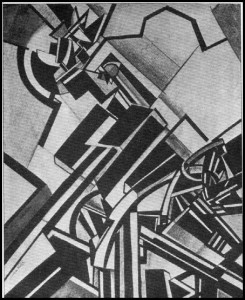
“What is Vorticism? Well, like Futurism, and Imagisme, and Cubism, essentially it is nonsense. But it is more important than these other fantastic, artistic, and literary movements because it is their sure conclusion. It is important not because it is the latest, but because it is the last phase of the ridiculous rebellion which has given the world the “Portrait of a Nude Descending the Stairs” and the writings of Gertrude Stein. It is the reduction ad absurdum of mad modernity.”

When The New York Times published this dismissal of “modernity” in August of 1914, only a couple of months had passed since the Vorticists had published their manifesto in the first volume of their magazine Blast. Earlier that year, Dora Marsden had established her journal The Egoist, Vorticist leader Wyndham Lewis had broken with the Bloomsbury artists and established the Rebel Art Center, and the Vorticist poet laureate Ezra Pound had published his anthology “Des Imagistes.” “Mad Modernity” was in full swing (despite that little matter of an assassination).
On the same day that the Times “blasted” Vorticism, they also published a glowing review of a show of American art in Paris featuring work by the figurative painters Ernest Lawson, Bryson Burroughs, and Harry Lachman, as well as the sculptor Cecil Howard. From the vantage point of New York, then conservative and academic, all the European modernisms were madness — the same madness.

Throughout 1914, however, Pound and Lewis were at great pains to emphasize that Vorticism was not the same. In June, they publicly rejected Marinetti’s attempts to co-opt them as a sub-movement of Italian Futurism, despite having previously taken advantage of his high profile for a fundraiser for the Rebel Art Center. Blast 1 is littered with aggressive criticism and rejections of all the modernisms, in an effort to publicly situate Vorticism as a uniquely advanced synthesis. In the introduction to the excellent exhibition catalog for the exhibit reviewed here, Philip Rylands describes it as the “most advanced, the most sharply characterized of the London-based avant-gardes,” including the Bloomsbury movement that fostered Virginia Woolf.

This is even clear from the first time the term “Vorticist” appeared, in a 1914 advertisement for the upcoming Blast 1, printed in the literary magazine The Spectator:

The Manifesto of the Vorticists. The English Parallel Movement to Cubism and Expressionism. Imagism in poetry. Death blow to Impressionism and Futurism, and all the refuse of naïf science.
The Exhibit

The exhibit of Vorticist art currently on display at the Nasher Museum of Art at Duke University, curated by the Nasher in cooperation with the Guggenheim in New York, is the first exhibition of Vorticist art in the United States since Pound mounted his own exhibition at the Penguin Club in New York in 1917. For that reason alone, it is worth attending.

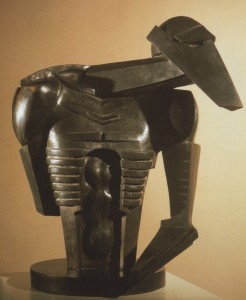
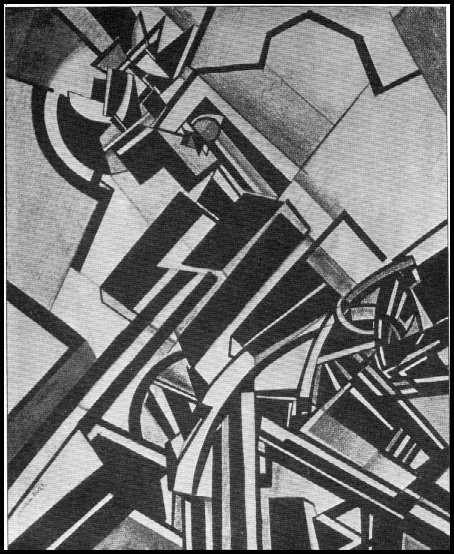
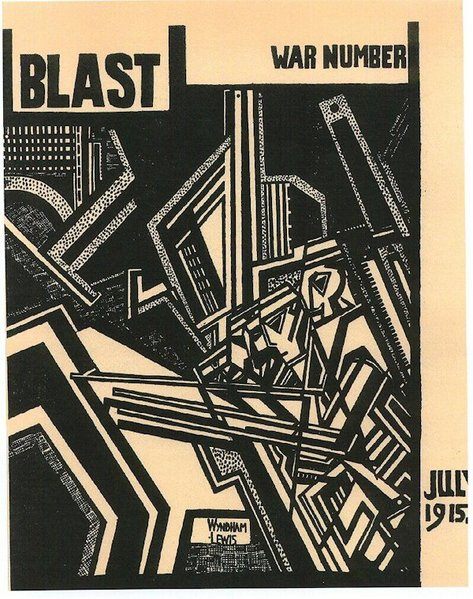
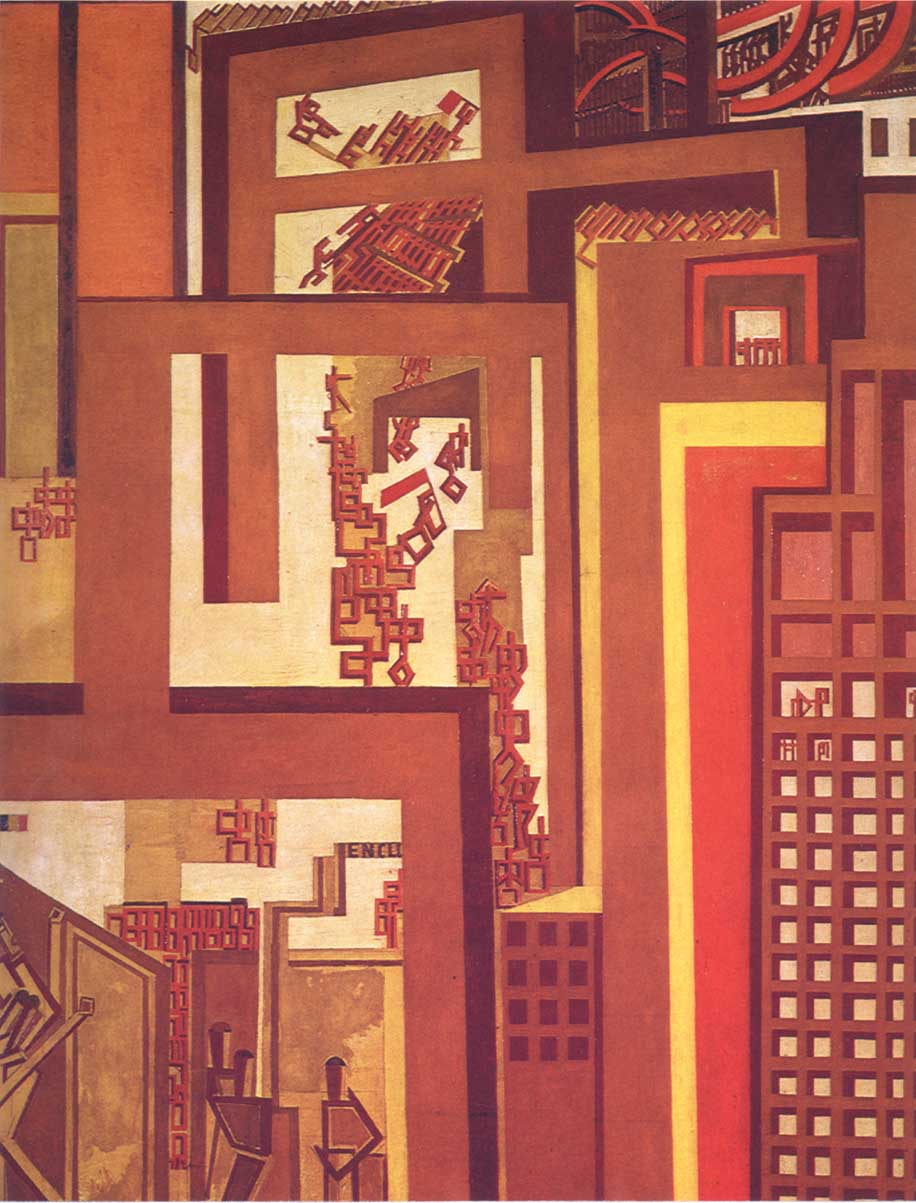
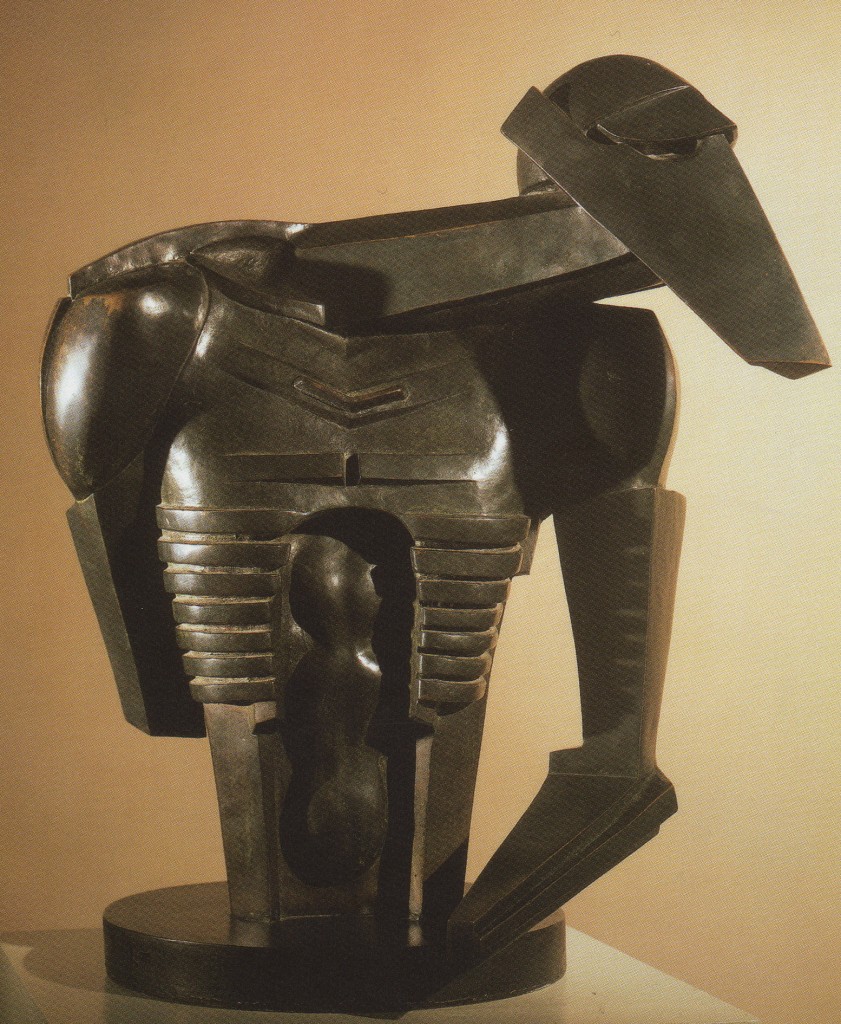
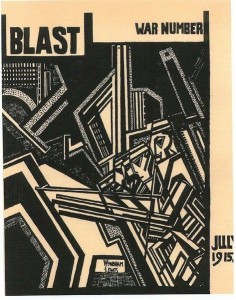
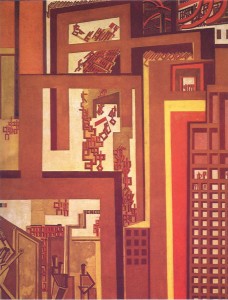
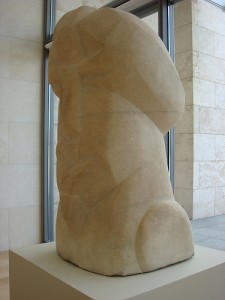
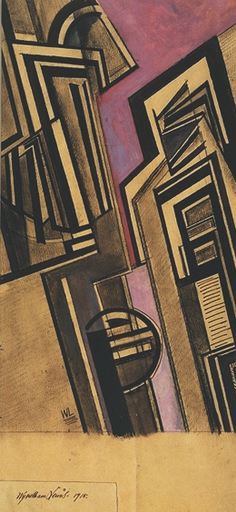
The exhibit is organized in five parts: A display of major works, including Gaudier-Brezska’s Hieratic Head of Ezra Pound (below), Wyndham Lewis’ The Crowd (right), and Jacob Epstein’s Torso in Metal from Rock Drill (below, third), begins the exhibit. That is followed by “re-creations” of the three exhibitions, including Pound’s at the Penguin, held between 1913 and 1917 when Vorticism was a current avant-garde, and a section devoted to the movement’s magazine Blast.
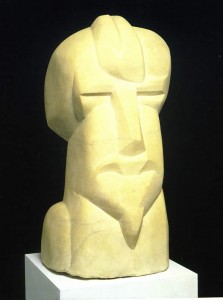
“Re-creation” is a strong word, as many of the originally exhibited artworks are lost – but the curators attempted to gather as many works from the original exhibitions as possible. Of particular note are the paintings by Helen Saunders, which were believed lost but turned up in boxes at Roosevelt University in Chicago, and the vortographs of photographer Alvin Langdon Coburn.

The impact of seeing all these works collected together – as opposed to the usual one-off buried in a room of “minor modernisms” – is significant. In this context, the aesthetic consistency among the movement’s practitioners, their debts to Jacob Epstein and to both Cubism and Futurist painting, and the inspiration they found in the urban landscapes of Northern English cities and English industrialism, all become readily visible.
The section focusing on Blast doesn’t make nearly the same impact. That section and the opening display of “major works” are both haunted by the spectres of literature and philosophy – particularly Pound, who coined the term Vorticism, and Wyndham Lewis, who was as much a novelist and essayist as a painter. Their mutual “friend” T.E. Hulme – in scare quotes because that friendship was characterized by competition and melodrama, which led to Hulme’s exclusion from Blast 1 – was almost singlehandledly responsible for Vorticism’s philosophical orientation, culled from his translation of Bergson and his friendship with the Expressionist philosopher Wilhelm Worringer. Add in Pound’s influential friendships with the feminist anarcho-individualist Marsden and the writer T.S. Eliot (who was also published in Blast), and it’s indisputable that Vorticism was as much a literary, philosophical, political, and social movement as it was a visual aesthetic one. (There was even Vorticist music, eventually.)

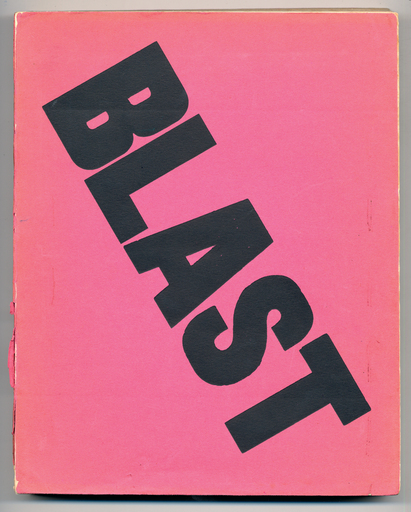
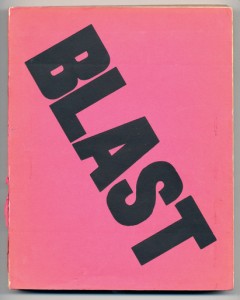
The Nasher exhibit emphasizes Blast as a material object, however, displaying original copies of both volumes in long cases, with framed original drawings for the magazine hanging above the cases. Although the physicality of this presentation gives a geeky thrill, Blast was never intended to be enclosed within a display case (to the exhibitors credit, a new facsimile edition of Blast 1 was developed just prior to the exhibit and is available in the gift shop or here).
There is no Vulgarity in Revolt

The manifestos of “mad modernism” depended on mechanical reproduction and fed off the vibrancy of their artistic activism. The avant-garde was here set against both aestheticism and academicism, as Lewis’ stated directly in Blast:

To make the rich of the community shed their education skin, to destroy politeness, standardization and academic, that is civilized, vision, is the task we have set ourselves.

To believe that it is necessary for or conducive to art to “improve” life, for instance, make architecture, dress, ornament, in “better taste,” is absurd.

The Latins are at present, for instance, in their ‘discovery’ of sport, their Futuristic gush over machines, aeroplanes, etc., the most romantic and sentimental ‘moderns’ to be found. It is only the second-rate people in France or Italy who are thorough revolutionaries. In England, on the other hand, there is no vulgarity in revolt. Or rather, there is no revolt, it is the normal state. … the nearest thing in England to a great traditional French artist is a great revolutionary English one.

The spirit in these quotes from the preface and manifesto, not to mention its influence on the experience of the visual art works and literature reproduced in the subsequent pages, is lost when the book is put in a case. Blast-as-exhibit can only suggest it; experiencing the historical materiality of the book can’t even begin to substitute for reading it – even in non-facsimile reproduction.

Likewise, the materiality of the traditional exhibit space doesn’t even evoke, let alone “recreate” the rebellious, radical spirit and context of the wartime exhibitions. The Penguin Club is a case in point: the Club had been founded shortly before the 1917 Vorticist Exhibition by Walter Kuhn, one of the progenitors of the Association of American Painters and Sculptors, who put on the influential 1913 Armory Show that introduced Duchamp, and Hopper, and Kandinsky, and the post-Impressionists – among many others – to American audiences. The club was a gathering place for modernist artists rebelling against the constraints of academic art, including Man Ray, Francis Picabia, and Joseph Stella. The club held exhibitions, put on costume parties and satirical theatrical productions, offered classes by its members to its members, and encouraged criticism, discussion, and debate. The sedate blue and cream walls of the exhibition don’t begin to capture the frenetic environs from which Vorticism emerged and in which it perpetuated itself. Mad Modernism indeed.

Which is to say – by all means you really must go to the exhibit if you are anywhere near Durham, Venice, or London. Read the wall tags, admire the materiality of the art, and marvel at the lost-but-now-am-found paintings. But be sure to flip through the facsimile edition of Blast and the superb exhibition catalog, too. Otherwise you’ll have seen Vorticist art, but missed what makes it Vorticist.

Through Space, Through Time: Four Dimensional Perspective and the Comics by Eric Berlatsky

Originally presented: Panel on Frames and Ways of Seeing in Modernist Narrative at The Tenth Annual Modernist Studies Association (MSA) Conference, Nashville, TN, November 2008.

Author’s introduction (“disclaimer”)

This paper was presented at the Modernist Studies Association conference two years ago. As such, the audience for the talk was not comics scholars, or, even, necessarily people who were interesed in comics. The paper is pitched to that audience and therefore says quite a number of things about comics that are fairly obvious to the comics scholar (or even just the perceptive comics reader). In fact, it even says things I know to be debatable, and even incorrect, since those things weren’t my primary concern. So, yes, I know that “The Yellow Kid” isn’t the first comic strip in U.S. newspapers (to say nothing of the world at large), but since splitting those hairs wasn’t the point of the paper, I used that as a generally “known” reference point.

I was invited to participate in a panel on “frames and ways of seeing in modernist narrative” after one of the participants in the original panel dropped out. As I recall, all three of the original panelists were from the University of Toronto, studying under/with noted modernist scholar, Melba Cuddy-Keane. Cuddy-Keane got in touch with my dissertation advisor at University of Maryland, Brian Richardson, and asked if he knew anyone interested in frame narration and modernism. Brian got in touch with me, recalling a paper I had written for him many years previous as a graduate student. That paper, however, was already forthcoming in Narrative, and I wasn’t really interested in recycling the material. So, I took the opportunity to apply some of the research I was doing on time, modernism, and comics and to write some of that out, rather than merely having it bounce around in my head. All of this is the long way of saying that the paper was even more rushed and “tossed off” than the typical conference paper, since I was a late addition to the program. At this point, I feel as if there may be nothing particularly revelatory here, as much of this material feels (to me, anyway) as if it’s fairly obvious and straightforward and covered elsewhere in the literature. Since this is a blog (my brother’s no less), I don’t feel quite so guilty about letting it see the light of day, as long as nobody really feels like it reflects the care I generally take in my scholarship. Things that make me cringe a bit, are… a) sources cited, but no bibliography listed. The sources are mentioned, for the most part, in the paper itself, but obviously, a bibliography should be included. Since I was only reading it out loud at the time, however, and I knew the sources, I never typed them up. (At this point, this note may be taking longer than it would take to type the sources… but let’s not ruin a fairly boring and mediocre story). 2) The paper also includes various notes to myself telling me to elaborate on this point or that orally. Obviously, for written publication, I should turn those into more coherent written claims… but I’m just writing a disclaimer instead. [Many of these were references to the images, so I’ve replaced them with “See Fig. X” reference. -ed.] 3) The quality of the scans is sometimes pretty bad, as well. My scanner is just an 8 x 11 and some of my sources were much bigger. I should have gone to the Artist Formerly Known as Kinko’s and done the scans on a larger printer to get things right… but, again, I reveal the generally slipshod nature of my efforts on this particular piece. All of this is why I told Noah and Derik that they could have this conference paper if they wanted it… but that I was generally unsure of its “ready for prime time” (using the term loosely) status. Derik and Noah decided to run it anyway (making me think that they reall need more submissions for this feature [We do! Send us something -ed.]), so, here it is “warts and all.”

“Through Space, Through Time:” Four Dimensional Perspective and the Comics by Eric Berlatsky

Whether pamphlet-form comic books, cramped newspaper comic strips, or more traditionally codex-form “graphic novels,” comics have only recently started to receive serious critical attention as “art objects,” as opposed to mass culture ephemera. The biggest breakthrough in comics criticism is still undoubtedly Scott McCloud’s 1993 book Understanding Comics, a book that makes a bold play for considering comics as “art,” by bypassing the typical starting date for its history. The standard date, particularly in America, is, of course, 1895, marking the beginning of R. F. Outcault’s Hogan’s Alley as a newspaper comics page in The New York World. This date, would, of course, place the origins of the newspaper comic strip in close chronological proximity to the “high art” development of modernism. However, McCloud’s choice to define comics as “sequential art,” or, in the longer version, “juxtaposed pictorial and other images in deliberate sequence,” allows him to include pre-Columbian picture manuscripts, the Bayeux tapestry, Egyptian painting, Trajan’s column, and Hogarth’s “Harlot’s Progress” as comics, along with other, more likely, suspects, like Rodolphe Topfer’s “picture stories” of the mid-nineteenth century (McCloud 10-17). McCloud discards some of the elements of earlier definitions of comics in order to detach the era of comics’ increasing popularity (the twentieth century) from its definition, suggesting that some of the greatest achievements of older “high art” are, in fact, comics. While this has the potential to raise the culture caché of comics as a medium, it also obscures the ways in which the form reflects and takes part in the modernist project and the advent of modernity.

Continue reading

Utilitarian Review 12/10/10

On HU

Busy week this time out.

Erica Friedman started the week out with a post on fashion, fighting, literature and Hana No Asuka-gumi.

Alex Buchet began a massive series on comics contribution to language, looking at Tad, Rube Goldberg, and other early strip artists.

Richard Cook evaluated some hobbit questing tunes.

I explained why I don’t like Pauline Kael.

I reviewed Arie Kaplan’s From Krakow to Krypton about Jews in the comic book industry.

Jason Overby guest posted about the relationship between comics history and comics.

Caroline Small had a follow up comment to Jason’s post.

Sean Michael Robinson discussed the difficulties of marketing Mitsuru Adachi’s sports comics in America.

Alex Buchet continued his series on the effects of comics on language with examples from Popeye, Milt Gross, and more.

Next week we’ve got posts on comics, modernism, and time; Art Young, faith, and humor; Vorticist art, and more.

Utilitarians Everywhere

At Comixology I talk about the weirdness of the superhero Katana.

Female super-heroes can be many things: Amazon warrior, out-of-control telepath, deadly ninja assassin. But whether in swimsuit, bodysuit, fishnets or boob window, they’re almost always cheesecake.

There’s no particular mystery as to why this is. Super-hero comics are male genre literature. Guys like to look at cheesecake. QED. There are some exceptions to the rule — but they’re usually built around genre exceptions as well. For example, the Claremont/Byrne X-Men made some effort to appeal to YA girl readers through the character of Kitty Pryde. Thus, Kitty got to mostly wear civies, rather than the skintight and/or improbably cut-out costumes that were the lot of her distaff teammates. (Not that the internets are above a certain amount of Kitty Pryde cheesecake of course.)

At Splice Today I review a new video anthology of Sid and Marty Kroft’s children’s television shows.

For the Kroffts, childhood is often a suffocating sweetness, a threatening plenitude. In both H.R. Pufnstuf and Lidsville, a boy is trapped in a magical realm from which he spends almost all his time trying (and failing) to escape. The child’s plight is especially unsettling in Lidsville, where the boy in question isn’t really a child. Butch Patrick, who played the protagonist Mark, was 18 when he picked up the role and close to 20 by the time he finished. When he wanders through the magic world of sentient hats, tyrannical patriarchal magicians, and evil doppelgangers, therefore, it doesn’t come across as a child’s adorable game of make-believe. Instead, it looks disturbingly like a young man’s schizophrenic fugue.Jazmine Sullivan neo-soul album.

At Madeloud I review a mediocre techno comp.

Other Links

Karen Green has an interesting discussion of Frank Miller’s 300.

Michelle Smith and Melinda Beasi have a good discussion of the formal qualities of some wordless manga.

R. Fiore on why the Green Hornet movie will suck.

And sometimes commenter Jason Michelitch has his first Splice Today article up about the glory and the limitations of experimental film online.

Strange Windows: Keeping Up with the Goonses (part 2)

Jeep! Jeep!

This is part two of our survey of language spawned by comics and cartoons.

Here’s a strip that, in comics, is one of the richest contributors to the language: Thimble Theatre, better known worldwide by the name of its protagonist, the sailor Popeye.

The strip’s creator, Elzie Segar (1894– 1938) is credited with several coinages, some of which are contested; let’s take them one by one.

“With a loanshark, it’s simple: you don’t pay, he sends one of his goons to break your leg“.

To Segar is generally attributed the word “goon”, but the truth is a bit more complex; the word long predated the strip.

However, it is arguable that Segar changed the sense of this slang term. Before, it designated a foolish simpleton.

But by the end of the thirties, after Segar introduced the fearsome but lovable Alice the Goon into the strip:

click image to enlarge

… the meaning changed to that of a hulking, violent thug.
Continue reading