Crossing Over- Mitsuru Adachi, Cross Game and the Problem of Genre

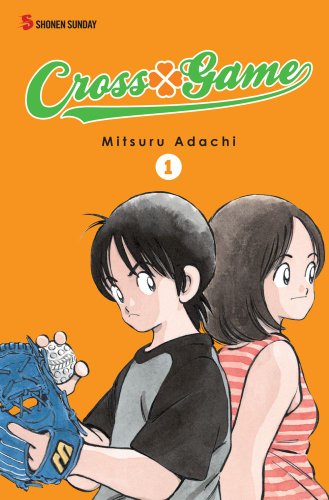
In October Viz released almost 600 pages of comics by one of my favorite cartoonists, Mitsuru Adachi, in the form of the first volume of Cross Game, a series from 2005. In honor of Adachi finally getting something else in print, and in the interest of hopefully furthering the recent discussion of genre, “Comics”, and “Art”, I’d like to share a few thoughts I had upon reading the volume.

But first, a quote! Yesterday on HU Jason Overby had a post up in which he had this to say about the changing face of comics history –

It brings up a good point about how arbitrary “comics history” is.  It’s easy to see that positive associations, as opposed to some more objective system of value, are what impel bloggers (critics?) to write about Kirby or King more than Toriyama or Baldessari.

This point applies even more so to creators who have never had their work officially represented in English, or have only had released a small, unrepresentative portion of their total output. What is the history of comics, when critical figures who influenced huge swaths of the work that is available have none of their own work available to an English-speaking audience?

This is the case for Mitsuru Adachi, a cartoonist who made his debut more than forty years ago and who, on a global level, rivals Rumiko Takahashi for popularity and acclaim.

Although Adachi was fairly well-known among the anime and manga communities of the eighties and early nineties, thanks to fan translations of an anime adaptation of his first major manga series, Touch, he’s had a sparse history of official releases in English. His official English debut came in 1999 in the pages of Animerica Extra with Short Program, a series of short stories connected only by their generally melancholic tone, lively drawing, and gentle, deft characterization. The serialization in Animerica Extra continued for two years, generating enough material to be included in two collected volumes, one released in 2000, followed four years later by volume two. For a major creator known for his slow-spooling multi-volume stories, this was a strange state of affairs.
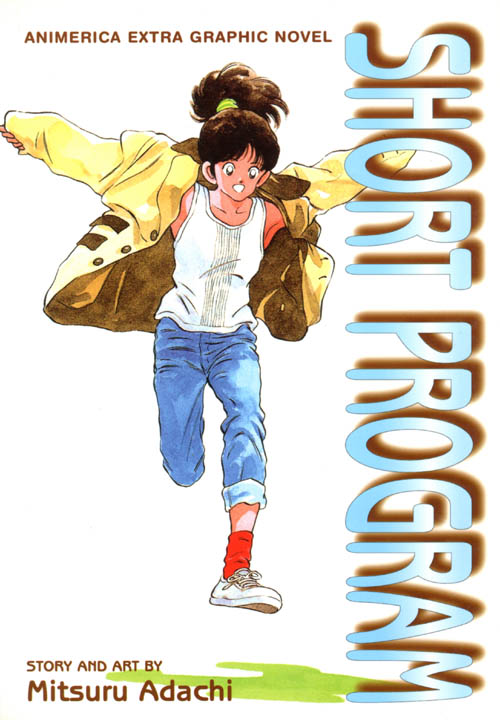
My best guess is that the Short Program releases were meant to test the waters and gauge the potential audience for Adachi in America. And although I personally think Adachi is one of the world’s greatest living cartoonists, it’s easy to see why Viz would be nervous about rolling out one of his major series. They are some of the same reasons that have prevented a wide swath of Japanese comics history from making its way into English.

For one, American anime fans still drive a large part of the market, as companies bank on the synergistic marketing opportunities available from manga series that also exist in other media. And although Adachi had two full-length anime adaptations in the eighties, the American anime fan culture has a very fickle relationship with surface style. In other words, any potential spin-offs (until the recent Cross Game anime adaptation) exist in a form that might seem outdated to the bulk of the anime fan community.

The second, and probably more significant point, is the matter of genre. All of Adachi’s major series (including Touch, Slow Step, H2, Katsu!, and the recently released Cross Game) could be most easily slotted in the category of “sports comics,” although I’ve seen the label “romantic comedy” attached to his comics as well. With the exception of some very popular young adult sports fiction in the fifties and sixties, there’s not a very long tradition of sports fiction in America, and certainly little to no tradition of sports comics. In the eyes of many marketing strategists, a general audience uses a genre label as an aid to enter the story, a convenient short hand that serves as a hook on which to hang the other elements of the story. How do you sell a piece of fiction that most easily fits into a genre that doesn’t exist for its target audience?
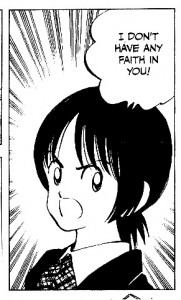
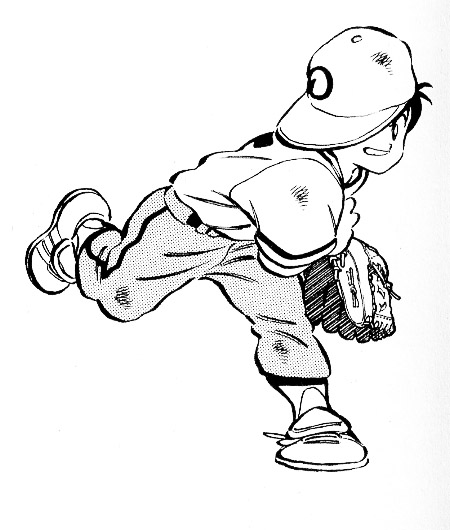
from Cross Game volume 1

Well, one way would be to try to create the market- to sell Adachi’s work to baseball fans.  As a former baseball fanatic myself, I think Viz could very well do so with that kind of strategy. But in trying to sell Adachi’s work to the comics market, and therefore to comics reviewers and critics as well, there’s an additional challenge- that for certain types of critics working within genres can carry a whole host of other negative connotations.

I find it very illuminating to observe the purposeful way that Vertical has marketed Osamu Tezuka’s work in the past few years. They’ve been very careful to package and design the books in ways that echo much of the aesthetic of English independent comics, including employing well-known designer Chip Kidd for many of the early books, and continuing the overtly modern and fragmentary designs with the more recent work by in-house Vertical designer Peter Mendelsund. Looking at the exterior of books like Dororo or Black Jack, would you have any idea that these series fit squarely within swordplay and medical drama genres?
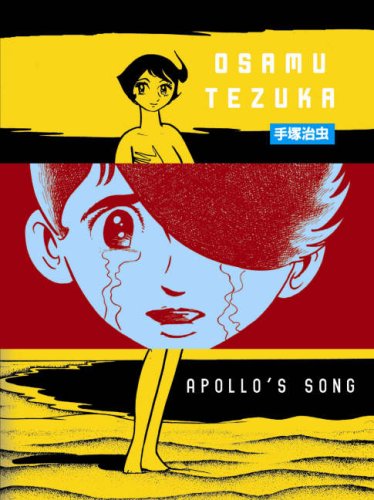
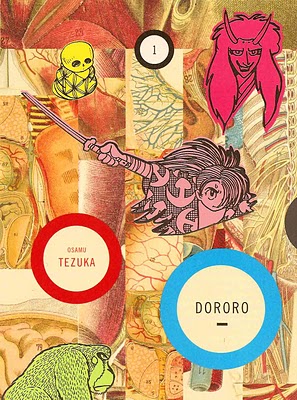
However, like most excellent genre fiction, Dororo and Black Jack play with the genres involved rather than being subsumed by them. This is the case with the work of Adachi as well. Cross Game is “sports comics” in the sense that the characters at the heart of the story love baseball, and playing it becomes a focus for much of their activity. But saying that “Touch” or “Cross Game” are about baseball is like saying that “Les Miserable” is about prison and sweeping and street fighting.

The first three volumes of Cross Game came out in October in one 576 page package. And how are they pitching it? As a tie-in to the spin-off anime, and as a “poignant coming-of-age story,” which, as far as marketing pitches go, isn’t half bad, as both elements happen to be true. They’ve minimized the baseball references in the description and press releases, and have centered around the relationships at the heart of the story, as well as attempting to capitalize on Adachi’s Japanese fame and reputation.
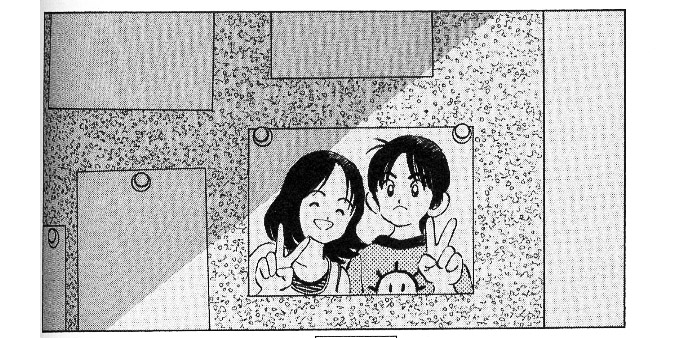
from Cross Game

And it probably has a chance of succeeding. Cross Game itself, or at least the three volumes represented in the recent Viz release, has all of the elements associated with classic Adachi series- clear and confident drawing with very smooth, natural storytelling, slow-moving plots that suddenly veer into unexpected and unpredictable territory, breezy dialogue, and melancholic, sometimes unmotivated young characters whose decisions are often surprising but are never inexplicable.

And yet it may be too genre bound, and maybe too casual, to be taken seriously by many critics. Present in the series are several stylistic choices that could be disconcerting for an audience unaccustomed to them. These include Adachi himself appearing in throw-away panels to mock his own work, background characters pitching other Adachi series to the reader, and a tendency to occasionally veer into cliché. Fortunately these clichéd situations are usually minor detours from the main plot, and seem to be the result of the unrelenting workload of weekly serialization. (Another possibly undesirable byproduct of this pace is the sometimes workmanlike background artwork, which occasionally takes stylistic detours from the figures, which are always confidently delineated.)

Last week Noah generated some heated feedback when he suggested that the manga community engages in a lot more reviewing than criticism, and that books like a Drunken Dream which “despite its genre links, doesn’t fit easily into current marketing demographics,” will have a hard time going without some in-depth criticism to create context for the work. As I mentioned in the comments section, regardless of how you might feel about the “review” versus “criticism” premise, Hagio and Adachi might be in the same boat. They’re sitting on many of those same lines of division.

Well, Noah, I’d like to respond to your post by urging interested readers to BUY! a copy of Cross Game. And cross your fingers that, one day, Touch will be available in English.

And critics, wherever you are? Try to go easy on Mr. Adachi, won’t you? It is just a baseball comic, after all!

(Someone once told me that sarcasm doesn’t come across well in print.)
Comics>Cartooning

Because it kicks ass, I’m reprinting and highlighting Caro’s comment from this post.

To Darryl’s point: for me, “divorcing comics from its cultural history” isn’t about being embarrassed about comics’ history so much as it is recognizing that “comics history” is neither sufficient cultural context for already existing comics nor necessary cultural context for yet-to-be-created ones.

The idea that comics history is both necessary and sufficient — I could put in jargony terms and say that it feels like a caving in to historical determinism. But it’s really more that it gives me no way in.

What L. describes — she says that about creators, but I feel that as a critic too. On the whole, very few comics keep me awake at night the way literature and criticism and theory and Godard films and conceptual art do — not because those things are better than comics-history-inspired comics, but because those are the things I like, and they’re having a different conversation than comics has historically been having.

I pay attention because occasionally, a comic comes along that really intervenes in the stuff I care about (like Feuchtenberger, or the stuff Jason just linked to!) and on the occasions when that has happened, it’s been so extraordinarily worthwhile that it’s worth keeping an eye out.

But for many things, it’s hard for me to muster the enthusiasm to do a real piece of criticism, because the book just isn’t doing anything to keep me awake. No matter how cool the tricks with comics history gets, no matter how nuanced the conversation, it’s just never going to keep me awake, because I’m interested in DIFFERENT histories — pop art, experimental fiction, 20th century theories of language and representation, artistic constructions of subjectivity. I think it’s wrong to say that comics can’t become part of those histories, now, even though they’ve historically not been. (Or, to return to the jargon, how can we expect the dialectic to work without antithesis?)

I absolutely don’t mean that comics-history-inspired comics aren’t doing very interesting things with that history. I don’t mean they shouldn’t exist, or that they’re “less” in any way than other comics. It’s just that, for me, who has no history with comics, comics history can’t on its own provide a foundation for challenging, provocative, mind-changing art, so for comics to challenge me, provoke me, and change my mind, I need there to be SOME comics that deprioritize the specific history of comics in order to engage more actively with those other histories.

That’s why the strength of the term “divorce” feels right to me. Comics’ relationship to their own history often feels like a marriage where one partner’s potential is being really held back in order to protect or build up the ego of the other partner. And I like comics better than I like comics history, so I say “girlfriend, leave!” Comics > cartooning.

The Concerns of “Comics”

“The product of art — temple, painting, statue, poem — is not the work of art. The work takes place when a human being cooperates with the product so that the outcome is an experience that is enjoyed because of its liberating and ordered properties.”

-John Dewey

There’s a post by Frankius over at comicscomics referencing something Evan Dorkin had written about the relatively minimal impact in the comics community of books like Wilson or Genesis.  Santoro’s talking about how the readership of comics is more diffuse than it used to be in the eighties and nineties where everyone was pretty much on board w/r/t what the important releases were.  What I remember of my own experience working at a comic shop at that time differs, though we were all probably following tcj religiously back then and felt like we were in it together, maybe.  But it was a good post.  The landscape of comics has changed to the point where fandom has become a smaller subset of overall readership and, therefore, less necessary.  The younger readers grew up with manga, anime, alternative/indy comics, sophisticated video games, and their frames of reference are different from those of the old guard.  And there’s a fresh crop of readers who aren’t so young, who have much more catholic tastes but, nonetheless, have no idea what formula Johnny Quick recited to gain super speed or what happened during the “Secret Wars.”

Lots of commenters offered their two cents on the post.  My attention was caught specifically by something Andrew White had written:

“I guess I just think people have to challenge themselves more in the types of works they see as important. Like, I think it would be the greatest thing ever if Jeet or Dan or someone tried to critically engage, say, Franquin’s Spirou or even (God forbid!) Dragon Ball or something in the same way that they do stuff like Gasoline Alley and Kirby’s Fourth World.”

It brings up a good point about how arbitrary “comics history” is.  It’s easy to see that positive associations, as opposed to some more objective system of value, are what impel bloggers (critics?) to write about Kirby or King more than Toriyama or Baldessari.  And It all gets confused because, though these canons are very personal, there’s a great deal of overlap, and it’s hard not to want to moralize and ascribe solid good/bad pronouncements to the various creations.  I don’t know whether I’d call most of it “Art,” but it is all, of course,  art.

art is not about making meaning, it seems to me.  It is the way we relate aesthetically to the world.  “Art,” on the other hand, is worried about the concerns of art, which is a form of meaning.  I was recently thinking about how art ideally escapes the manichean system of valuation that is all but unavoidable in literature, which seems to be concerned with the accuracy of sign/signified relationships.  But this is another typically binary way to view culture –  aesthetic vs. conceptual – beauty vs. meaning.  It’s a map, but it can be restrictive.

I made this post as a way of coming to terms with the fact that I can’t escape my own goofy influences.  I grew up immersed in a certain subset of the larger visual culture, and it’s useless for me to completely reject the way I, Jason Overby, respond to Spiderman’s costume, Batman’s utility belt, Toth’s page layouts, Bushmiller’s economy, Gould’s weirdness, Beto’s brushstrokes, etc.  My aesthetics were formed by this random soup, but that doesn’t mean that I want “Comics” as a medium to embrace its own heritage.

I get frustrated with people wanting the “Art” establishment to take “comic art” (meaning the actual inked comics pages as objects) seriously.  I look at Dan DeCarlo originals and they’re magically beautiful to me, but that’s ignoring the fact that they’re illustrating dopey stories about teenagers.  There are some thorny questions about taste and objective criteria that have historically elided the concerns of “Comics” but which are part of the concerns of “Art.”

But the concerns of “Comics” are changing.  The protective insularity of the eighties and nineties has given way, with the success of manga, critical acclaim, newer formats, etc. to the wide open, less-detached-from-the-cultural-zeitgeist aughts.

The most exciting thing to me about comics in the nineties, something that was on everyone’s minds, was the idea that comics, as a mode of expression, could be divorced from comics, as a cultural history.  I guess we’re beginning to reap what we’ve sown.

What’s “Clark Kent” in Yiddish?

This essay first ran on Splice Today.
_________________________

One of the smartest books I’ve ever read about ethnicity is James Loewen’s Mississippi Chinese. Like the title says, it’s an academic study of Chinese immigrants in Mississippi during the first half of the twentieth century. Specifically, it tries to explain why virtually all of them ended up working as shopkeepers in black neighborhoods. The answer turns out to have next to nothing to do with racial or ethnic predilections or talents, and everything to do with specific social factors. In other words, the Chinese didn’t run stores because they had some sort of gene which made them good salesmen. They ran stores in black neighborhoods because (a) the only way such stores could be economically feasible is if the shopkeeper lived above the shop, and because of racism white people wouldn’t live in black neighborhoods, and (b) African-Americans had difficulty being storekeepers themselves because they had strong community taboos against dunning their neighbors for debts. Thus, because of racism on the one hand and community solidarity created by oppression on the other, there was a particular space available for non-black, non-white immigrants — and the Chinese stepped into it.

I’ve long hoped to find a similar study which would explain why Jews were so dominant in the comic industry. I’d hoped Arie Kaplan’s From Krakow to Krypto would provide some answers — and it didn’t completely disappoint. Kaplan points out that because of prejudice, Jews were effectively barred from advertising illustration, newspaper cartooning — from every commercial artistic outlet, that is, except for comic books, which were considered to be such dreck that nobody cared who worked on them. In this, Kaplan suggests, comics were like Hollywood movies, or comedy, or music: entertainment occupations so low caste that the usual barriers to entry did not apply.

Bringing up music, though, points to a lacuna in the thesis. After all, there were other low caste folks in New York in the thirties, forties, and fifties when Jews were moving into the comics business. I’m pretty sure African-Americans weren’t welcomed with open arms into the world of commercial illustration; why then weren’t they, too, being funneled into the low-class funnybooks?

I can think of a couple of answers to this, but the most likely ones aren’t especially flattering to comic-bookdom.. Perhaps that’s why Kaplan avoids them; certainly, he seems determined to discuss race only when it’s possible to do so while patting the industry loudly on the back (Matt Baker and the Black Panther both make — shall we say, token appearances?) Similarly, though Kaplan’s book does touch on the exploitation comics creators faced, it doesn’t do much to put this in a specifically Jewish context. Did publishers take advantage of shared ethnicity to build trust and more effectively screw their underlings? How important were Jewish social networks to staffing these companies? How did that affect the way the companies were run?

Of course, just because the issues which interest me don’t interest Kaplan isn’t to say that the book is worthless. On the contrary, From Krakow to Krypton covers the history of Jews in American comics — which is more or less the entire history of American comics — with bright efficiency. In only 200 pages or so, Kaplan hits Golden Age superheroes, EC, the Silver Age at Marvel and DC, the undergrounds, and more — and even finds time to mention Michael Chabon way, way more often than necessary. No doubt experts in the field will find the tour cursory, but I learned lots of fun facts, whether big (I’d always thought Gardner Fox was responsible for updating the Flash…duh) or small (Clark Kent was based on Cary Grant! Buffy was based on Kitty Pryde! Neil Gaiman is Jewish!) In addition, the tome is lavishly and carefully illustrated. My favorite image is the adorable Jack Kirby drawing of the Thing in prayer shawl and yarmulke, but the Al Jaffee self-portrait with upside-down head is a close second. Certainly, with all the information and all the art, the book seems very reasonably priced at $25.00.

The main weakness is, inevitably, the boosterism. The constant reiteration of how great Jews and comics are and how far they’ve come had grown wearisome long, long before I reached the last page — and, indeed, long before I opened the volume. I do understand the impulse to cheer on the tribe, but the success of comics isn’t ultimately about culturally validating the Jews, or vice versa. If we want to understand Jews, or comics, or how the two relate to each other, at some point we’re going to need a history that is a little, or a lot, more ruthless.

Mistaking the Movies for the Trees

This essay first appeared on Splice Today.
____________________________

As a first time reader of Pauline Kael, I was surprised to discover that she’s boring as fuck.

Okay, to be fair, she’s sometimes slightly less boring than that. Going Steady, her third volume from 1968 and the one which I happened to get my hands on, has its share of zingers. I smiled when she noted acidly of Mel Brooks’ script for the producers: “That’s not screenwriting; it’s gagwriting.” I’m always up for seeing Norman Mailer ridiculed, and her pummeling of his Wild 90 as a lazy egoistic exercise in flab was satisfying on that account. And there are several entertaining anecdotes sprinkled throughout. Such as this one:

Once, in Berkeley, after a lecture by LeRoi Jones, as the audience got up to leave, I asked an elderly white couple next to me how they could applaud when Jones said that all whites should be killed. And the little gray-haired woman replied, “But that was just a metaphor. He’s a wonderful speaker.

Continue reading

Hobbit Tunes

If you’re going on the quest, best make sure you have the right quest music. Tolkien songs are always reliable for any quest involving lots of walking.

“The Road Goes Ever On” from The Hobbit
by J.R.R. Tolkien

Roads go ever ever on,
Over rock and under tree,
By caves where never sun has shone,
By streams that never find the sea;
Over snow by winter sown,
And through the merry flowers of June,
Over grass and over stone,
And under mountains in the moon.
Roads go ever ever on
Under cloud and under star,
Yet feet that wandering have gone
Turn at last to home afar.
Eyes that fire and sword have seen
And horror in the halls of stone
Look at last on meadows green
And trees and hills they long have known.

Or if you prefer, the version from The Lord of the Rings:

The Road goes ever on and on
Down from the door where it began.
Now far ahead the Road has gone,
And I must follow, if I can,
Pursuing it with eager feet,
Until it joins some larger way
Where many paths and errands meet.
And whither then? I cannot say.

Just one problem: what does the song actually sound like (and where can I download it?)

Option 1: Drinking song


Continue reading

Strange Windows:Keeping up with the Goonses (part 1)

Art by Rube Goldberg

As you raise spoon of soup (A) to your mouth it pulls string (B), thereby jerking ladle (C) which throws cracker (D) past parrot (E). Parrot jumps after cracker and perch (F) tilts, upsetting seeds (G) into pail (H). Extra weight in pail pulls cord (I), which opens and lights automatic cigar lighter (J), setting off sky-rocket (K) which causes sickle (L) to cut string (M) and allow pendulum with attached napkin to swing back and forth thereby wiping off your chin. After the meal, substitute a harmonica for the napkin and you’ll be able to entertain the guests with a little music.

“Fred’s neighbor buys a jeep, so of course Fred buys a Hummer. I zap him with ‘Keeping up with the Joneses, eh, Freddy?’ He was steamed up, but he doesn’t scare me. The palooka may be built like a goon, but he’s more Caspar Milquetoast than Superman.

The ocean of the English language is fed by many rivers, and some of the main streams are those of popular media.

Movies, television, songs, theater, vaudeville, books, radio… all have created uncounted idioms, words, catch-phrases and phatic utterances.

Cartoons and comics have contributed their own rich share:

The comic-strip artist[…]has been a very diligent maker of terse and dramatic words.

–H.L. Mencken, The American Language

In this column we’ll review a sampling of these colorful idioms.

Part one of the five-part series focusses on American English from the early newspaper comic strips and cartoons.

Along the way, however, we’ll debunk some false etymology. And because, at times, cartoons have  influenced a word’s meaning without creating the word itself, we’ll also take note of such ambiguous cases. Most examples were invented by me, but if attributed they’re actual quotations.

We’ll kick off with a look at a man who was one of the most famous cartoonists of his day; although his life and work are now obscure, his coinages live on in the vernacular: Thomas Aloycious Dorgan (1877 – 1929), who signed his work Tad.

click image to enlarge

W. J. Funk, of the Funk and Wagnall’s dictionary company, placed Dorgan at the top of the list of the ten “most fecund makers of American slang.”

Tad is generally credited with either creating or popularizing such words and expressions as dumbbell (a stupid person; see cartoon above); for crying out loud (a cry of exasperation); cat’s meow and cat’s pajamas (as superlatives); applesauce (nonsense); cheaters (eyeglasses); skimmer (a boater hat); hard-boiled ( for a tough person); drugstore cowboy (loafers or ladies’ men); nickel-nurser (a miser); as busy as a one-armed paperhanger (overworked); Yes, we have no bananas, which became a popular song, still heard today; Twenty-three, Skidoo, (let’s get out of here); and dogs for shoes.

However, he is best-remembered today for coining the word “hot dog” for the frankfurter sandwich that appeared at the turn of the century.

Nathan’s of Coney Island, birthplace of the hot dog. The establishment is still there, and the nosh is still great.

Alas! This appears to be a case of faux folk etymology.

Supposedly, Tad had drawn a cartoon of a dachsund between two buns and christened it the Hot Dog– as in this modern re-creation:

However, no trace of this cartoon has ever been found in Tad’s works. The term probably came from common jokes about dog meat being inserted into cheap sausages.

This term for a sausage served on a bun got its start in college slang in the 1890s. The first known (printed)  use of the term is in the Knoxville Journal (Tennessee) on 28 September 1893:

“It was so cool last night that the appearance of overcoats was common…Even the weinerwurst men began preparing to get the “hot dogs” ready for sale Saturday night.

From the Yale Record of 19 Oct 1895:

“They contentedly munched hot dogs during the whole service.

Two weeks earlier, on 5 October, that same paper recorded a poem, “Echoes From The Lunch Wagon”:

“‘Tis dogs’ delight to bark and bite
Thus does the adage run.
But I delight to bite the dog
When placed inside the bun.”

No Tad in sight in hot-dog land… but he was still a mighty coiner of words!

*******************************************************

We are on firmer ground tracing how a cartoon led to the naming of a much-beloved toy:

President Theodore “Teddy” Roosevelt was an ardent big-game hunter. One day in Mississipi, the game was scarce. Some of Roosevelt’s aides captured an old she-bear and tied it to a tree for the President to shoot. Roosevelt, disgusted by this lack of sportsmanship, refused.

The cartoonist Clifford Berryman was inspired by this anecdote to draw in 1902 the above cartoon, “drawing the line in Mississipi”. It was immensely successful and was copied the nation over.

Berryman began inserting a bear into any cartoon featuring Roosevelt, but changing it from an adult to a cub:

A shopkeeper, Morris Michtom, took two stuffed bear dolls made by his wife and put them in his shop window.
Michtom asked for permission from President Roosevelt to call them “Teddy’s bears”. ( His store eventually became the Ideal Novelty and Toy Company.) And thus was born the teddy bear.

That’s just one example of cartoon to toy to language.

************************************************************

“With her apple cheeks and sweet smile she’s as cute as a kewpie doll.”

The Kewpies (derived from ‘Cupid’) were  the angelic babies featured from 1909 in the  magazine Ladies’ Home Journal, the creation of cartoonist and illustrator Rose O’Neill (1874– 1954):

In 1912 O’Neill licensed production of dolls based on her characters, thus creating one of the most successful toys in history.

Rose O’Neill surrounded by Kewpie dolls

A ‘kewpie doll’  look referred to  women who were pretty in a chubby, childlike way; it wasn’t always a compliment. (Animated cartoon star Betty Boop  owed a lot of her design to the kewpies.)

At carnival fairgrounds, kewpie dolls were frequent prizes at shooting galleries and other games. Hence the sarcastic expression ‘You win the kewpie doll’ when someone guesses  an answer correctly.

**********************************************************

“Jim’s neighbor has a tennis court, so of course Jim has to install a swimming pool — he’s just keeping up with the Joneses.”

This popular expression denoting envy- motivated consumption comes from the title of Arthur R. “Pop” Morand‘s strip chronicling the life of the McGinis family. These upwardly mobile middle-class denizens occasionally referred to their neighbours, the Jones family, with envy or anxiety in their constant war to one-up them:

Interestingly, the Joneses never appeared in the strip named for them.

****************************************************************

“The staples of old yellow journalism are the staples of the new yellow journalism: sex, crime; and, even better, sex crime.” —Nick Denton, Gawker founder

In the 1890’s, there was a fierce commercial war between two popular New York papers: Joseph Pulitzer’s New York World and William Randolph Hearst’s New York Journal. They competed with sensationalist stories, eye-catching illustrations, and an innovation that was to spread to every newspaper in the land: the Sunday color comic-strip supplement.

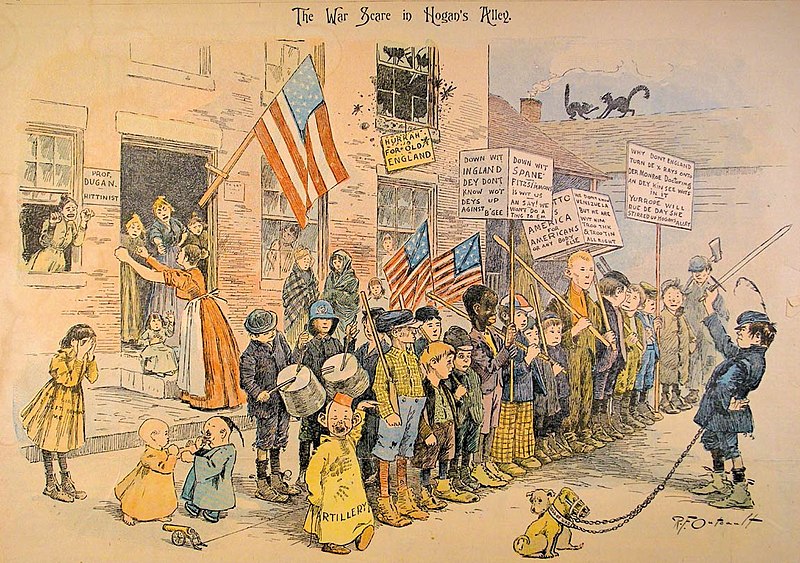
One of the first regular cartoons to appear in the World was Hogan’s Alley by R.F. Outcault (1863– 1928), featuring comic vignettes of the slums.

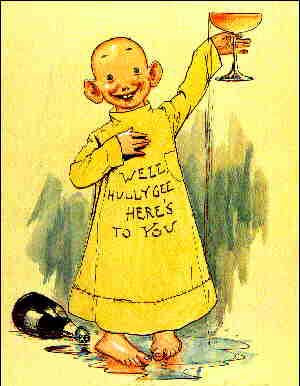
The hero of the cartoon soon came to be a rascally urchin called ‘The Yellow Kid’:

Hearst lured Outcault and his cartoon away from the World; Pulitzer sued; the upshot was that Pulitzer continued Hogan’s Alley, now drawn by George Luks, while Hearst published Outcault’s version under the title The Yellow Kid.

The traditional press looked on these vulgar papers with distaste. In an 1897 article in the New York Press, veteran newsman Ervin Wardman attacked Pulitzer and Hearst for their “yellow kid journalism”. Shortened to yellow journalism, the phrase still designates sensationalist, populist media reporting, whether in print or on the air… or on the Internet.

” The entire filing system has to be fixed — as it is, it’s as screwed up as Hogan’s goat.”

Outcault’s strip also gave rise to an expression especially popular in the Armed forces, particularly the Navy.

Hogan’s Alley had a smelly, bad-tempered goat in residence.

Any situation that is seriously fouled-up is said to be as f—ed up as Hogan’s Goat.

However, another famous Outcault creation– Buster Brown— was not, as some say, the source of the nickname and epithet ‘Buster’, which had existed years before he drew the strip.

************************************************************

“Wimps, I think; milquetoast souls who cough if someone is smoking across the street, who wear cardigans and bicycle clips; for god’s sake, if you’re so delicate, move to an ashram!”

George Michelsen Foy, Zero Decibels

The disparaging word (noun and adjective) “milquetoast“,  evoking weak-tea wimpiness and pusillanimity, comes to us from Caspar Miquetoast, the pathologically shy and timorous ” hero”,  courtesy of H.T. Webster (1885 – 1953),  of the weekly comic panel,  ‘The Timid Soul‘.  Milquetoast:  it’s a word often used for so-called  “henpecked” husbands in the Walter Mitty vein.

“Voters in this election were almost all polled at saying they were sick and tired of milquetoast congressmen: they wanted rebels with the guts to challenge the status quo”.

As my composite example attests, it has been trotted out repeatedly in the 2010 midterm congressional election: google “milquetoast politician/congressman” for examples.

********************************************************

“He spent the whole vacation complaining about the weather and worrying about the cost; it’s no fun having a gloomy Gus as a travelling companion.”

The appellation gloomy Gus for a depressed, pessimistic individual comes from Frederic Burr Opper (1857 — 1937)’s strip Happy Hooligan. Gus was one of the brothers of the hobo title character, and indeed he was in a perpetual state of  gloom; ironically, he always fared better than the optimistic Happy or the pretentious other brother, Montmorency, in their calamitous adventures.

Copyright registration for a Gloomy Gus doll.

In the panel below, Gus is at far left, next to Montmorency with Happy at the kissing booth at right.

****************************************************************

“Enter a haunted house? After you, my dear Alphonse!

Another Opper strip gave us a lasting idiom: Alphonse and Gaston. It was a one-gag concept, featuring two Frenchmen who would waste time insisting, with preposterous courtesy, on the other’s precedence even in the direst situations.

A situation where neither side will take the first step in concerted action is often called an Alphonse- and- Gaston situation:

“Both Democrats and Republicans agree the budget must be reduced, but neither party wants to be seen cutting popular programs such as Medicare; thus the Alphonse-and- Gaston standoff in the House.”

****************************************************************

“One of the FBI interrogation techniques is the old Mutt-and-Jeff routine taught by Army intelligence.”– Washington Post, 30 August 1964

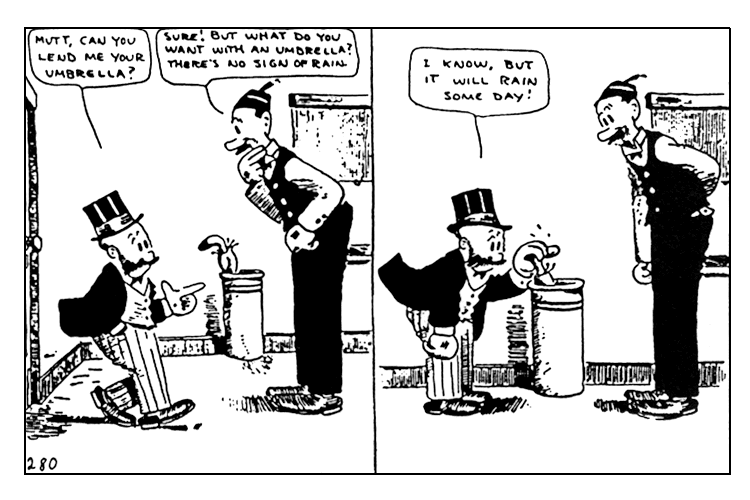
Mutt and Jeff was an immensely popular strip by Bud Fischer (1884 — 1954), featuring the adventures of a comically mismatched duo of friends, tall Mutt and small Jeff:

This physical disparity ensured that any pair of height-mismatched companions in America would be dubbed “Mutt and Jeff”.

The two differed in character, too.  Mutt fancied himself a sharp operator, quick with schemes to turn a fast buck, preferably at the racetrack. Jeff was a  gentle soul, something of an innocent, whose unworldliness would frequently derail unwittingly his compadre’s latest scheme, to the latter’s exasperation.

In police slang,  the “good cop/bad cop” interrogation technique was logically dubbed a Mutt-and-Jeff routine

************************************************************

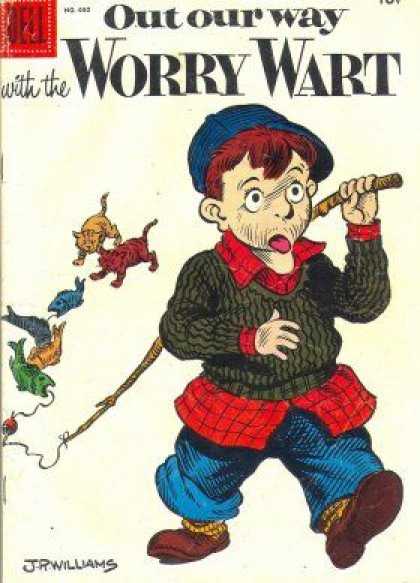
“First you think we’ll miss the plane, then you’re afraid it’s overbooked– honestly, you’re such a worry wart!

Art by J.R. Williams

From 1922, the cartoon panel Out our Way, drawn by J.R. Williams (1888– 1957)  celebrated the foibles of life in small- town America. A recurring character was the boy dubbed  the Worry Wart, because he created so many worries among others. When worry wart entered the language about 1956, the sense had shifted to one given to excessive worrying.

(Another Williams catch-phrase much beloved of my mommy was “Why mothers get gray“, trotted out at any egregiously foolish conduct on my part.)

*************************************************************

“He set up his own pump-and-filter system cobbled out of  reclaimed junkyard parts;  I’ve never seen such a crazy Rube Goldberg contraption.

Sometimes it’s the cartoonist who gives his name to the idiom.

Rube Goldberg (1883 — 1970), a prolific cartoonist with a long career, is best remembered for his designs of insanely complicated machines, made of ridiculous parts, to accomplish trivial feats like knocking on a door or catching a mouse.

Here’s Goldberg’s idea of an alarm clock:

Any over-complicated,  jury-rigged machine or system is apt to be tagged a Rube Goldberg contraption. ( We also refer to bureaucratic systems of insanely complex red tape as Rube Goldberg systems.)
I recall, as a child, being inspired by these cartoons (and by the Goldberg-derived game ‘MouseTrap‘ — does anyone else remember that?) to build my own nutty contraptions.  I’ll wager Goldberg inspired many a future inventor or engineer.

Since 1949, Purdue University has run the Rube Goldberg Machine Competition, where contestants are assigned a simple task to be carried out by a machine; the most absurdly complicated machine wins.

At the 2007 competition, this device was for pouring orange juice into a glass:


************************************************************

This was part 1 of a seven-part weekly series. In part 2, we’ll cover the great age of the comic strip…from Popeye to the Dragon Lady and beyond!

See you in the funny pages!

************************************************************
This is part one of a seven part series; click here for part 2, part 3, part 4, part 5, part 6,part 7 and an index.

Part 3 concludes our look at strips; parts 4 and 5  cover the comic book; part 6, gag and editorial cartoons; part 7, British and Commonwealth cartoons; and I would like to have a part 8, consisting of French, Italian, and other European colloquial languages enriched by their cartoons.

Friends–I need your help!

If you have any suggestions for cartoon-derived idioms along the above lines, please mention them in comments– or e-mail me at the yahoo dot com address alexbuchet

++++++++++++++++++++++++++++++++++++++++++++++++

Here are some useful and interesting online resources for language:
The Online Etymological Dictionary, an exhaustive source of word and phrase origins.
The blog wordorigins tracks current and historic words; its index of words and phrases The Big List is guaranteed to keep you riveted for hours.
The lively blog Language Log features witty and perceptive contributions from linguists. They keep a special watch on cartoons and comics.
A wonderful source for information on classic comic strips is Don Markstein’s Toonopedia, and another is the famous Lambiek encyclopedia of cartoonists. The two are complementary.

Oh, and congratulations to Craig Yoe and Clizia Gussoni on the birth of their son Griffin! Mazel Tov!