So Little Time, So Many TCJ Covers!

Since 1978 I haven’t missed a single isue of The Comics Journal. I won’t go into the many reasons for my devotion, but I’m sure many fellow readers will agree that one of its little pleasures were the numerous lovely, often witty covers it commissioned from some of the best cartoonists and illustrators worldwide.

Below is a small gallery of some of my favorites…


tcj_122

 
This merry drawing by Brian Bolland for #122 graces what is is easily my favorite TCJ cover. Impeccable execution and fine humor, contrasting boozy reveller John Bull with tight-assed Uncle Sam. The British do often like to mock American puritanism; however the illo also comments on the welcome shake-up of U.S. comics brought about by the artists and writers of the early ’80s “British Invasion”. Try to find a copy; the interviews are some of the most entertaining you’ll likely read. The Kevin O’Neill conversation made me laugh out loud.
 

895069

 
One of those Brit invaders was Bolland’s long-time compadre David Gibbons, who truly rocked the comics scene when he and scripter Alan Moore produced the seminal series Watchmen. One of that comic’s recurring motifs was a circular “smiley” face bisected by a blood splatter. The above cover by Gibbons for issue 116, depicting his drawing desk, evokes that image subliminally.
 

2832594-279

 
Two more from across the Atlantic: #279’s crisp composition by Dutch artist Joost Swarte
 

616745

 
…and the incomparable French draftsman Moebius in #118.
 

2352922-bookcover_cj1211

 
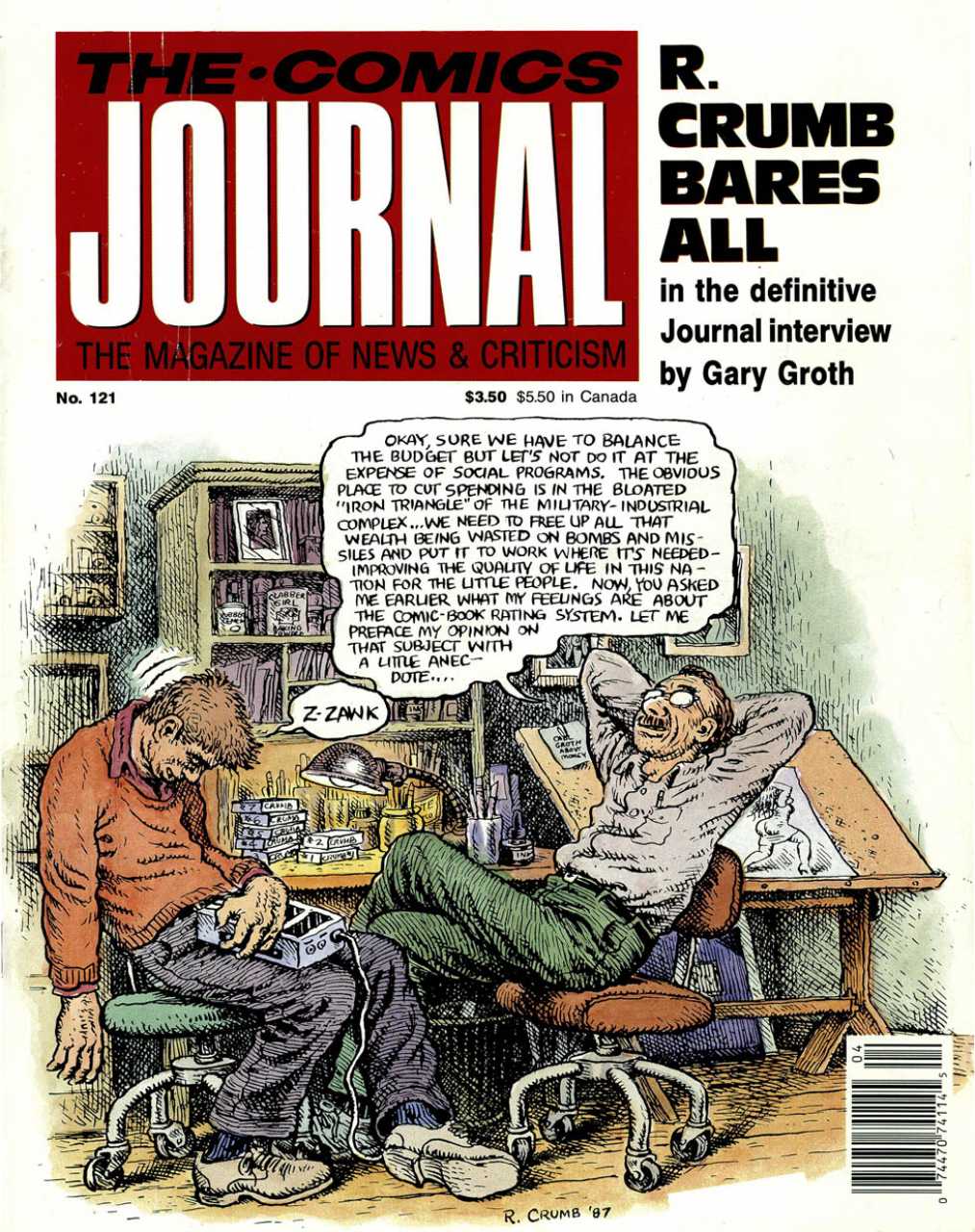
Another very funny cartoon for issue #121 by Robert Crumb. The artist mocks his own pomposity. The chap struggling to stay awake on the left is Journal publisher/editor Gary Groth, who’s made the cover several times — often to be teased… The cover showing the interview process is a recurring theme, one that I enjoy. Three more examples below:
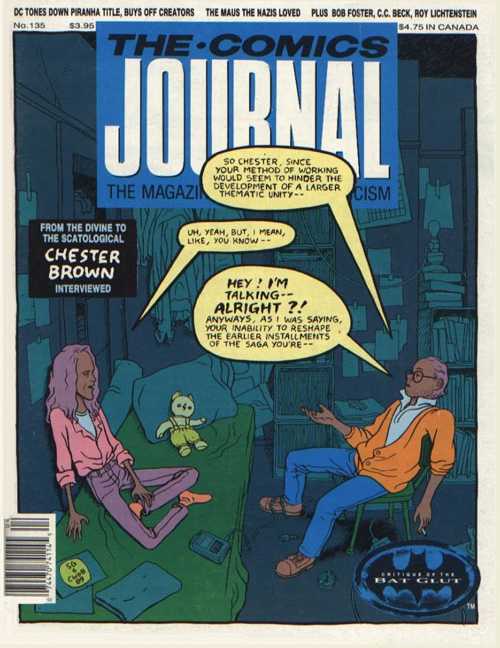
 

2832477-135

 
Chester Brown, who drew #135, was indeed a somewhat reticent interviewee faced with a garrulous questioner, as shown.
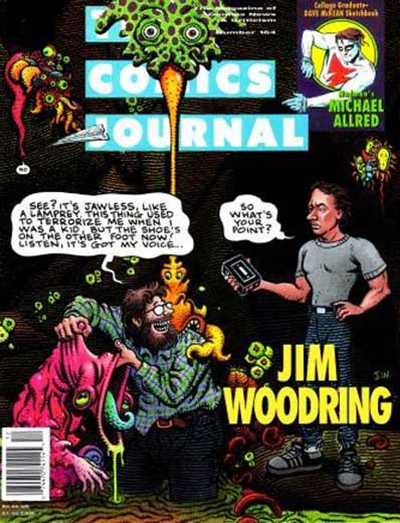
 

2832503-164a

Gary Groth again, drawn by Jim Woodring –another self-satirising artist…
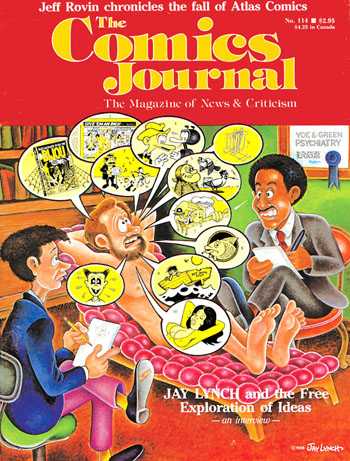
 

2352802-bookcover_cj114

 
And yet another, the underground comics artist Jay Lynch!
 

1093173

 
We segue to another underground classic cartoonist, the late Spain Rodriguez, whose gritty urban scene with touches of fantasy encapsulates the diversity of his art.
 

1093143

 
Spain was one of the artists who illustrated the naturalistic scripts of Harvey Pekar, as was Crumb, who illoed this slice-of-life for #97. (That’s Pekar in the blue coat, with Crumb next to him.)
 

631627

 
And another Pekar collaborator was the master of grotesque realism Drew Friedman.
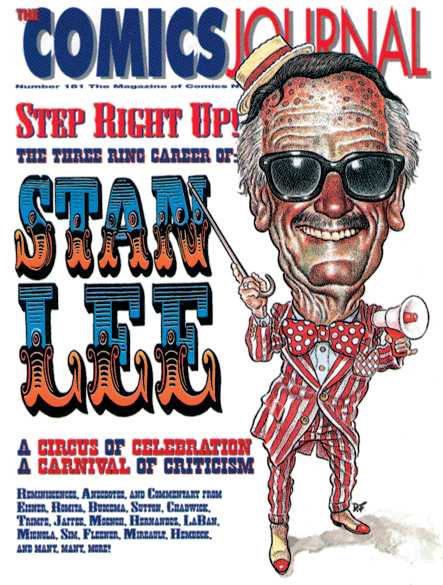
 

2831702-181

 
Friedman also contributed this caricature of writer-cum-huckster Stan Lee for #181. Now, sometimes the art direction for the covers is frankly not up to the actual illustration; but this time the AD worked in impeccable harmony with the artist. Below are two more exemplary cases of this.
 

954899

 
A terrific character design by Mike Ploog for #274 elegantly set off…
 

2832003-269

 
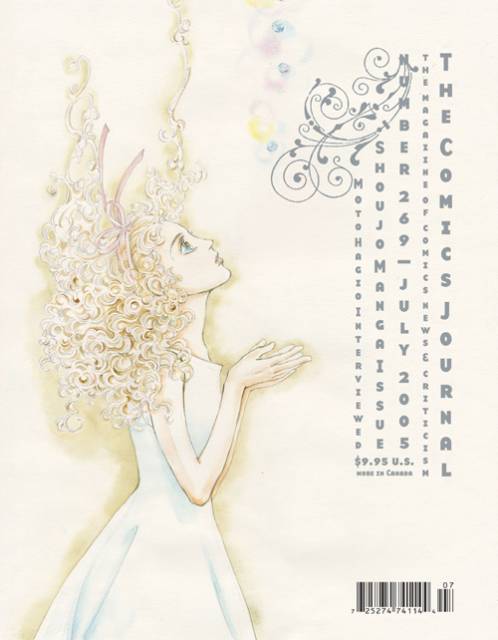
…and a lovely drawing by Moto Hagio for #269; apologies for the light scan, but the cover is truly a delicate confection.

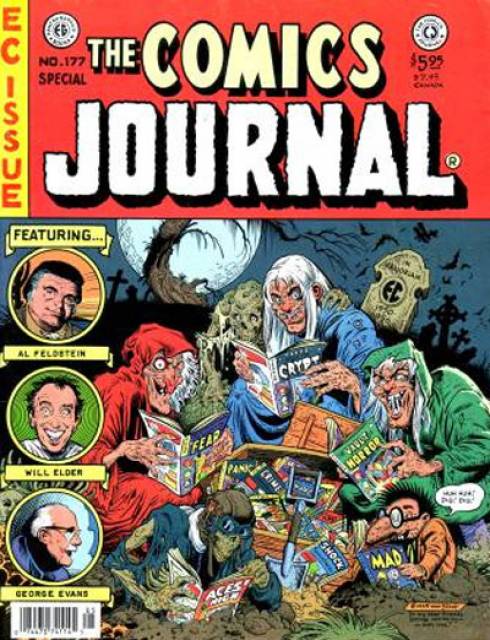
The EC comics from the ’50s were an inspiration to generations of artists.
 

2832505-177

 
Notable among them was Bill Stout, who pastiched their cover format twice for the Journal; above, for issue 177…
 

1093133

 
…and here, for #81. Those three Journal contributors at left? The Critic Keeper is, I presume, Gary Groth; the Old Bitch is probably Marilyn Bethke, one of the most virulent early writers for the mag; but who is the Fault Keeper? Enquiring minds want to know!
 

719287

 
Topping off this EC-themed trio: a Mad magazine pastiche by frequent Mad cover artist Kelley Freas for #225. Two of Freas’ iconic characters meet here: Mad mascot Alfred E. Neumann in the red spacesuit; and the Martian from Freas’celebrated cover to Fredric Brown’s comic SF novel, Martians Go Home. Freas is considered by some the greatest science-fiction illustrator of all.
 

895223

 
I’m frustrated by this one. Don Simpson drew an awesome wrap-around cover for issue 115, featuring literally dozens of comics characters from around the world. Alas, I could only find a scan for half the cover.
 

2352552-bookcover_cj0981

 
Kevin Nowlan drew this Alternative Comics Cadaver Derby for #98. Apart from Fantagraphics and Last Gasp, all the publishers whose characters are here racing off a cliff are in fact extinct: Eclipse, First, Renegade, Kitchen Sink, and Aardvark-Vanaheim…BTW, Howard Chaykin, the creator of American Flagg, stated that Nowlan’s depiction of that character (2nd from the right) was the best he’d ever seen, including his own.
 

1124755

 
I am very fond of multi-panel comics as covers, and above is a magnificent example by the mighty Frank Thorne for #280. Here the aged cartoonist, famed for his porn and cheesecake, laughs in the face of his own mortality: a joyful victory of Eros over Thanatos.
 

895281

 
Another good comics-as-cover by Dan Clowes.
 

895261

 
I simply enjoy the peacefulness of this drawing by Paul Chadwick for #221. The cross-section of snow with burrowing field mouse is a touch typical of the nature-loving artist. Its soothing blues contrast with…
 

2831728-218

 
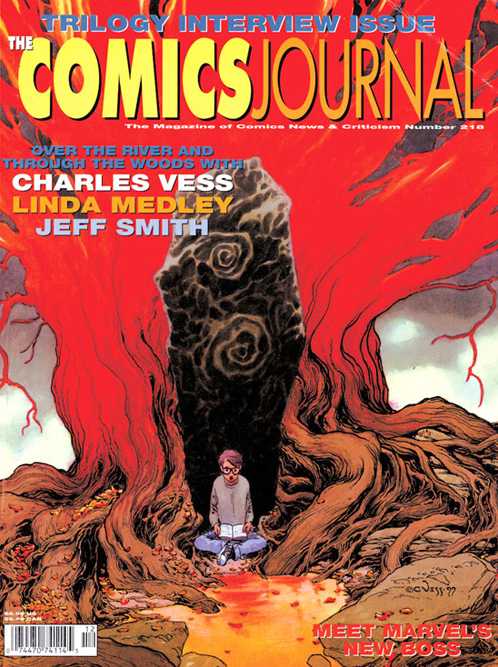
…the fiery eldritch reds of this Charles Vess illustration for #210. It’s hard to compose a symetrical picture that isn’t boring; he pulls it off here.
 

1093141

 
Another tranquil illustration by Stephen Bissette and John Totleben. Swamp Thing meditates on a newt for #93.
 

2350516-bookcover_cj052

 
Something of a fanboy guilty pleasure, this. Three stretching superheroes — Jack Cole‘s Plastic Man, Jack Kirby‘s Mr Fantastic, and Carmine Infantino‘s Elongated Man get tied up in knots… The artist is Dennis Fujitake, a prolific contributor to the early Journals and the artist on Journal publisher Fantagraphics” first color comic, Dalgoda, written by Jan Strnad.

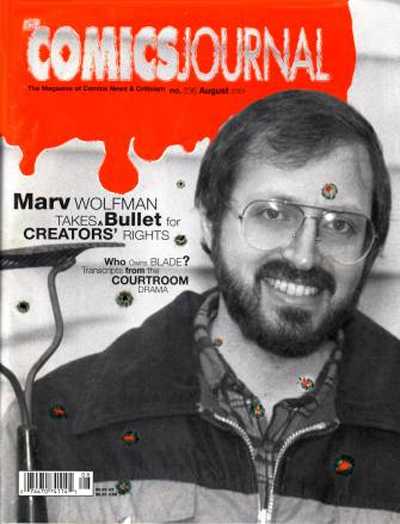
So much for attractive covers. What’s the Journal’s ugliest cover? The late Kim Thompson nominated this:
 

2832577-236

 
I can’t honestly disagree, can you?


697657

 
Let’s finish with a cover from The Comics Journal’s sister publication, Amazing Heroes, by the ever-inventive Bill Sienkiewicz. “Faster than a speedding bullet”, indeed.

Any of your own favorites missing? Browse for them either at mycomicshop or at the Comic Vine.
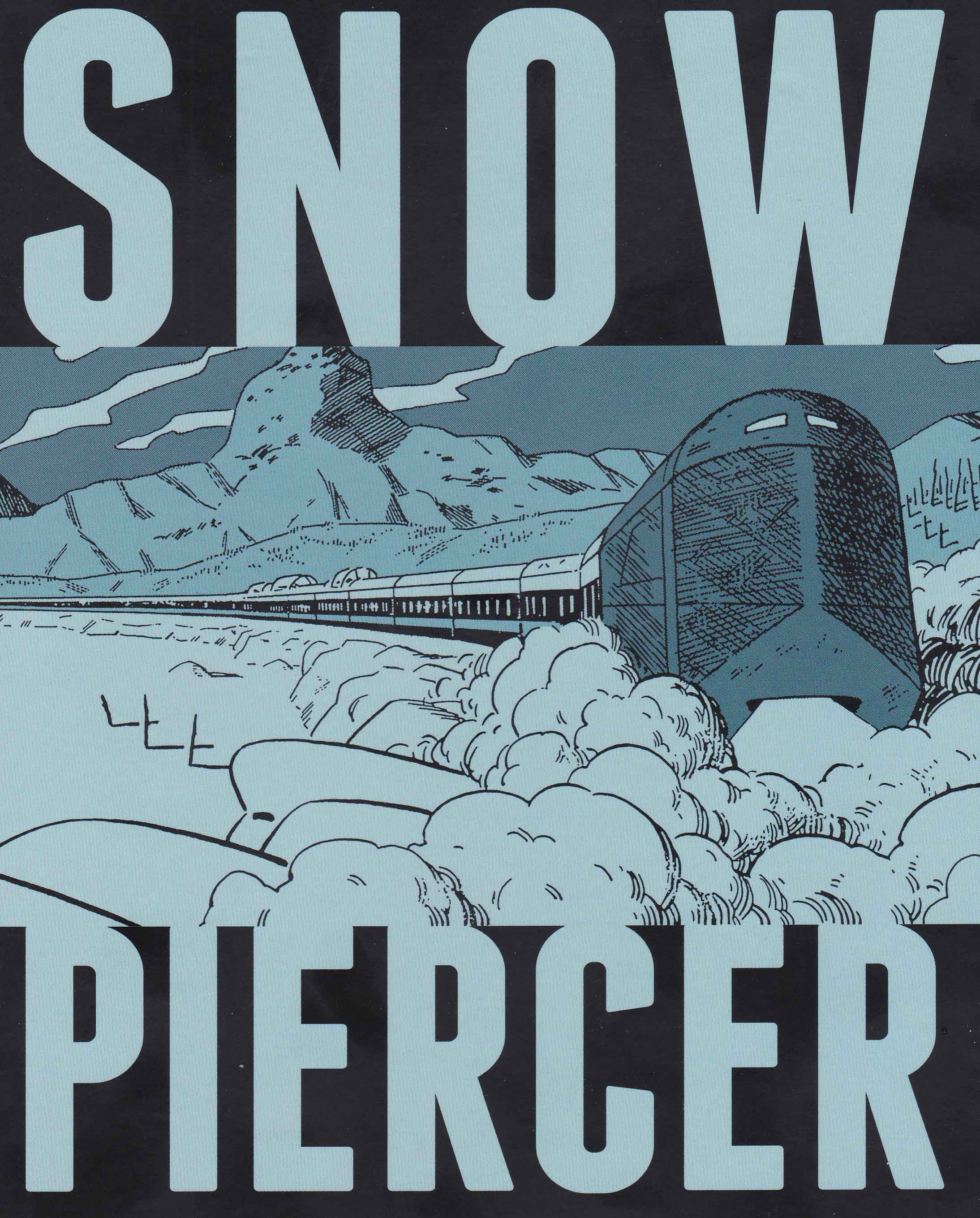
Snowpiercer and the Last Messiah

(Spoiler alert: The endings of both the comic and movie are spoiled utterly and completely)
 

Snowpierecer_0006

 
Films are quite often acts of misreading and miscommunication. The presence of fleshy humans and life-like movement have a tendency to lull audiences into passive acceptance, to turn metaphor into reality. If some people have enjoyed Bong Joon Ho’s adaptation of Jacques Lob and Jean-Marc Rochette’s Snowpiercer, it appears to be on the basis that it is an action movie with a few micrograms of grey cells ladled on top of it; those grey cells taking on concepts such as class and inequality, all somewhat lost in the shuffle of blood and bullets. In a sense, this seems an acceptable trade-off if only because I enjoy watching action movies.

The comic upon which the film is based is fragmented (possibly due to its roots in serialization in À suivre), almost meaningless in its connections, and has a Heavy Metal-style, Eurotrash obsession with naked women and whores. Yet it is intellectually more coherent and concerted in its purpose than the adaptation. The central device of a self-sustaining train (named Snowpiercer) as a metaphor for society is of course intact though Lob and Rochette’s description of it is impossibly large and thus purposefully absurd right from the onset. In both instances, the arctic apocalypse which has driven humanity to this mobile refugee camp appears to be man-made. Apart from this, there are other minor callbacks to the comic: there is the greenhouse carriage seen as a mini-wonderland within the close confines of the train; the glass observation cradle from which the protagonists view their metal world (reduced to a shootout in the film); and the sentient blob which is poked and sliced to produce food for the masses.

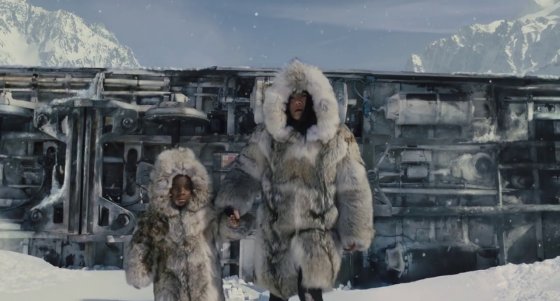
Bong has the money to feed his audience’s vicarious voyeurism, and the poverty and misery is laid on thick throughout his adaptation. There are fleeting glimpses of 20th century famines and assorted other tragedies. The (in)justice meted out in this hermetic society is medieval and the removal of body parts serve as compensation for sins committed—not an unfamiliar trope in Asian costume dramas. Their presence here reminds us that we live in an oligarchy if not an absolute monarchy. The minutes are filled with Tilda Swinton’s somewhat satisfying manic performance, as well as considerable forward momentum and violence. In the final reveal, the entrenched social hierarchy is seen to be the product of collusion between John Hurt and Ed Harris, the religious figures of the poorest and richest members of the locomotive. Perhaps a meditation on false consciousness and the complicity of the poor in their subjugation. Thus the film adaptation becomesan almost straightforward call for revolution. More, this particular revolution has a happy ending, one ignited with explosives which derail the train. Chris Evan’s pilgrimage to the front of the train is a success (though he does not survive it)—he is, in the end, a martyr, savior of children, and messiah. The survivors of the train wreck—a black Adam and Korean Eve—look out on to a barely hospitable winter landscape and life in the form of a polar bear. The world is saved; life will continue.
 

Snowpiercer Survivor

Snowpiercer Polar Bear

 
Strangely enough, Lob and Rochette’s comic hardly ever shows the degradation of the carriage slums, the final links in that chain of humanity. Most of it is communicated in words. We assume a multitude of deaths, cannibalism and what not. The decadence of the aristos is completely middle class and late 20th century Western Europe. They are ourselves and not distanced by the exaggerated efficiency of Tilda Swinton’s effete bureaucrat.

The protagonist, Proloff, is seen from the start in a carriage near “third class” being interrogated by soldiers who have caught him sneaking past his social station through a lavatory window (a meaningful escape). Adeline, his female appendage, is very much in the pre-feminist tradition of science fiction (see 1984’s Julia). She’s a social activist from third class hoping to alleviate the suffering of those crammed in the ghettoes of the nether carriages. She’s the innocent; the reader’s protective object and conscience; yet still possibly of more utility than her facsimile, Yona (Go Ah Sung), in Bong’s movie.

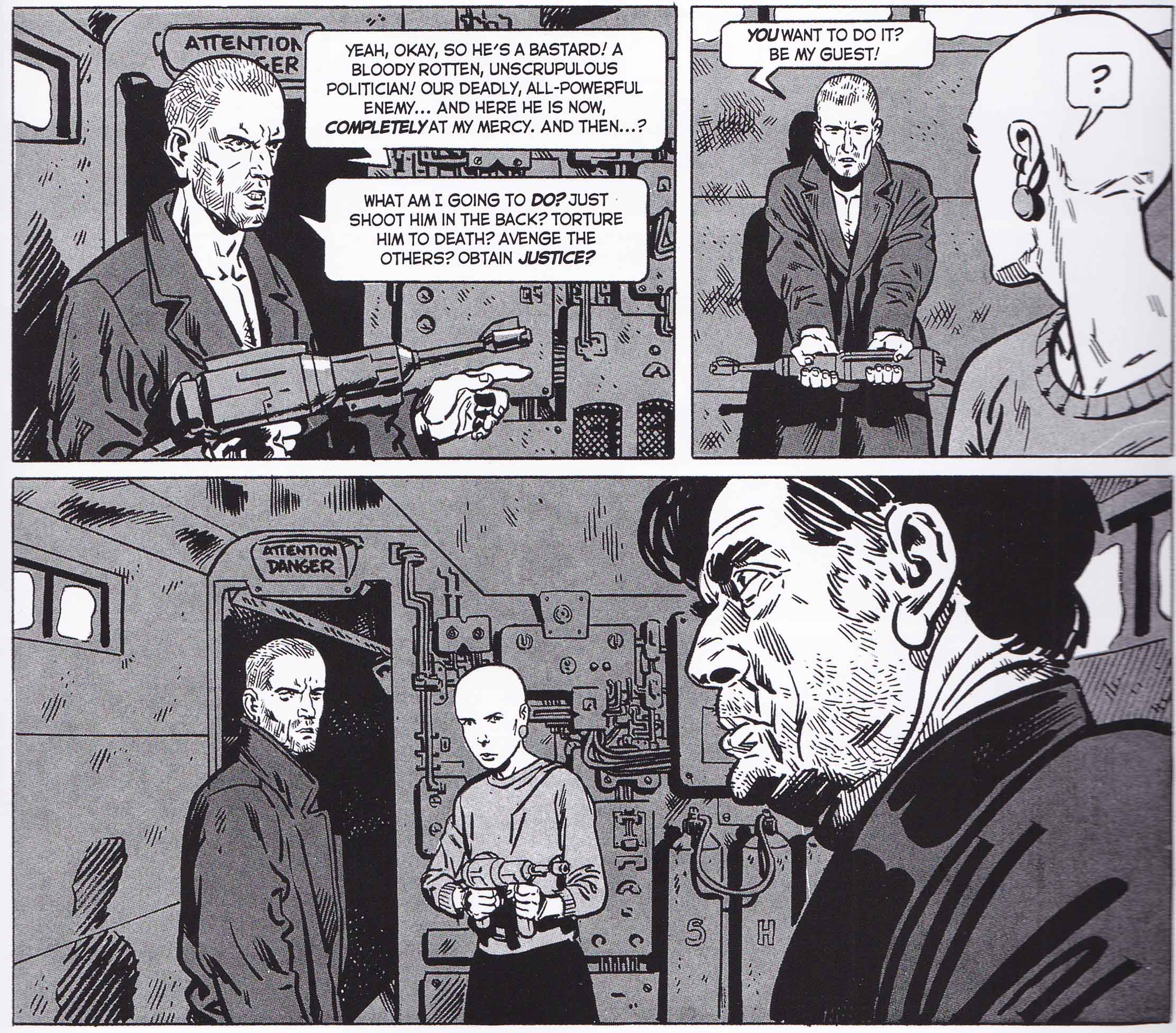
As with the film adaptation, Proloff also reaches the front of the train after a series of trials. The pair confront el Presidente who has hitherto been seen shouting orders to his henchmen down a microphone while monitoring the serfs on his mobile estate via closed-circuit television. But there is no comeuppance here; the President seems very much alive at the end of things. Proloff lets him go without any attempt at rectifying social injustices or enacting lethal vengeance. When Proloff offers his gun to Adeline, she turns around and refuses to do the same.
 

Snowpierecer_0002

 
And since this is a comic very much in the French tradition, one assumes an implicit rejection of the values of that more famous revolution of 1789—no murderous rampage, no guillotine, no reign of terror, and certainly no cleansing Napoleonic wars. Then again, since the name of our protagonist has a Russian-Slavic ring to it, one might evince some connection to the Russian revolution of 1917 which ended with even more dead bodies than the French one. The links are purposefully uncertain—the cramped suffocating cabins of the comic and desperate crowds milling in front of the carriages certainly bring to mind Holocaust transportation; the shaven heads of our protagonists every form of concentration camp and gulag.

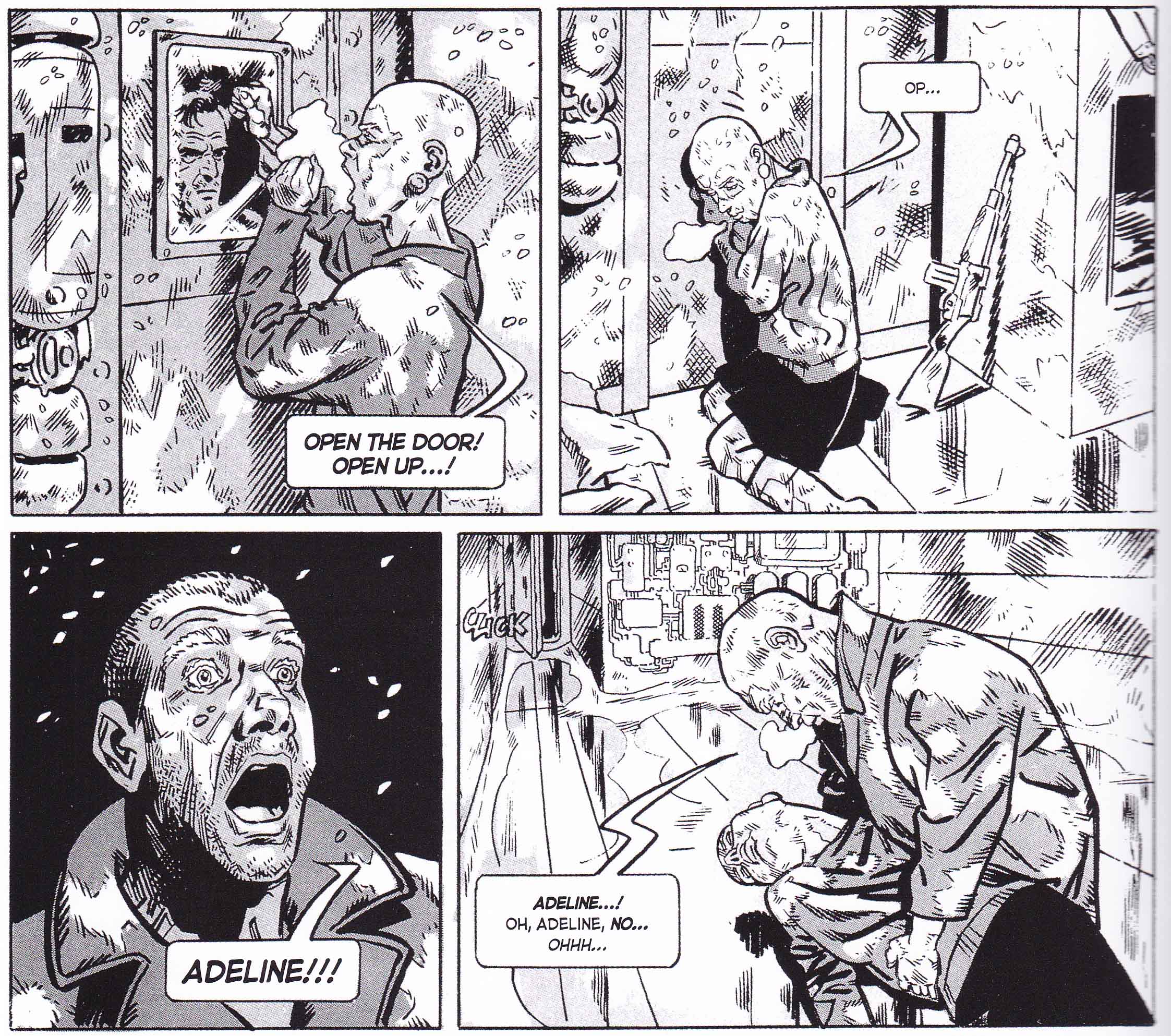
Proloff is characterized by his haphazard planning and inaction at critical junctures. In fact, his only act of volition in the closing pages of the comic is to shoot out the windows of the next to last carriage he has found himself in—the carriage just before the main engine room of Snowpiercer—thus condemning both Adeline and himself to a quick icy death; an act which he regrets almost immediately since he realizes that his nihilism isn’t shared by Adeline.
 
Snowpierecer_0003

 
So dies Adeline—the Marianne of Lob’s tale—so dies idealism and reason. The winter which envelops her is not the welcoming, livable land of Bong Joon Ho’s film but quite incompatible with life. Proloff’s subconscious attempt at suicide is to no avail since he is saved by Alec Forrester, the father of the (near) perpetual motion engine which drives Snowpiercer, a haven which is periodically referred to by some cultists as Saint Loco.

The train is the universe in seemingly unending motion, yet gradually and imperceptibly losing its momentum—the Big Freeze beckons, all of space doomed to snuff out with the whimper of heat death.
 

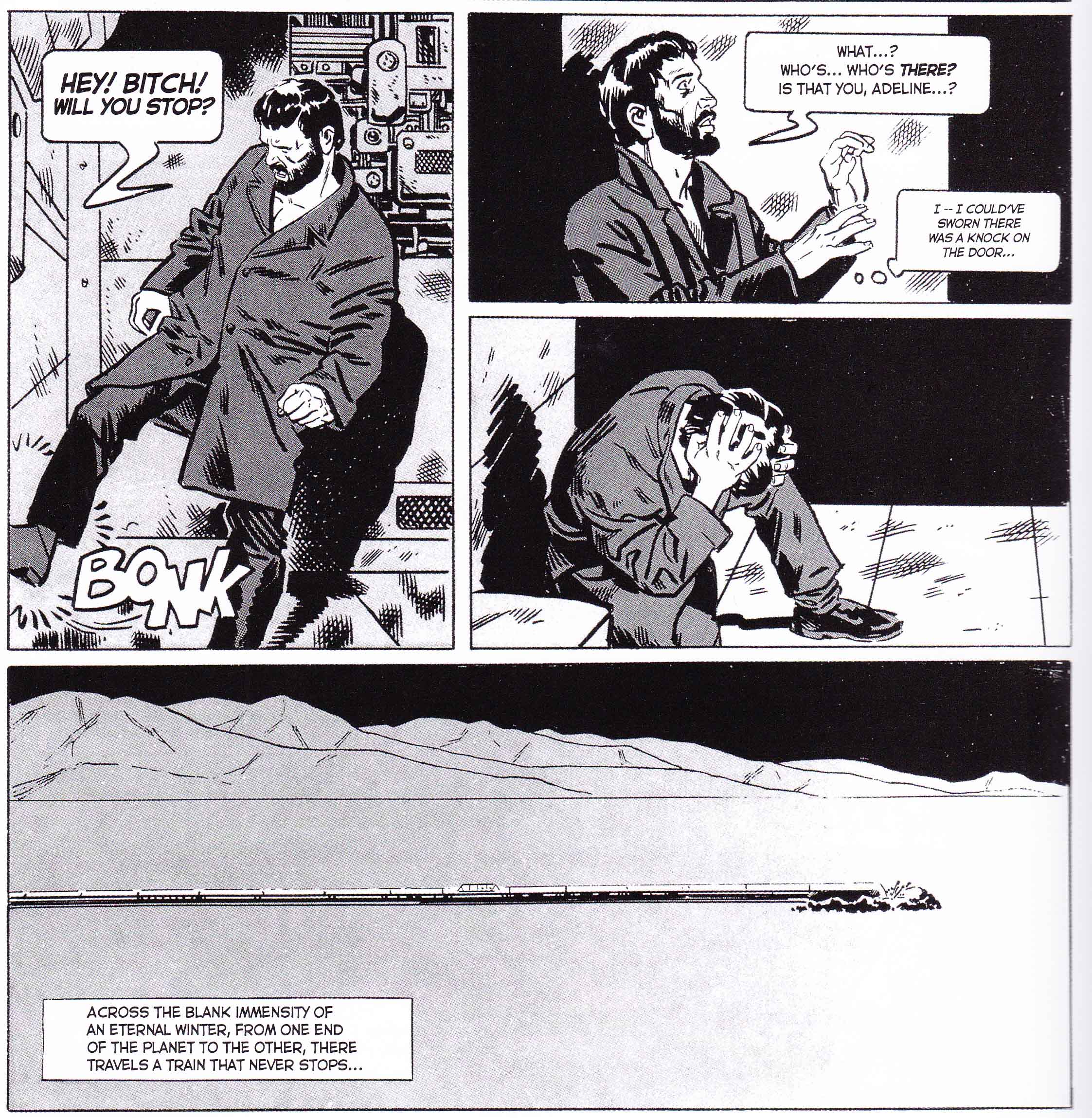
Snowpierecer_0005

“Across the blank immensity of an eternal winter, from one end of the planet to the other, there travels a train that never stops.”

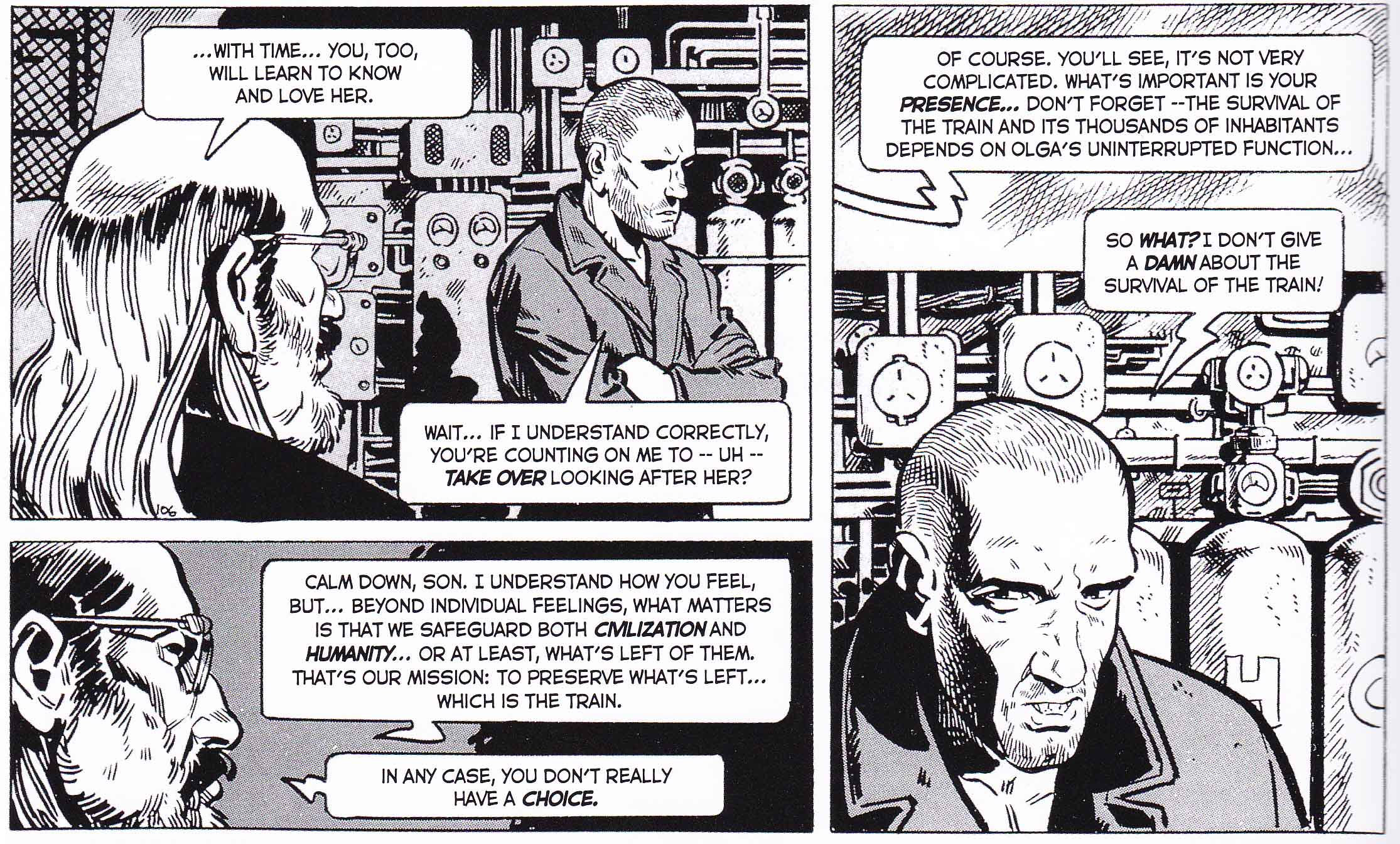
The aging engineer, Forrester, is a sickly but calm mad man. He is obsessed with the survival of the human race and civilization, yet so alienated from his fellow humans that all he desires is complete isolation—a misanthropic humanist. He may seem like a balding Ancient of Days but is anything but.
 

Snowpierecer_0004

 
This is not to say that misanthropic humanism represents the highest ideal of our society, but  it does appear to be the central driving force behind it (according to Lob). If anything, the engineer (this impetus) is depicted as an object of ridicule—a petty man behind the curtain, a diseased Wizard of Oz. The creator of the train is unnecessary for its running. He is the absent watchmaker voyeuristically spying on the train’s lesser beings, tirelessly speaking to a rumbling machine which makes no response.

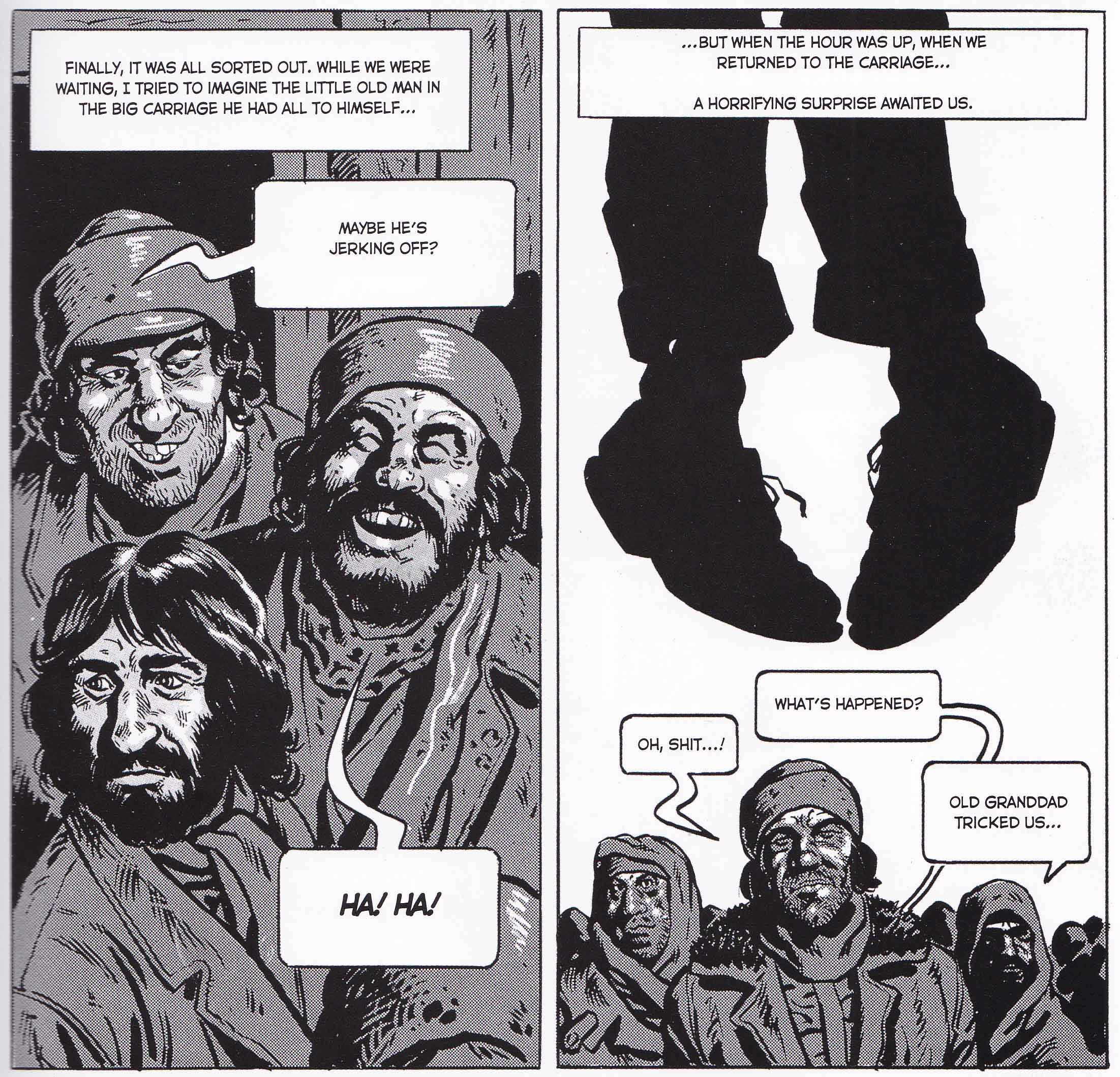
The train(s) keep on running but for no objective reason except the act of reproduction, occasional tenderness, and countless instances of inhumanity. This is the sum total of everything that has preceded this point in the story. Antinatalism would seem the obvious solution but is summarily rejected. The single memory which Proloff recounts to his interrogators at the start of the comic involves the act of providing a birthday present to a “sweet and quiet” old man “loved” by everybody. That gift is an hour of solitude which the man promptly uses to hang himself.
 

Snowpierecer_0001

 
And that is probably the central motivation of Snowpiercer. Proloff’s entire journey to the “front” of the train (to the “front’ of society) is a quest for solitude to die with dignity, to kill himself in the luxurious confines of first class. As Varlam Shalamov writes in Kolyma Tales, “There are times when a man has to hurry so as not to lose his will to die.” In this allegory of life, the next to last carriage before meeting “God” has been christened death. The tragedy of Proloff’s tale is that even this simple extravagance is forbidden him. A similar kind of stoicism is found at the denouement of Max Ophul’s Lola Montes where Lola’s precipitous dive into an impossibly small tub does not lead to her death but a dull, humiliating existence; a kind of unwanted life after death.

At the close of the comic, a mysterious plague is carrying all before it from the back end of the train; its source unknown, possibly disseminated by Proloff himself, his nihilism reeking havoc on everything he touches. Only Proloff’s isolation from the mass of humanity protects him from its effects. He has “lost his right of residence in the universe” (Peter Zapffe) and in solitude waits out the end; not the last Messiah, just the last man.


__________


“…he feels the looming of madness and wants to find death before losing even such ability. But as he stands before imminent death, he grasps its nature also, and the cosmic import of the step to come. His creative imagination constructs new, fearful prospects behind the curtain of death, and he sees that even there is no sanctuary found. And now he can discern the outline of his biologico-cosmic terms: He is the universe’s helpless captive, kept to fall into nameless possibilities.”

The Last Messiah, Peter Wessel Zapffe

The Real Meaning of Columbusing

This first ran on Splice Today; thought I’d rerun it here for Columbus Day.
______________

To Columbus. It’s a verb meaning to discover something (especially if you’re white) that’s already been discovered.  The term was coined by College Humor last month, and it’s useful. Miley Columbused twerking; Elvis Columbused rock ‘n’ roll; Richard Burton Columbused the source of the Nile; the protagonist in that College Humor video Columbuses a mostly non-white bar. Columbusing—everybody’s doing it.

Still, for all its benefits, the term is also a bit misleading. “To Columbus,” suggests that the funny/icky think about Columbus was cultural appropriation. The problem with Columbus, “Columbusing” tells you, is that the guy, Columbus, took credit for stuff that he didn’t do. And taking credit for something that you didn’t do is unpleasant, there’s no doubt. But it’s not really as unpleasant as murder, slavery, torture, and genocide. Which is what “Columbusing” should actually mean if we wanted to be honest.

Christopher Columbus, the great explorer, is one of the monsters of history. That’s not because he claimed to discover something that he didn’t discover. It’s because he was a vicious, evil murderer. When he first landed in the Bahamas, Columbus met the Arawak Indians (or the Taino), and commented on their generosity and friendliness. He also ominously said, “[T]hey would make fine servants…. With fifty men we could subjugate them all and make them do whatever we want.” And sure enough, right off the boat he kidnapped a number of them and took them back to Europe.

Most of the kidnapped Arawaks died from disease and mistreatment, but Columbus was not deterred. He returned to the Bahamas, determined to get precious metals. He commanded all Arawaks over 14 to bring him a quota of gold every three months. Those who didn’t were, according to Columbus’ son, “punished by having their hands cut off,” and left to bleed to death. Since there wasn’t much gold in the Bahamas, few people could bring Columbus what he wanted. Some estimates suggest that the Spaniards, in their greed, maimed and killed as many as 10,000 people.

Historian and priest Bartolome de las Casas recorded additional atrocities. The Spaniards turned their hunting dogs loose to tear Arawak apart; de las Cases says “Arawak babies were killed for dog food.” Children had their legs cut off when they attempted to run away; some Arawaks were roasted on spits. Columbus rewarded his men for their services by giving them Arawak women and girls of as young as nine and 10 years old to rape.

Thanks to these atrocities, the Arawak population dropped from as many as a million to only 60,000 by 1507, and less than 500 by the middle of the 1500s. Many of these deaths were from disease, but given the evidence of Columbus’ widespread spree of murder and cruelty, it’s fair to call this a vicious genocide. Columbus’ crimes were so glaring that he was arrested and sent back to Spain, where he was convicted… only to receive a royal pardon.

Ideally, then, “to Columbus” would not mean, “to claim to have discovered twerking.” It would mean, “to enslave people and amputate their hands,” or “to rape 10-year-olds,” or, more generally, “to commit a genocide.” Columbus shouldn’t be a cute term for cultural appropriation; he should be a synonym for Hitler or Stalin or Pol Pot.

I don’t mean to dismiss the problem of cultural appropriation altogether. People borrow from each other all the time, and that’s not a bad thing. Unless, as Brenda Salinas notes, you borrow only bits and pieces while continuing to indulge in racist contempt for the people from whom you’re borrowing. “It seems like a paradox to relish your fajitas,” Salinas says, “while believing the line cook should get deported.”

The issue then, isn’t cultural mixing, but cultural mixing in a context of racism and systematic disproportions of power. And the irony is that the term “Columbusing,” which is supposed to highlight those disproportions of power, actually works to erase them. Columbus isn’t a hero; he’s not a joke. He’s the genocidal rapist and murderer who our government has decided to honor as the iconic founder of our country and polity. Imperialism may work in part by giving people credit for things they didn’t do, but it works even more insidiously by conveniently forgetting to give people credit for the unpleasant stuff they did. Maybe that’s really what “to Columbus” should mean—to forget the atrocities you’ve committed so thoroughly that you don’t even know when you’re joking about them.
 

De_Bry_1c

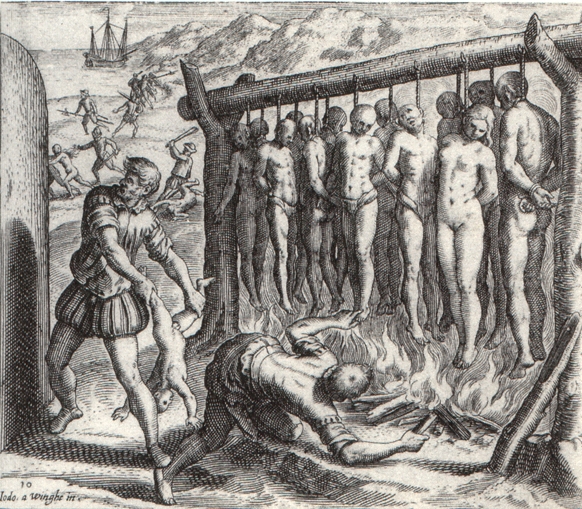
Theodor de Bry, illustration for Bartolomé de las Casas, A Short Account of the Destruction of the Indies (1552)

The Shadow Done Gone

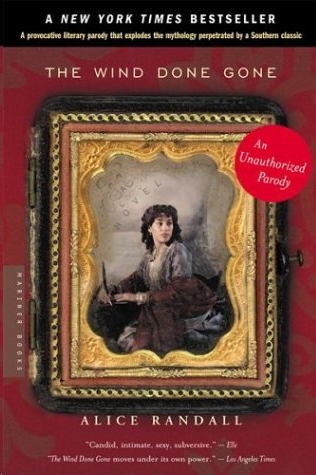
Wind-Done-Gone-RandallAlice Randall’s “The Wind Done Gone” is superior to the Margaret Mitchell novel it is based on in many respects. Though Mitchell’s prose is quite good, Randall’s is better , earthier and more poetic at once (“It’s a pissed bed on a cold night to read words on paper saying your name and a price.”) Randall’s economical, short book also avoids Mitchell’s tendency to ramble. But perhaps most surprising in a sequel/parody, Randall’s book makes more sense.

It’s a staple of fan fiction to fill in the blank spaces and plot holes. Still, Randall manages to do so with unusual grace. Much of Mitchell’s drawn out plot and her surprise twists are built on her characters lack of self-knowledge. Rhett is so afraid of giving power to Scarlett that he won’t tell her he loves her, even after they marry — and then, finally, he falls out of love with her, thump. Scarlett, for her part, thinks she loves Ashley and hates Mellie, until Mellie dies and she realizes, no that was all a mistake. Ashley has a similar storyline; he loves Scarlett until he realizes he doesn’t and never did. Mellie thinks Scarlett is her best friend even though Scarlett spends most of her life loathing her. Everyone seems utterly severed from their own emotional life. It strains credulity that one character could be this gob-smackingly dumb; but two? three? four? It starts to seem like carelessness.

In Randall’s book the source of the stupidity isn’t carelessness. It’s racism. The main characters in Gone With the Wind can’t know themselves, because if they knew themselves, they’d have to know about black people, and then their world would collapse. Mitchell’s characters, as seen by Randall, aren’t dumb; they live in a society of secrets and lies, in which not knowing is the basis of their existence. So Rhett doesn’t just fall out of love with Scarlett; rather, he always was in love with her half-sister, Mammy’s daughter Cynara, and his vacillations in love are the result of his painful uncertainty about marrying, or loving, a black woman. Ashley, for his part, never declares for Scarlett not because he’s a dishmop, but because he’s gay; Mellie has his black lover whipped to death at one point. And Scarlett, so set on not knowing herself, is not just stubborn, but has a real secret or two — a lifetime spent refusing to think about the fact that her beloved maid and surrogate mother slept with her father, and a lifetime spent refusing to think about her sister.

You’d think that looking unflinchingly at the racism in Gone With the Wind would make the white characters unsympathetic. In fact, though, Randall’s Scarlett, and Rhett,and Ashley are all significantly less awful than Mitchell’s. In Mitchell’s version, they’re all just horrible people, indecisive, whining, opaque to themselves, and fighting ceaselessly on behalf of slavery because they suck. Randall, in contrast, grants them the context that has deformed them. Rhett’s decision to become a Confederate soldier at the last minute, for example, is seen in GWTW as a triumph, and is therefore unforgivable. In Wind Done Gone, it’s portrayed as a painful lapse; a mark of how much racism touches even a man who, in many respects, has been able and willing to get beyond the prejudices of his society. (“R. fought and tried to die in a Confederate uniform to save this place,” Cynara thinks of her lover, and later husband. “I have tried to forget this, but I remember.”) Scarlett’s blank self-centeredness becomes more understandable when we see her parents’ marriage as loveless, and lack of self-knowledge seems more understandable when we learn her life was in no small part a lie. Her mother was partially black,and concealed her past and her own emotional investments from family, and especially from her daughter. GWTW famously (and counter-intuitively for a romance) concludes in bitterness and the break-up of a marriage; Randall’s is the book with the not exactly traditional, but still happy ending. The Wind Done Gone can manage forgiveness because it is able to talk about what needs to be forgiven; GWTW is filled with too much hate to arrive at love.

___________

Ruthanna Emrys’ novella “The Litany of Earth is version of “The Wind Done Gone” for evil fish-creatures. Where Randall presents GWTW from the perspective of the slaves and freed blacks, Emrys looks at H.P. Lovecraft’s mythos, particularly his Innsmouth stories, from the perspective of the monsters — and from the perspective of Lovecraft’s own vile racism. The main character, Aphra Marsh, has had much of her family hunted down and killed by the authorities, who also subjected them to brutal medical testing. Innsmouth people are still regularly policed by government spies; the parallels to the U.S. Japanese concentration camps, and to Hitler’s genocide, are drawn explicitly.

In discussions of Lovecraft, I’ve often seen fans argue that the horror in his stories is not linked directly to the racism. Instead, they say, the terror is tied to his atheism — to the apprehension of an infinite, indifferent cosmos, which was not built for humans and does not care about them.

Emrys keeps the cosmic emptiness in her story. Marsh’s people repeat a litany, in which they number the people of earth, from the distant past to the distant future, who have lived and will live and will all pass away. ““After the last race leaves, there will be fire and unremembering emptiness. Where the stories of Earth will survive, none have told us.” But the emptiness and meaninglessness don’t lead to horror. Instead, “In times of hardship or joy, when a child sickened or a fisherman drowned too young for metamorphosis, at the new year and every solstice, the Litany gave us comfort and humility.”

I think that’s right; knowing the universe is alien isn’t a horrible or fearful thing unless you first believe, as Lovecraft did, that the other and the alien are terrifying. The cosmic horror is horror not because the cosmos is intrinsically horrible, but because Lovecraft was racist. The indescribable gibbering darkness, the unnameable monstrosities; they’re indescribable and unnameable for the same reason that Scarlett and Rhett are irritatingly dense — because racism means you’re not allowed to know those other people, over there, which means you also can’t know yourself. Racism poisons Gone With the Wind, and it poisons Lovecraft’s world too. In Lovecraft and Mitchell that’s the shadow that can’t be named, and that neither wind nor war can blow away.

Utilitarian Review 10/11/14

On HU

Featured Archive Post: Allan Haverholm on comics definitions.

A few of us talked about the best music of the year so far.

Me on Nick Cave’s The Boatman’s Call.

Nicholas Labarre on the history of the history of meta-Godzilla.

Me on Alexis Coe’s book about a lesbian murder in Memphis, Alice and Freda Forever.

Ng Suat Tong on the crappiness of the Dishonorable Woman.

Christopher Lehman on warnings about racist content on Tom and Jerry episodes.

Chris Gavaler on Les Mis, superheroes, and the closet.
 
Utilitarians Everywhere

At Reason I wrote about how Internet activism helps sex workers.

At Pacific Standard I wrote about

—Emma Watson being wrong about Beyoncé performing for the male gaze

Steven Salaita and how the university doesn’t care about teaching

At Splice Today:

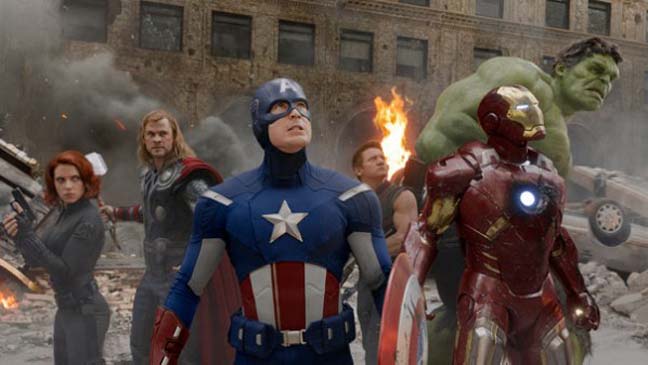
— I finally saw the Avengers and it sucked.

— I finally saw the Game of Thrones pilot and it wasn’t so great either.Center for Digital Ethics I argued that it’s unethical to look at stolen celebrity nudes.

At the Chicago Reader, a brief review of Marketa Irglova.

A short music mix for Publik Private.

 
Other Links

A comic on stripping and stigma.

Samantha Field on Buffy and Riley’s abusive relationship.

Jamie Nesbitt Golden on grieving for her mom.

Olga Khazan on Nickelodeon and white guys.
 

the-avengers-film-still

How to Out Yourself

Logo_ncod_lg

I don’t know if Victor Hugo was gay. But I do know he wrote some of his most influential work from exile—including political pamphlets, three books of poetry, and Les Misérables, a historical novel about the French Revolution that he “meant for everyone.” Hugo describes it like a superhero answering a cry for aid: “Wherever men go in ignorance or despair, wherever women sell themselves for bread, wherever children lack a book to learn from or a warm hearth, Les Miserables knocks at the door and says: ‘open up, I am here for you.’”

I did not see Les Mis, either on stage or on screen, but my kids went with their Nana after my wife and I escaped for our own outing: fancy dinner (turns out steak tartare is a raw hamburger), romantic movie (Jennifer Lawrence is a shape-shifting genius even when not playing a blue-skinned mutant), and historic B&B (former haunt of musical legend Oscar Hammerstein). We had a better time than the kids. My son was not wooed by Hugh “Wolverine” Jackman, and my daughter would not list on-set singing among his superpowers.

But the X-Men casting choice did spotlight some secrets in the musical’s origin story. Both literary blogger Chrisbookarama and Slate culture editor David Haglund declared Jean Valjean a “superhero.” They note his dual identity (alias “Monsieur Madeleine”), his superpowers (the strength of “four men”), and his arch nemesis, Inspector Javert (inspired by real-life detective Eugène François Vidocq). There’s even an unmasking scene:

“One morning M. Madeleine was passing through an unpaved alley” where an “old man named Father Fauchelevent had just fallen beneath his cart.” A jack-screw would arrive in fifteen minutes, but “his ribs would be broken in five.” Madeleine sees “there is still room enough under the cart to allow a man to crawl beneath it and raise it with his back,” and he offers five, ten, then “twenty louis” to anyone willing to try. Javert, “staring fixedly at M. Madeleine,” declares: “I have never known but one man capable of doing what you ask.”

Although Valjean is breaking the law by disguising his past as a convict, he “fell on his knees, and before the crowd had even had time to utter a cry, he was underneath the vehicle.” Even the old man, “one of the few enemies” Valjean has made as Madeleine and then only from jealousy, is begging him to give up, when “Suddenly the enormous mass was seen to quiver, the cart rose slowly, the wheels half emerged from the ruts,” and “Old Fauchelevent was saved.”

“Just like a superhero,” writes Haglund, “outed by the noble use of his super strength.”

My daughter assured me the film framed it as a burst of Hulk-like adrenaline, but Victor Hugo was going for much more. Although Valjean emerges in torn clothes and “dripping with perspiration,” he “bore upon his countenance an indescribable expression of happy and celestial suffering” as the old man calls him “the good God.”

It’s the self-sacrificing yet self-ennobling choice saviors make every day. Even Jesus in Martin Scorsese’s Last Temptation of Christ wants to hide in a mild-mannered lifestyle, before fully accepting the job of super-savior. Ditto for Tobey Maguire’s Peter Parker and Michael Chiklis’s Ben Grimm. A hundred years earlier, O. Henry’s safe-popping Jimmy Valentine outs his Valjean past by saving a child from suffocating in the town bank vault. Philip Wylie’s superhuman Hugo Danner longs for the quiet life too, but fate slams another would-be victim into another character-revealing bank vault.

And there’s always a Javert standing right there trying to glimpse your secret self. Jimmy has detective Price on his trail (though in a typical O. Henry twist, he lets his Valjean go). That pesky tabloid reporter followed Bill Bixby for five seasons, always ready to snap a picture when Lou Ferrigno burst out during the emergency-of-the-week. Like Les Mis director Tom Hooper, the CBS team decided their Incredible Hulk was just a burst of green adrenaline, the kind that allows Clark Kents to shoulder cars off endangered loved ones. That’s the phenomenon Bixby’s Banner is researching before his laboratory mishap, his atonement for failing to save his wife when fate dropped Fauchelevent’s oxcart on her.

But Haglund’s comment unmasks another kind of outing. When my former department colleague and next door neighbor Chris Matthews read that Slate article “Why Tween Boys Love Les Miz,” he emailed me about Hagland’s “silent premise,” the implication “that there’s something weird about boys liking musicals.” And we know what alter ego lurks under that tale-tell proclivity. “The figure of the musical-loving boy or man,” says Chris, “has long functioned as both an element of gay male identity and as a handy stereotype for mocking ‘effeminate’ men, gay or not.”

I noticed plenty of family photos decorating the Hammerstein B&B, evidence that Rodgers was his partner in the strictly professional sense. But it did occur to me to check. GLBTQ, the online encyclopedia of gay, lesbian, bisexual, transgender & queer culture, lists Hammerstein as “apparently quite straight,” but the site still can’t explain “the attachment many gay men have to the musical theater or the fact that in the popular imagination a passion for showtunes is practically a marker for homosexuality.”

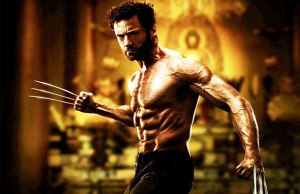
Les Misérables premiered in 1980, twenty years after Hammerstein’s death, ninety-five after Victor Hugo’s. I was fourteen, Chris’s age when he saw it on stage. Haglund was nine his first time, so his pubescent body wasn’t bursting through his sweaty clothes just yet. Maybe that’s why he remains a tone-deaf Javert when it comes to identity-shifting. He sounds relieved that a superheroic explanation for Miz-loving boys hit him while watching Jackman belting it out. Why Do Tween Boys Love Superheroes? Because they’re not “weird.” He thinks his men-in-tights insight is “more particular” to boys, even though both sexes get equally erotic eyefuls of Jackman’s shirtless flexing. Sorry, David, but as my former neighbor points out: Hugh is hot.
 

hugh-jackman-ripped-up-for-wolverine-hot-sexy-images-ggnoads

 
Chris, by the way, is not gay. At least not in the I-like-to-have-sex-with-other-men sense. Like my and Hammmerstein’s homes, his is decorated with family photos. He claims to be “terribly low on football-related and power-tool-based conversation,” but wow can he unman me on a racquetball court—an advantage none of my Hulk-like adrenaline can match. Chris also grew up in the apparently quite straight world of comic books. While his tween-self was singing along to the Les Mis soundtrack, he was flipping pages of Spider-Man and Moon Knight. “Superheroes were not the guise of normalcy I wore over the shameful secret of loving a musical,” he says, “they were yet another way of getting around the pressures to be normal.”

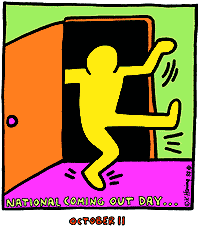
Saturday October 11 is National Coming Out Day. It’s not a Revolution. It’s just a celebration of the superheroic who continue to overthrow the pressures of the so-called normal. I wish them all a safe return from their personal exiles.
 

x-t2

How Should Tom & Jerry’s Ethnic Humor Be Packaged Today?

drw-mammy2shoes

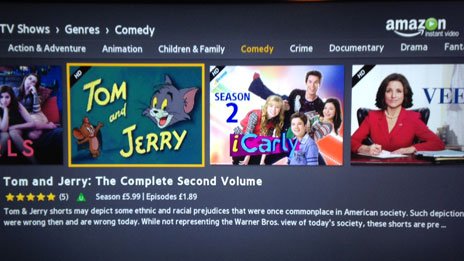
Amazon Prime and iTunes have included a warning with their packaging of Tom and Jerry – Metro-Goldwyn-Mayer’s series of theatrical cartoons starring Tom Cat and Jerry Mouse. From 1940 to 1952, an African American female domestic servant appeared in episodes, and in that period the characters often appeared in blackface. These images undoubtedly are the reason why the warning says that the cartoons may contain “ethnic and racial prejudices that were once commonplace in American society.”

The warning has its detractors. Some of them find the disclaimer unnecessary because to them Tom and Jerry is not racist, and others dismiss the warning as another example of contemporary excessive political correctness. The problem is that detractors are using personal feelings to try to stop a potentially useful discussion about ethnic depictions in American entertainment. Their knee-jerk “It’s not racist” and “liberal political correctness” reactions are only opinions that disregard the facts concerning the cartoons.

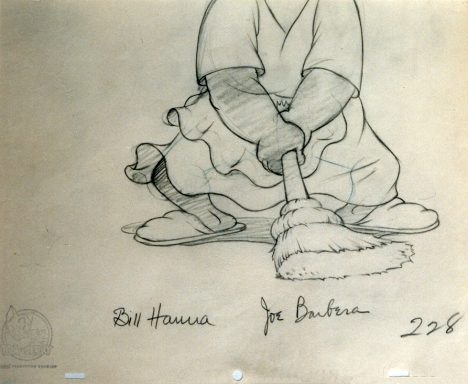
In my book The Colored Cartoon: Black Presentation in American Animated Short Films, 1907-1954, I chronicled the servant character’s development from her debut to her final episode. I noted that in her twelve years in the series, MGM never changed her dialect. The writers of the scripts gave her the same mis-conjugated verbs and spelled her mispronounced words exactly the same throughout that period, refusing to develop her at all. Also, none of the scripts give the character a name. She is the “maid” or “colored maid,” and the denial of an identity is part of her lack of development over a decade’s time.

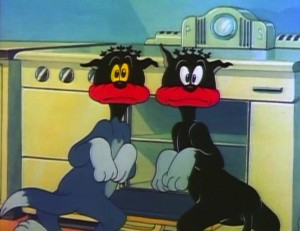
I also looked at the blackface scenes in MGM’s cartoons, most of which have a character darkened after an explosion. Again, the scripts are stereotypically charged, using phrases like “looking like a pickaninny” and walking “a la Stepin Fetchit.” Thus, the MGM artists made these cartoons with ethnic jokes at African Americans’ expense very much in mind. Even one of the series’ animators I interviewed called the maid an “outright racist cartoon character.”

tandj1

As for the cries of modern political correctness, it’s not that modern. In my book I note that civil rights groups protested the showing of Tom and Jerry episodes in theaters as early as 1949. They claimed that the exhibitions of the maid character harmed the minds of children, and they occasionally convinced theater-owners to withdraw the cartoons.

Such protests became so impactful to Hollywood that MGM eventually became proactive about the maid. The studio reanimated the 1948 episode The Little Orphan in wide-screen format as Feedin’ the Kiddie in 1957. The original episode featured the maid, but the remake omitted her entirely. Then in 1965, MGM prepared the series for Saturday morning network television by reanimating all of the maid’s appearances. The studio replaced her with a European American maid character in all of her scenes. In recent years, the original scenes returned for cable television broadcast on Cartoon Network and  Boomerang, bur MGM overdubbed Lillian Randolph’s stereotyped vocal performance with Thea Vidale’s dialect-free delivery.

_77912574_tomandjerry

The 2014 warning is just the latest attempt to make Tom and Jerry commercially viable in a changing ethnic American landscape. The disclaimer is a new approach in that it does not censor or gloss over but instead informs. It allows an opportunity for education about the films, while the detractors get to enjoy the uncensored original episodes.

Does the warning do enough to address the ethnic content of the series? Are other solutions besides disclaimers possible?