
One of my all time favorite Peanuts panels is from the late 70s. Sally has corralled Snoopy first into helping her scare away bullies at the playground (“Speak softly and carry a beagle,”) and then into terrorizing innocents at the playground (“Speak loudly and carry a beagle.”) In this strip, Sally is stomping off to force some kid out of the sandbox. She thinks Snoopy is right behind her, ready to bark ferociously and run the kid off. But Snoopy, unbeknownst to Sally, suddenly perks up his ears and stares off frame. “My old flame!” he declares, and disappears. Sally’s left to the tender mercies of her unterrorized peers (“How can you speak softly and cary a beagle without a beagle!”) As for Snoopy and his flame…your guess is as good as mine. Was Snoopy just wandering off into one of his own fantasy scenarios? Did he really see a girl beagle from his youth? It’s a mystery. Schulz never followed up on the storyline. Snoopy disappeared from the panel, from the strip, and from the story.
Tag Archives: Noah
Lies Real Enough to Love
In Andrei Tarkovsky’s 1972 film Solaris the first glimpse we catch of the titular planet is in a film of a film of a film. The pudgily somnolent hero, Kris Kelvin (Donatas Banionis), bores us by being stolidly bored himself as he watches the film of the testimony of Henri Burton (Vladislav Dvorzhetsky), a space pilot who way back when saw a giant space baby in the fog above the ocean of Solaris — a giant space baby that was not, we repeat not, cribbed from 2001, damn it, we swear. Young Burton in the film stutters and drones his way through a foggy mire of drab description while an older, balder Burton fusses and twitches, occasionally skipping ahead as if to taunt us with our inability to do the same (or, in the era of DVDs, to goad us into doing so.) Eventually the young Burton in the film cues another film, on which is no baby, but just more foggy mire. Young Burton stutters, old Burton twitches, Kelvin somnolents, and the film ends, and the film ends, and the film trudges wearily on.

Utilitarian Review 1/8/11
On HU
Erica Friedman talked about her love of manga audio drama CDs.
Robert Boyd tried to figure out why Jaime Hernandez’s original art sells for the prices it sells at.
The mysterious internet troll Cough Syrup talked about Jason Overby and the Cocaine Modem.
Caroline Small and I discussed Gilbert Hernandez’s Human Diastrophism.
I looked at one panel from Ariel Schrag’s Likewise.
Vom Marlowe wished there weren’t so many zombies.
I talked about philosophy and film.
Next week: James Romberger looks at the personal reasons he is so drawn to the work of Alex Toth and Jack Kirby; Ng Suat Tong looks at Mezzo and Pirius’ King of the Flies; I look at the films in Solaris; Kinukitty on yaoi and more.
Utilitarians Everywhere
At Splice Today I the Lovers and the tyranny of best of lists.
Not that I’ve anything against Kanye; I still haven’t heard that album, but “Monster” is a great song. More power to him and Nicki. It’s churlish to sneer at late capitalism when you’re mired up to your neck in late capitalism. The Internet that lets me instantly download albums by Sarah Vaughn or Esoteric is the Internet that makes it possible for everyone on earth to simultaneously speak Robyn’s name at the end of the year. For that matter, I love Robyn, just like I’m supposed to. If the world’s at your fingertips, then you shouldn’t be upset if you can’t detach your fingertips from the world.
At the Chicago Reader I have a brief blurb about an MCA exhibit focused on Chicago comics artists.
At Madeloud I review a new album by French black metal group Murmuure.
Other Links
The big news around these parts is the big new blog at tcj.com. The Panelists include Jared Gardner, Isaac Cates, Derik Badman, Charles Hatfield, Craig Fischer and Alex Boney. They’ve had a great first week, so go over there and check them out if you haven’t already.
Tom Spurgeon has a fascinating interview with Dirk Deppey over at the Comics Reporter.
Michelle Smith and Melinda Beasi have a fun column about visual duds.
I Flicker Therefore I Am
This article first appeared at Splice Today.
_________________________
A substantial portion of Descartes’ Discourse on Method is devoted to explaining why discussing his ideas with other thinkers would be useless. Instead, he concludes, his interlocutors could best contribute to the advancement of knowledge not by talking to him, but by “contributing to defray the expenses of the experiments that might be necessary.” Don’t criticize; just send money.
Which just goes to demonstrate that, from the beginning of modern Western philosophy, philosophers have not held a very high opinion of criticism, language, or philosophy. Descartes denigrated philosophical discourse in favor of experiments; Kierkegaard denigrated it in favor of faith; and now John Mullarkey denigrates it in favor of film.
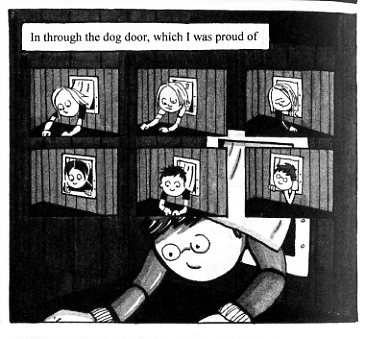
One-Panelist Criticism: Likewise
If you’ve seen the tcj.com homepage recently, you know that we’ve been joined here by a spanking new blog called The Panelists, featuring Derik Badman, Charles Hatfield, Jared Gardner, Alex Boney, Craig Fischer and Isaac Cates (my apologies if I forgot anyone!)
To kick off their blog, The Panelists are doing a round-robin where each of them look at one panel from a comic of their choosing. It seemed like a fun idea, so I thought I’d
So here we go.
Form, Fetish, and Diastrophism
In our blog roundtable on Charles Hatfield’s Alternative Comics there was much discussion of Gilbert Hernandez’s Human Diastrophism. At the time of the roundtable, neither Caroline Small nor I had read the entire work. So we decided to do so, and then talk about it. Page references are to the 2007 Fantagraphics edition.
_______________________________________
Noah: So one of the discussions we had in the roundtable with Charles Hatfield was about the use of fetishization in Hernandez’s work. And after reading this book, I have to say that I”m more than ever convinced that fetishization is just absolutely central to his comics in a way which I often find both ugly and hypocritical.
As I said before, the fetishization is sometimes worked through in terms of pin-up art; the Dan DeCarlo zaftig curves on Luba, or Pipo or Tonantzin’s perfect proportions. But I think it touches all of his female characters. The cornucopia of body types he presents (tiny Carmen, body-builder Diana, va-va-voom Doralist) or his obsession with imperfections (characters without arms, or with scarring) — there’s just a very insistent emphasis on defining people by surfaces. And I think that ties in to the way Palomar works in general; it’s very much a world of surface; you very rarely get internal monologue or a sense of what’s happening inside character’s heads. Instead, you get caricature and theatrical gesture. And there’s also, as Charles pointed out in Alternative Comics, a insistent formalism — Hernandez leaping from time to time or character to character, fracturing the narrative so that you feel it as narrative construction. The result is for me that the characters don’t have independent life; that Hernandez is pushing them about the board hither and thither for his own amusement. All the frantic insistence on interconnectedness and infidelity and the wonderful variety of people and bodies — the point seems to be “Look at this wonderful web of life!” But to me it feels cynical and dead, the characters worn flat by his obsessive need to run his hands over them.
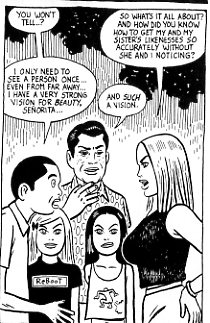
In that sense, there’s something queasily apropos about Humberto’s statues of all the townspeople sunk beneath the lake. In “Chelo’s Burden,” one of the later stories included in the “Human Diastrophism” Fantagraphics volume, Petra demands to know how Humberto can reproduce people if they haven’t sat for him, and he says he can instantly size people up. “I have a very strong vision for beauty, Senora” he explains, while his coconspirator Augustin agrees and checks out Petra’s chest. Basically, Humberto’s artistic process involves a facile empathy in the interest of creating a world of collectible, “beautiful” fetish objects. It’s condescending…and not the less so because Hernandez is also (perhaps self-reflexively) condescending to Humberto.
Utilitarian Review 1/1/11
On HU
First I wanted to highlight this lovely comment by composer and artist Diamanda Galas, responding to James Romberger’s essay about David Wojnarowicz. The thread actually has a ton of thoughtful and heartfelt responses from Wojanrowicz’s associates and others. It, and the original article, are well worth reading if you missed them.
We started the week with a post by Domingos Isabelinho on Mat Brinkman.
Stephanie Folse continued her Elfquest reread with issue #2.
Sean Michael Robinson argued that the concept of talent is not helpful in teaching art.
I didn’t much like Hitchcock’s 39 Steps.
Ng Suat Tong discussed Tobias Tycho Schalken’s “Folkore.”
Alex Buchet provided a comics New Year gallery.
And Alex Buchet continued his series on language and comics, focusing on Batman, Smurfs, Mad magazine, and more.
Next week we should have posts on manga drama CDs; the pricing of original Jaime Hernandez art; Jason Overby, cocaine, and the internets; Gilbert Hernandez’s Human Diastrophism, and more.
Utilitarians Everywhere
At Splice Today I discuss a book by John Mullarkey about philosophy and film.
Mullarkey is insistent on the “aesthetical properties” of film. He notes that philosophers who discuss film often focus on narrative and theme and ignore mise-en-scene, editing, sound, music, etc., to say nothing of extra-aesthetic issues such as distribution, consumption and audience. Yet he’s so intent on listening to what this wonderful heterogeneity of film has to say to philosophy that he misses the most obvious point, which is that philosophy is aesthetic and heterogeneous as well. Just as film is not just it’s narrative and theme, so philosophy is not just its thought and theme.
Also at Splice I discuss a new comp of Bollywood psychedelia.
But such is the Columbus-like experience of world music crate diving, in which you compulsively pat yourself on the back for discovering that obscure fruit off which some significant proportion of the world’s population was already living.
At Madeloud I highlight some great Muppet music.
Other Links
Robert Stanley Martin on Lilli Carre’s The Carnival.
Been looking at a bunch of essays about The Wire. Interesting pieces by Marc Singer here and here/
Jonah Goldberg says the Wire is conservative here.
And a long profile of David Simon here.