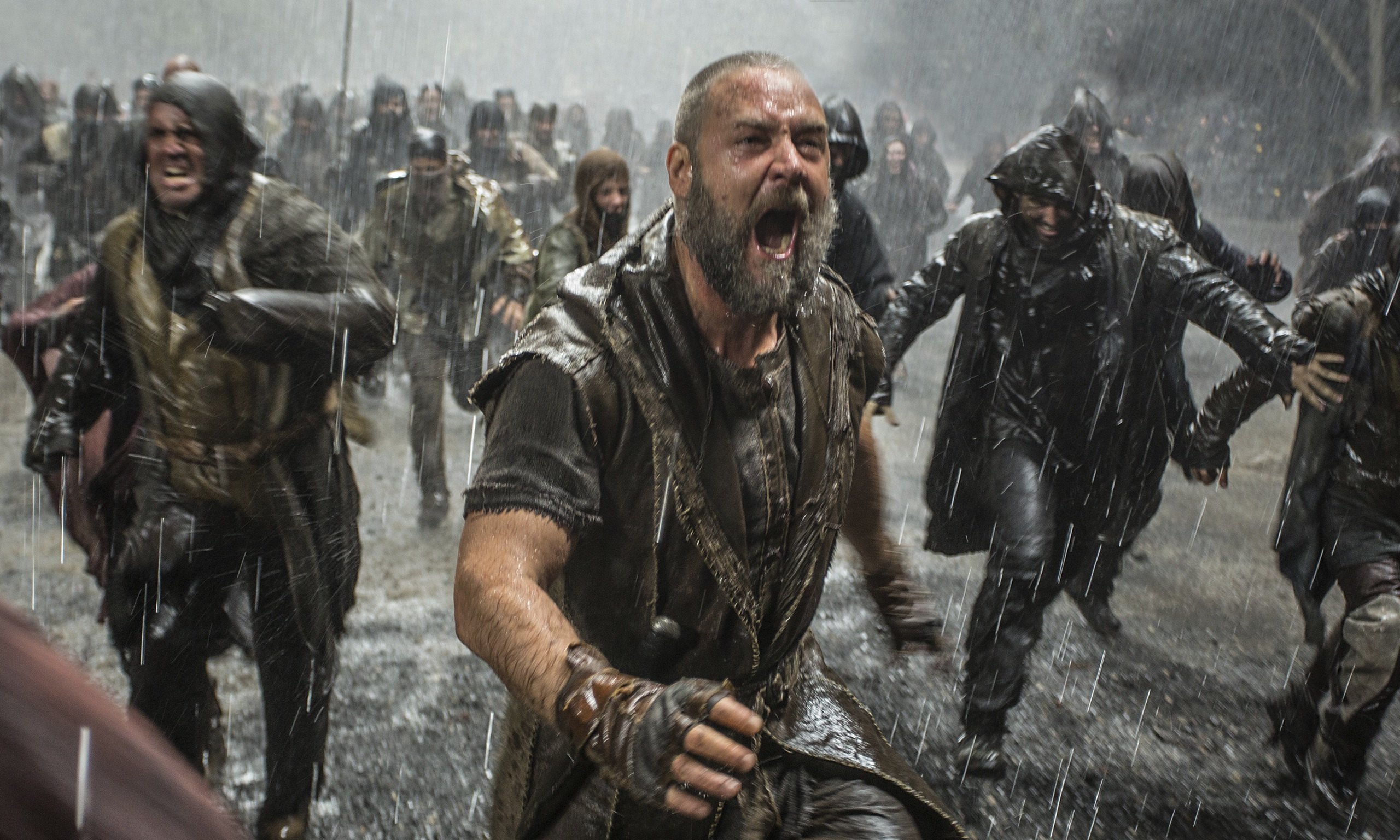
Noah: Not Drowning, Just Waving

Russell Crowe as Noah

 
I saw this with a co-worker at the end of a long work week (I’m now working 8-4 every weekday and 10-5 every Saturday, plus commuting time, which is why I haven’t been posting here much). I thought it was going to be a stupid three-hour blockbuster, like Apocalypto or 10,000 B.C., and it was in a way, but it was also WAY weirder, so when Darren Aronofsky’s name came up in the credits I was like oh yeah that explains it.

The main thing that makes the movie weird is that it completely lacks the three-act structure of a modern blockbuster movie, or really any sense of cinematic pacing at all. Many individual scenes do have a dramatic build, especially the ones that develop Russel Crowe/Noah’s puritanical zealotry*, but there was also a tendency after about the halfway point to try to wring maximum melodrama out of EVERY domestic scene, which leaves you-the-viewer with no sense of which scene is a “climax” and therefore no sense of when the movie is going to end.

(After the Ark reaches land, presumably – but then the movie continues for another half-hour, RoTK style.)

Spoilers ahead!

Overall the old-school chronological pacing style makes an already long movie seem even longer, but personally I’m glad that Aronofsky didn’t attempt to fit a biblical epic into a structure that couldn’t have fit it. It’s not that he lacks a sense of how long each scene should be – the opening voiceover about The Fall of Man and The Curse of Cain is mercifully short, about the length of the opening of the Avatar TV series, for instance, because we already know how those stories go. But the movie is faithful to its source material in this way: it follows all the events and doesn’t leave anything out, not even the genealogy bits. Biblical epics are SUPPOSED to seem long because the idea is that we should get to enjoy them for the maximum length of time – sort of like how you might prefer American comics over Japanese ones because the dense writing and lack of visual flow means they take longer to read. I’m completely sick of Saves the Cat style blockbuster pacing so I thought this was a nice change.

In other ways Noah is not faithful at all, LOL, and personally I really enjoyed all of the movie’s attempts to take a story that doesn’t make sense (it rains so much that the world floods instantly, the Ark is big enough to house two of every animal, five adults build the whole thing, etc) and to invent ways to MAKE it make sense. It was kind of like Chris Nolan’s Batman in that way (and just like Batman, there’s still that one thing the movie doesn’t even attempt to explain). The stop-motion-ish Guardians were cute, and the human King was a good foil.

Personally, though, my favorite change was the thematic shift from ALL DESCENDANTS OF CAIN MUST DIE BECAUSE THEY ARE IMPURE – ONLY SETH’S LINE IS WORTHY (ugh) to ALL OF HUMANITY, INCLUDING OUR OWN LINE, MUST DIE BECAUSE WE AREN’T ANY BETTER. By making that change, in a single stroke you remove the racism/tribalism/determinism/whatever you want to call it of the original story, turn Noah into a more interesting character, and provide the drama that powers the rest of the movie.

Though speaking of drama, as a gay person the emphasis on how Noah’s kids HAD to find a Faithful Wife and Have Kids to be happy seemed kind of misplaced to me, like for instance a lot of the conflict in this movie could have been averted if Shem and Ham had only shared the barren Emma Watson** between them. The film’s unquestioned assumption that heterosexual monogamy is The Way Things Are seemed odd especially considering the incest themes in the biblical Noah story, which the movie didn’t get into, but did kind of imply (Emma has twin girls, Mom says Hurrah The Creator has given us what we need for our other two sons!). But I’m sure for many people this wouldn’t even have pinged.

There’s a scene of doomed humans dying on a rocky outcropping as the stormwaters raged on that I thought was a nice touch, like something out of a Goya painting. Apart from that one (brief) scene, Russell Crowe’s visions of death and destruction were probably the most visually interesting part of the movie, which for a “blockbuster” action movie looked pretty shockingly low budget at times (for instance it’s hard to make a couple of raggedy actors in a totally barren, untouched-by-human-hands landscape look like anything but a way to keep costs down). But since I thought I was watching a popcorn-blockbuster for a Christian audience, I kind of enjoyed that cheapness too. I’m easy, I guess.

*Russell Crowe is not only starting to get typecast as a zealot after his role as Javert in Le Mis, he also sings (badly!) in this movie, too! I personally was happy to see him characterized as a zealot – one of the frissons of “Noah” is that Noah is clearly not wrong that humans are going to mess up the planet again and therefore the only permanent solution is to wipe us out – the radical environmentalism of some Japanese anime directors – but at the same time, his horror at humanity is clearly also at least partially psychological, f’rinstance when he visits the human camps outside his own settlement and decides humans are venal and weak based on a half-real-and-half-dream interpretation of what he sees there.

**Emma Watson is too good-looking and too charismatic and has too much chemistry with everyone, including Russell Crowe. In fact she might have MORE chemistry with Russell Crowe than with the actor who plays Shem, although we could also put that down to the fact that her scenes with Noah are a lot more emotionally intense. The chemistry between her and Crowe reminds me of how John Cusack is drawn to teen-popstar Hillary Duff in War, Inc, resists because he’s old enough to be her father, and later finds out that he really *is* her father! The moral of the story: don’t sleep with anyone who’s young enough to be your own daughter because you just never know. Anyway, Russell Crowe is working with Jennifer Connelly again in this movie, whom he also worked with in A Beautiful Mind, and would (probably) never go there.

***

To sum up, I personally enjoyed this movie, despite all its shortcomings. It made a well-known story from the Hebrew Bible seem bizarre, which as a Jew I’ve also felt was the case. Maybe my expectations were low, maybe the movie was just stupid enough at the end of a long work week, maybe I’m so sick of formulaic dreck that I’ll happily take idiosyncratic dreck instead, but I’d say it’s worth seeing.
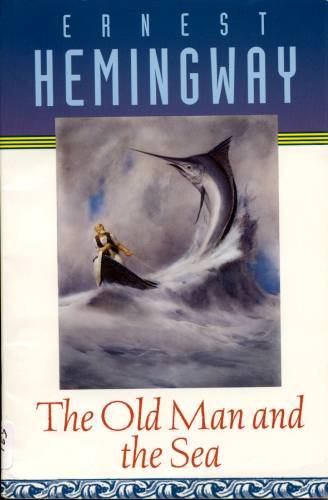
Overrated Man and The Sea

Underrated/overrated 20th century lit? Hemingway gets my vote for overrated; he’s treated like a god and I find most of his work fairly puerile. “The Short Happy Life of Francis Macomber” with its boys’ adventure misogyny is a particular low point, but the manly men doing manly things with fish narrative also seems like Jack London without the hyperbolic preposterousness which makes London fun.

Underrated I’d say James Baldwin. His essays are maybe the best essays in the English language, but he’s mostly seen as a specialist interest, as far as I can tell. I wish folks would read him in high school rather than the Great Gatsby.

So what do you folks think? What 20th century writers are underrated or overrated?

41aAU9FYX3L

Utilitarian Review 3/29/14

On HU

Featured Archive Post: Betsy Phillips on Iron Man the song and the superhero.

Lee Relvas‘s lovely vision of the gay utopia.

We all chatted about the most overrated television show (and possibly most underrated if such things exist.

Alex Buchet on the mediocrity of the recent Asterix legacy volume (Asterix and the Picts).

Chris Gavaler on the sources of Sandman.

I ask if this post needs a trigger warning.

Adrielle Mitchell on comics and walking (for PPP.)

Kailyn Kent on wine at the Grand Budapest Hotel.
 
Utilitarians Everywhere

At the Atlantic I wrote about:

—the self-conscious incoherence of Divergent

the 4 ways sci-fi handles race

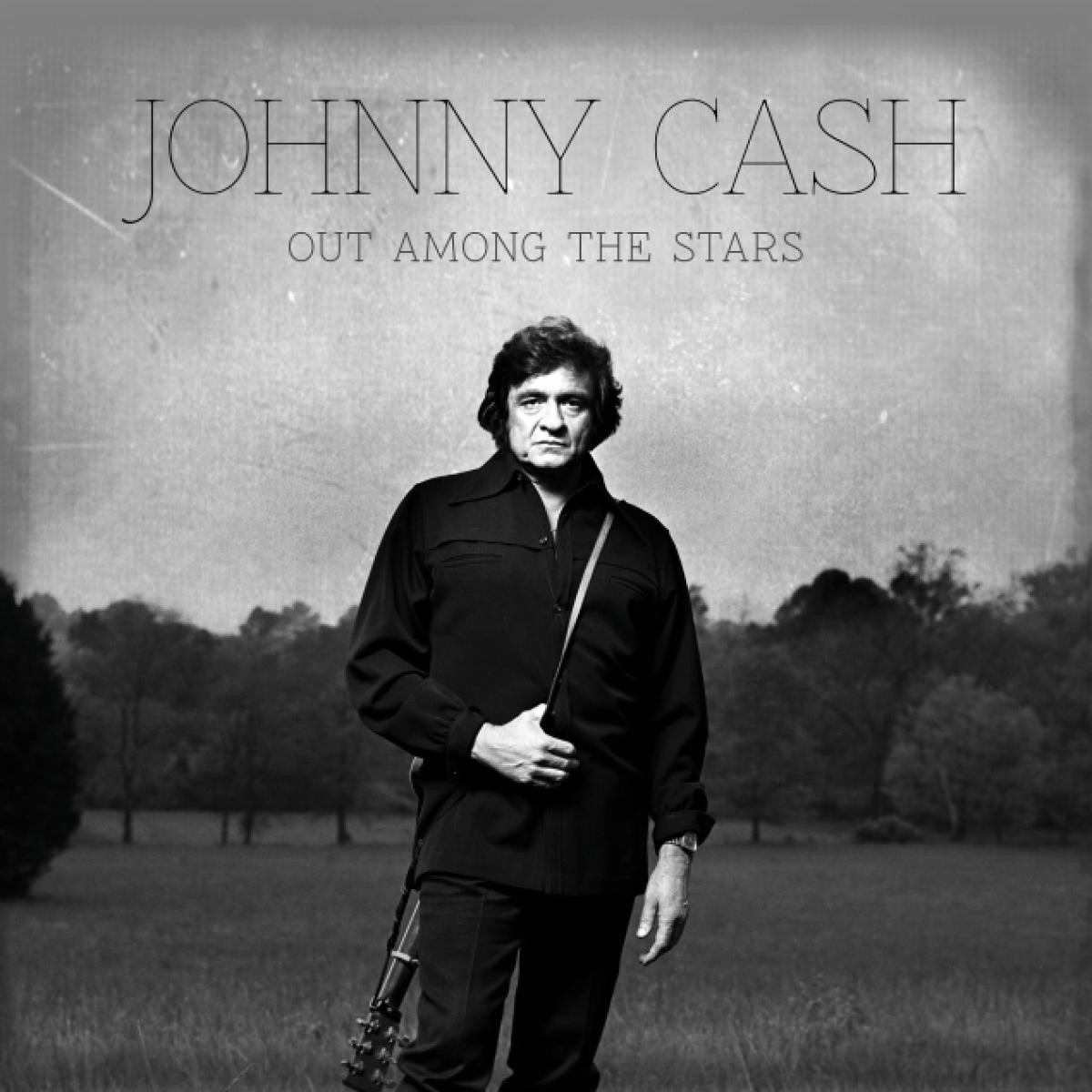
Johnny Cash as trend chaser

—I wrote about the bracingly cynical Schwarzenegger cop drama Sabotage

At Splice Today I wrote about:

— how Ginsburg and Breyer should retire

— student debt as nightmare dystopia in the comic The Default Trigger

And I worked on this study guide for Orson Scott Card’s Speaker for the Dead
 
Other Links

Julianne Ross asks why all action heroines are petite.

Hoping I get to see Dear White People at some point.

The debut issue of the journal Porn Studies is online.

Erin Gloria Ryan on CancelColbert; Brittney Cooper on the same.

Russ Smith tells alt weeklies to go out with some dignity, for pity’s sake.
 

johnny-cash-nashville-1978

Does This Post Need a Trigger Warning?

So this is a bit different than what I usually post here, mainly because I thought I’d be posting it somewhere else. But that didn’t work, so at HU it is. You can consider that a warning of sorts, I suppose.
_________

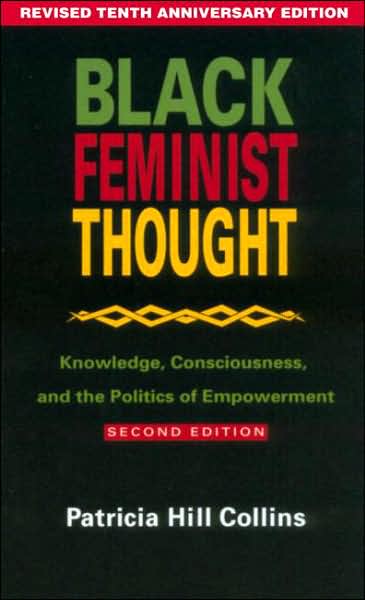
Black-Feminist-ThoughtIn Patricia Hill Collins’ classic monograph Black Feminist Thought (2nd edition, 2000), she describes seeing a difficult presentation by a White feminist scholar. The lecture was about Sarah Bartmann, a Khoikhoi African  woman who was displayed as a freak show novelty under the name the Hottentot Venus in 19th century Europe. The scholar, Collins says:

“refused to show the images [of Bartman] without adequately preparing her audience. She knew that graphic images of Black women’s objectification and debasement, whether on the auction block as the object of a voyeuristic nineteenth century science or within contemporary pornography, would be upsetting to some audience members. Initially I found her concern admirable yet overly cautious. Then I saw the reactions of young Black women who saw images of Sarah Bartmann for the first time. Even though the speaker tried to prepare them, these young women cried.”

The white feminist scholar Collins is discussing here could be seen as providing an early form of trigger warning — a notification intended to warn people of content that may cause a painful or damaging emotional reaction.

As Collins’ anecdote shows, trigger warnings have existed for a long time in informal settings. But they became codified on the internet, especially on feminist websites and blogs. Feminist internet trigger warnings focused on sexual abuse or torture, suicidal or self-harming behavior, and eating disorders, according to the Geek Feminism Wiki. The goal of these warnings was to alert survivors of sexual assault, or those with a history of suicide attempts or eating disorders, that the article might trigger PTSD or anxiety. “Someone who is triggered,”  according to Melissa McEwan, “may experience anything from a brief moment of dizziness, to a shortness of breath and a racing pulse, to a full-blown panic attack.” Andrea Garcia-Vargas, a PolicyMic columnist who writes about the intersection of gender, sex, and tech, argued in an email to me that such warnings are:

…absolutely necessary. Why? Because PTSD in response to depictions of violence (particularly sexual violence or war violence) is a very real issue, and people who may be triggered by violent images or depictions deserve a “heads-up” that it’s coming. That’s not to say that the trigger warning is going to completely stop PTSD. Of course it won’t. It’s only one step. But it’s a very necessary step. With the trigger warning, the reader can decide whether or not they are in a frame of mind to proceed.

Many writers use trigger warnings as a matter of course. There’s one on McEwan’s article, for example, and one on this piece by Soraya Chemaly at the Huffington Post. Some commenters, though, argue that the warnings aren’t all that helpful. Amanda Marcotte, for example, notes that

“I write often about difficult subjects like rape and abortion, but I never use trigger warnings. My experience is that the audience can do a better job than I can at figuring out what kind of content will upset them by reading the headline than I ever could randomly guessing what blog posts count as triggering.”

Along the same lines, Jill Filopovic points out that PTSD “triggers are often unpredictable and individually specific — a certain smell, a particular song.” Trigger warnings suggest that you can protect people from traumatic reactions, which isn’t necessarily the case.

Filopovic agrees that it’s reasonable to provide warnings for the most common triggers like sexual assault or eating disorders on feminist blogs. She and others,  however, have become worried that the use of trigger warnings is moving off the internet and into other real-life venues, especially college classrooms.   Oberlin College (my alma mater) has recently put out an official discussion of triggers, advising faculty to “strongly consider” making “triggering material” optional for students. Among the books that were suggested as being triggering was Chinua Achebe’s classic Things Fall Apart, which Oberlin warns might “trigger readers who have experienced racism, colonialism, religious persecution, violence, suicide and more.”

Some argue that the use of trigger warnings in a classroom setting may do more harm than good. Emory sociology PhD candidate Tressie McMillan Cottom worries that trigger warnings play into a model where students are perceived, not as learners, but as customers, who are never supposed to feel any discomfort. Trigger warnings then become part of a system which works “to rationalize away the critical canon of race, sex, gender, sexuality, colonialism, and capitalism” — students who don’t like discussions of racism or colonialism will never have to confront their prejudices or preconceptions.  Jenny Jarvie at The New Republic goes even further, arguing against trigger warnings not just in college settings, but online as well. “Structuring public life around the most fragile personal sensitivities will only restrict all of our horizons,” she says. “Engaging with ideas involves risk, and slapping warnings on them only undermines the principle of intellectual exploration. ”

I can see the virtues in the arguments both for and against trigger warnings — and partially as a result, I feel like both may be framed in overly absolutist terms. To me, it seems like it might be better to think about trigger warnings not as a moral imperative, but rather as a community norm. Warnings exist, after all, in dialogue with reader expectations. In some forums, people may expect to be warned about difficult content. In other cases (as with Amanda Marcotte’s posts)  readers will have a sense going in that sensitive issues are going to be discussed with some regularity.

Negotiating exactly when and where there needs to be a warning, and what kind of warning, then becomes something that different communities can work out differently. Marcotte, for example, mentions a recent episode of the television show Scandal in which a major character was raped. Many fans responded with anger, insisting that the show should have included a trigger warning — and the show’s creator, Shonda Rimes agreed with them.  You could see this as the show failing in its moral duty to protect its fans. Or you could see it as Rimes caving to oversensitive censorship. But it seems like it might be more useful to see it simply as a particular community figuring out how it wants to deal with charged material.

This doesn’t mean that writers have no ethical obligations when discussing difficult content. On the contrary, it seems like trigger warnings are just one possible way of dealing with one’s obligation to deal thoughtfully with such material. Angust Johnston, a historian and founder of studentactivism.net, wrote to me in an email that:

“content warnings are a part of a larger set of questions about how you’re interacting with your readers. Are you shocking them for the sake of shocking them? If so, content warnings are just a fig leaf. On the other hand, if you’re being careful about how you approach a subject, I think you can often write your way around the need for them.”

Johnston added that this applies offline in a classroom context as well. “I think professors have an obligation to recognize that their students are human beings who may have strong emotional and psychological responses to class materials and discussions, and to deal with those responses in a respectful and sympathetic way,” he said. Content warnings could encourage professors to think about those issues, which would be good — but they could also be a way, as Tressie McMillan Cottom suggests, to avoid important issues. Content warnings themselves are just a tool, which can be used well or badly. The real ethical imperative is to approach an audience, whether online or off, with, in Johnston’s words, “thought and care (and humility.)”
In Black Feminist Thought, Patricia Hill Collins describes another, less sensitive presentation on Sarah Bartmann. A White male scholar lecturing about historical scientific racism included pictures of Bartmann as part of his PowerPoint presentation.

“Leaving the image on screen for several minutes with a panel of speakers that included Black women seated on stage in front of the slide, this scholar told jokes about the seeming sexual interests of the White voyeurs of the nineteenth century. He seemed incapable of grasping how his own twentieth-century use of this image, as well as his inviation that audience members become voyeurs along with him, reinscribed Sarah Bartmann as an “object…a malleable ‘thing'” upon which he projected his own agenda.”

The issue, then, is not simply including or failing to include a warning. The issue is recognizing your own relationship, as a writer or presenter, to race, gender, violence, and other intersections of power. Trigger warnings can be one way to do that, but the argument about them pro or con shouldn’t be allowed to obscure the main goal. That goal, as Johnston says, is to treat your audiences, or audiences, as human beings.

Most Overrated Television Show…And Most Underrated, If Any Exist

I’m watching Orange Is the New Black for an assignment, and being impressed again by how the new era of television drama seems to rely on basically overrating every single thing on the tube. With the exception of the Wire and the first season of Twin Peaks, I’m not sure I’ve ever seen a television drama that managed to get past sporadically entertaining and onto “good”.

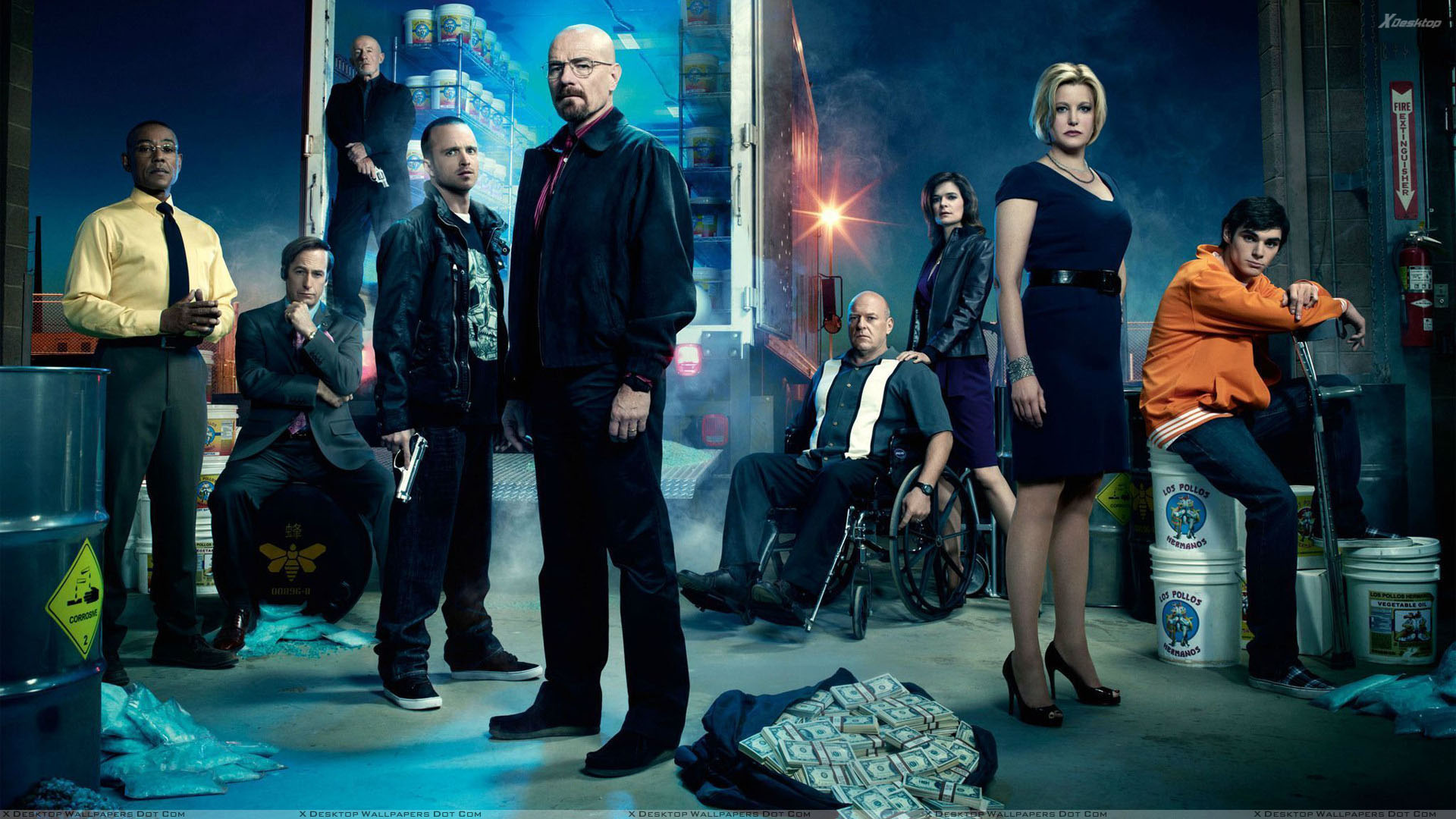
Anyway, the most overrated thing I’ve seen is probably “Breaking Bad,” which is supposed to be one of the great artistic triumphs of our time but to me (in the first season at least) seemed mired in all too familiar television cliches and lazy dramatic devices. Outside of drama, there are shows I love — the Batman TV show for example, or Warner Bros cartoons, and so forth. But I don’t know that any of them are underrated exactly.
 
breaking-bad-all-characters

Utilitarian Review 3/22/14

On HU

Featured Archive Post: Travis Reynolds on comics gutters.

Kinukitty on bisexuality, reading yaoi, and the closet. (Part of our ongoing reposting of the Gay Utopia.)

I asked folks to list the best music of the year so far, a request that was for the most part met with indifference. Oh well; they can’t all be gems.

Ng Suat Tong on David B’s “Incidents in the Night” and the dream of books.

Osvaldo Oyola tells me why I should like the Stones’ Sympathy for the Devil more.

Kailyn Kent on service and Wes Anderson’s Grand Budapest Hotel.

Michael A. Johnson on Bechdel’s Are You My Mother?, Almodavar’s All About My Mother, and weeping at comics.

Me on fantasy dragons and real romance in Laura Kinsale’s For My Lady’s Heart.
 
Utilitarians Everywhere

At the Atlantic I wrote about:

students who do sex work, and how they’re not all the same.

Ms. Marvel and the tradition of superhero assimilation fantasies.

At the Dissolve I wrote about the vile misogynist pile of crap that is How To Be a Man.

At Salon I had a list of songs for the coming nuclear apocalypse.

At Splice Today:

— I argue that sexuality can sometimes be a choice.

— I sneered at Jonathan Chait for kicking his less fortunate colleagues.

The study guide I worked on for Rick Riordan’s Lost Hero is online at Shmoop.
 
Other Links

Ta-Nehisi Coates is skeptical of liberal outrage at Paul Ryan.

Alyssa Rosenberg kicks off her blog at the Washington Post with a statement of purpose re: writing about pop culture.

Tucker Stone lists the 25 best albums of 2013.

Standardized tests are an off-shoot of eugenics.

Julia Carrie Wong on journalists mining the twitter accounts of Women of Color.
 

03-Nonfiction-Book-Review-The-Lost-Hero

Real Romance

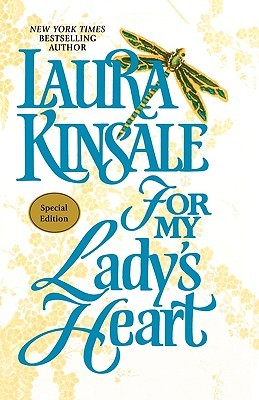
802147In Laura Kinsale’s medieval romance novel “For My Lady’s Heart,” there’s one scene where the heroic knight Ruck is guiding the noble lady Melanthe through the north of England, an area, he explains, which he has visited before while hunting dragons. Melanthe is doubtful that dragons exist in that part of the world, but Ruck insists he has killed one. Melanthe still demures…perhaps, she suggests, he merely encountered a large basilisk. He assures her that it must have been a dragon,and after a rousing tale of his battle, he offers to show her its bones, which are located in a church close by. And sure enough he does:

She saw it immediately. The skull lay in the shaft of light from the door, enthroned upon a wide bench below the crude altar. It was huge, and nothing like a basilisk’s eagle head. Just as he had said, a long and pointed snout, with great eye and nostril hollows and vicious teeth like no living creature she had ever seen. Remains of its spine lay scattered in a rough line down the bench. A fan of thinner bones, like an enormous hand or a wing, was assembled carefully on a nearby talble.

“It is a dragon.” Melanthe strode into the church, stripping off her gloves, leaving the knight leaning upon the door to hold it open. She bent over the skull.

And, bending over, she discovers that the skull is not a real skull; it’s made of stone. The dragon isn’t a dragon after all, and Ruck certainly didn’t kill it. He was lying…or, as he says, simply telling “A tale, my lady, that I made for your pleasure.”

The twist here is that the reader doesn’t necessarily know that it’s just a tale any more than Melanthe does. It’s true that up to this point in the novel, there haven’t been any fantasy elements — Kinsale’s medieval milieu includes a lot of talk of witchcraft and enchantment, but (at least until we reach the dragon) it’s all explained naturalistically. But this is a novel, not a history, and Ruck is a very honest, straightforward character — certainly as I read, I felt, with Melanthe, that maybe, possibly, he really had killed a dragon. Maybe there were more things, not necessarily in heaven and earth, but in this book than I’d initially thought. It would be fun to suddenly have a fantasy dragon make a walk-on in the middle of a romance novel. It could happen, couldn’t it?

That tease — the delighted possibility that the fantastic might be real, and the concomitant delight/reversal/disappointment that is isn’t — is a kind of magical, virtuoso acknowledgement, or demonstration, of the links and disjunctions between the genres of fantasy and romance. Romance is often sneered at for its lack of realism; for the way that, when “My lady wished a firedrake,” as Ruck says, a firedrake, and/or a perfectly noble man, is provided. Yet, if romances are about wish fulfillment, historicals like this one are also about period detail — the machinations of the Italian court, the intricacies of Ruck’s armor, even the lapse into a readable but still well-researched form of Middle English. Reality in fiction (and perhaps elsewhere?) is a negotiation; a matter of tropes and trust. Which is why Melanthe is not, in fact, delighted with Ruck’s tale. Instead, she becomes enraged, telling him coldly, “If I find thee in a lie to me again, knight, thou will rue it to thy early death.”

Melanthe’s freak out seems like caprice. But it’s actually part of the romance plot. “There is but one person on the earth that I trust, and that is thee,” she tells Ruck, by way of explaining why his dragon fiction upset her. Melanthie herself, having married into an important Italian house, with all the backstabbing and intrigue that that (stereotypically) implies, has been trained to lie constantly, to stifle all her natural impulses and do the opposite of what she feels. “I have some talents in common with base liars and cowards,” she tells Ruck bitterly.

The lying, at least, is something she has in common with Kinsale, the author of the story, as well. At one point Melanthe tells Ruck that she is always lying, and that’s the truth — everything she says is fiction. For that matter, even Ruck’s honesty is a fiction — except, perhaps, when he makes up that story about the dragon. The fiction really is a fiction; dragons, in the book and outside the book, aren’t real.

Kinsale’s narrative, for the most part, is organized to demonstrate the virtue of Ruck’s straightforward honesty in opposition to the treachery and deceit of the manipulative dusky southerners. But that binary of good-truth/evil-lies has many caveats and winks. Ruck passes Melanthe off as his “wench” at one point in order to protect her from kidnapping — or is it instead, extra-diegetically, so that she can play at being his to do with as he will, just as, through much of the rest of the novel, she is his lady, and he must do her bidding? It’s the pretense of being his lover that precipitates their first actual intercourse, immediately preceded by their private commitment of marriage before God and each other in the darkened bed-chamber. True love comes through a lie…or, if you want to take it back a step, the fiction of true love is delivered through the play-acting characters realizing that the fiction they are acting is the truth.

The declaration and marriage come somewhat early on in the book; there are many contrivances, most of them unlikely, before you get to the also-not-especially-likely happy-ever-after. But to complain about the improbability seems as churlish as Melanthe getting upset that her knight has told her a story. For that matter, even Melanthe has to admit that the Ruck’s fiction “was somewhat agreeable.” What romance writers and romance readers know, perhaps, is that it’s not so much whether the dragon’s tale is true, as whether it is told with love.