A Few Words Of Intent Concerning A Different Website Entirely, But Also This One, And, Perhaps, All Of Them In The Current Situation

The following expulsion relates to a Twitter conversation into which I rudely inserted myself earlier this week, concerning the mission of certain websites in publishing writing on comics, and the character of certain tendencies in comics criticism. I was then offered one million dollars to expand on those tweets here. I’ll be checking the usual address for payment, Noah!

***

Years ago, when I was younger, I started a blog about comics because I wanted to be part of a conversation, and I found the message boards to be slanted toward rock star frequent posters, all of whom should have been me. It takes some measure of self-regard to presume that anybody would want to read your words on a topic in the absence of solicitation, and I found it rightly cheering and worthwhile to control my little island of dictation and catch the occasional seagull-bound dispatch from neighboring personal nation-states. At that time, you could identify most of the writers-on-comics-online from a generous sidebar listing, and — if you were oversensitive, which is to say you were blogging — you felt the need to respond to basically everything of probable interest that was ever said, or occasionally just implied.

Gradually, the scene became large enough that it was less a consortium of islands than a small city, and in a city you lack the psychological compulsion to acknowledge every dress outlet and cheese shop simply because they are there. I became no less self-interested, but the primacy of conversation became subsumed into the fascinations of communication: argumentative craft, writerly noodling. Of course, I had to be careful in some ways, as I was aware that I had a small audience, and also that the parity of linkage afforded by the meme-prone internet kept a momentary larger audience perpetually on the horizon. I became aware, silently, of how much I could write before I’d safely assume I was boring people. Today, I think I was too generous in that estimation, but I am not the same person, and neither are you.

Always I knew I would be my editor. That I would self-censor for the good of the communication. I had editors at The Comics Journal too, which I expected, of course, from a print publication. With apologies, I confess that the editors I encountered through online group sites were thought of as gatekeepers, yes — as homeowners and hosts, as sounding boards and error-catchers — but not as forces behind the craftwork of identity online. I would be me, on any site that would have me.

Eventually, though, there came a time when individual blogging faced the same perils of noise as message boards. This was inevitable, given the volume of free, equidistant writing online – given the choice of two types of apples, the consumer will exercise some informed judgment, but given the choice of two hundred they will stick to what they know. The illusion of permanence and the glamor of size became crucial. I don’t know anybody who reads Ain’t it Cool News anymore, but by god it’s still around.

This was the age of aggregation, and I went willingly. A certain publication I’d contributed to twice invited me to write for their online edition. In the future, some would place Comics Comics toward the front of a small movement to construct counter-histories of comics evolution; whether the chicken of this departed forum preceded or followed the egg of Dan Nadel’s Art Out of Time and other publications is a matter for future and no doubt highly exciting controversies. At the time, I did become aware of a reputation existing for the “Comics Comics gang,” which I never felt encompassed the attitudes of everyone on the site, but fuck it – I’d always appreciated history, and history’s manufacture, and comics’ tendency to forget all but the most victorious of popular winners. It was once said that the readership comic books departed every five years to make way for new, young readers devoid of expectations; that’s not true of comics, but it seems right for histories thereof.

But Manny Farber convinced me, in my arrogance, that I ought to be a termite, and burrow my way into the neglected crevices of the culture. That wasn’t what Farber meant by his essay, admittedly, but I was too busy reading comic books. Lots and lots of comic books, more than I could ever possibly write about, particularly after I graduated school and found a day job and stopped posting seven days a week, as I had done for years. I loved many of the ‘established’ classics. I still dearly love Chris Ware. But even in the diminished state of comics criticism — the truest and most damning thing about which I’d ever heard was from the critic Ng Suat Tong, who told me that prose books, as periphery as they are to the popular culture, could always count on several and varied reviews of the bigger releases, while comics cannot — certain vaunted works do attract a goodly amount of continuous reaction, while too many others join the congress of orphans shivering in dank and yellowed longboxes in Donnie’s Dojo and Sports Collectables, thirteen miles from the state line.

When I could not find things about a comic online, the compulsion rose. What I could not read, I would want to write. I would abandon 6,000 words on Building Stories without much regret, seeing the writing that was out, but a stray back issue of Métal Hurlant would have me rising at 2:00 on a work morning to delineate the gaps in the common understanding of what that magazine represented.

Alas, I understood then that I am as much a character as an author.

The aggregation of voices online inevitably subsumes the individual into the common understanding of the forum’s inclination. This was made plain as scalding water when Comics Comics fused itself onto The Comics Journal and became its online edition. Many Journal writers were retained, as was the Journal‘s name and reputation, and Comics Comics verily ceased as a going concern, both ‘physically’ and rhetorically. The editors were thrust into dialogue with the expectations of the one comics magazine that would span the whole of the history of the comic book direct market.

Personally, I formulated a whoppingly pretentious concept for the new releases checklist column I’d carry over from Comics Comics: half would be a reflection on something I’d read very recently, while the other half would make brisk assumptions about things imminently due. THIS WEEK IN COMICS!, in both the retrospective (THIS past WEEK) and prospective (THIS coming WEEK). Additionally, it would allow me to retain a certain seat-of-the-pants, blog-like character I’d come to prefer in composing frequent writing.

But there was a difference. This was not a blog.

And I found myself grateful to be able to exercise such stylistic discretion without the burden of editorship.

It is said, occasionally, that the criticism dedicated to new, young, experimental comics is meager; I don’t disagree. Nor do I disagree that some critics seek the obliteration of the prior canon, and the ripping down of the old heroes. Sometimes I rip a few scraps myself, but my mission, oh god, is individual engagement with works. I realize, though, that I’m on the internet, and that I cannot be exactly an individual anymore; we are all part of sites, of movement, of Ideas. To post on the Hooded Utilitarian is, in part, to be seen through the prism of things Noah Berlatsky wrote in the mid-’00s, often about Art Spiegelman. To write about Heavy Metal is to participate, in part, in a devaluation of the prominence of accepted ‘good’ works, because they are just that less prominent. If Heavy Metal is seen as a misogynistic enterprise, you are part of that misogyny. If the Hooded Utilitarian is seen as a negative force in comics criticism, you are a party to negativity.

This too is history’s manufacture.

Yet if I don’t write about these things… who the fuck will, he screamed, sweating at a mirror, fists clenched, the hero, trying to watch his own back. The function of a critic, he knows, can be to establish or demolish canon, or to theorize on the form, synthesizing the thinking of past experts, applying rigor and distinction as to worth, as to societal narrative, as to moral concern. He thinks, sometimes, that he needs a critic to explain to him exactly what the fuck he is doing, but still –

I am disinterested in formulating mortal [k]ombat between comics canons. That I tend to write about dodgy French gloss porn is not a deliberate statement on the superiority of (say) Heavy Metal to (say) RAW. Rather, it is a (knowing) effort to explore areas of interest to me that otherwise will receive little sustained attention. If I want to say that a work or a tradition is garbage, I will say exactly that, by name, individually. The resultant state of any online venues ‘advocating’ one tradition over another by dint of published writing is an editorial concern. I am not an editor. I’m grateful for editors! It is a bias of my own to focus on works of little demonstrated critical value. Perhaps I’m a narcissist. Nonetheless, I am convinced of the value of this pursuit.

I used to be a libertarian, but then I got old.

[BARTENDER CARDS ME GETTING A BEER]

Fin.
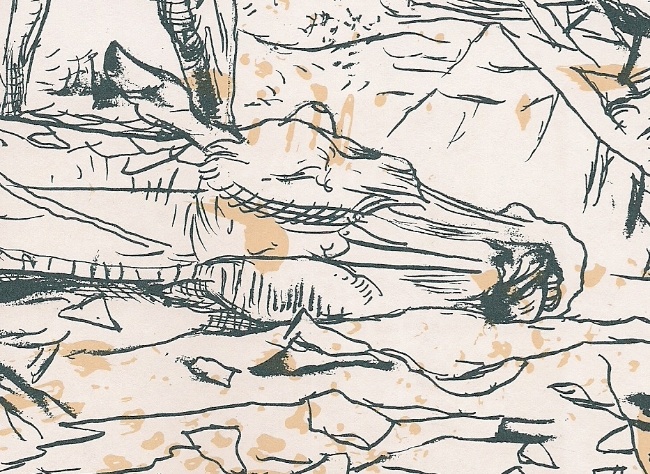
 

JimboHorse

The dead horse from the final page of
Jimbo: Adventures in Paradise,
the greatest work published under the auspices of RAW.


Women In Comics

Just wanted to mention that I’m friends with both Lilli and Derik, but somehow writing about their work here it seemed weird to use their first names. So I didn’t. Hopefully they won’t be offended!
_____________

A bit back I talked about Bart Beaty’s claim that comics have been culturally gendered feminine in relationship to high art. As I said in my post, I don’t find Beaty’s argument entirely convincing. In the first place, high art is itself often gendered feminine (and often mocked as such.) And, in the second place, after thinking about it more, it seems like comics are more often associated with children than with the feminine per se. Children are, of course, often associated with femininity themselves, since traditionally raising children is women’s work and also because anything not-man (whether it’s women, boy, girl, or a horror-film pile of undifferentiated slime) often gets lumped together as “feminine.” Still, it seems worth noting that comics’ femininity seems like its arrived at through a series of somewhat abstracted substitutions. In terms of culturally coded femininity, comics isn’t needlepoint.

Still, just because comics aren’t usually directly associated with femininity, that doesn’t mean that artists can’t treat comics as feminine, or play with the idea of comics as feminine.

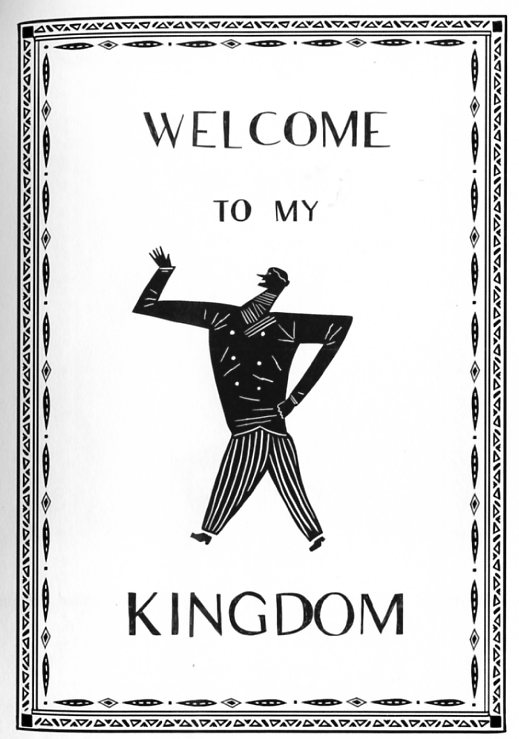
For example, consider the short story “Kingdom” by Lilli Carré, included in her recent Fantagraphics collection Heads or Tails. The story starts off with a well-dressed fellow celebrating his expansive masculinity inside a high-art picture frame.
 

carre_kingdom043

 
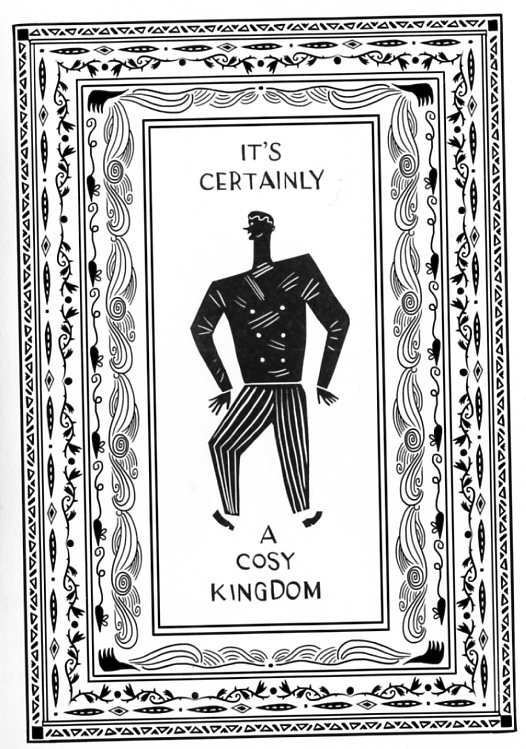
Page by page, though, new detailing and fringes are added to the inside of the frame, till the wide masculine range becomes a hemmed in, overly-crafted cozy feminine interior
 

carre_kingdom044

 
And finally the man himself is reduced to a stylized decorative element. Instead of master of all he surveys, he is an object — or, rather, a surface, surveyed.
 

carre_kingdom045

 
Again, the border here looks, and is surely intended to look, like a picture frame, and so the shuffling of gender is also a shuffling of the gendered connotations of fine art. On the one hand, high art is (as Beaty says) seen in its performative, striding creativity as a masculine kingdom — a canvas over which total control can be exercised in the interest of totalizing self-expression. At the same time, though, the detailed handwork and patterning associated with art — its prettiness, or fussiness, or surfaceness, or frivolousness — links it to the femininity of the craft fair.

If art is both hyperbolic masculine swagger and small-scale feminized detail, though, for Carré the form that mediates between the two is something that looks a lot like comics. The border in Carrés story is a frame…but, from page to page, it’s also a panel. So, on the one hand, the progression of the story could be seen as going from the least-decorated, most comic-like panel at the beginning to the most-decorated, least comic-like panel at the end — or, alternately, the initial image could be seen as a single picture frame, while the additional images emphasize more and more the sequential comic nature of the story. Thus, comics can be either a masculine form feminized by high-art frippery…or a feminine form which pulls high art down into the crafty feminine repetition of surface details.

Carréis herself a female artist who works in both the traditionally male-dominated art world and the traditionally male-dominated comics world. As such, she is, it seems, gently tweaking the masculine pretensions of both — or perhaps tweaking her own attraction to the masculine pretensions of both. That tweaking is performed in part by deploying comics as the feminine alternative to high art — and high art as the feminine alternative to comics. Both comics and high art, in other words, are only nervously, unstably masculine, and that instability is, for Carré, not so much a danger or a weakness as it is a potential — a way for masculine and feminine, art and comics, to open out and lock together in a single claustrophobic, vertiginous spiral.

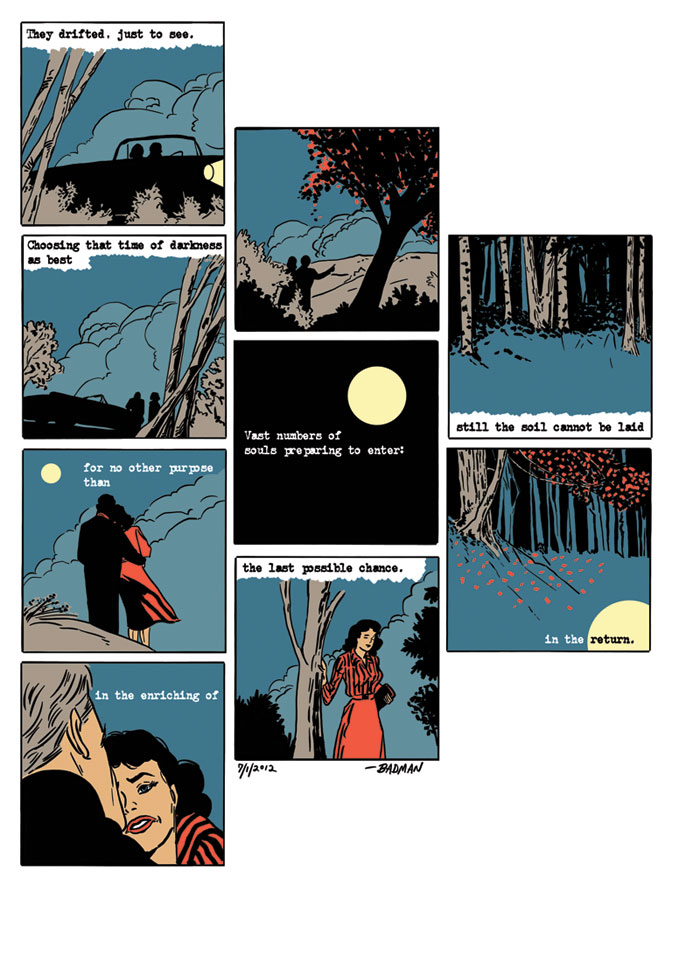
Derik Badman takes a very different approach to comics as feminine. In the anthology Comics As Poetry, Badman channels pop art in a series of ambiguous pages.
 

badman1

 
Lichtenstein mostly used single panels drawn from comics for his canvases — he ironized melodramatic narratives by pulling single moments out of them, and so highlighting their generic artificiality. There’s a little of that in Badman’s version too; the off-kilter columns of images make the narrative flow uncertain — the panel sequence is almost arbitrary. You can read left to right or top to bottom, or even in some sense randomly around within the page.

Again, you could argue that the effect here is something like mockery and something like appropriation; taking the feminized tropes of romance comics, hollowing them out, and presenting the remains as a de-emotionalized, high-concept masculine avante garde. As I’ve written before, though,I think that reading does a disservice to Lichtenstein, and I think it’s not really fair to Badman either.

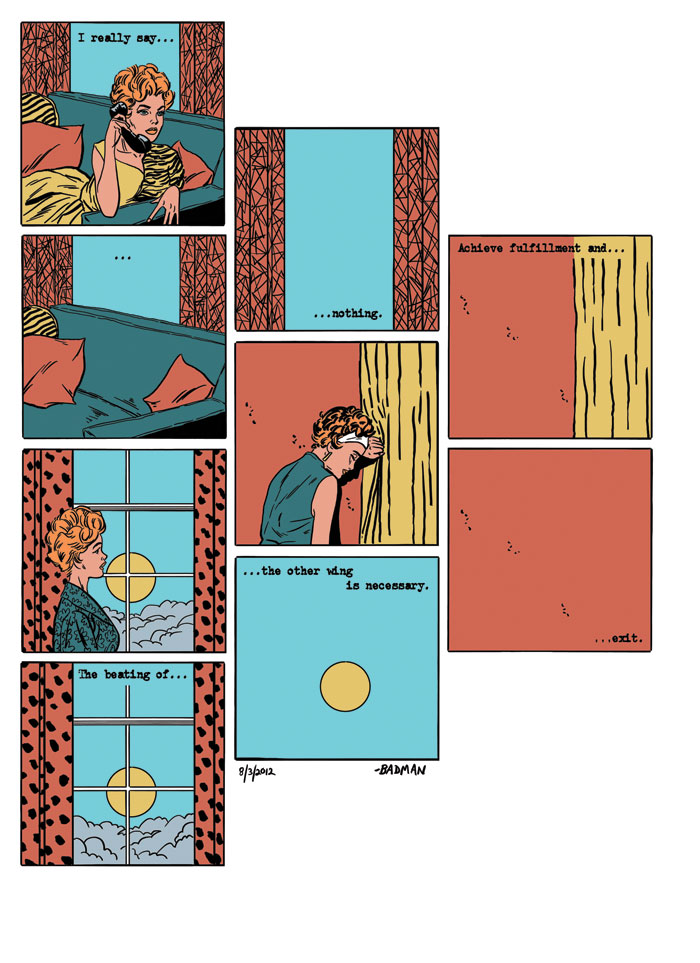
Rather, in Badman’s case, it seems less like the high art avant garde masculinizes the melodrama than like the melodrama reveals the true, feminized emotionalism of the avant garde. In the page below for example:
 

badman6

 
The first panel, with the telephone, becomes a kind of synechdoche for the entire page, thematizing an illustory connectedness which emphasizes a greater absence or distance. The ellipses trailing off or trailing in, to which panel or from which panel is never clear, similarly hesitantly underline the way each panel comes out of and goes into white space…comics not as Charles Hatfield’s art of tensions, but rather as an art of slack disconnection. The desire to make meaning of the narrative — to have “The beating of” connect to “the other wing” — is also the desire or loss of the woman — or perhaps of the women, plural, since the identity of multiple images is one of the comic conventions of continuity that here breaks down into the overarching convention of discontinuity. Comics multiplies bodies, and multiple bodies is desire. The avant garde lacunae, the resistance of interpretation, becomes, not anti-narrative cleanliness, but — through the mirror of comics’ formal elements — a hyperbolic extension of narrative’s most febrile excesses of deferment and longing.

Badman, then, seems to out-Beaty Beaty, inasmuch as, in this reading, comics is not just culturally feminized in relation to high art, but is actually, formally feminine. Indeed, that formal femininity is so overwhelming that it starts to absorb not just comics, but everything connected with comics — not least of all Pop Art. Badman’s comics almost demand to be viewed, not as cut up panels of comics, but as conglomerations of pop art images — and in creating those conglomerations, he makes it hard to see pop art as anything but conglomerations. Lichtenstein’s canvases…are they really isolating images from a narrative? Or, instead, are all those isolated images trying but failing but trying to talk to each other, so that all of Roy Lichtenstein’s panels end up, not as bits from different comics, but as their own single melodramatic discontinuity? For that matter, when you go to a gallery or a museum, each piece isolated in it’s own frame — doesn’t that isolation, that disconnection, that yearning gap, make the high art more comics than comics, and therefore, formally, more feminine than feminine?

For Badman, as for Carré, then, the binary art/comics doesn’t so much map onto the binary masculine/feminine as it creates an opportunity to think about binaries and gender. In the work of these two creators, comics and art want each other and want to be each other and want nothing to do with each other, and certainly too, are each other. So, too, does male/female close in upon itself and empty out of itself, a folding, unfolding box holding and releasing form and desire.

reel gone: Matt Levin’s Walking Man Comics and Kelly Copper’s America

(Some reflections on found art and the end of the Comics Buyer’s Guide)

Of all the things I discovered in the pages of the Comics Buyer’s Guide (CBG) during the 1980s and early 1990s, I still cherish Matt Levin’s Walking Man Comics, a series of minicomics the artist began producing in 1988.  I first read Levin’s work, which he creates with a variety of rubber stamps, in the anthology Oh, Comics! The Official Comic of the Mid-Ohio Con (1988).  I received a copy of Oh, Comics! from my friend S. Minstrel, a San Antonio-based zine maker who’d read a review of one my minicomics in CBG’s small press column.  Without CBG, I would never have begun my correspondence with Minstrel and the other zine makers in his circle, and I would never have discovered Matt Levin’s work, which remains a vital and idiosyncratic contribution to the art and history of the minicomic.

I began thinking again of Walking Man Comics while reading the many online essays and blog postings about the demise of CBG, which will come to an end with issue #1699 in March.  Other writers have already told the magazine’s history in far more detail than I could offer; see, for example, pieces by Rich Johnston, John Jackson Miller, long-time CBG columnist and comics writer Tony Isabella, and, of course, CBG editor Maggie Thompson .  I have decided, then, to offer a short reminiscence of the magazine in the form of a review of Levin’s work which, like the other zines and minicomics I discovered in the pages of CBG, prepared me for other works on the fringes of American popular culture which I now adore as a adult.

While those who enjoy John Porcellino’s King-Cat Comics and Carrie McNinch’s You Don’t Get There From Here will no doubt appreciate the do-it-yourself minimalism of Walking Man Comics, Levin also has affinities with New York City-based photographer and playwright Kelly Copper.  Her work with Pavol Liska and the Nature Theater of Oklahoma seeks to reassemble the fragments of the everyday—transcripts of mundane telephone conversations, for example—into epic works like Life and Times: Episodes 1—4, which has been popular in Europe and enjoyed a successful January 2013 run as part of the Under the Radar Festival at The Public Theater.

Masterpieces are beautiful, too, in a spectacular, Technicolor fashion.  But sometimes small, quiet works of art—covered in the smudges and fingerprints of their makers—are more lasting and precious.  I suspect if I had not read Walking Man Comics in 1988 I would not have fallen in love with Copper’s photographs in the late 1990s.

These notes, then, began as a documentary of the years I spent reading CBG—memories of Don Thompson’s reviews; Cat Yronwode’s “Fit to Print,” which featured a column heading drawn by a different amateur artist each week (including, in 1987 or so, ones from me and my younger sister Alison); Mark Martin’s “20 Nude Dancers 20” cartoons.  I also recall the letters from firebrand science fiction legend Harlan Ellison and pioneer comics scholar M. Thomas Inge.  When I needed information on a project on comics for one of my high school Spanish classes, I wrote a letter to CBG’s “Oh, So?” column asking for help and received a detailed, encouraging letter from Inge and a package of Condorito comics from a new pen pal in New York City.  I once received a phone call from Ellison regarding a letter I’d written on comics and censorship, but that is a story perhaps best left for another essay.

Writing a personal history of my relationship with CBG, I realized, would be impossible.  When I finished a first draft, I found myself with a shopping list of memories meaningful only to me.  I had fallen into the trap of nostalgia Alan Moore describes in his early 1980s Marvelman proposal: “Nostalgia, if handled wrong, can prove to be nothing better than sloppy and mawkish crap.  In my opinion, the central appeal of nostalgia is that all this stuff in the past has gone.  It’s finished.  We’ll never see it again…and this is where the incredible poignance of nostalgia comes from” (Moore 24).

How ironic, then, that, as a means of commemorating the passing of CBG, I should write instead about a series of minicomics which seek to evoke wistful feelings of some lost, idyllic world.  Like Copper’s photographs of stills from abandoned home movies, however, Walking Man Comics also seeks to discover an otherwise unspoken or unrealized present.    As Levin writes on the cover of a Walking Man Sampler from 2002, “I like / layout design, / words, / simplicity— / I like rubberstamps’ ability to mimic nature’s multiplicity…”

Levin continues to produce Walking Man Comics, which he describes on his Facebook page as “12-page mini-comics” filled with “rubber-stamp images combined with photographs and line-work in imaginative page layouts.”  In addition to “Imagination, brevity, elegance and wit,” Levin’s goals include “the promotion of mini-comics as an affordable, pocket-sized means of personal communication available to everyone regardless of age, education, and ‘professional ability,’ dedicated to the principle that one’s level of drawing ability should never discourage creators.”

Both Levin’s comics and Copper’s photographs might be understood as examples of “found art.”  Frank Bramlett has written about the relationship between found art and comics in a post to Pencil, Panel, Page in which he challenges us to open our eyes to the neglected visual narratives which surround us: “Do found comics qualify as a ‘legitimate’ (!?) genre, arising out of occasional and/or accidental use of comics conventions?  If so, where do you see found comics?”  With Bramlett’s questions in mind, we might read the following detail from Copper’s Untitled as a sequential narrative—a repetitive depiction of a quiet, intimate moment.

In her 2002 exhibit reel, Copper included a series of photographs based on images from abandoned home movies she had found at New York City flea markets and antique stores.  Untitled is an Andy Warhol-like grid featuring a blond, middle-aged woman’s face.  She is wearing sunglasses with cat’s-eye rims.  There is an expanse of sky behind her—first blue, then white.  The whiteness then meets a rim of trees.

The woman laughs, turns her head, looks over her right shoulder, stares at us, invites us to laugh with her.  We will never know her name.  Her pale shoulders shrug, then straighten again:
 

1010_001 (1)

Fig. 1: A detail from Kelly Copper’s Untitled (2002), an image from her 2002 show at An American Space Gallery in NYC.  Image courtesy of Kelly Copper.
 
Copper took each portrait from a film which presumably tells the story of this woman’s vacation.  Copper projected the film on the blank, white wall of her apartment, froze the images, and then photographed those still figures. What pleasure is there in these forgotten, neglected movies, blurry records of family vacations, 4th of July parades, high school graduations, and gaudy senior proms?

As Copper explains in a 2006/2007 interview with Amber Reed, home movies have a seductive power unlike other forms of cinema.  Watching these old films, Copper found a new confidence in her role as an artist, a sense of fun which “short-circuits the critical voice that says, ‘oh, that’s really dumb,’ because ultimately I’m just playing.  And I think that’s also been part of the aesthetic for the Nature Theater of Oklahoma—how do you get back to this feeling of theater as play?” (Copper qtd. in Reed).

Like the anonymous subject of Untitled, Copper is at play in a world notable for its simplicity—the sunlight, blue sky, and green trees of a family vacation.  Of course, it is a point in time which did not exist, at least not as figured in this image.  No lived moments have such clarity.  Only the eye of the artist can record such an image.  While joy such as this might be fleeting, the few minutes this woman spent with a Super-8 camera over half a century ago have made her ageless and eternal.

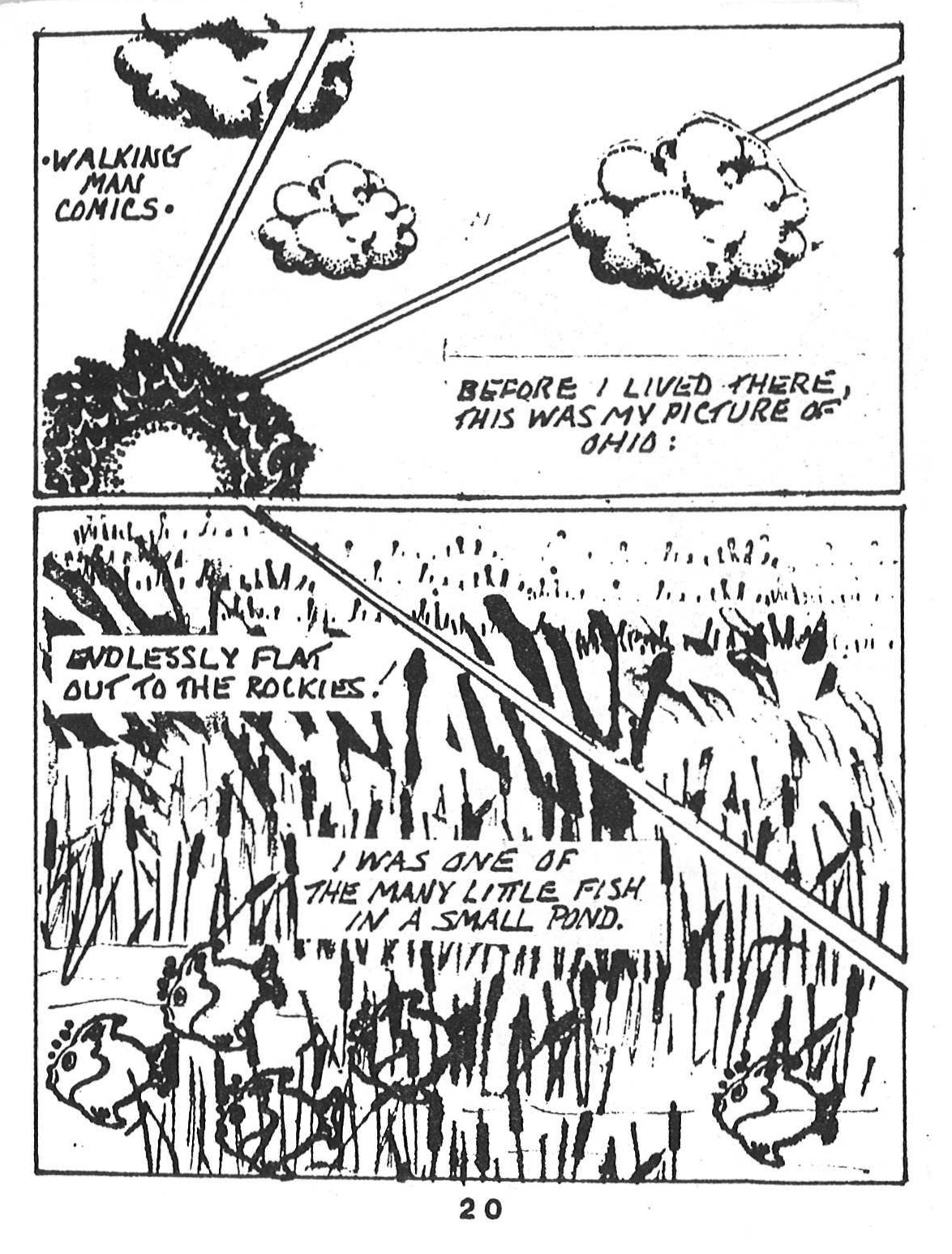
Is a rubber stamp itself a kind of found art like these stills?  Or is it a tool like a pen or a brush?  In his short piece in Oh, Comics!, Levin uses rubber stamps of clouds, a sun, fish, cattails, and trees.  Like Copper, he has recorded for us these quotidian moments:
 

1012_001 (1)

Fig. 2: The first page of a Walking Man Comics story in the anthology Oh, Comics!  The Official Comics of the Mid-Ohio Con (No. 1, 1988).  The following pages are also from Levin’s story in Oh, Comics!
 
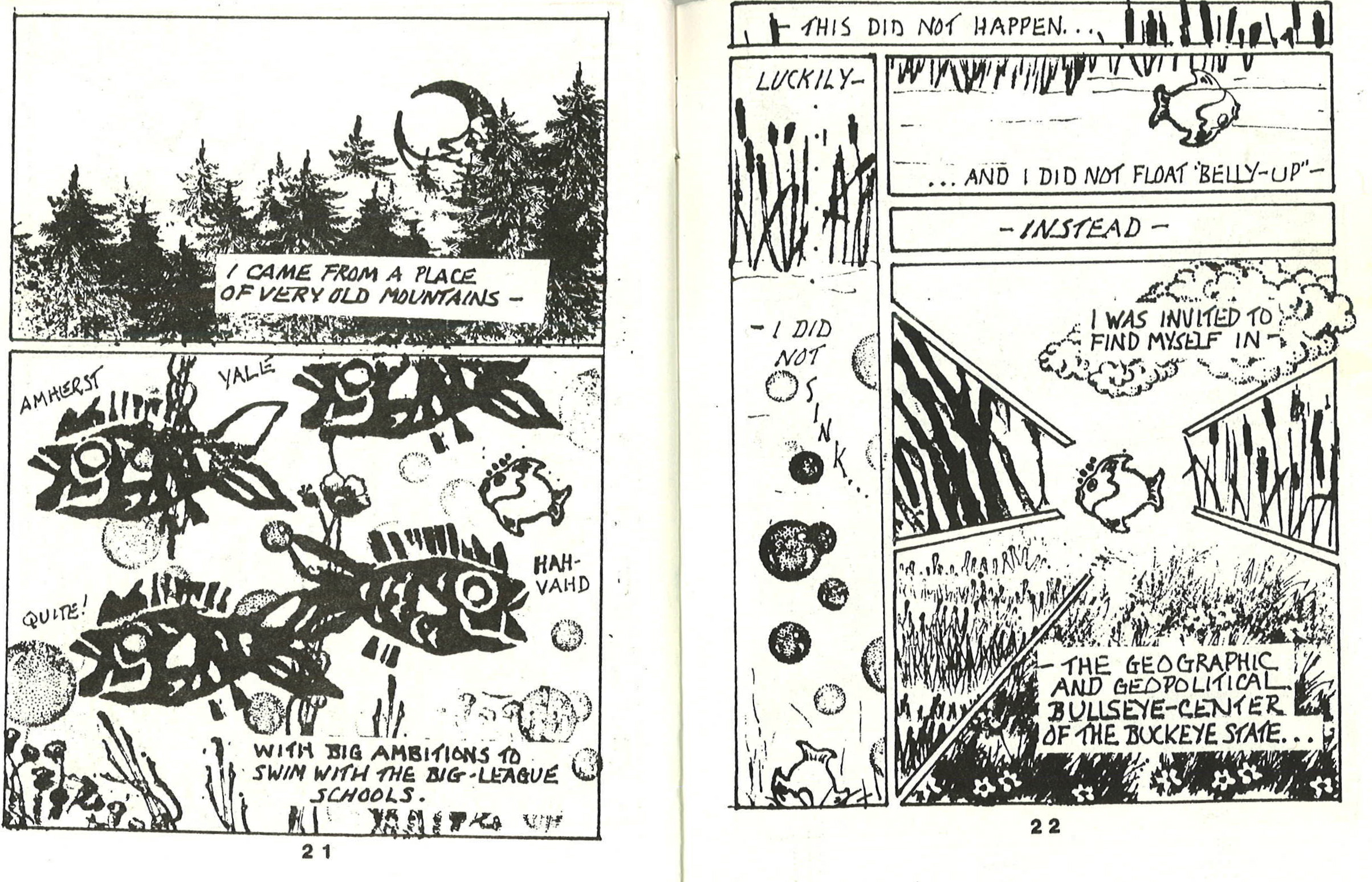
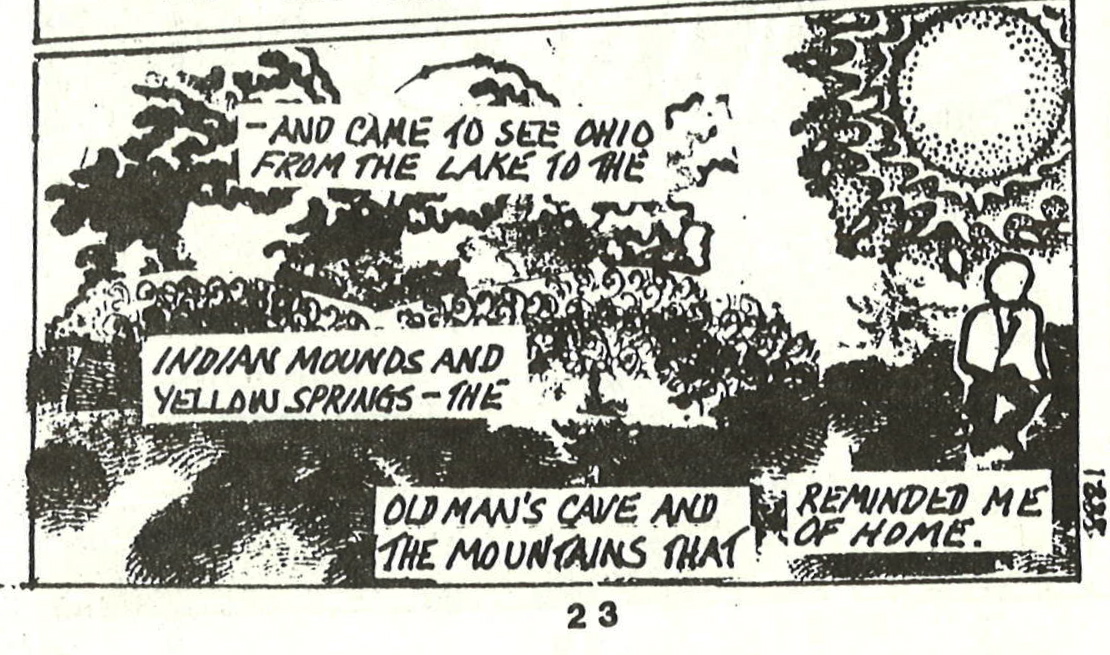
Whereas Copper’s photo-collage is the record of a location, Levin’s story is the diary of a walk from “a place / of very old mountains”—the Berkshires of Western Massachusetts—to what the narrator later describes as “the geographic / and geopolitical / bullseye-center / of the buckeye state,” a place he maps for us on the final page of the story.  Our narrator eventually “came to see Ohio / from the lake to the / Indian mounds and / Yellow Springs—the / Old Man’s Cave and / the mountains” as locations which remind him “of home”:
 

1013_001

 
Levin uses his fingerprints in the final panel on the last page of the comic to create a pattern of shadows from which his hero, the Walking Man, emerges.  His story is as simple as these images.  It is the story of a journey:
 

1014_001

 
Levin’s use of rubber stamps, the repetition of the same fish, the same cattails, the same sun, the same trees, and the same clouds, has told us his story before we have time to read the narrator’s final thoughts: what this wanderer has been searching for he has carried with him.  This collection of rubber-stamped figures and panels becomes a map of Amherst, Massachusetts; of Yellow Springs, Ohio; and of his inner world, its silence broken only by his breath.

In his final public speech in 1992, novelist and essayist Ralph Ellison urged other American writers to see their work, whatever form it might take, as a means of manifesting a more just and democratic nation: “I’ll close by reminding my fellow writers, as I frequently remind myself, that you’re doing far more than creating interesting tales based on your individual view of the American experience.  Underneath your efforts you’re helping this country discover a fuller sense of itself as it goes about making its founders’ dream a reality” (Ellison 860).

I read Walking Man Comics and Copper’s Untitled as works by American artists who seek to map the United States not at its center but along its perimeter.  Copper locates meaning in those precious objects we discard—home movies, family photographs, jumbled cellphone conversations.  Levin conjures landscapes of New England and the Midwest from his box of rubber stamps.

Both Levin and Copper remind us that these fleeting, sometimes painful, often playful moments of existence only become real when transformed by art into objects or images which can be shared—the journals of a walking man and the photographs of a young woman.

Are these works of art glimpses of the“founders’ dream”?  Yes, each one: the black and white of a rubber-stamped tree, and the curve of a bare shoulder, and a cloudless summer-blue sky, and the red-lipped smile of a woman at play.
_____
Update: A follow up to this post is here.
 

1017_001

Fig. 3: A detail from the cover of Levin’s Musicomics #9 (March 2002; first edition March 1996).
 

References for Print Sources:

Ellison, Ralph.  “Address at the Whiting Foundation” in The Collected Essays of Ralph Ellison (Ed. John F. Callahan).  New York: The Modern Library, 2003.  853—860.

Moore, Alan.  “Alan Moore Original Proposal to Warrior Magazine” in George Khoury (Ed.) Kimota! The Miracleman Companion.  Raleigh: TwoMorros Publishing, 2001: 24—29.

Voices From the Archive: Prose and Eddie Campbell’s Alec (and also Peanuts)

Can-I-Come-In-300x231

So for a change I thought I’d highlight one of my own comments from way back when. This is in response to a piece by Caroline Small talking about the prose in Eddie Campbell’s Alec. Here’s what I said:

Ack! I’m reading along and grooving on Caro tossing around comics and space and time and then I get this [passage by Eddie Campbell] as an example of stellar prose:

“But hey! to cultivate a separate life from the one happening in front of you. There’s a thing to pursue. An inside life, where Fate talks to you, sometimes in the charming tones of a girl singer with old Jazz bands.
Othertimes in a naive wee voice in which all things are still possible.”

And I just want to bang my head against the wall.

I just…to me that’s such romanticized, sub-Beat, stentorian self-dramatizing bosh. If I never, ever, hear anyone reference girl singers in Jazz bands as some sort of ne plus ultra of authentic wonderfulness again, then I will have died only hearing it about fifty billion times too many. And “a naive wee voice in which all things are still possible.” Fucking gag me.

Really, I have a visceral loathing of that passage. It’s slam poetry crap.

And part of what I hate about it is exactly the time slips that Caro describes. Maybe I suffered too much damage from my youthful immersion in contemporary poetry, I dunno…but so many, many ungodly contemporary poems (and maybe not just contemporary, but…) end in this lyrical future tense. And it’s supposed to do exactly what Caro says here:

“This is the “potentiality of being” specific to the artistic mindset: “to cultivate a separate life from the one happening in front of you.” That describes an ecstasy of art, and part of the brilliance of this book is the recognition of that ecstatic potential in the mundane life story.”

The world is cut off from the world and made poetic; the mundane is made lyrical. Or, alternately, you could say that the world is picked up and dumped in the poetry machine and then you turn the crank. And out comes ecstasy, hoorah.

I don’t think there is an artistic mindset. I don’t think there should be. I don’t think artists are priests, who make the world ecstatic through their transcendent quiet inwardness; who cast a glamour on the earth through their numbing recitation of important aesthetic touchstones (girl singers! Krazy Kat!)

I think this quote points to what made this book so unpleasurable for me:

“Solipsism is alluring, but impossible. Art comes from other people, and other art, and from experiences in the world. ”

The thing that interferes with solipsism is that it doesn’t fit with art. You start with the need for art, and that leads you to realize that the world has to be there too. But the problem is…for me, in this book, the world is *always* there for the art. The experiences are all there to be chucked into the poetry machine. That’s what happens to his wife and his baby; new fatherhood gets transmuted into standard-issue poetry tropes. That’s what it’s there for. Which I find both, yes, solipsistic, and also really depressing.

Obviously that’s not what others are getting from this, and
I appreciate that, and I think this essay is lovely, but…man, it makes me like the book even less, not more.

___________

And just because this comment isn’t long enough…and I want to say something positive….I think the discussion of prose is really interesting…but I think that you’re kind of missing out on what Charles Schulz is doing if you’re arguing that he’s using condensed meaning in images as a substitute for prose. I think Peanuts is probably as prose the best-written comic, period — certainly better written than Alec, to my mind, though not as wordy obviously. Better written than Delillo too, by a long shot. Schulz had a really idiosyncratic ear for language and a love for words. Some of his strips are sight gags, but a lot of them would pretty much work without the pictures; they’re about puns and verbal dead ends and misunderstandings and different registers of language. He’s usually thought of as a minimalist because of the drawings obviously; but thinking about your essay, you could also see the sparseness of the drawings as a way to give room for the language; as you say, the drawings become a kind of rhythmic device rather than a meaning making one.

Waiting for the Revolution

This first appeared on Splice Today.
_________________

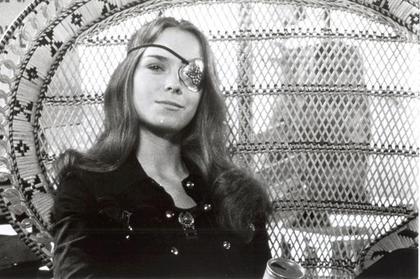
Switchblade Sisters (aka Jezebels) is the last major film of Jack Hill, one of the greatest and least known American directors. Hill worked almost entirely in exploitation film, toiling away mostly for the Corman studios on women-in-prison, blaxploitation, and other genre crap. Switchblade Sisters has everything you’d expect from such a director; there’s gratuitous violence, gratuitous sex, gratuitous T&A, and gratuitously preposterous acting. As Roger Ebert noted with a sniff, “this movie falls far below Pauline Kael’s notion of “great trash.”

And, indeed, this has been the consensus opinion. Switchblade Sisters bombed on its first release in 1975, and it’s re-release with much hoopla in 1996 by Quentin Tarantino’s Rolling Thunder Pictures didn’t exactly rehabilitate it. Tarantino’s DVD package has just been re-re-released, and I doubt that’ll change things much either. Rotten Tomatoes gives the film a pretty rotten 53% fresh rating,, and the intensity of scorn on display from many of the critics is impressive. Stephen Holden of the New York Times sneers (http://www.nytimes.com/library/film/switchblade_sisters.html), “To watch “Switchblade Sisters” is to visit a never-never land of shopworn media images colliding in a tabloid high school of the mind.” Richard Harrington of The Washington Post fulminates inaccurately, “The acting is so bad that apparently none of the performers ever got another job in the movies.” He adds, with more justice that “the costumes in Ben Hur seem less dated that those on display here.”

Why exactly dated costumes would be a drawback is something I don’t entirely understand; the crazy retro-to-a-world-that-never-was wardrobe seems like a feature rather than a bug to me. My favorite stylistic choice is the gigantic ornate uber-tacky beret things that Lace (Robbie Lee) wears in her hair so she can look like Princess Lea (before there was a Princess Lea) while toting a machine gun in the climactic firefight. Props also to whoever decided that gangsters should wear day-glo patterned shirts.

As this suggests, the film has many defenders of the so-bad-it’s-good variety. And there’s no doubt that Switchblade Sisters is a delirious camp-fest from beginning to end. From the amped-up woman-in-prison juvie lesbian nightmare to the bloodbath at the roller rink to the macho black female revolutionaries quoting Mao, the film careens from one flamboyant set-piece to another. The dialogue is chock full of profane melodramatic quotables. For example:

”You know, sooner or later every woman’s bound to find out — the only thing a man’s got below his belt is clay feet.”

“My old man, God rest his ass, told me once, “Son, don’t ever let ‘em push you, because once they get you moving, it’s awful hard to stop.”

“Everybody knows your crank can hook a tuna.”

And, finally, there’s Robbie Lee as Lace — leader of the Dagger Deb girl gang — who speaks all her lines like her teeth have been epoxied together and she’s sucking helium through a straw. Her performance starts out outrageous and moves on up to utterly insane, culminating in a full-on wild-haired wild-eyed Shakespearean rage of jealousy and despair. Her deranged, “He was treating me like a little gutter cat!” has to be one of the most ludicrously bile-filled lines in film.

It’s also, counter-intuitively, one of the most poignant…which is why I’m not exactly comfortable with the so-bad-it’s-good reading here. As Quentin Tarantino points out in his commentary on the film, Switchblade Sisters for all its goofiness, is a film with some surprising depths.

As in many of Jack Hill’s films, those depths involve a sympathetic and unusually nuanced take on female-female friendships. The movie is about the relationship between Lace and Maggie, the newest, toughest girl in school. The two fall into a quick, intense, love-at-first-beatdown friendship. This quickly turns into a love triangle, as Patch (Monica Gayle), Lace’s former first lieutenant and best friend, tries to pry Lace and Maggie apart. And then that turns into a love quadrangle when Lace’s boyfriend Dominick, leader of the Silver Daggers boys’ gang, falls in lust with Maggie. Despite the fact that he sort of rapes her, she reciprocates his interest. (I discuss the rape at greater length here: http://hoodedutilitarian.blogspot.com/2008/03/jack-hill-and-rape.html)

So far that sounds a lot like YA teen girl melodrama, complete with crushes, jealous backbiting, and bitchy rivalry. And it is that in part. But the film balances this toxic view of women’s relationships with a more positive view. In the first place, Maggie and Lace really do care about each other. Lace goes out of her way to protect Maggie from a punitive cavity search in juvenile detention. For her part, Maggie reacts with rage when Dominic mocks Lace’s love letter in front of the rest of his gang. And even though Maggie is attracted to Dominic, she tells him repeatedly and convincingly that her primary loyalty is to Lace

Moreover, the film makes a thoroughgoing call for feminist revolution. The Dagger Debs are more or less the ladies’ auxiliary of the Silver Daggers…and they are mercilessly exploited. The boys’ literally pimp them out to other students, and force them to hold lit cigarettes in their hands so the men can bet on which of the girls will flinch first. Dom treats Lace like crap, sneering at her behind her back to his friends, sleeping with Maggie, and reacting with a torrent of abuse when Lace tells him she’s pregnant (“You think I’m ready to haul freight in some fucking warehouse for two dollars an hour so you can have a little brat suck on your tit? No thanks baby.”)

The solution to these myriad indignities, the film says, is feminism. Maggie’s courage and competence inspires the other girls to toss the boys out of the clubhouse and go it on their own, changing their name from “Dagger Debs” to “Jezebels” in the process. Instead of allying with white men, they then ally with a group of black women revolutionaries. In the triumphal apocalyptic showdown, the multiracial sisters sweep down with superior planning, courage, and firepower to kill the drug lords and politicians who oppress them. Death to the man!

If that was the end, we’d have an unambiguous but simplistic vision of feminist triumph. But Hill’s too clever for that. After the showdown with the man, there’s the showdown with the woman. Convinced that Dom was cheating with Maggie, Lace had betrayed the gang’s attack plans to their rivals. The hope was that Maggie would be offed; instead, Dominic is killed along with Lace’s unborn child. In one of the most painful scenes in the film she lies in her hospital bed and hysterically spins a fantasy of domestic bliss, pretending that Dominic had proposed to her rather than demanding she get an abortion. “Can you see me having a kid, hanging around some dumb house doing housework and dishes and diapers…,” she laughs in that helium-fueled whine, both pathetic and terrifying.

But the death of her man doesn’t free Lace. While the other girls throw off their false consciousness, Lace clings more tightly to hers, challenging Maggie to a knife fight over the dead jerk who was worthy of neither of them. Maggie’s victory, seen in silhouette, is a kind of exorcism, killing the part of herself that chose Dom over her sisters.

Again, though, this isn’t exactly a happy ending. Lace isn’t just a part of Maggie; she’s a sister herself. By combining the teen melodrama with the feminist parable, Hill complicates both. Maggie never would have joined the Debs without Lace; it’s their love for each other that makes the wider sisterhood possible. Until the moment that Lace calls her out to fight, Maggie insists that all she’s done has been for the other girl…and she’s not lying. Without the personal relationships, sisterhood isn’t possible — but those personal relationships are mired in poisonous sexism and jealousy. The society we’ve got furnishes the materials of the revolution; those are the only materials around. But that means that the revolution is inevitably tainted. Lace’s act of faith — her decision to befriend Maggie — makes sisterhood possible. But Lace’s weakness, and Maggie’s as well, means that Lace can’t stay true to her initial act. She doesn’t see the promised land, and as a result the promise is stained. By murdering Lace, Maggie gives the police the ammunition they need to put her away. The final scene shows her being shoved into the paddy-wagon covered in both Lace’s blood and her own. It’s not entirely defeat: the gang seems rededicated to each other, and Maggie is defiant and exuberant. But it’s not victory either.

Stephen Holden concludes his review of the movie by claiming that Switchblade Sisters is “a place where the only thing that really matters is holding onto your unworthy louse of a boyfriend.” This is such a thorough and obvious misreading of the film that it’s hard not to wonder what’s behind it. After all, this isn’t Pretty Woman, or Yes Man, or Boomerang, or any other of a billion Hollywood romantic comedies where the louse of a boyfriend gets the girl and that’s supposed to be a happy ending. In Switchblade Sisters, the fact that Lace holds onto her boyfriend is not romantic comedy. It’s hyperbolic, melodramatic tragedy.

Perhaps that’s precisely what makes Holden and other critics uncomfortable. Maybe the problem isn’t holding onto the lousy boyfriend, but portraying him as a louse in the first place — and suggesting that Lace’s love for him has not just personal, but social, and even apocalyptic consequences. For all its exploitation goofiness, Switchblade Sisters really believes that sisterhood matters more than men. Thirty-six years after it came out, that’s still an unsettling message.
 

switchbladesisters_large

Utilitarian Review 2/2/13

On HU

Featured Archive Post: Ng Suat Tong on original comics art and a nostalgia for racism.

I talk about Irish music and authenticity.

Voices from the Archive: Matt Thorn on Kirby and the world outside his skull.

Bert Stabler on the new free Chicago comics issue of Lumpen.

Emma Vossen kicks off a short Twilight roundtable by explaining why you should hate Twilight hate memes.

I argue that Edward is a male variation on the manic pixie dream girl.

Peter Sattler wonders what reading influenced Kirby (Charles Hatfield, Jeet Heer, and James Romberger weigh in, among many.)

Mette Ivie Harrison on Bella as a Mormon Goddess.

Charles Reece ends our twilight roundtable with a whimper, as he explains why he hated the series too much to write about it.

We had the first of what may be a regular music sharing post…so let us know what you’ve been listening to if that appeals.
 
Utilitarians Everywhere

At the Atlantic I got to write about the great romance of Charlotte and Mr. Collins in Pride and Prejudice.

At the Atlantic I argue that geeks are not necessarily bullied for being geeks (but instead for reasons involving class and gender.)

At the Loyola Center for Digital Ethics I write about the ethics of scanlation.

At Splice Today I argue that US employers are crippled by their hatred of workers.

Also at Splice I talk about the great gospel duo The Consolers.
 
Other Links

Eleanor Barkhorn on not overselling marriage.

Amanda Marcotte argues that my feminist argument against women in combat is wrong.

The American Conservative on right-wing copyleft.

Miss Universe national costumes.

This story about being out with HIV made me cry.
 
This Week’s Reading

I finished Sense and Sensibility, read for review a preview copy of Alex Sayf Cummings’ book about the history of music piracy, Democracy of Sound, and started Elmore Leonard’s Get Shorty…which is mediocre, but plugs along quickly. Also started Storms, Carol Ann Harris’ memoir of dating Lindsey Buckingham…which I may or may not finish….
 

Mexico