Joss Whedon’s Next Project

joss-whedon-sp

Dear Joss,

Hey, I’m a big fan, seen all your stuff, love it all (except maybe season one of Dollhouse, though the unaired pilot was brilliant). So I’m embarrassed to confess I only streamed Cabin in the Woods on Amazon recently, and I have to say, yes, totally brilliant too. So much so I was thinking, since you’re Mr. Marvel now, why not a mash-up? I know, you’re way way too busy with Avengers 2 and Agents of S.H.I.E.L.D to draft another script. So I’ve gone ahead and done it for you:

Cabin in the Superhero Origin Story

Open with a shot of a corporate building and pan down to an entrance sign, “Zarathustra Technologies,” with a yellow school bus parked in front. A guide leads a high school group through the complex as a nerdy kid peels away to investigate a temptingly open lab door: “Arachnid Gene Modification.” As he studies the array of weird, glowing spiders, one descends on a thread and bites him. He slaps it, but too late, he’s already pale and sweaty. Spider arms rip through his sides as he transforms into an enormous, harry spider. It stands there a moment, screeching in confusion, before rows of hidden machine guns pivot from the walls and blast it into twitching pulp.

Cut to Control Room monitor of same image. Three TECHS frown down at the mess as they argue: “Told you the DNA sequencing was off,” “You always say the DNA sequencing is off,” “So next time maybe listen,” etc.

Roll credits as we travel down the row of screens, each monitoring a different room in the complex with a different nerd suffering a different transformative accident: a shelf of chemicals tipping over, a slippery walkway above a vat of toxic waste, a massive machine whirring out of control, a metal door sealing shut beside a countdown clock, etc. The TECHS press buttons, sip coffee, and record data from the staged mayhem, while continuing to banter.

“Okay,” one asks, “who we got next?”

A new bus pulls up and exiting jocks and cheerleader types jostle aside the newest NERD. One of the techs is reading his file in a voice over, revealing their improbable depth of knowledge and so long-term monitoring and manipulation. He’s not a great candidate though, just barely made the cut, but what the hell. He enters the building last.

A female tour GUIDE in Clark Kentish glasses (she’s cute but bumbling) is describing an antique gamma cannon, now a harmless lobby display. Only wait, why did that light start glowing when she bumped against that button? It charges up as she strolls unknowingly in front of the massive barrel. The NERD, the only one aware of the impending disaster, shoves through the jocks and cheerleaders to push the GUIDE to safety as he’s soaked in a roar of distorted green light.

He stands there, shocked, but when nothing else happens, the crowd of teens cracks up. The TECHS, however, applaud (“Nobody ever saves the girl anymore!”) before readouts indicate no change in NERD’s gamma levels. Damn it! They must have fired a dud. GUIDE thanks him as she climbs to her feet and adjusts her glasses. They shake hands in an awkward moment of mutual romantic dizziness—interrupted by one of the TECHS talking through the bluetooth in her ear to keep the tour moving before they get bottlenecked.

The Arachnid room is ready for a reboot. GUIDE fumbles through her lines, distracted when she sees NERD lured by the open door. She’s torn between protecting him and doing her job. “Don’t!” she calls. “Don’t, um, stay behind too long. We’re stopping in the cafeteria next.” Jocks and cheerleaders cheer as the tour moves on and NERD enters the lab.

This time we see the TECHS orchestrating everything and the difficulty of lowering a spider on a puppet string. They miss twice before the spider grabs his arm. They applaud when he slaps it away, then freeze, waiting for the reaction. Except nothing happens. Readout scans show zero change. He must have slapped it away before it bit him. Man, this kid is lucky! When NERD catches up to the tour, GUIDE squeaks with surprise and pleasure, nearly hugging him then awkwardly stopping herself.

Meanwhile, someone very important in a black suit arrives in the Control Room. The TECHS snap to and give a progress report on the Zarathustra Project, which we glean is a secret, internationally funded R&D program designed to produce a Homo Superior, a literal Superman.  BLACKSUIT is highly agitated at the lack of progress, watching as the TECHS narrate two, simultaneous events on the monitors.

A nerd is lead into the basement where a walkway “breaks” by remote control, dropping him into toxic sludge. Another nerd is lured into a lab where a shelving unit tips onto him as he stands on an exposed wire. The BLACKSUIT is thrilled, until TECHS report that the kid is dead. “Dead? What happened?” “We dropped a shelf of chemicals on him.” “While electrocuting him.” “It tends to kill people.” “98%.” “You have survivors then?” “Well, ‘survivor’ is a strong word.” “And not so much with the present tense really.” Discussion escalates until a TECH notices the other kid climbing out of the sludge—which, hey this looks promising. His vitals are stable, and, wow, the toxins are bonding to his cells. The kid slumps onto the walkway as his arm turns into a new swamp-like substance. The TECHS are cheering! Except, uh oh, the readouts. His arm is dripping away. They watch as he melts into a brackish puddle.

BLACKSUIT is hysterical with disappointment. TECHS try to calm him down, explaining this is how it works everyday here. “But today,” BLACKSUIT blurts, “is not every day! Today is surprise inspection day!” This hardly seems like news to the TECHS, since BLACKSUIT is there already. “No,” he continues, “not me. The Watcher is coming down.” This cracks up the TECHS. “The Watcher? Coming down from, what, his Fortress of Solitude on the moon? He’s going to visit us puny humans?” Actually. Yes. BLACKSUIT received a moon transmission this morning. TECHS are stunned. “The Watcher hasn’t come down to earth in decades, not since , since—” “1938. When we agreed to begin the Zarathustra Project or face his wrath. And today he wants results.” All look at the monitors. They’re blank except for GUIDE and her one remaining tour group.

GUIDE is explaining something, when she steps away to respond to her bluetooth. “The Venom Room? That’s crazy—we haven’t even finished preliminary—” She flinches from the shout in her ear, then tells the group they’ll need to take a little unscheduled break, please make your way back down to the cafeteria again. Everybody but NERD, who she leads down a restricted corridor. He looks nervous, especially when they end up alone in a dim lab—is she making a pass at him? She pockets her glasses and walks toward him sexily, but then stumbles on something. She puts the glasses back on, but tries to keep up the sexy thing—while behind his back a strange oily substance crawls from a centrifuge the TECHS have just switched off and unlocked. GUIDE continues to distract NERD as she watches it over his shoulder. Her lips approach his as the black goo nears his back.

But as it is about to engulf him, she can’t do it, and shoves him to safety. The substance strikes her hand, congealing around it. TECHS are cursing, “What the hell is she doing?” But then NERD dives full force at the black goo, until it releases her hand and swirls around him instead, coating him and slithering into his mouth and nostrils. BLACKSUIT nods. “Wow. She’s good. We could use her in ops.” “Nah,” says a TECH, “total klutz.” NERD is now lost in a black blob as TECHS study readouts. The symbiont is acclimating to the host. GUIDE stares, horrified at what she has done. Excitement builds in the Control Room—until the black goo pours from his body, inert. GUIDE rushes to his side, but can’t embrace him because he’s vomiting out the black remains. TECHS argue about what went wrong (“Told you it wasn’t stable!” “You always say it isn’t stable!”), until BLACKSUIT cuts them off. It doesn’t matter. He’s just received official word on his cell: The Watcher is on his way.

NERD and GUIDE have found a table in the cafeteria. He’s picking off the last of the black goop as she sits down with a tray, nearly dropping everything. She laughs. “I don’t know what it is about you, but I swear I go weak in the knees when I’m near you.”

Romantic interlude continues while behind them a new high school group arrives in the lobby. Another guide runs through the gamma cannon routine, only this time no one notices the warning light, so she just stands there waiting to be rescued. TECHS wait too, someone’s finger on the fire button. The guide gives up and moves on as a couple of goof-offs play with the cannon. When one sticks his face into the barrel, TECHS fire it. He staggers back as the group laughs. They stop laughing when his skin turns green and his muscles rip through his clothes.  He’s turning into an incredible . . . BOOM! He explodes across the lobby.

More cursing in the Control Room. “Well, at least we know the cannon is working.” A TECH blinks, realizing something: “But that means—” She’s cut off by shouts that the Watcher is in radar range, he’s descending!

Outside a spaceship drops through the clouds to hover above the Zarathustra building.

GUIDE and NERD are talking at their table when she looks up, alarmed.

The ceiling of the Control Room peels back in the glow of a tractor beam as the WATCHER levitates through the opening. He’s pretty much Marlon Brando in his white Jor-El costume from the 1978 Superman.

GUIDE jumps up from the cafeteria table, leaving NERD as she shouts: “Sorry, gotta go!”

The WATCHER addresses the Control Room in pompous, alien-Brando speak. He is done waiting. The time for Earth to produce a specimen worthy of propagation is upon them. Report your results! TECHS and BLACKSUIT whisper-argue among themselves, until BLACKSUIT steps forward. “Although we have made tremendous progress, I am afraid that we have not yet achieved—”

WATCHER cuts him off. He’s not talking to the humans. He’s talking to the figure stepping into the Control Room behind them. It’s GUIDE. There’s no longer any klutziness to her. She discards her glasses and emits a cocoon of light. When the light recedes, she’s a Superwoman, complete with regal red cape. She reports: “Father, the humans have failed to evolve. I regret to report that I have encountered no genetically adequate mates on this planet.” WATCHER: “Then they have given us no choice.”

WATCHER looks up, and his ship begins to emit a column of light that penetrates the building. BLACKSUIT rushes forward, begging for more time, pleading to spare humanity—they can still produce a Superman! WATCHER smiles. He agrees. The cosmic rays bombarding the building will do exactly that. Sure enough, BLACKSUIT and TECHS are transforming: one’s skin begins to blister; another’s bones bend under his weight; a third shimmers in an invisible force field; the fourth grows orange and craggy. The transformations continue until a TECH self-immolates in a ball of flame; another oozes across the floor in an elastic puddle; the third claws at her face, unable to breathe through the invisible field; and BLACKSUIT expands into a giant orange rock.

BLACKSUIT’s body grows so big it crashes through the floor, smashing down level by level until landing on a cafeteria table as NERD jumps out of the way. WATCHER floats down afterwards, not bothering to pause over the transformations taking place. Each floor has its own flavor: X-men mutations, 50s scifi monsters, horror classics, etc. GUIDE follows him, but she looks upset at all the suffering.

When they arrive at the bottom, NERD is staring up at them, confused and horrified but not . . . transforming. WATCHER cocks his head. He asks his daughter why this one is immune to the rays, but she can only grin with relief that NERD is okay. Red rays shoots from the WATCHER’s eyes, allowing us to see NERD’s internal organs, his skeleton, even close-ups of his DNA. WATCHER raises a hand and the ship rays stop. The writhing bodies on each floor relax and begin to return to their human states. WATCHER is smiling now too. He has found a worthy mate for his daughter. The NERD is a spontaneous mutation, a being higher on the evolution scale than the mere humans that produced him.

NERD is trying to take this all in—the cute GUIDE is really a Superwoman from another planet whose father wants them to have babies together—when WATCHER gives the planetary extermination order.

Wait, what?

GUIDE explains: “Your planet has produced its superman, you. The rest are superfluous.”

“But you can’t!” NERD grabs her arm, and her knees go weak. Literally. She can’t stand. She’s collapsing. WATCHER looks alarmed for the first time. The NERD’s mutation doesn’t just make him immune; he’s kryptonite to them. And so he must be destroyed!

GUIDE shouts no! as her father turns his eye rays into lasers, blasting through tables and rubble as NERD leaps out of the way. Eventually NERD is downed and cornered and WATCHER steps up for the kill. GUIDE tries to stop him, but she’s too weak. He squints and his laser beams strike NERD in the chest. Nothing happens. He’s impervious to this too. WATCHER blinks, intensifying the rays, as NERD stands and walks toward him through the beams. They grapple, excess laser radiation flashing, until NERD grabs WATCHER’s head and forces him to shoot his eye rays straight up through the openings in the floors, straight up to the ship, which explodes. WATCHER collapses.

NERD pulls GUIDE out of the rubble, but can she really be redeemed after okaying the extermination of the human race? Maybe he finds her dying, her body no longer super after being exposed to him, and they kiss during her final breath. WATCHER should stagger to his feet behind them, bloodied and clearly no longer so super either, and just as he’s about to crack NERD’s head open with a piece of debris, BLACKSUIT clobbers him. Remember BLACKSUIT was the big orange rock that fell through the floors, and so he’s normal again, though almost naked in rags.

Should GUIDE and NERD have a happy ending? That’s your call. Seriously. Call me. I can dash out the rest of the dialogue and have this ready for production by, when are you free, 2019? You think J. J. Abrams is too busy to direct? We should talk about that too. I’m sitting by my phone right now.

Sincerely,

Chris
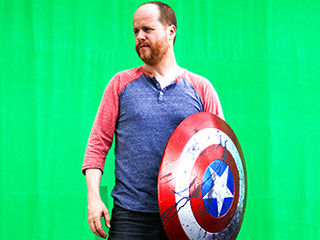
The Avengers (2012) Director Joss Whedon on set

Utilitarian Review 9/21/13

On HU

Featured Archive Post: Caroline Small on how SPX blows her mind.

Me on why Harry Potter isn’t very good (it’s all about quidditch.)

Isaac Butler on perceiving race.

Alex Buchet continues his series on the prehistory of the superhero, this time focusing on Holmes and Wells.

RM Rhodes argues that SPX has something for everyone, unlike the mainstream.

Osvaldo Oyola on queer silence and a radical ending for the Killing Joke.

Me on the Joker’s wife, and also no how the Killing Joke is sanctimonious pulp crap.

Chris Gavaler on the superheroine dress code and how the mainstream is (slowly) becoming less sexist.
 
Utilitarians Everywhere

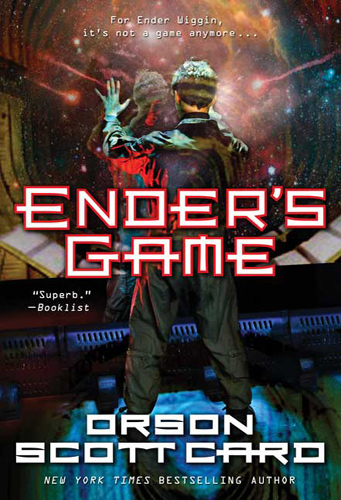
For my first ever piece at Salon, I talk about Ender’s Game and making genocide a sacrament.

At the Atlantic I argue that the NYT Book Review should just embrace its identity as a lit fic fanzine.

At the Atlantic I talk about the documentary the Revolutionaries and why right-wing ideologues in Texas are only part of a broader problem with education.

At Splice Today I talk about how racists who think Indians are Arabs aren’t actually confused (just racist.

 
Other Links

David Brothers on how racists-react-to-things posts are themselves racist.

Feminists pretend Playboy cares about consent.

on why focusing on confessions of white privilege are counter-productive.
 

enders_game_ya

The Artist As Troll

This ran first on Splice Today.
_________

“For as writing gains in breadth what it loses in depth, the conventional distinctions between author and public…begins…to disappear. For the reader is at all times ready to become a writer, that is, a describer, but also a prescriber. As an expert — even if not on a subject, but only on the post he occupies — he gains access to authorship…. It is in the theater of the unbridled debasement of the word…that its salvation is being prepared.”

Reading that quote above, you could almost think it was yet another over-carbonated paean to the wonders of the internet — some pseudo-academic talking-head ranting on about how blogs are going to bring about the egalitarian millennium. Everyone’s an expert, everyone’s an author, everyone’s got the keys to the kingdom and, hey look, they’re all running through the pearly gates with words dribbling from their gums and bytes blasting from their backsides.

And yep, that’s precisely what the quote is about. It’s just that the vision of a thousand points of blather is a little hoarier than you might expect. Specifically, the above was written by none other than Walter Benjamin all the way back in 1934. The essay was called “The Author as Producer,” and here’s what it looked like originally:

“For as writing gains in breadth what it loses in depth, the conventional distinctions between author and public, which is upheld by the bourgeois press, begins in the Soviet press to disappear. For the reader is at all times ready to become a writer, that is, a describer, but also a prescriber. As an expert — even if not on a subject, but only on the post he occupies — he gains access to authorship…. It is in the theater of the unbridled debasement of the word — the newspaper —that its salvation is being prepared.”

Yes, Virginia, 80 years ago Benjamin was touting the newspaper — or at least the Stalinist newspaper — as a truly democratic voice. Newspapers were the bright new genre that would allow the people to take an active role in their culture and cease to be the stoned recipient drones of capitalist trash. The press (or “at any rate” as Benjamin says “the Soviet Russian press”) is changing everything; it “revises the distinction between author and reader.” The means of production are now in the hands of all, and the revolution is sure to follow.

One wonders what the Frankfurt School would have thought of the new day that has now dawned. If Benjamin’s beloved Brecht encouraged audiences to think critically about the artist’s work, surely blogs, twitter, and comments threads encourage the audience to come up on stage, beat the actors bloody and shit on their remains while screaming racial epithets sprinkled with smiley icons. If Benjamin truly believed, as he claimed, that the best art, the most valuable art, the art with the highest “technical quality” was that art which succeeded in “promoting the socialization of the intellectual means of production” — well, you’d think he must be right now leaping from his grave in joy and wonder, scurrying over to the nearest internet café, and greedily scrolling through the latest 4chan flame war , all the while muttering to himself, “Lolz! Lolz! The revolution will be Rickrolled!”

The idea that the people will save culture has an almost irresistible fascination for leftists. On the one hand, you have Frankfurt school dyspeptics who think corporate crap has blinded us all. On the other, you’ve got cultural studies pollyanna’s claiming that fans of Ameircan Idol creatively repurpose the show as a site of resistance to hegemony. But whether sad or cheery the dream is the same: some day the masses will rise up and write better novels their own damn selves.

Now the people are here, though, and…well, it’s a mixed bag. Certainly, lots and lots of folks who could never have gotten their voices out before are able to do so now. The result could not exactly be characterized as an increase in art’s “technical quality,” though, nor as a socialist utopia. Capitalist desires have not been shucked; instead, they’ve metastasized. Given the means of production, as it turns out, people mostly want to scream fire in a crowded messageboard, talk about their furry fetishes, or check the weather.

The point isn’t that the people are innately frivolous or deluded — in fact, there’s tons of political discussion online, and the Iranian uprising showed quite clearly that access to communications technology can have potentially liberating effects. But hedge as you will, the democratization of the literati cannot be said to have created a world in which socialism is ascendant, or in which there is an overwhelming majority of speech exhibiting what Benjamin refers to as the “correct political tendency.” It’s almost as if the rallying cry “every man a genius!” is as much a call to debased polymorphous revels as to fraternal salvation. Benjamin himself, from that perspective, starts to look decidedly libidinal, sensuously spitting his half-baked theories through his mustache and out into the ether, a troll in love with trolling long before his time.
 
225px-Benjamin-sm

Superheroine Dress Code

“We just happen to show a little more skin when we get to the ladies,” says Image Comics artist Todd McFarlane, explaining that the portrayal of women as sex objects in comics is a natural byproduct of the genre’s generally exaggerated style. “As much as we stereotype the women, we also do it with the guys. They are all beautiful. So we actually stereotype both sexes.”

McFarlane was trying to plug the PBS documentary Superheroes: The Never Ending Battle (it starts October 8), but his comments, and those of Kick-Ass writer Mark Millar trivializing rape (“I don’t really think it matters. It’s the same as, like, a decapitation. It’s just a horrible act to show that somebody’s a bad guy”), pissed off plenty of fans. Garth Ennis combines the two approaches—rape and lady skin—in The Boys when his Superman stand-in Homelander compels newcomer Starlight to give him and his teammates blowjobs before taking a Sharpie to her costume and drawing in navel-deep cleavage: “New costume concept for you. They want something a bit more photogenic.”

McFarlane co-founded Image in the 90s, The Boys premiered in 2006, Kick-Ass in 2008, so that might be the problem. These Cro-Magnons are behind the times. Todd thinks he’s just obeying the testosterone-driven norms that give him no choice but to draw scantily clad, super-breasted, Barbie-legged uber-women. But if that’s true, why is the comic book population of anatomically impossible porn gals in decline?

A friend of mine, Carolyn Cocca, spent her summer staring at T&A. She studied 14,599 comic book panels, adding a checkmark to her tallies only if a particular tit or ass cheek “was just about to fall out.” She didn’t count mere cleavage or skintight curves unless they included a panel-dominating breast “larger than a woman’s head.” The results? “Female characters,” she reports, “were portrayed in more panels and less likely to be objectified in the early 2010s than they were in the mid-2000s or mid-1990s in the same titles.” Carolyn is also chair of Politics, Economics & Law at SUNY’s Old Westbury College, so her expertise in quantitative analysis is larger than Todd, Mark, and Garth’s breast-sized heads combined.

Professor Cocca’s not alone in critiquing the absurd poses male artist inflict on their female subjects. The internet is busting out with parodies of McFarland inhabitants:

Alexander Salazar asks what if male superheroes were drawn like female superheroes with some very bare-chested and shorts-bulging results.

Kelly Turnbull refashions the entire Justice League in Wonder Woman style.

Steve Niles has similar fun with the Avengers.

Multiple artists take aim at Hawkeye.

Michael Lee Lunsford dares the impossible by drawing superheroines fully clothed.

John Raptor’s “reality”-based superheroine includes “practical underwear” and “legs like tree trunks.”

Ami Angelwings’s Escher Girls documents a disturbing range of anatomical impossibilities.

The list goes on, and for good reason. Though Carolyn’s sample shows a decrease in objectification, practically all of the comics she looked at show at least some. “Had I counted each depiction of cleavage or of extraordinary shapeliness in spandex or of focus on clothed curves,” she explains, “this number would have been almost exactly the same as the number of panels depicting women.”

If you’re wondering how things got so far out of proportion, you need to travel back to the Dark Age of the late 80s. This was a primitive time, when the dictates of the Comics Code still ruled the multiverse. As far as “Costume,” it decreed “Females shall be drawn realistically without undue emphasis on any physical quality.” That’s what the Comics Authority had been saying since 1954, only with the phrase “undue emphasis on” swapping out “exaggeration of” in 1971. It wasn’t much of a reboot, which might explain why the 1989 revision stripped off so much more. Under the new heading “ATTIRE AND SEXUALITY,” the update declared: “Costumes in a comic book will be considered to be acceptable if they fall within the scope of contemporary styles and fashions.”

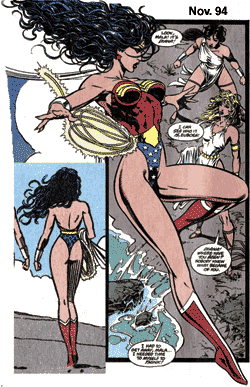
Doesn’t sound very revolutionary till you see Wonder Woman in a 1994 thong. In his defense, artist Mike Deodato Jr. said he preferred drawing monsters anyway.

WW thong

The superheroine bikini cut deepened again in the 2000s as the Code teetered toward collapse. Marvel dropped it in 2001. Image never had it. Either way, we’re looking at plenty of T&A for Carolyn’s tally sheets during the two decade range. Arguably, this was the multiverse before the cleavage-confining Code trussed up the free market. Breast abounded in the early 50s, enough to alarm the U.S. Senate into holding hearings and the industry to impose self-censorship.

But lest you think this is a plug for big government regulation, the current superheroine fashion trend suggests the post-Code market could be growing out of its prurient adolescence all on its own. The new changes aren’t being imposed from above but grown from below. Welcome to 21st century grassroots feminism.

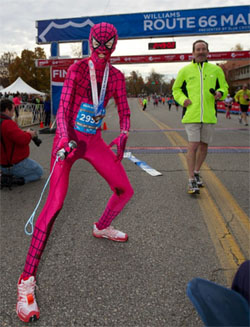
Though there’s still reason to show a little skin. “Reality”-based runner Camille Herron was the first female finisher in an Oklahoma marathon last year—a feat all the more impressive since she was wearing a full-body Spider-Man suit at the time. She also beat the previous Guinness Book record holder for a women’s marathon run in a superhero costume by twenty minutes. Imagine how fast she’d be in shorts.

Camille Herron

My daughter’s running role model, 23-year-old Alexi Pappas, wins races in a Spider-Man singlet. And yet she, like any professional female runner, just happens to wear the equivalent of a bikini bottom below it.

Alexi Pappas in Spider-Man singlet

Why? I have no idea. But I don’t see male runners at my daughter’s meets in anything as revealing. You can call them all beautiful, but the female-half of her high school track team races in skintight short shorts. They’re apparently regulation-sized and yet also a violation of the school’s dress code—which means her half of the team can’t practice in the uniforms they compete in.

I bought her a Flash t-shirt for her sixteenth birthday, “fitted” because she stopped wearing baggy tops in middle school. Except now wishes she hadn’t given them all to Goodwill. Forget fashion, she says, they’re perfect for running.

running girl

The Joker And The Joker’s Wife

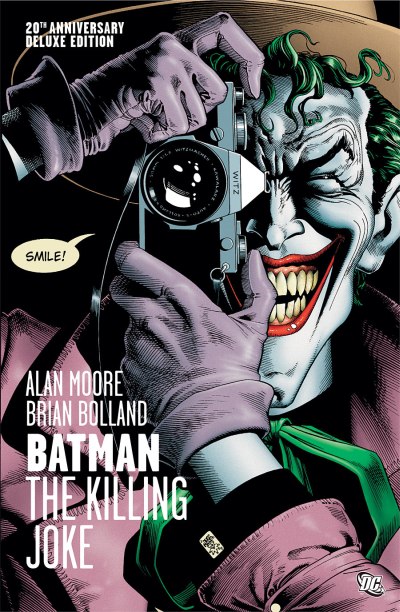
Prompted by Osvaldo Oyola’s essay earlier this week, I moved about six boxes of clothes and a paper cutter out of the closet in order to get at my comics collection and reread Alan Moore and Brian Bolland’s The Killing Joke.

And no, it wasn’t really worth it. The comic was a disappointment when I first read it upon its release in 1988, and 25 years later it continues to underwhelm. The Joker’s sad sack origin hasn’t gotten any less pro forma melodrama with the passage of time, while the visual rhymes and formal density that served Moore so well in Watchmen here simply inflate a standard genre exercise in good guy/bad guy pulp doppelganger Manicheanism with gratuitous pomposity, robbing it of charm without adding any weight. The sexualized crippling/rape of Barbara Gordon is, as Osvaldo says, a low point, but it’s also of a piece. Extra violence, extra sex, extra unpleasantness, extra formal trickery and the odd leaden bit of wordplay; it’s all there to desperately claim significance via special pleading, rather than by actually writing a thoughtful story. Bang, Pow, Batgirl shot through the spine, comics not just, etc.
 

joker-704285

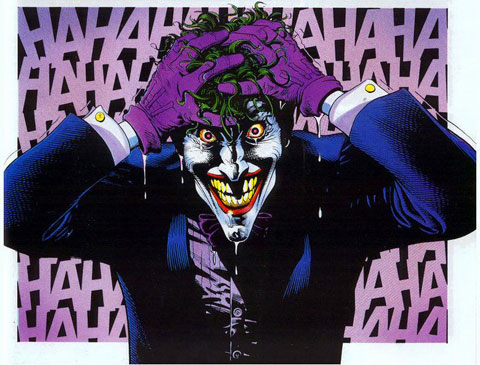
There was one pleasant surprise, though; Brian Bolland’s art. I’d always thought of him and Watchmen artist Dave Gibbons as more or less interchangeable, but in fact Bolland’s work is a lot more fun to look at. His faces have a nice plasticity and solidity; a realism shading into cartoonish grotesque which fits the Joker nicely — and suggests the throwaway EC comics horror dreck hiding beneath Moore’s high-falutin’ script. In some sense, it makes you wonder whether the problem with The Killing Joke is that Bolland is too good, his enthusiastic mastery pulling Moore by the collar into a farrago of pulp, just like those grossly offensive dwarves pull Gordon onto the train to view a cornucopia of sadistic incest torture porn. Much of Moore’s career has been a sometimes winning, sometimes losing struggle with genre, and in this case genre appears to have teamed up with Bolland to strip him naked and kick his sorry ass. Then he rose up with his hands on his head, giggling maniacally and burbling about how cool it would be to have Boland draw circus freaks and sexual assault — all for profound philosophical reasons, of course.

Be that as it may, Boland adds significantly to the weirdest, most disturbing moment of the comic.
 

11-62b010ff9a

 
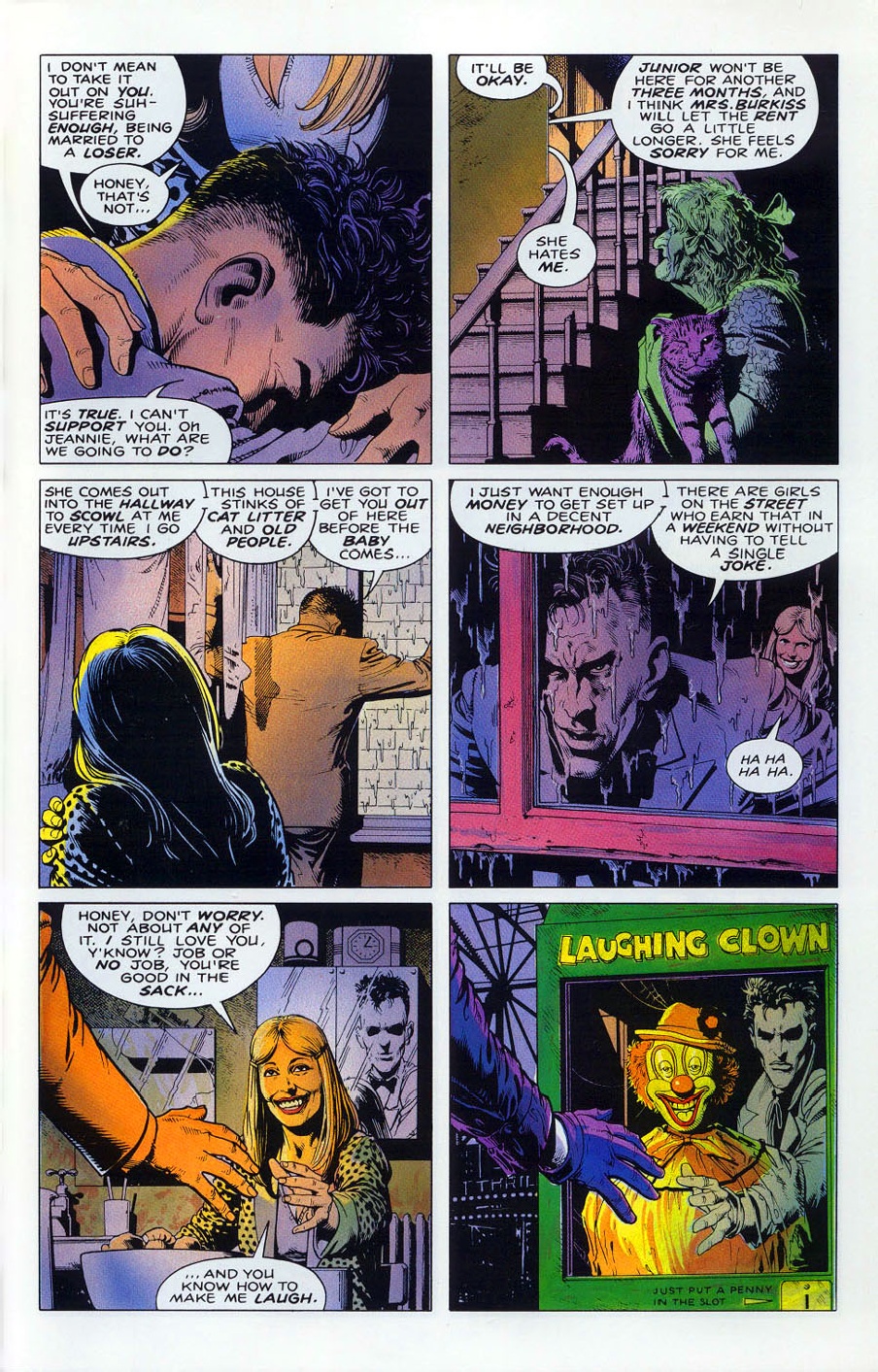
That’s the Joker in his sad sack pre-Joker days, talking to his pregnant wife about how he’s once again failed to get a gig as a comedian. He makes some bitter, crude remark about how girls on the street can make more money than him — and his loving, long-suffering, nurturing wife cracks up. She finds bitter allusions to prostitutes funny, and tells him he’s good in the sack as she reaches for him with a bizarrely exaggerated clown grin.

On the one hand, the grin is there to supply the transition to the laughing clown in the next panel. But it also makes the wife the ur-Joker — the one who finds (her husband’s) suffering and (female) degradation funny, and the one with the demon’s grin. Boland really sells that too; I didn’t remember the dialogue here at all, but that feral, toothy, malevolent smile stayed with me across the decades. Pre-Joker’s hollow, confused look in the mirror is also perfect — he doesn’t look like a man being comforted by his wife. He looks like the terrified victim who suddenly realizes the evil spirit has possessed his love one, and is about to devour him. Osvaldo notes Joker’s queerness — I think that queerness is here presented, specifically, as transvestism. The Joker is taking the place of his wife, or his wife (who we later learn dies in a freak accident) is possessing him.

That sequence seems like a tell; a quick conflation of sex, femininity and terror which suggests that the assault on Barbara Gordon isn’t an accidental, unnecessary indiscretion, but rather a condensation of the book’s central obsessions. In the panel before she’s shot, Barbara too wears that weird Joker grin, her hand extended as Joker’s wife’s hand was extended, the coffee-cup echoing the pencil cup in the other image. Thus Joker is both his wife and the murderer of his wife; the sexualized, uncanny woman brings upon herself vengeance for her wrongness. As in Junji Ito’s Tomie stories, the female ensorcels men, and what she ensorcels them to do is murder her.
 

dcmoment55a

 
Ito’s stories present his horror and lust — or his horror of lust, or his lust for horror — without apology. Not so Moore, who wants us to believe that he didn’t really want to show us those pictures of Barbara Gordon, or that he doesn’t really enjoy all those gruesome rictus grins on the corpses, or that he didn’t really want to off the Joker’s wife. Moore’s rooting for sanity and Gordon and Batman and reconciliation and rehabilitation along with the rest of us, right? The real killing joke, maybe, is that it doesn’t matter whether Batman kills the Joker, or Batman kisses the Joker. The structure and the end aren’t important. Instead, what matters here are those women grinning and asking for sex and death, the genre pleasures that make us smile.
 

alan-moore-brian-bolland-batman-the-killing-joke

Queer Silence and the Killing Joke

Recently, as part of an interview with Kevin Smith, Grant Morrison claimed that all these years no one has gotten the ending of Alan Moore and and Brian Bolland’s The Killing Joke (1988).  Morrison claims that those obscured and silent final three panels are meant to suggest that Batman is finally killing the Joker—breaking his neck or strangling him. In other words, The Killing Joke is a form of final Batman story.  In the interview Kevin Smith reacts to this interpretation as if it were some form of big revelation that utterly changes the framework for understanding the story.  The reaction on the web was mostly similar, just look  here and here and here.  Comment threads on stories reporting this were filled with a lot of speculation about how this killing interpretation holds up in light of the fact that some of the events from The Killing Joke (like the crippling of Barbara Gordon) made their way into the main Batman continuity, because clearly the Joker is not dead.

I think it an adequate, but nevertheless anemic interpretation. Sure, the killing exists as a possibility, but other and more sweetly radical possibilities might actually redeem (in part) a great, but flawed book, that Moore himself later repudiated. The Killing Joke is built on the uncertainty inherent to the serialized superhero comic book medium, so we can’t look to what was included or not included from it in the main continuity as evidence of the acceptability of Morrison’s interpretation, because the book itself works to remind us of how the history constructed by long-running serialized properties are incoherent. No. I think the interpretation’s weakness comes from being an unimaginative ending to the Batman story.  The Killing Joke reminds us that as a series of events the Batman story makes no sense, but rather it coheres through the recurring structural variations within that history.  Moore is having Batman and Joker address that structure in a winking and self-referential way.  Violence, even killing, is already a central part of the recurring interactions of these characters (how many times has the Joker appeared to die only to return?), so why give weight to an interpretation claimed as an end that only gives us more of what already explicitly pervades the entire genre—violence?   Instead, a close “listening” to how Moore and Bolland use sound (particularly, the lack of it in certain key panels) to highlight the queerness of the Batman/Joker relationship provides the reader with a different way to interpret those final panels.

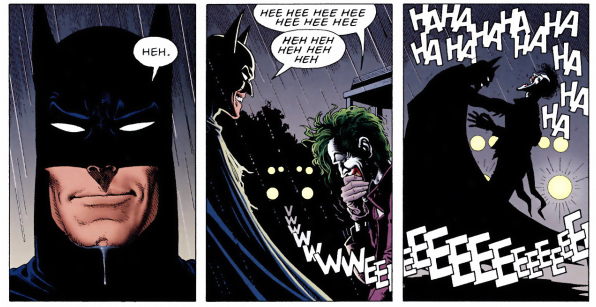
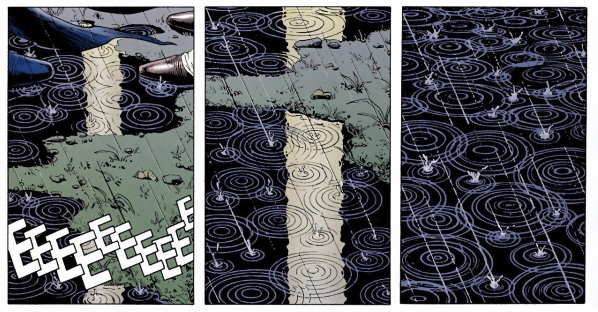
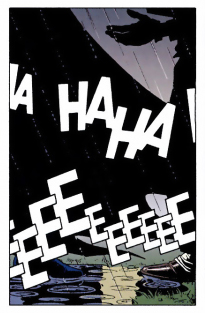
I contend that rather than indicating violence, that final silence is recapitulating an intimacy between the Caped Crusader and the Clown Prince of Crime that is found in several silent panels throughout the work and that echoes the intimacy implicit in the structure of the Batman/Joker relationship.  As such, in the end, when the Joker tells the joke that makes Batman join in the laughter, when the Batman grabs the Joker by the shoulders and the panels shift their perspective to show the Joker’s hand kind of reaching out towards Batman’s cape amid the depiction of their laughter and the approaching sirens, followed by a panel that shows only their feet (and a wisp of Batman’s cape), and then finally just silence amid raindrops making circles in a dirty street, instead of violence, I imagine they are locked in a passionate embrace and kiss.

TKJ-laughter

TKJ-finalpanels

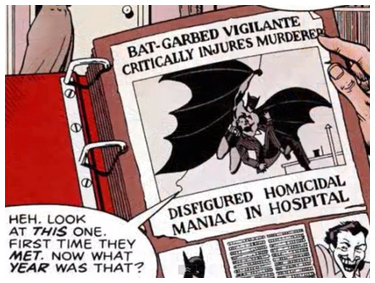
In his book, How to Read Superhero Comics and Why, Geoff Klock does a great job of breaking down how The Killing Joke is structured in a such a way to comment on the contradictions, misprision and re-imaginings that pervade the histories of these characters. While Moore’s comic plays on the idea of the Joker and Batman being two-sides of the same coin—two men playing out their psychotic breaks in different (but dangerously violent) ways after experiencing “one bad day”—the profound similarity between the two is one that emerges from the structures of the serialized medium they appear in (and in the multiple mediums versions of these characters have appeared in over the years). They both have deeply entwined “multiple choice pasts” that outside of their individual encounters of repeated conflict makes for a farraginous and incoherent history. It is the structure of the relationship and the homosocial desire it represents that provides a foundation for understanding their stories regardless of the confusion of how long it has really been going on and what from it may or may not really “count.”

TKJ-scrapbook

The Killing Joke  is an even more brutal and direct indictment of the superhero genre’s state of arrested development than Watchmen (1987) was. Moore’s work seems to want to drain any remaining appeal from their accreted and subsequently problematic histories by appearing to complete the trajectory that Batman expresses concern about in the text itself. Unfortunately for Moore, however, it didn’t quite work. A work built on highlighting the artifice of the comic pastiche becomes something of a lauded lurid spectacle. Even though The Killing Joke seems to consciously want to stand outside of continuity it nevertheless falls victim to continuities’ power to assimilate or exclude narrative events. Thus, the maiming of Barbara Gordon and the suggestion that she’s raped were later rehabilitated into the main continuity of the Batman line (wheelchair-bound, she becomes the superhero dispatcher, archivist and IT-tech, Oracle).   So, in the same vein it is not outside the realm of possibility that Grant Morrison could be right and the death of the Joker has simple been excluded from continuity in the same way that “official” history ignores Bat-Mite or the Rainbow-colored Batman costume.  However, within the skein of The Killing Joke itself, the possibility of a kiss, of a breaching of the limits of their homosocial bonds to transform it into a homosexual one not only fits within the structure of their relationship, but levels a more powerful indictment against the pathologies of repression and violence that pervade the genre.

TKJ-jokershand

Batman killing the Joker may be a suddenly popular interpretation of the end of The Killing Joke because many readers seem uncomfortable with the unresolved ending of the two of them standing in the rain laughing until their laughter fades away under the howl of an approaching siren and then becomes silence. For some, for Batman to laugh along with Joker is too “out-of-character” and/or shows that the Joker is right all along—the world is an unjust and disordered place and for Batman to think he can provide order by dressing up as a bat and beating people up is as crazy as running around performing random and outlandish acts of violence as a way to get a laugh. But I see that shared laughter as indicative of not only an unresolved narrative tension, but also sexual tension. It is a “here-we-are-again-drawn-together-but-at-an-impasse” kind of laugh (which is an echo of the joke itself). Sure, the idea that Batman and Robin had/are having some kind of sexual relationship has long existed, but there is a kind of rough intimacy to the Joker and Batman relationship that makes me agree with Frank Miller that their relationship is “a homophobic nightmare.” Joker can be seen to represent what happens when you allow queerness free reign, Batman when it is closeted.  They are both extreme reactions to a comic book world where queerness is defined as deviancy, and as such deviant behavior is the only way to express the queerness underlying their relationship.  Any chance to express intimacy outside of those confines is engulfed in silence, and it is by seeking out these silences in the text (or how sound and silence interact) that this special bond between them is demarcated.

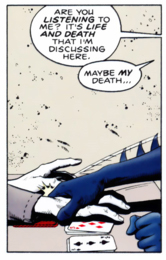
TKJ-hands

The book opens with three straight pages (22 panels) without a word of dialog and no narration. Instead we have the typical establishing shots that perfectly capture the prison for the insane/sanitarium trope used whenever the Arkham Asylum set piece appears. Batman is not here to solve a mystery or quell a riot. He arrives to pay a personal visit to the Joker. When the silence is finally broken, Batman speaks. “Hello. I came to talk.” This is a profound reversal. The panels here alternate between a normally taciturn Batman doing all the talking—expressing his feelings, seeming almost desperate in his desire to reach the Joker—and the normally boisterous talkative Joker being silent. The scene is punctuated by the the “FNAP” of the Joker putting down cards in a game of solitaire.  The scene has the rhythm of a tense discussion regarding a topic long in the air, but only finally broached by an anxious or disillusioned lover. There is a desperation and emotionalism that seems to emerge from long contemplation on the part of Batman about his relationship to the Joker. The visit suggests that Batman has come to accept that violence will not resolve the conflict between their extreme reactions to a queer identity. When the man in the cell turns out not to be the Joker at all, but a double duped into taking his place while the real Joker escapes, that moment melts back into something like the “typical” Batman and Joker story. Joker has escaped and needs to be captured before he accomplishes some outlandish and murderous scheme.

This time, the Joker’s outlandish plan involves driving Commissioner Gordon mad as a way to get Batman to admit their similarity through madness. The image of the Commissioner stripped naked and made to wear a studded leather bondage collar does a lot to equate madness and queerness run rampant.   The Joker’s desire for Batman to “come out” and admit they are the same echoes a dichotomy between the closeted and the “out” individual. The Batman character is largely about his secret identity, the construction of a hyper-hetero playboy cover for his life in spandex and a mask, tackling, wrestling and binding (mostly) other men in the guise of combating criminal deviance.  He is homophobia turned inward. The Joker on the other hand has no identity outside of being the Joker.  He embraces his mad flamboyance and doesn’t see it as deviant, but as a different form of knowledge about a world that could create him and/or Batman.  The Joker is dangerously queer and that is his allure. He is the manifestation of licentiousness that homophobia conjures when it imagines queerness.

Even the past given to the Joker in The Killing Joke reinforces this idea.  Sure, he is given a pregnant wife in the version depicted, but her death frees him from the yoke of a heteronormative life as much as being chased into a chemical vat by Batman does. It is suggested that losing his wife is just as much to blame for Joker’s particular madness, but the real clincher is Joker’s assertion regarding his past: “Sometimes I remember it one way, sometimes another… If I’m going to have a past, I prefer it to be multiple choice!” Despite the choice between these varied pasts, what remains constant is the centrality of Batman to the Joker becoming who he is, which helps to fuel the Joker’s desire to have their relationship be of primary importance in Batman’s life (as it is in his).  Whatever violence the Joker commits, whatever other desires he may evince, they are subsumed in that primary desire.  In a genre where beginnings and endings are written, erased and rewritten so as to become a palimpest, it is the recurring structure of the characters’ engagements that define them more than any sense of origin or goal.

TKJ-understand

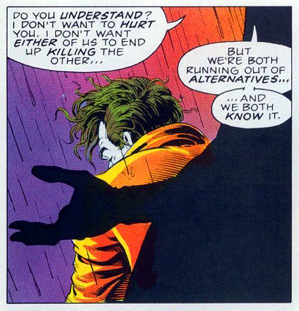
This intimacy explains the uncharacteristically intense tenderness with which Batman seeks to confront the Joker. When he catches the Joker near the story’s end, Batman finally gets to broach the subject, to bring up the issue that precipitated his attempted visit with the Joker earlier.  He says, “Do you understand? I don’t want to hurt you,” and makes the offer: “We could work together. I could rehabilitate you. You needn’t be out there on the edge anymore. You needn’t be alone.”

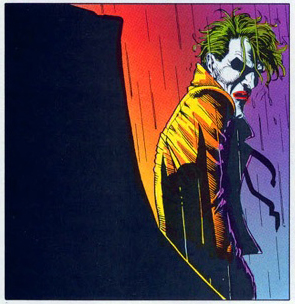
Look at the panel right after Batman makes that offer. There is a vulnerability to how the Joker is depicted. He is slightly hunched as if suddenly aware of the cold rain, his eyes are in shadow as if to hide tears and he is looking at Bats from over his shoulder with a frown that is at odds with his usual exaggerated grin. It is perhaps one of the few (if not only) human moments between these two characters and it is a silence.

TKJ-joker-vul

The strange thing about Batman’s offer that the Joker contemplates in heavy silence is that “out there on the edge” exactly where Batman lives as well. The offer to rehabilitate the Joker is also an offer to rehabilitate himself—to rid them both of the desires that repeatedly and destructively bring them together. This is Batman as Brokeback Mountain. By making this speech, Batman is revealing himself to be something of a hypocrite, unless he means to find someway to admit his own flaws and overcome his own secrets, to really become a part of the “togetherness” that he suggests can help the two of them to avert their fate. The Joker refuses, saying “it is too late for that. . . far too late.”
 

batfamily

 
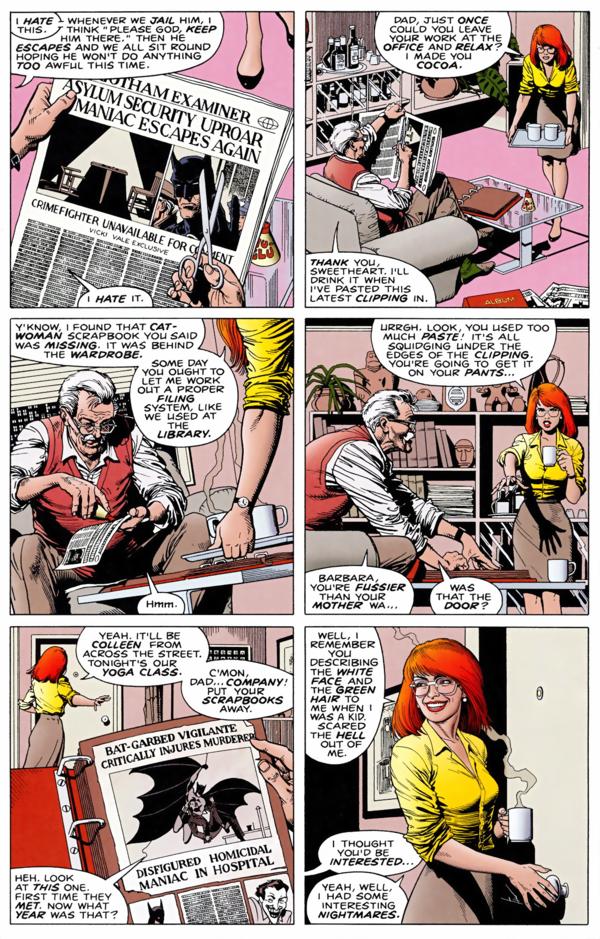
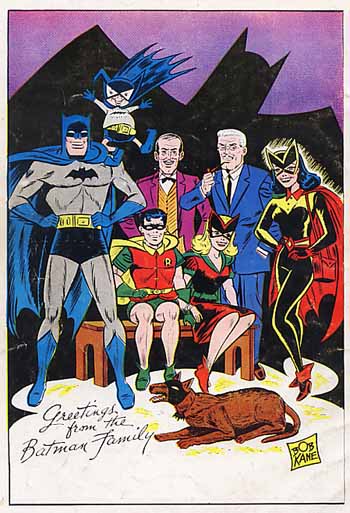
Silence marks several other important panels throughout the work, including Batman’s wistful look at the portrait of the anachronistic “Bat-Family.” The picture (made to emulate a Bob Kane sketch) depicts characters that no longer existed in the main continuity at that time. The original Batwoman and Bat-Girl (not Barbara Gordon) were editor-mandated creations—romantic interests for Bruce and Dick in order to combat the accusation of Frederic Wertham that Batman and Robin are a “wish dream of two homosexuals living together.” The inclusion of the portrait serves to destabilize the notion of coherent history that the whole of The Killing Joke is working at. But it is also a signal of the need in the past for Batman to have a “beard” written into the story to deflect gay accusations. It is a reminder that even the lighthearted era of the (now false) Bat-Family was part of a structure of secrets and lies meant to cover for fear of a repressed desire. The nostalgia of this scene is laid with irony, since the call to a simplistic normative family is belied by the constructed nature of that “family” and the queerness of their life of masks and costumes.

batman_yaoi_time_by_manawua-d1vfftt

Even the most contentious scene in the graphic novel, the brutal shooting of Barbara Gordon, leading to her disrobing, (likely) rape and photographing, is attended to in silence. Now, I think the scene itself is part of what makes The Killing Joke flawed. Its brutal treatment of a beloved female character, who has been shown on more than one occasion to be able to hold her own, is egregious. The sexualization of the violence against her also serves to give the scene just the kind of morbid appeal that plagues a lot of contemporary comics, and distracts from the ways The Killing Joke can be seen as a (re)visionary text. It is completely unnecessary for Moore to make his point. Yet, regardless of its failure, the scene’s silence casts it as part of that unspoken attraction between Batman and the Joker. Like an especially twisted reference to Eve Kosofsky Sedgwick’s Between Men (1985), this is a love triangle, with Barbara playing the proxy for the desire between the “rival suitors.” Sedgwick writes, “in any male-dominated society, there is a special relationship between male homosocial (including homosexual) desire and the structures maintaining and transmitting patriarchal power. . . this special relationship may take the form of ideological homophobia, ideological homosexuality, or some highly conflicted but intensively structured combination of the two” (25). Thus, the maiming and violating of Barbara Gordon is not about her at all, but about the Joker’s desire for Batman. She is the proxy through which this desire is expressed as it literally serves to summon Batman to attend to him so they may take up their “highly conflicted, but intensively structured” relationship. It is this very structure that helps the Batman oeuvre to cohere despite its historical ambiguity.

The silence of those two final panels echoes the silence immediately following Batman’s offer, just as it parallels the silence that attends many of the scenes that highlight their intimacy. The silence is a recapitulation of that moment of tender vulnerability seen in the Joker as he contemplates the offer, and I think that silence is best filled not with violence —violence is loud and obvious and strewn throughout The Killing Joke and the entirety of the Batman canon—but rather with tender love. The silence is the signal for that which cannot be depicted or spoken aloud. It is an actual act of bravery on the part of Batman, proving to Joker that it is not yet “too late.” The Killing Joke’s abundant self-awareness regarding the incoherence of comic history also suggests an incoherent future where anything is possible as long as it can be enclosed in the broad structures of their relation—even Batman and the Joker as lovers. That—not violence, not a killing—would be an end to the Batman story as we know it.

I don’t see the kiss as the definitive action of those panels—I can’t say what really happens in because there is no “really happened”—but find it much more profound than killing. The kiss is a more delightfully radical possibility than the usual violence of the genre. It upends their entire history, but somehow still fits within its skein.  The off-panel action remains unseen because that’d be a real end.  Violence doesn’t change anything in superhero comics, it is a normalizing force that builds routine, and killing is just the beginning of a come-back story.  It is love that transforms. Sure, it would be best if superheroes could move beyond the pathologizing of queerness, but to even have a chance to imagine a world where Batman and the Joker could both be saved from their violent self-destructive spiral through loving each other is too wonderful to dismiss.
________
Osvaldo Oyola is a native Brooklynite. As a kid in the early 80s, in the days before people got the idea that they might be worth something, he would scour flea markets and yard sales for cheap old comics from the 60s and 70s. These days he’s still obsessed with Bronze Age comics, but mostly for how they represent race, gender, and urban spaces. He is currently completing a doctoral dissertation on the intersection of pop culture and ethnic identity in contemporary transnational American literature, writing on Los Bros Hernandez, Junot Diaz and Jonathan Lethem. He still lives in Brooklyn, with his poet wife and cats named for Katie and Francie Nolan from A Tree Grows in Brooklyn. He writes briefish thoughts on comics, music and race on his blog, The Middle Spaces.