Utilitarian Review 3/30/13

News

Chris Gavaler is joining us as a regular blogger. Welcome aboard Chris!

It’s about two years since our Victorian Wire post took over the internets.

On HU

Featured Archive Post: Alec Stevens on Christian Comics.

The 1993 Rolling Stone Record Guide. 2 Stars for Reign in Blood?

Saying the same thing over and over about gun violence.

Aishwarya Subramanian on Timpa, an Indian comic inspired by Tintin.

Alex Buchet on the strange collaboration between Steve Ditko and Eric Stanton.

Mahendra Singh on how Tintin is the perfect hero for Indian children.

Thomas Hardy vs. Charles Schulz. Bonk.

Chris Gavaler on Jack Kirby’s metafiction.

Erin Polgreen asks whether comics journalism can be funny.

Gary Groth appeared in comments to talk about Al Plastino’s Peanuts.
 
Utilitarians Everywhere

At the Atlantic, I talk about:

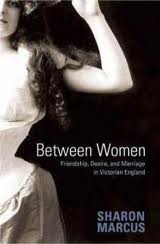
why women’s magazines treat women much like men’s magazines do. Sharon Marcus knows all.

why there should be less handwringing about expensive weddings. Bonus anecdote about how my wife proposed to me!

Megan McArdle’s silly argument that gay marriage will end the sexual revolution.

the uncanny valley awfulness of The Host.

On Splice Today, I talk about:

Child Ballads, and good and bad versions of ancient songs about murder and death.

A Civil Remedy, a documentary about trafficking, and different experiences of prostitution.
 
Other Links

Stop fat shaming Kim Kardashian. She’s fucking pregnant.

Nanette Fondas on myths about mothers who opt out.

Kate Losse on the downsides of leaning in.

Amanda Marcotte argues that Victoria’s secret sexy underwear for teens is fine.
 
This Week’s Reading

Finished David Graeber’s Debt. Read for review a preview of Jal Mehta’s excellent book about school reform, The Allure of Order. Started Octavia Butler’s Kindred.Also still reading The Two Towers to my son…got to the trek through Mordor, which I think is the best part so far….
 

images

Funny vs. Facts: How can you make a joke in comics journalism?

What’s the funniest comic you’ve ever read? Was it true?

Editing a magazine of comics journalism presents some interesting challenges. Symbolia merges non-fiction reporting, illustration, and interactive elements. We’re trying a new kind of news, and it seems to be working. We’ve built a truly global audience for our work (only 55% of our subscribers are in the US), which is amazing.

But there’s still something that I’m struggling to do: break through the somber tones affecting most comics journalism today and publish something that is deeply, truly, gut-bustingly hilarious. Editorial cartoons don’t count. While they rely on fact, the use of caricature and, y’know, opinion, can obscure the integrity of the reportage.

Seriousness is something that plagues non-fiction comics in general. From Fun Home to Stitches to Palestine, things can get pretty grim. It could be because comics are still trying to “prove themselves” as a medium—but I sure hope not. We’re all over the “but comics aren’t for kids anymore” thing….right?

When I was developing Symbolia, when it was just a twinkle in my eye, I was continually asked two questions:

  1. But how will you make it funny?
  2. Well, is it true?

I’d like to think there’s room in the world for both. Give me the John Jeremiah Sullivan of comics journalism. Please. The funniest non-fiction comics work I’ve read in the past few years has been autobiographical, not reportage: Vanessa Davis’ Make Me a Woman and Drinking at the Movies by Julia Wertz. More David Sedaris than David Remnick.

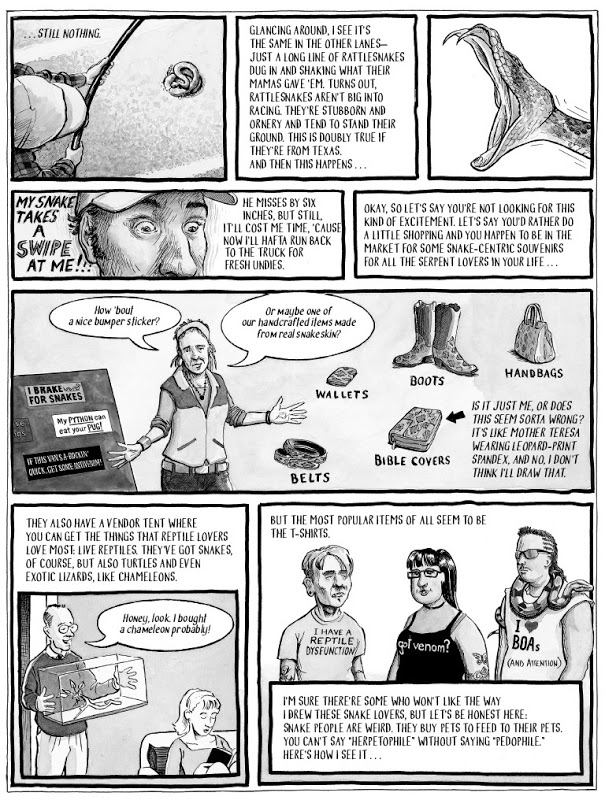
Matt Diffee’s reportage on snake handlers in the Cartoon Picayune is a refreshing break from the oh-so-serious comics journalism trope, but his breed of work is pretty rare. Andy Warner has also done some amazing work for us and we love the little easter eggs he peppers throughout each project.

page8

Matt Diffee for the Cartoon Picayune

What to do about it?

We’re closing production on Symbolia’s third issue now and one thing is painfully obvious: Comics journalism can be whimsical. It can be gut-wrenchingly honest. It can be evocative and convey real emotions. Comics can convey humor. Comics can convey truth. But can they do both?

I often feel, as an editor of a news product, that we have to prove the veracity of our work since it’s not “typical news.” That often means we fact-check the funny out.

That doesn’t mean that Symbolia is dry and dull and depressing. Joyce Rice, Symbolia’s cofounder, and I do all sorts of things to adapt: We have a really whimsical sense of design, we pair cultural reporting with stuff that goes a little deeper, investigation-wise, we add interactive treats to cultivate delight…but straight up humor is really, really hard.

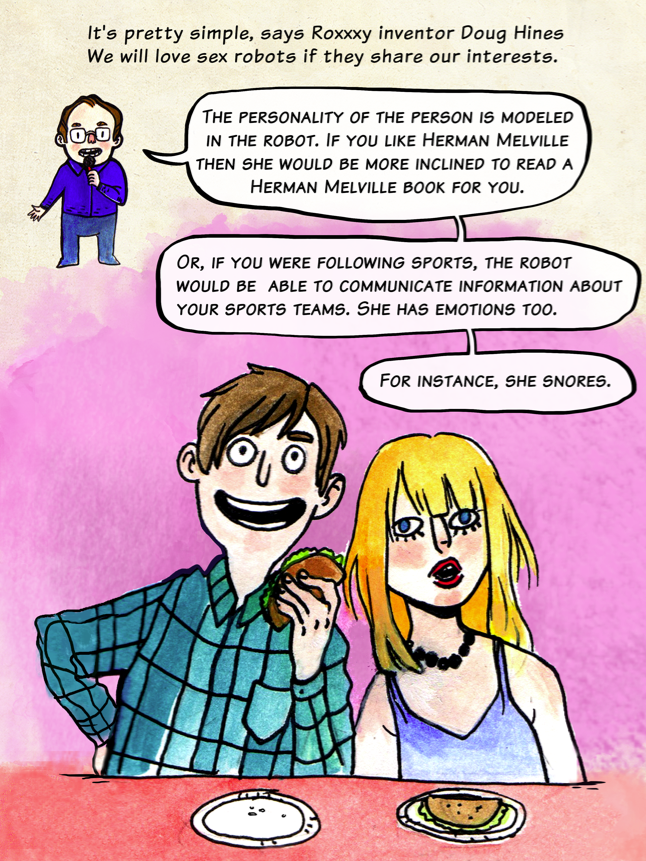
Audrey Quinn and Kat Fajardo for Symbolia

Audrey Quinn and Kat Fajardo for Symbolia

So, we’ve developed all of these coping mechanisms to add delight–but our jokes are few and far between. We’re publishing a story on sexbot AI in the next issue and I finally feel like we have something that is deeply humorous, though it pushes a few journalistic boundaries.

I figured I’d take this conundrum to the HU community and ask you to prove me wrong. I’m looking for deeply funny, deeply true examples of comics journalism. SO: Let’s take this to the comments. I want you to tell me I’m wrong. What’s out there? Is what I’m looking for even possible?  I’ll be diving in and out of the ensuring thread over the weekend and will pull the most interesting, most insightful comments up into this post.

Starter question: What is the single most hilarious work of non-fiction comics you’ve ever read? Why? GO!

All right, we got some great ideas–R. Crumb, Jessica Abel, Harvey Kurtzman, and more.

Time for my next question: When the cartooning is REALLY cartoony, can a comic still convey truth?

Marvels of Metafiction

bookcover

 
Google “jennifer egan” and seconds later the term “metafiction” will attach itself leech-like to the side of her postmodern head.

I know this because members of my university have made the possibly foolhardy decision to ask me to give a talk on the Pulitzer winning author for our 2013 Tom Wolfe Weekend Seminar. I’m to place A Visit from the Goon Squad into “the context of contemporary American culture” with “a discussion of Egan’s special skills as a writer,” keeping in mind she will be “sitting right there in front of you.”

I regularly tell my first year comp students that even if we could materialize authors in our classroom (usually during a discussion of Henry James’ mind-blowingly ambiguous The Turn of the Screw), their opinions would be completely irrelevant. Readers and only readers determine the meaning of a text. Except of course in this case. Because that will be the actual Jennifer Egan. In the front row. Listening. To me. Blathering. About her book.

 

Jennifer Egan

 
Poetic comeuppance aside, the author’s physical presence will be especially apt for a discussion of Goon Squad. Chapter one opens: “It began the usual way . . .” and before you’ve waded in a dozen pages you’re knee deep in self-referential story-telling, overt comments about symbols and plot arcs and collaborative writing. Ms. Egan is pulling off her metaphorical mask and yelling: Look at me!

So now, after stretching to pluck David Lodge’s The Art of Fiction from my office book shelf, let me flip to Chapter 46: “Metafiction is fiction about fiction: novel and stories that call attention to their fictional status and their own compositional procedures.”

Apart from a requisite nod to the 18th century’s Tristram Shandy, Lodge spends most of his time chatting with John Barth and Kurt Vonnegut. William Gass coined the term in 1970, after Barth demonstrated the style in his 1968 novel Lost in the Funhouse. Slaughterhouse Five was published a year later. Add Pynchon’s The Crying of Lot 49 (1966) and a couple of short stories by Robert Cover, and there’s your course syllabus for “Goon Squad: Founding Fathers of American Metafiction.”

Except, wait, here’s that inevitable moment, my weekly plot twist, where I veer to where I must always veer:

Superheroes!

No, no, no, NO. American metafiction did NOT begin in the late 60s. It was not a highbrow literary phenomenon. It was the lowest of the lowbrows, the pulpiest of the pulps, that ultimate literary stepchild, the comic book.

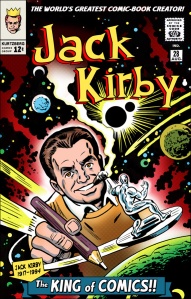
Stan Lee and Jack Kirby beat Pynchon by a half-decade. In Fantastic Four #2, on newsstands in 1961, Reed Richards convinces an alien race not to invade Earth by showing them drawing of monsters. “Those are some of Earth’s most powerful warriors!” he tells them, while thinking, “I pray he doesn’t suspect that they’re actually clipped from ‘Strange Tales’ and ‘Journey into Mystery!’” Two other Marvel titles sharing newsstand space with Fantastic Four.

Two issues later, the Human Torch chances onto a stash of old comics. “Say! Look at this old, beat-up comic mag! It’s from the 1940’s!!” It features the Golden Age Namor on the cover. “The Sub-Mariner! . . . He used to be the world’s most unusual character!” And guess who shows up two panels later?

In issue five, Johnny’s reading habits have expanded. Reed asks, “What are you reading, Johnny?”It’s The Incredible Hulk #1, out the same month. “A great new comic mag, Reed. Say! You know something—! I’ll be doggoned if this monster doesn’t remind me of The Thing!” Because he’s supposed to. Marvel created Hulk because of the Thing’s popularity.

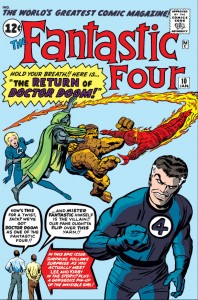
The cover of FF #9 asks: “What happens to comic magazine heroes when they can’t pay their bills and have no place to turn?” But #10 is even bolder: “In this epic issue surprise follows surprise as you actually meet Lee and Kirby in the story!!” The authors stare up at the action from the front row.

Stan: “How’s this for a twist, Jack? We’ve got Doctor Doom as one of the Fantastic Four!!”

Jack:  “And Mister Fantastic himself is the villain!! Our fans oughtta flip over this yarn!!”
 

Fantastic-Four-10

 
As promised, Dr. Doom uses the Marvel duo to lure Reed into a trap.

Johnny: “Phone call for you, Reed! It’s Lee and Kirby! They’d like you to go to their studio to work out a plot with ‘em!”

Reed: “Strange…we just finished discussing a new plot yesterday!”

Thing: “Tell ‘em if they don’t stop makin’ me even uglier than I am, I’m liable to go up there and wrap this two-ton weight around their skinny necks!”

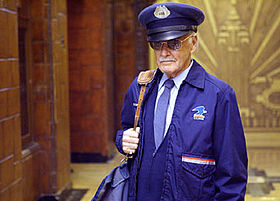
Issue 11 goes further still. The team has to stand in line to get a copy of their own comic book, and then they go home to answer fan letters, shattering the last remains of the fourth wall. Mr. Lumpkin, their mailman, laments in the final panel: “Blankety blank fans and comic magazine heroes, and letters to the editor pages! Ohhh my achin’ back!”
 

Stan Lee

 
The trend dies a quiet death in the next issue when the Hulk shows up with no mention of that comic mag John had been reading. Marvel traded in metafiction for multi-title continuity. That brings us into 1962, still eight years before Barth coins the term.

And does all of this put Jennifer Egan into “the context of contemporary American culture”?

Um, no, not really.

So you’ll forgive me if I sign off now and finish reading Goon Squad.

‘Nuff said.
 

Jack Kirby

Charles Schulz vs. Thomas Hardy…Bonk!

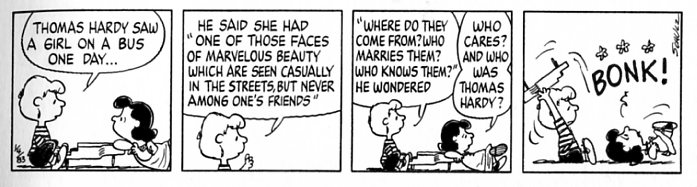
As regular readers know, over the last month and a half or so the blog has been engaged in a sporadic roundtable on the place of the literary in comics. I was recently reading the 1983-84 volume of Fantagraphics Peanuts collection, and came across a strip that seemed like it had interesting things to contribute to the discussion. Here it is:
 

Hardy_Peanuts

 
So what does this have to say about the literary in comics? Well, several things, I’d argue.

First, and perhaps most straightforwardly, the strip can be seen as an enthusiastic endorsement of literariness. Schroeder — the strip’s most ardent proponent of high art — quotes Thomas Hardy. The second panel is given over almost entirely to Hardy’s words, which take up so much weight and space that they almost overwhelm Schroeder’s earnestly declaiming face. Lucy — Schulz’s go-to philistine — expresses indifference and self-righteous ignorance — for which she is duly and gratifyingly punished by Schroeder, who pulls the piano (marker of the high art she’s rejected) out from under her. Bonk!

In terms of the debate we’ve been having on this blog, you could easily see this as a pointed refutation of Eddie Campbell’s rejection of literary standards and literary comparisons. Campbell’s argument that literariness is not relevant to comics seems to fit nicely with Lucy’s “Who cares?” — while Ng SuatTong’s ill-tempered riposte seems quite similar to Schroeder’s.

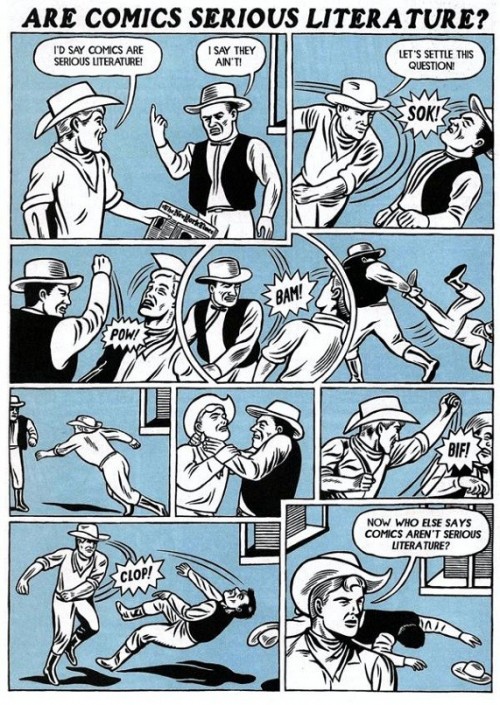
On second thought, though, Schulz’s attitude towards literariness can be seen as a little more ambiguous. It’s true that Schroeder, the advocate for high art, gets the last word. But the last word he gets is not precisely high art. On the contrary, it’s slapstick. The point of the strip, you could argue, isn’t the Hardy quote, which ends up essentially being little more than an elaborate set-up — it’s literariness there not for its high-art meaningfulness, but simply to signal “high art meaningfulness.” The real pleasure, or energy, of the strip, is in that last image, where Schroeder pulls out the piano — almost throwing it over his head and off panel, as if to toss aside the very possibility of including high art in a comic strip. From this perspective, the strip might be seen as being in the vein of Michael Kupperman’s “Are Comics Serious Literature?” (HT: Matthias.)
 

SeriousLiterature-500x705

 
The point isn’t so much to advocate for literature as it is to use comics to giggle at the idea of advocating for literature in comics — a position that Eddie Campbell would probably find congenial.

One last, perhaps less schematic,possibility is to think about the strip in terms of gender. It’s interesting in this context that, while Schroeder is generally the advocate for high art, he’s also generally uninterested in, or immune to, the appeal of romance — he’s one of the few characters in the strip who (as far as I’ve seen) never has an unrequited crush. Lucy, of course, has a crush on him, and it’s usually she who brings up images of marriage or love or domestic bliss, only to have Schroeder disgustedly reject them.

This strip is different, though. Hardy’s words are not just a default marker of high art; they’re in particular a paen to a woman’s (or a particular kind of woman’s) “marvelous beauty,” and a speculation — with more than a little longing — on who such beautiful people marry. It sounds more like something Charlie Brown would say about the little red-headed girl than like something Schroeder would say to Lucy.

Lucy’s lack of interest, then, can be seen as not (or not merely) philistine, but as tragic — Schroeder is finally, finally talking to her about love, and she can’t process it or understand it.

You could attribute this to her soullessness, I suppose — she is blind and doesn’t deserve love. But you could attribute it to Schroeder’s soullessness. Certainly there’s a cruelty in babbling about the beauty of random unobtainable women to someone who you know is head-over-heels in love with you. For that matter, the Hardy quote itself seems to exhibit some of his most maudlin and least appealing tendencies; it’s pretty easy to read it as a self-pitying lament for the fact that beautiful women are human beings, rather than simple objects to be collected by men who admire them in the street. The high-artist idealizes Woman and ignores the woman sitting in front of him. Lucy’s utter indifference could then read as a recognition that Hardy is indifferent to her — and Schroeder’s violence as a tragi-comic extension of Hardy’s violence. In this case, the literary is neither defended nor ridiculed, but is instead a kind of doppelganger — a shadow of meaning cast by the comic, the meaning of which is in turn cast by it.

Literature, then, appears for Schulz in this strip as an ideal, a butt, and a fraught double. As I’ve said on numerous occasions, I don’t really have any problem comparing comics and other forms (Charles Schulz is a greater artist than Thomas Hardy, damn it.) But I do feel like the anxiety around those comparisons, in every direction, sometimes ends up drowning out potentially more interesting conversations about how, and where, intentionally and despite themselves, comics and literature can meet.

Steve Ditko Oddity

gano022

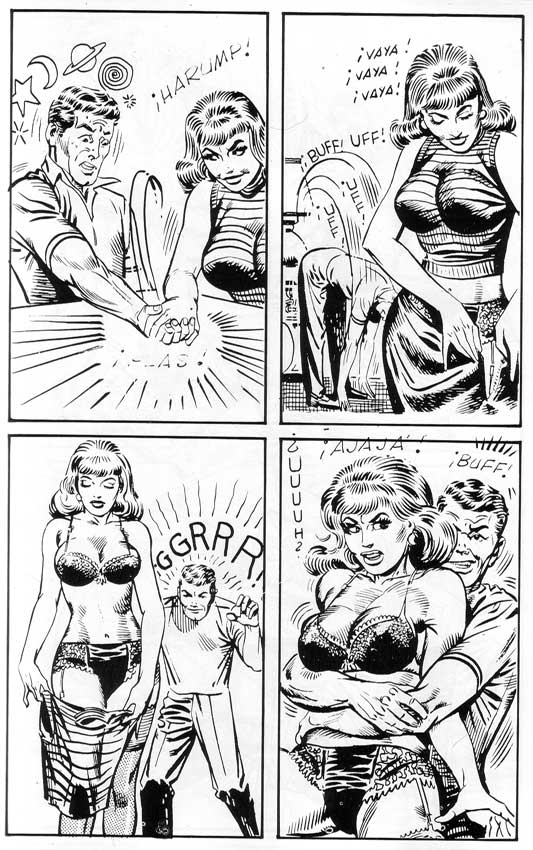
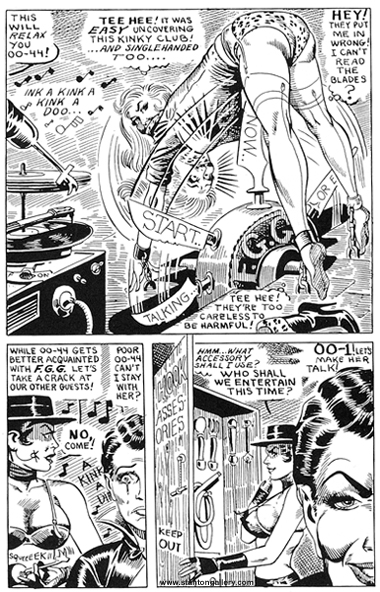
The above bit of ribaldry may disconcert certain comics fans. Its style of drawing evokes that of Steve Ditko, the creator of Spider-Man and of Dr Strange — wholesome comic-book superheroes for kids. Is there a secret side of Sturdy Steve we don’t know about?

Yes and no.

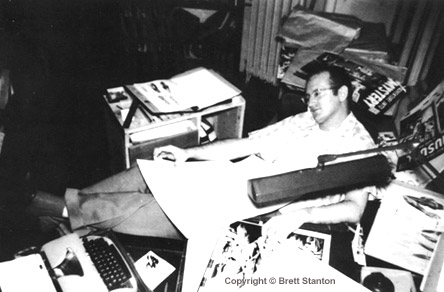
Ditko attended the School of Visual Arts in Manhattan, where he made friends with another budding cartoonist, Eric Stanton (1926– 1999). He and Ditko shared a studio on 8th Avenue from 1958 to 1966.
 

eric-stanton-in-studio2-gla

 
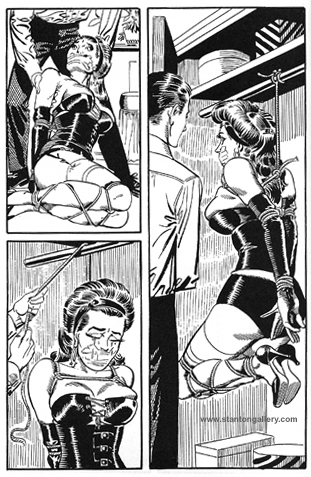
Stanton had a specialty, though — kinky sado-maso bondage comics– his “stantoons”. Legal dynamite in the ’50s, they look oddly innocent in our current porn-saturated times.
 

ditko_pic_brettstaton

Steve Ditko, at the same period

 
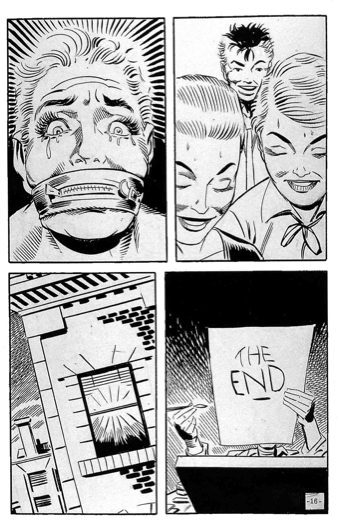
The two cartoonists had superficially similar styles, and were given to helping each other out with deadlines. So the above strip has, at the least, Ditko inks in the equation; the next one seems to have been laid out by him, as well.


Ditko never made a secret of his association with Stanton. With his reputation as a stern moralist, though, he seems open to a charge of hypocrisy.

But Ditko is a conservative of the Libertarian kind, and as such would have a keep-the-damn-government-out-of-the-bedroom attitude.
 

confidential-tv2
 
As for Stanton’s assists to Ditko, it’s long been rumored that he’d contributed to the first Spider-Man story. Stanton does claim to have come up with the idea of webs shooting from the character’s hands. When asked by Greg Theakston about the extent of his contribution to Spider-Man, Stanton replied:

“Almost nil…. I think I added the business about the webs coming out of his hands.”

He elsewhere makes the intriguing claim, though, that he helped Ditko out with “storyboards”.

By that word, did he mean storyboards in the usual sense — for TV or movies? New York was, and remains, a major center for the audiovisual industry, and certainly many cartoonists based in the area, such as Lou Fine and Bill Everett, produced storyboards for TV advertising. Ditko and Stanton might well have done a job or two for the screen.

Or did he use the term “storyboards” to mean comic book layouts? Ditko, at the time, was an astonishingly productive artist, not just for Marvel but also for Charlton and Warren comics. And he certainly wasn’t averse to artistic collaboration: he was sometimes inked by Dick Ayers or Mike Esposito, among others, and he himself often inked Jack Kirby ( a wonderfully quirky pairing.)

Here’s a casual claim by Stanton that seems plausible, in connection with a bondage comic:

“I made ‘Sweeter Gwen’ from John Willie’s ‘Gwendoline.’ I roughed out (penciled) 30 pages and took them over to Burtman and he said ‘great … but then I got another commission and I had to stop on ‘Sweeter Gwen.’ I asked Steve Ditko to ink it for me and we’d split the money 50% / 50%. So then we story boarded like we used to do for Spider-Man. We gave ideas to each other. We came up with a very beautiful story and we finished it and took it over….”

We’ll never know for sure. Stanton is dead, and Ditko is famously adamant in refusing to speak about his career.
 

kinky-hook-use4

 
Why did the pair break up? According to Stanton’s daughter Amber, her father announced to Ditko he was getting married. Ditko took this as a betrayal of Stanton’s principles… and the partnership, and friendship, were over.

One last sample, and you be the judge: how much is Stanton’s, and how much — if any– is Ditko’s?


(Nota Bene: the comics in this post were researched for reasons of scholarship ONLY.)

stantditko097

Timpa

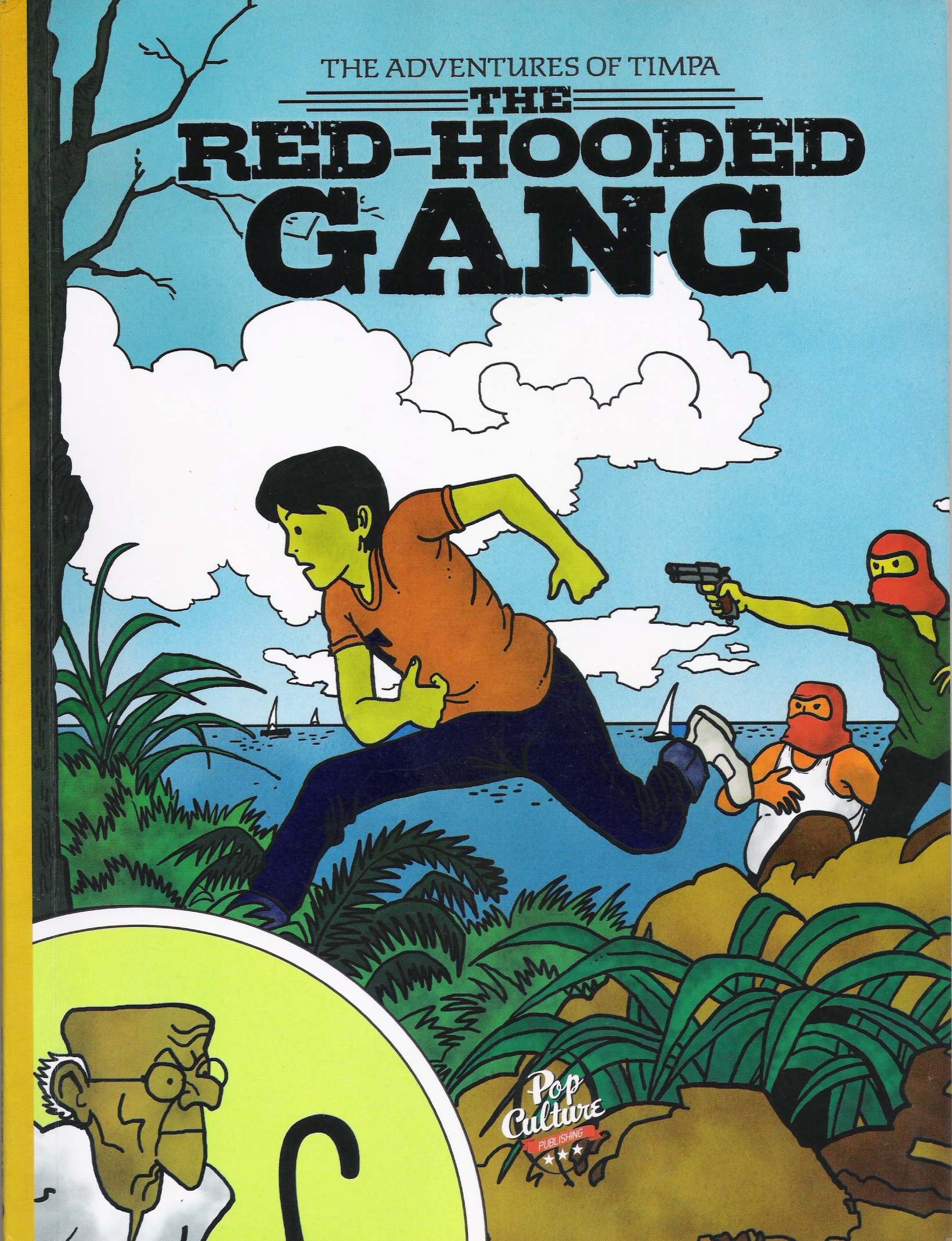
I think there was a distinct period in my childhood when I believed that the Phantom and Mandrake the Magician were Indian comic book characters. Indrajal Comics had been publishing these (and other King Features characters) in India since the 1960s and on visits to the country I’d occasionally read old issues. But these visits were few and far apart, and by the time I moved to India in the 1990s Indrajal had folded. So I’d never read the Timpa stories that Indrajal serialised as backup features in the late 80s until recently, when Pop Culture Publishing brought out four full-length adventures.
 

timpa1

 
It’s obvious from the style of the art (and from the fact that creator Jhangir Kerawala freely admits to it) that the Timpa stories are heavily inspired by Hergé’s Tintin comics. Timpa is a boy detective as well, though in somewhat more realistic circumstances; he’s an actual child for one thing, and is only taken seriously by anyone because his (alarmingly indulgent) father is a police inspector. Timpa’s Calcutta is one where market shopkeepers sleep half the afternoon, where policemen occasionally take bribes, and where middle-class Calcuttans will always argue with rickshaw or taxi drivers about fares—this is a world I recognise. Tintin flies all over the world (and occasionally into space); Timpa takes trains and buses and doesn’t get further than the Andaman islands. His dog, “Rexy”, is always portrayed as a dog. He may chase the occasional cat but we never know what’s going on inside his head, as we do with Snowy.

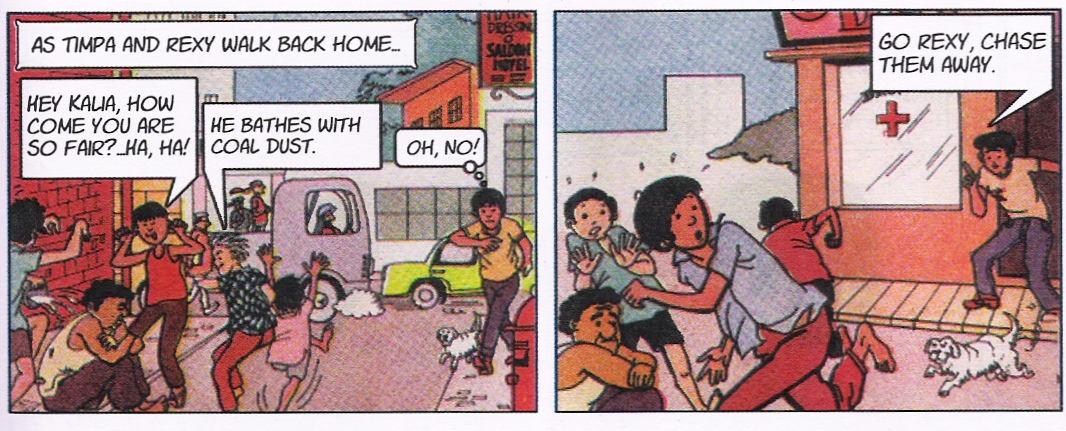
Like Tintin, Timpa himself is fundamentally dull. There’s not much to him, other than an earnest need to help, and he stumbles onto things through sheer coincidence more than by any exciting process of deduction. Like Tintin he has a cringingly grateful faithful companion—Kalia, who is of a distinctly lower class, is tellingly dark-skinned, and is apparently incapable of defending himself against children without Timpa’s help.
 

Kalia

 
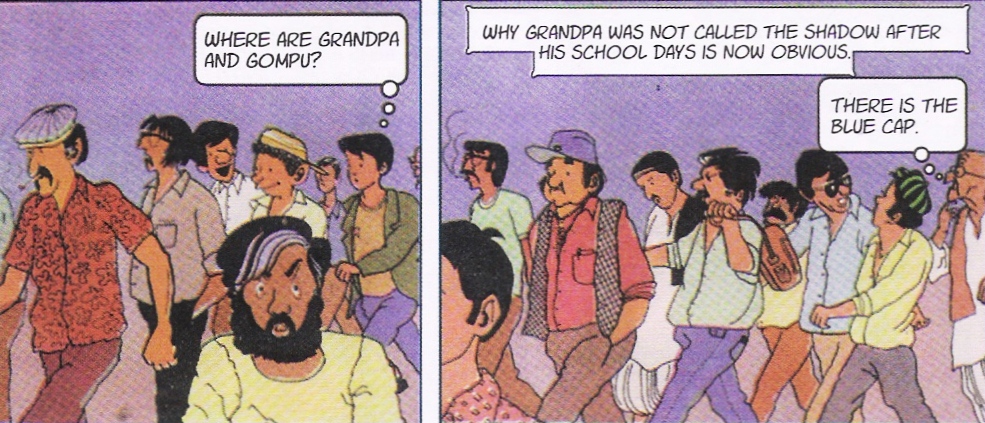
But the really important character here is the grandfather who joins Timpa on his adventures. Grandpa has Captain Haddock’s belligerence combined with some of Professor Calculus’ talent for misinterpreting a situation. He’s grumpy, convinced of his own misunderstood brilliance, and often imagines himself as a superhero, or at least super-muscled. He’s also convinced that he’s the brains of this operation, though in this he is sadly misguided.
 

Grandpa

 
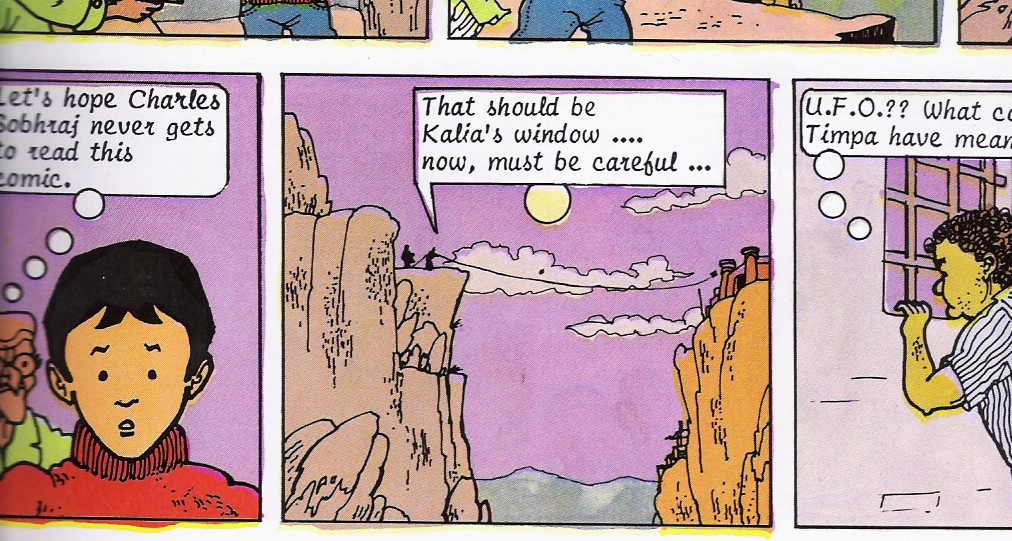
Grandpa gets all the best lines because in addition to being the comic relief he’s also the background voice snarking at (and therefore somewhat deflating for the reader) Timpa’s heroic plans. At one point Timpa drags him into a grand attempt to break out of prison a friend who has been sentenced to death. Grandpa is seen muttering darkly in the background about the whole thing possibly inspiring real murderers like Charles Sobhraj.
 

sobhraj

 
As I write this I realise that in a sense Grandpa is this series’ Snowy as much as he is its Haddock. A wry commenter placed partly outside the text by a refusal to entirely play by its rules: Grandpa rarely accepts the obvious realities of the plot.

Pop Culture appear to have faithfully reproduced the original comics, flaws and all. Sarbajit Sen, the artist for the first two books (The Red-Hooded Gang and Operation Rescue) appears to me to be a far superior artist to Avijit Chatterjee who did Runners of The Golden Horn and Legacy of the Gods. We’re given no clues as to who was responsible for the mystifying decision to have all the text in Operation Rescue be in cursive. And Kerawala’s grasp of the English language isn’t always all it could be. (He has now written a Timpa novel, The Soothsayer of Sealdah. I do not recommend it.)

And yet. Kerawala’s Calcutta feels just right, Timpa’s father and Grandpa are fantastic (his mother, who is usually the sole female character, sort of hangs around in the background weeping about her son’s safety). I complain about the less than perfect use of English, but Kerawala clearly has enough command over the language to make wordplay something that his characters indulge in almost instinctively. Timpa may be a lukewarm Tintin ripoff, but his setting and the people around him feel a lot more real than the people in Tintin’s world. If not necessarily realistic.

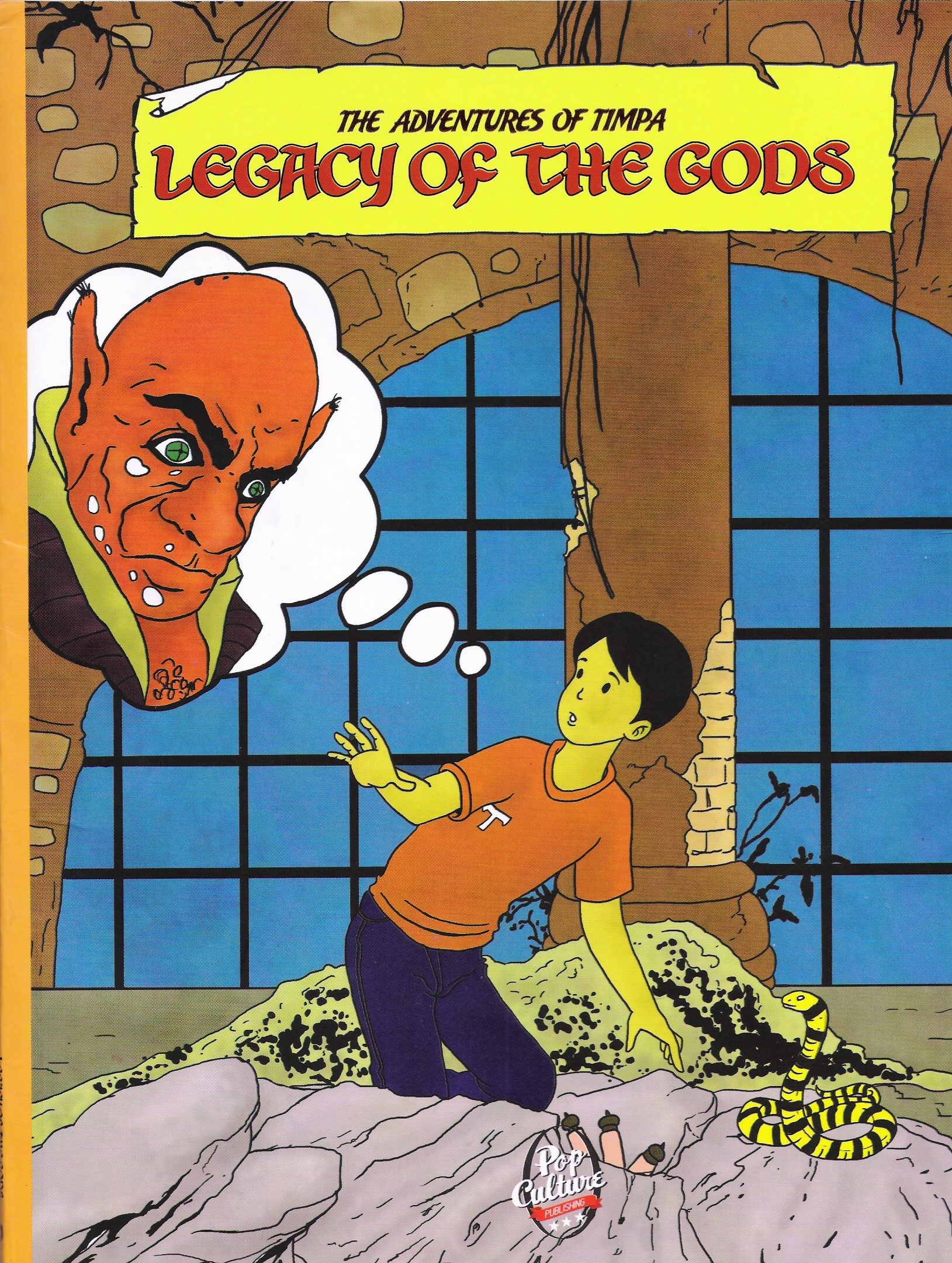
Which brings me to the real reason to read these comics – the fourth one, Legacy of the Gods.
 

timpa4

Rereading Hergé’s Flight 714 last year I realised that it had first been published in 1968, the same year as Erich Von Däniken’s Chariots of the Gods? Von Däniken’s theory in this book (popular with teenagers around the world, or at least it was in my day) is that in Earth’s far-distant past it was visited by various extra-terrestrials whose far superior technology made them appear as gods or angels to our primitive ancestors. Flight 714 has Tintin and his companions taken aboard a hijacked plane to an island that, the natives claim, was once visited by gods in “fire-lorries”. There are statues that look suspiciously astronaut-like, and a strange man who can communicate telepathically, but aliens wipe the characters’ memories of these events before anyone else can be told.

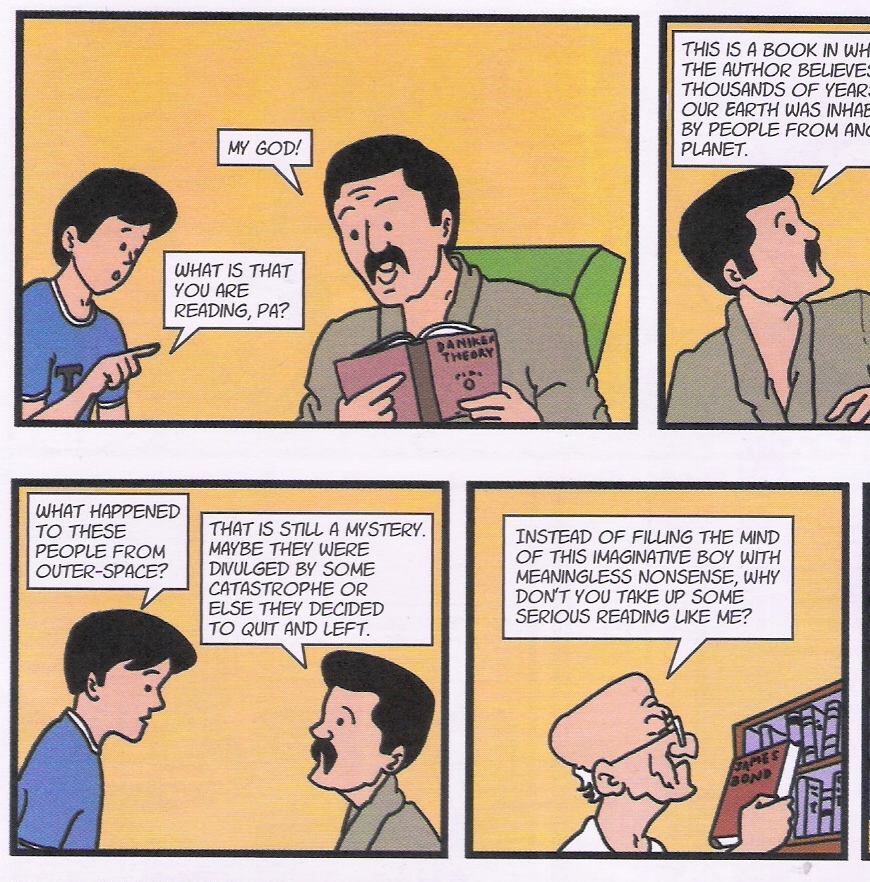
I’m not sure if it was coincidence or a deliberate continuation of the Tintin theme that prompted Kerawala to do a Chariots of the Gods?-themed Timpa story. Legacy of the Gods opens with a direct reference to the book when we see Timpa’s father reading Von Däniken.
 

Daniken1

 
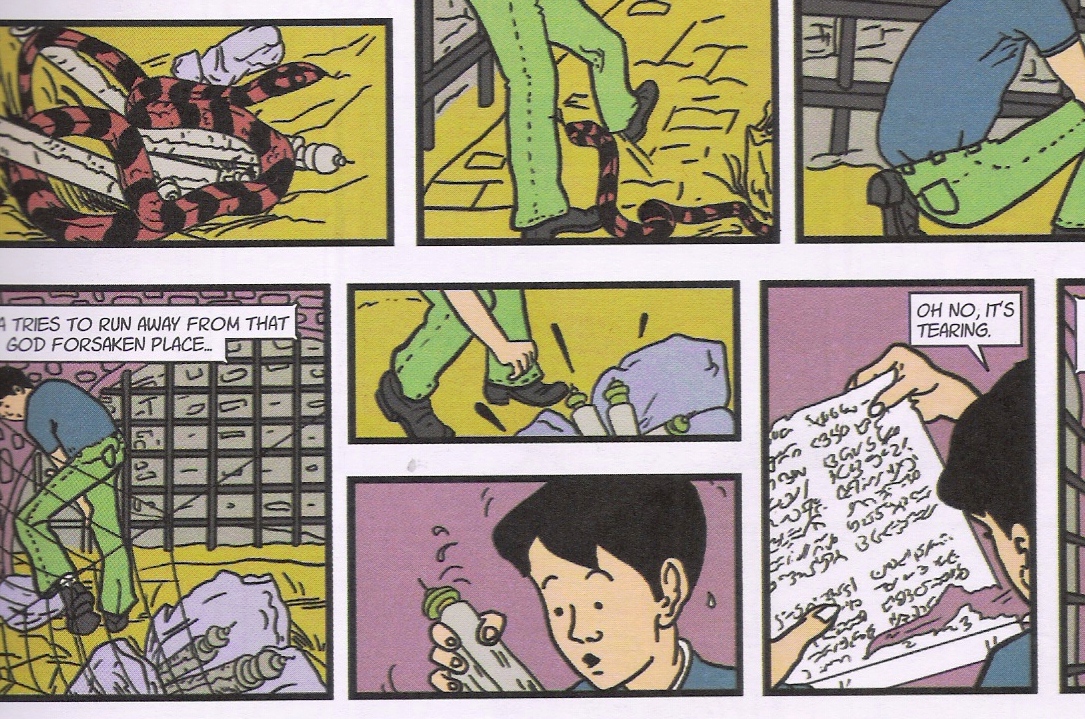
Soon after, Timpa visits an uncle in Murshidabad, stumbles upon a secret underground chamber and finds ancient scrolls written in an unknown script.
 
ASnake
 
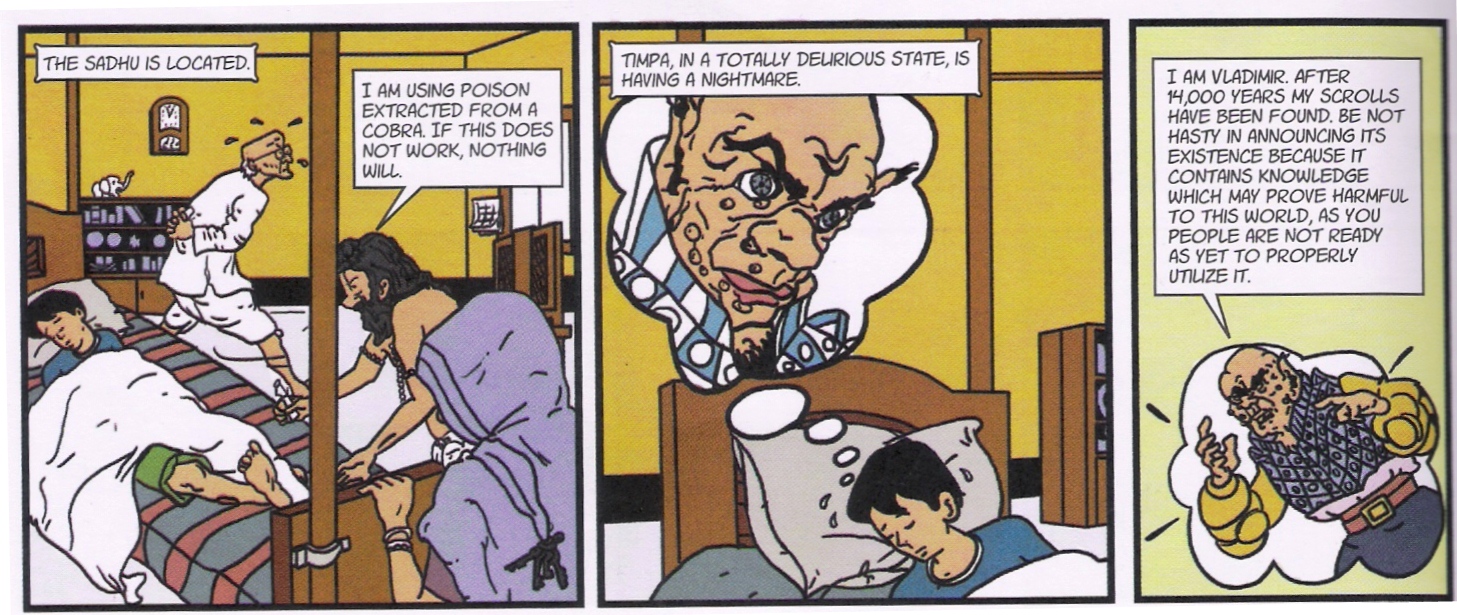
As Timpa suffers from a raging fever caused by snakebite he dreams of a strange man (we will learn that he is an alien) who warns him that the knowledge in these 14,000 year old scrolls is dangerous to humans. The alien’s name is … Vladimir. I cannot explain this. I also cannot explain why Vladimir has sparser chest hair and better skin on the cover of the book.
 
EnterVladimir
 
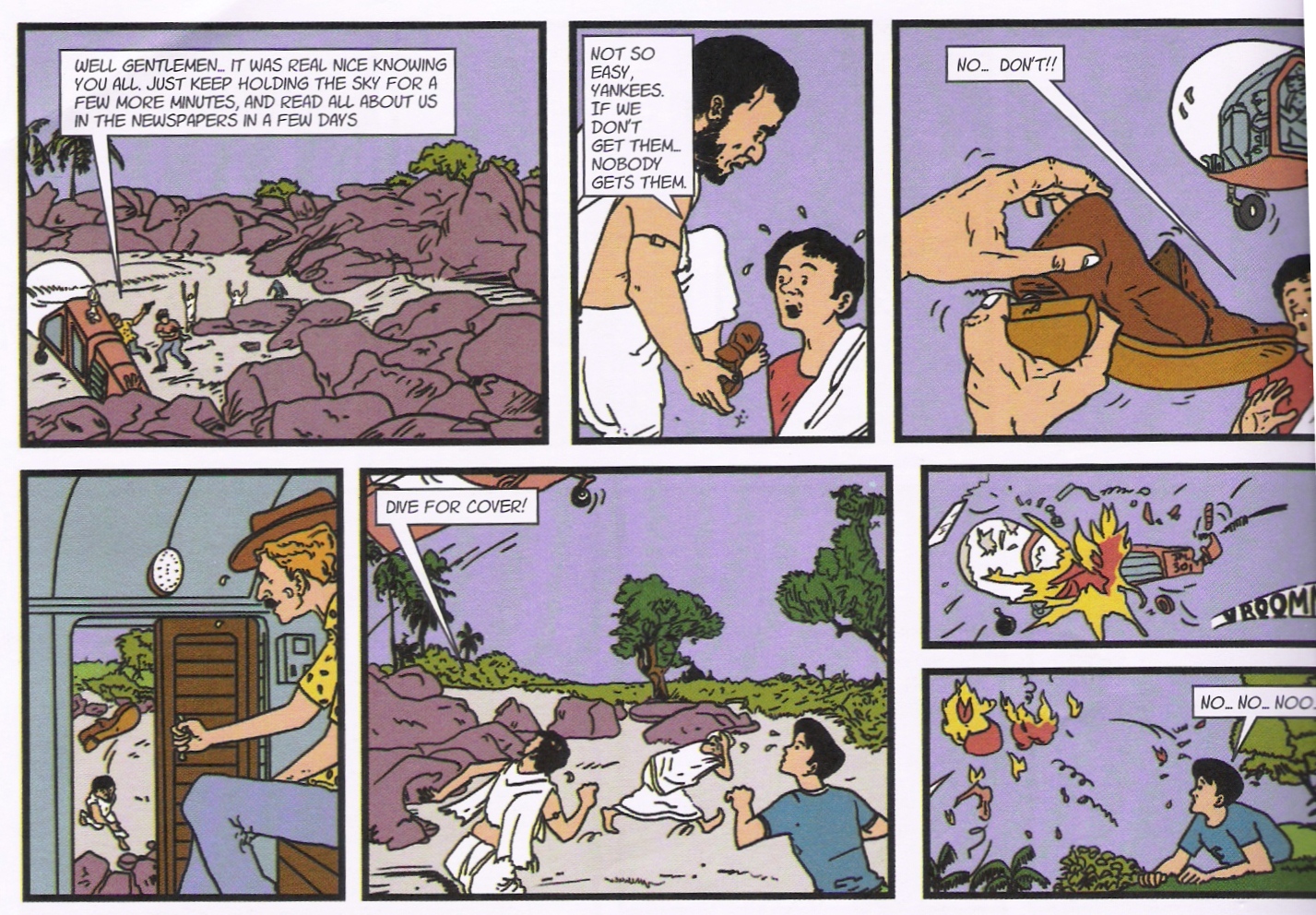
The scrolls, it turns out, are in an old form of Pali. Naturally the Indian government fails to listen to young Timpa’s insistence on the importance of these scrolls. Naturally the Americans and the Russians (this is set in the 1980s) are interested. A series of kidnappings and interchangeable villains follow.

Naturally the Americans almost get away with it. Until the Russians blow up their helicopter.
 
Conflagration
 
And so once more, great (or terrible?) knowledge is lost to the world.