The Same Words

This first ran on Splice Today.
_________________

If you want a glimpse into the sorry state of America’s gun policy debate, look at Brian Doherty’s smugly incoherent pronouncements over at Reason.

Doherty’s main point is in his article’s title: tragedy, he insists, shouldn’t make policy. The shooting at the Dark Knight showing in Colorado is a random incident without any broader lessons to teach us about guns, or assault weapons, or America.  He declares:

Trying to “turn tragedy into politics” feels gross, because the deaths and the grief for the living are real and terrible and demand respect… If I weren’t a professional writer about the Second Amendment (in my 2008 book Gun Control on Trial) on record as believing in the right to bear arms, I wouldn’t dream of weighing in at all.

Or, to sum up, only people with credentials like Doherty should be allowed to draw conclusions from tragedy, and only as long as those conclusions are that we should dismiss the tragedy from theoretical consideration. Refusing to think about how the tragedy might involve our society or us is, apparently, the best way to show respect for those who have died.

In the real world outside the abstract libertarian compound, tragedies do very often lead to political thinking and political consequences. Sometimes, this has horrible results, as in our decade of foreign policy motivated by 9/11. Sometimes, though, it’s necessary and important. Surely it’s not disrespectful to suggest making sure nuclear reactors are earthquake proof after the disaster in Japan. To point out that people died because of inadequate safety features or (in, say New Orleans) because of poor policy response, isn’t callous. It’s acting as if we care about the dead, and about the living. Preventable deaths should be prevented. That’s not an insult to anyone’s memory; it’s simple human decency.

Not in Doherty’s world, though. On the contrary, he’s so myopically certain of his position that, without irony, he quotes himself blandly dismissing Gabby Giffords’ shooting.

Americans understand that even strange people should be able to own weapons, and not just for deer hunting. The very rare crimes of very unusual Americans should not dictate how everyone’s right to self-defense is managed, and even in the wake of tragedy that is fortunately unlikely to change.

Doherty apparently hasn’t noticed that putting “very” in front of “rare” and “unusual” is a rhetorical device somewhat undermined by the fact that such events are, at least, frequent enough that he’s got a canned spiel to pull out every time they happen. When, I wonder, will he notice this contradiction? The third time he reprints it? The fourth? The 10th?

Doherty is correct that it’s politically impossible to change gun laws at the moment, but I don’t think that’s because Americans have decided en masse that it’s a good idea for “strange people” to have unlimited access to semi-automatic weapons.  Rather, it’s because the NRA and the pro-gun lobby has bludgeoned politicians into submission—and, perhaps most importantly, because the Democrats abandoned the issue. Doherty himself notes that at the beginning of the 1990s, 78 percent of Americans supported stronger gun control laws. Then along came Bill Clinton. Without a political party to lead or make the case for stricter controls—without a party to, for example, point out that perhaps we could stop our regular cycle of tragedies if we made an effort—public opposition to guns has cratered. Doherty sees this as a sign of America’s growing wisdom, but it’s just as likely a result of a craven lack of leadership.

That leadership might reappear, though, if people begin to get weary of random yahoos loading up with firepower so they can kill children. That’s why Doherty has taken to the Internet again to wave around airy phrases like, “The endless and unmanageable mystery of the individual’s power and choice to do evil,” as if somehow an evil person’s power to do harm is completely unaffected by the availability of machine guns.

Doherty insists there is no connection between violence and gun possession. That assertion is debatable. James Fallows, for example, points out that after a terrible 1996 massacre in Tasmania, “Australia tightened up its gun laws, and there has been nothing remotely comparable in all the years.” In the U.S., on the other hand, we’ve apparently decided that it’s better to accept the occasional multiple shooting than it is to reexamine gun policy. That’s a political decision. Which is why Doherty is taking the occasion of the tragedy to make his polemical points, and why he will use the next tragedy to do the same, and the next, and the next, and the next, until, at some point, Americans get tired of hearing the same words spoken over yet another grave.
Two Stars for Reign in Blood?

This first ran at Madeloud.
________

imagesI received the Rolling Stone Album Guide, third edition, as a graduation gift from my  brother, who knew well exactly what sort of obsessive I was. I probably looked at it every day, or at least every week, for a couple of years there.  The book’s binding wasn’t meant to sustain that sort of long term attention, and it disintegrated.  The book’s prose wasn’t either, and it more or less disintegrated as well — which is why I never need to read another word by critics Mark Coleman, J.D. Considine, Paul Evans, or David McGee, thanks.  But for all its structural failings, the guide did introduce me to a ton of music I might never have known about otherwise, from the Soul Stirrers to Wanda Jackson to Stetsasonic to Bob Wills.

I haven’t looked at the book in a long time though. In the first place , the thing was published in 1993, so it’s seriously out of date.  And in the second place  — well, the Internet.  Google, Wikipedia, Amazon, and MySpace, have rendered this sort of undertaking really redundant — even precious.  “Oh, goodness,” you say as you flip through the pages, “they thought they were being so completist by including Charles Mingus and Kylie Minogue!” (And so brave for giving Mingus those five-star album ratings!  Oh, congratulations, guys!)

Still, if the Album Guide isn’t exactly useful as reference anymore, it retains sentimental and historical interest.  Consider, in 1993:

—   Nirvana  was a decent band peddling a poppier version of the “metal-edged punk” that typified Soundgarden and Soul Asylum.  “At their best,” J.D. Considine says, Nirvana’s songs “typify the low-key passion of post-MTV youth.” Bleach (three-and-a-half stars) is faulted for  relying on “metal riffage” as much as on “melodic invention,” while the poppier Nevermind gets four stars. Since Nirvana has not yet been named rock royalty, no one needs to trace its bloodline, and bands such as the Melvins and the Vaselines don’t exist.

—   Paula Abdul is the musician with “the most successful debut in history”. That means she’s worth taking down a peg according to Paul Evans, who characterizes her singles as “aerobicized rhythm tracks and sex-chipmunk singing,” and concludes “this was Madonna-cloning at its most plastic,”. As if anyone gives a crap. Mariah Carey is about equally relevant and receives similar treatment (“ersatz soul music…breathtaking in its wrongheadedness”). Brandy, Monica, and Aaliyah haven’t released albums yet; TLC has, just barely, but isn’t important enough to get an entry.

—   Sun Ra is great, but his music is mostly impossible to find. The guide lists and rates less than ten records, a fraction of those discussed on Wikipedia (which is in turn a fraction of his total output.)

—   Eric B. and Rakim are solidly mediocre; their debut, “Paid in Full,” gets two stars; “Let the Rhythm Hit ‘Em” gets three-and-a-half.  EPMD is dismissed even more summarily — they “too often play it safe” according to Evans. Tribe Called Quest and de la Soul do better, though neither Low End Theory or 3 Feet High and Rising receive the five stars awarded to Peter Gabriel’s  So. On the other hand, everybody has already figured out that Public Enemy matters. N.W.A. too, though you get the sense that reviewer J.D. Considine rather wishes they didn’t..

—   Johnny Cash is toiling away without much of an audience at Mercury records…though David McGee presciently notes that there’s still life in the singer yet. The 1988 Water from the Wells of Home is given 5 stars, which is probably the first and last time that this (very fine) recording would be considered a pinnacle of Cash’s career.

—   Bruce Springsteen is humongously important. Way more important than the Pixies.

Of course, there are a lot of performers who looked pretty much the same in 1993 as they do in 2010 — even after the twelfth time their music has been repackaged, the Beatles are still the Beatles. But it is amazing, when you flip through this guide, to think how much the future influences the past, rather than the other way round. Where’s Bathory in this book? Where’s Judee Sill? From our perch, it’s easy to see that Kraftwerk should have more column inches than Lenny Kravitz, but from the offices of Rolling Stone in 1993 — hey, they probably hoped this electronica shit would just go away.

Instead, it was them who went away. Rock critics and rock criticism have proliferated like roaches and roach eggs, of course — and a 2004 edition of the Rolling Stone guide itself is still available, according to the internets. But the dream of a single, massive, authoritative critical touchstone is gone. An infinite number of monkeys could write a more perspicacious record guide . And so they have.

Utilitarian Review 3/23/13

On HU

Featured Archive Post: Ng Suat Tong looks at Gary Groth’s interview with Gil Kane.

Iron Man vs. Bataille.

I review an album of post-war hillbilly music.

Matthias Wivel weighs in on the debate over literariness in comics.Eddie Campbell clarifies his position in the (lengthy) comments thread.

Alex Buchet on Peanuts, as you’ve never seen it before.

Chris Gavaler looks at eugenics and the House of Slytherin.

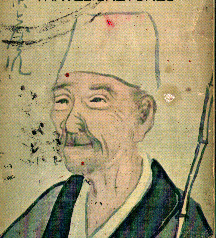
I compared the poetry of Zen poets Basho and Ryokan.

Robert Stanley Martin provides an audio download of Pauline Kael lecturing on the auteur theory.
 
Utilitarians Everywhere

I was on the Charles Adler Show talking about Persepolis and censorship in schools (in reference to my Atlantic article below.)

At the Atlantic, I talk about:

The Client List, The Tenant of Wildfell Hall and cultural images of sexy, deviant single moms.

debt and housework.

Persepolis and school censorship.

Steubenville, I Spit on Your Grave, and failures of imagination about rape.

— what Andrea Dworkin would,and would not, have liked about the new film Ginger & Rosa

Olympus Has Fallen, which is one of the worst movies I’ve ever seen, and makes me despair for my country.

what Rush Limbaugh got right about Beyoncé.

At Splice Today, I talk about

how the internet ate my dream job. Whine, freelancer, whine….

the left wing pro-war pundits and how they sucked.
 
Other Links

Jessice Luther on feminism and romance novels.

C.T. May on CPAC.

Mallory Ortberg on CNN”s coverage of Steubenville.

And then there’s the Onion on a courageous athlete who overcame raping someone.

Philip Cohen on gender segregation in the workplace.

Alex Pareene on awful local news reporting.

Ronald Reagan was a traitorous thug.
 
This Week’s Reading
I reread Persepolis, and started David Graeber’s Debt: The First 5000 Years. Also still working on LOTR with my son; we’re in the middle of the Two Towers now.
 

images

Go and Stop Chasing

I wrote this essay back when I was in college — so more than 20 years ago now. I’m curious whether folks think I still sound like me or not….
________________________________

“‘Go to the pine if you want to learn about the pine, or to the bamboo if you want to learn about the bamboo.'” –Basho, p.33

“‘If you want to find the meaning, stop chasing after so many things.'” –Ryokan, p.43

Both Basho and Ryokan attempt to capture, through their poetry, the beauty and simplicity of nature, the “meaning” inherent within everyday existence.  Yet, despite analagous subjects and attitudes, the essence of the two poets work is clearly different.  For while the fundamental principle which guides Basho’s art is that of motion, the desire to “Go to the pine”, at the basis of Ryokan’s poetry is stillness, the injunction to “stop chasing”.  to stay in one place.  To look at the two poets, then, is to see a contrast between restlessness and acceptance, between poetry which searches and that which reveals.

Basho’s motion, his desire to go outward and into the world for knowledge and wisdom, can perhaps best be seen in the form of his poetry, which is mostly interspersed amidst his travel journals.  Thus, virtually every  poem is placed in a particular location and even at a particular time. When he writes, for example, that:

Three months after we saw

Cherry blossoms together

I came to see the glorious

Twin trunks of the pine.

it is necessary for the reader to know not only that the poet is referring to the pine at Takekuma, but also that he is responding to another poem written by a friend before he began his journey. (111)  While this kind of specificity makes the poem at least partially inaccessible to modern readers, it also, in Basho’s time, connected him to the world outside of himself, placing the events of his life in a clearly recognized continuity of location and history.  Similarly, his use of the haiku, a form utilized and understood by many of his contemporaries and one which, moreover, lent itself to group compositions, indicates the manner in which poetry allowed him to reach out, to link, with others, with nature, with the landscape and past of Japan.(12)

It is not only this linking itself, however, which truly distinguishes Basho, but rather the dexterity and originality with which he creates these contacts, the power of the imagery with which he touches and contains the objects towards which his “wind-swept spirit” reaches. (71)  Within the strict confines of the haiku  form, Basho attains an amazing degree of motion and intensity.  In describing “a gate-keeper’s house” in which he “was held up for three days,” for example, Basho writes

Bitten by fleas and lice,

I slept in a bed

A horse urinating all the time

Close to my pillow. (120)

Here, the poet moves from close up, next to his skin where the insects are biting; to a wider view, himself asleep; to the sudden and striking image of the “horse urinating all the time”; and then back to his own pillow, next to which, now, of course, the reader sees the shadowy figure of the horse.  By the end of the short poem, the journey is so thorough that it is almost impossible to remember the “fleas and lice” of the first line — they disappear in the sound of the horse’s urine splashing on the floor.

This switching of perspective, this quick movement from image to image, is perhaps the most characteristic feature of Basho’s poetry.  Often the reader moves with the poet, discovering each new object, each new perspective, simultaneously with the narrator.  Thus,

Deep as the snow is,

Let me go as far as I can

Till I stumble and fall,

Viewing the white landscape.(76)

But even when Basho himself is not present within his poems, the poems themselves move by reaching, by moving out into the world.  Each one, then, attempts to find some essence outside of the self, to seek out some place where

At midnight

Under the bright moon,

A secret worm

Digs into a chestnut. (27)

Ryokan, on the other hand, writes not to discover an outer world, but rather to reveal inner experience; his personal response to occurrences and events in that outer world.  Ryokan’s allusions, therefore, are not historical or literary, but personal; he writes of the scenery of his own life, of how “The children play peacefully with this old monk” (31), how “I forgot my begging bowl”(60), and how “A thief has stolen my zafu and futon.” (56)  The form of his verse, too, is idiosyncratic; he writes not in perfect haiku, but instead loosely follows the structure of many different forms of Chinese and Japanese verse. (17)

By refusing to limit himself to the haiku  and traditional verse forms in which Basho writes, Ryokan both frees and disconnects himself from a larger literary community, allowing him to adopt an easy, almost rambling style in which he can touch not only on images in nature, but on his own thoughts, his opinions and beliefs.  When he writes, for example, that “With no-mind, blossoms invite the butterfly,” the blossoms and the butterfly are entirely hypothetical; Ryokan is not writing of a specific place or a specific incident; he is writing solely about what occurs within his own mind. (16)  Similarly the poem

Who says my poems are poems?

My poems are not poems.

After you know my poems are not poems,

Then we can begin to discuss poetry! (39)

Is completely devoid of any imagery whatsoever — appropriately enough, considering the subject matter.  Yet, even in a more conventional poem, such as

The thief left it behind —

the moon

At the window. (75)

there is a sense of stillness.  For while the poem moves from “thief” to “moon” to “window”, the philosophic cast of the whole, the meditation that is inevitably raised by the question of what can and cannot be stolen, by what has and does not have value, slows the poem down, creating an air of contemplation, rather than hurry.

The space which Ryokan creates allows him to connect with the world, to find “meaning”, not through the reaching that Basho undertakes, but rather through a kind of blurring, so that the line between inside and outside disappears, and he becomes both observer and observed.  The ease with which he is able to merge with the outside, with which he can “pretend to be a crane softly floating among the clouds” is as incredible as the powerful motion of Basho’s verse. (33)  In the poem

The island of Sado —

morning and evening I often see it in my dreams,

Together with the gentle face of my mother. (76)

Ryokan blends a real place with his own inner dream world and then with his past in the space of three lines.  By forgetting place, by standing still, then, Ryokan allows the world to rush through him, so that

Going out to beg this spring day

I stopped to pick violets–

Oh!  The day is over! (61)

To suggest that Ryokan is solely a poet of inner and Basho solely a poet of outer; that Ryokan is only stillness and Basho only motion, is, of course, an oversimplification — Ryokan writes poems that flit from image to image, Basho writes poems that remain inside himself.  Yet, these exceptions, too, demonstrate the fundamental differences that separate the two writers.  In looking at them, in fact, the distinctions become not less, but more apparent.  For when Ryokan writes

Returning to my hermitage after filling my rice bowl,

Now only the gentle glow of twilight.

Surrounded by mountain peaks and thinly scattered leaves;

In the forest a winter crow flies. (26)

the movement from hermitage to twilight to moutain peaks to forest and crow is still suffused with quiet.  The “gentle glow of twilight” shifts the reader’s mind from the ground to the sky without the sudden rush of Basho’s verse, and leaves it there among the “mountain peaks and thinly scattered leaves” until the “winter crow flies” into view.  The open form of the poem, the leisurely shifts of imagery, all create stillness, despite the broad movement of the poem, and despite Ryokan’s near abscence.

In the same way, when Basho, after attending a funeral, writes

Move, if you can hear,

Silent mound of my friend,

My wails and the answering

Roar of autumn wind. (133)

the limited space of the narrative, and the prevalence of his own emotions, do not detract from the radical rush of images, the leaps from “Silent mound” to “my wails” and then out to the “Roar of autumn wind.”  Pushed into a small space, in fact, Basho turns to auditory, rather than visual imagery, creating a haunting poem in which the reader is without bearing or placement, and must search for purchase solely amidst the rising and falling sound.  Thus Basho, even without sight, continues to search, just as Ryokan, casting aside self, remains resting in quiet.
 

Matsuo_Basho

Basho
 

Heirs of Slytherin in the Virginia State House

slytherin

“I always knew Salazar Slytherin was a twisted old loony,” says Ron Weasley, “but I never knew he started all this pure-blood stuff. I wouldn’t be in his house if you paid me.”

And yet the House of Slytherin has no shortage of new applicants. It’s a Who’s Who of Recent Movie Supervillains, including Magneto, Sebastian Shaw, the Lizard, and the Red Skull. Oh, and Lord Whatshisface minus Ralph Fiennes’ nose. Also, if you don’t mind a little song and dance with your supervillainy, the Broadway Green Goblin. My family only just caught up on the fall season of Syfy’s Alphas, so now I can add Stanton Parish to the list too. He has the best advertising slogan of the batch:

“Better people, Better world.”

The semi-immortal Parish has been honing his PR skills since the Civil War, so he may have cribbed the phrase from Kentucky eugenicists in the 1930s:

“Fewer Babies, Better Babies.”

That was back when contraception was about preventing the unfit from breeding. Or as Margaret Sanger phrased it on a 1921 cover of Birth Control Review: “To Create a race of thoroughbreds.” The American branch of Slytherin House, AKA the Eugenics Society of the United States, was sponsoring national “Fitter Family” contests, with winning families receiving medals inscribed with the slogan: “Yea, I have a goodly heritage.” The pamphlet writers over at the Carnegie Institute Department of Genetics were lesser word wizards, but no less dedicated to the cause: “Eugenics Seeks to Improve the Natural, Physical, Mental, and Temperamental Qualities of the Human Family.” Other eugenic poster writers focused on the flipside: “Some people are born to be a burden on the rest.” Ads for The Black Stork, a 1917 documentary about a pediatrician who allowed unfit babies to die, cut to the chase: “Kill Defectives, Save the Nation.” The 1921 Second International Eugenics Conference gave it a scientific-sounding spin:

“Eugenics is the self-direction of human evolution.”

That means fixing the gene pool through compulsory sterilization, immigration boycotts, anti-miscegenation laws, and what was once euphemistically termed euthanasia,  AKA Auschwitz. By losing World War 2, the Nazis largely (though not completely) killed the eugenics movement. All that “pure-blood stuff” would be forever associated with the uber-Aryan Adolf Hitler, AKA Salazar Slytherin.

So why is popular entertainment still waging the war? Lord Voldermort is just the tip of the white hooded iceberg.

Ian McKellen’s Magneto complained that “nature is too slow,” back in the 2000 X-Men. Michael Fassbender’s Magneto was still complaining in the 2011 X-Men: First Class, but under the tutelage of Kevin Bacon: “We are the future of the human race. You and me, son. This world could be ours.” A month later, Hugo Weaving’s Red Skull was giving Captain America the same lesson: “You pretend to be a simple soldier, but in reality you are just afraid to admit that we have left humanity behind. Unlike you, I embrace it proudly. You could have the power of the gods!”

Last summer, Harry Potter alum Rhys Ifans, AKA Dr. Curt Connors, AKA the Lizard, wanted to “enhance humanity on an evolutionary scale” and “create a world without weakness.” “This is no longer about curing ills,” he assured Peter Parker. “This is about finding perfection.” Unfortunately, “Human beings are weak, pathetic, feeble minded creatures. Why be human at all when we can be so much more? Faster, stronger, smarter!”

Another Spider-Man supervillain sings the same song every night, plus weekend matinees. According to Bono’s Green Goblin, “The crossroads of the world just need a little tweak from a freak.”He studies “enhanced genetics” and “super-human kinetics” to create “new men,” a “new species.” The military only wants a “new breed of Marines,” but the Goblin’s “designer genes” lead him into a much bolder “do it yourself world” in which human beings are the new “masters of creation,” claiming “powers once reserved for the ancient gods.”

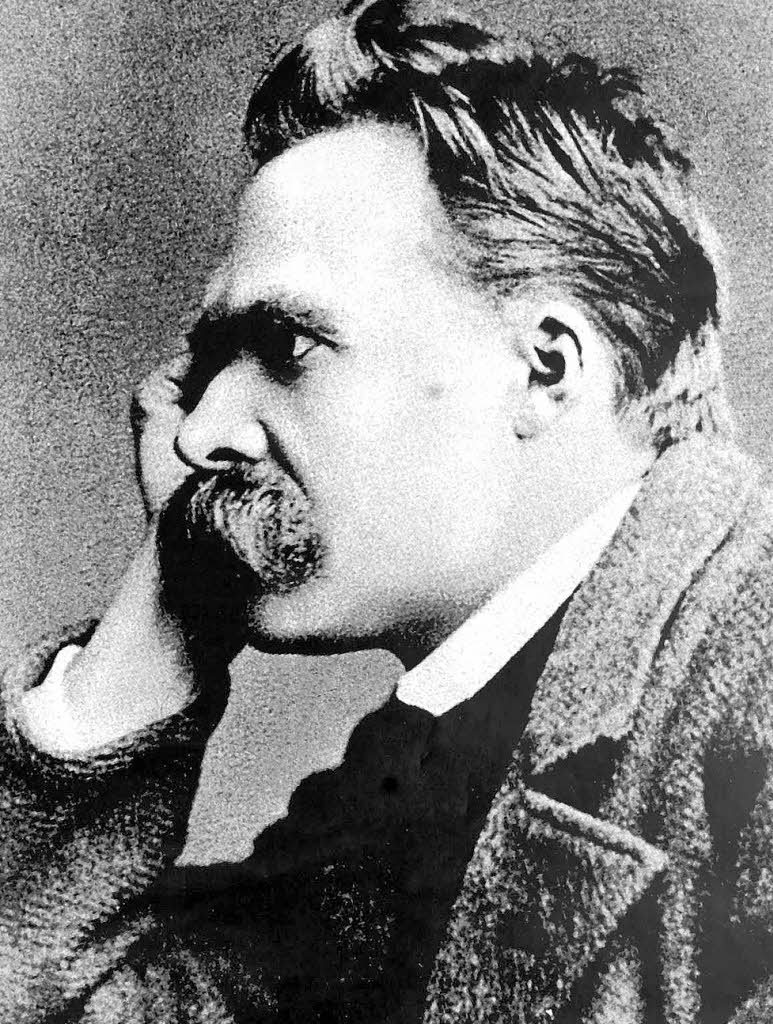
nietzsche

This is the song of the Superman. Nietzsche wrote it back in 1883. “Lo, I teach you the Superman!” shouts Nietzsche’s PR man, Zarathustra. “Ye have made your way from the worm to man, and much within you is still worm. . . .Man is something that is to be surpassed. . . . What is the ape to man? A laughing-stock, a thing of shame. And just the same shall man be to the Superman . . . .”

The Superman was Nietzsche’s answer to the death of God. Who needs Him? We can evolve ourselves. You could argue Nietzsche was writing philosophical allegory, not Aryan supremacy. But once George Bernard Shaw (any relation to Sebastian?) translated “ubermensch” into “superman,” the House of Slytherin was up and singing:

For each of the four founders had
A house in which they might

Take only those they wanted, so,
For instance, Slytherin
Took only pure-blood wizards
Of great cunning just like him.

Said Slytherin, “We’ll teach just those
Whose ancestry’s purest.”

Maybe Rowling, like recent screenwriters for the X-Men, Captain America, and Spider-Man, just borrowed eugenics as a boiler plate bad guy. There’s no twisted old loony bigger than Adolf.

But then why did it take till January of this year for my state to introduce the Justice for Victims of Sterilization Act? Virginia was once the cutting edge of eugenics. The future chancellor of Germany admired our 1924 Racial Integrity Act while scribbling Mein Kampf in his prison cell. He used its DNA for the Nazi’s own Law for the Prevention of Hereditary Diseased Offspring.

Hitler removed himself from the gene pool in 1945, but Virginia eugenicists kept sterilizing the unfit till 1979. Governor Warner apologized over a decade ago, but only now is the legislature even considering paying for its Death Eater history. The bill limits claims to $50,000 per victim, with an estimated grand total of $76M.

If that sounds like a lot, then imagine living your muggle life under the reign of Voldemort.

Yes, Virginia, there are supervillains. And they don’t come from kids’ books.

Now pass the damn bill.


Peanuts Oddity

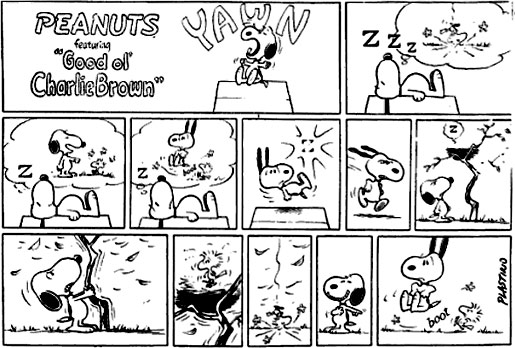
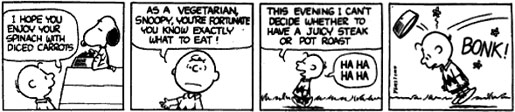
The most popular, and arguably the best-beloved comic strip in American history is  Peanuts, by Charles M. Schulz (1922 — 2000). Above is a sample of his charming artwork for the strip…

NOT!


Notice the signature in the last panel? Who is this guy Plastino?

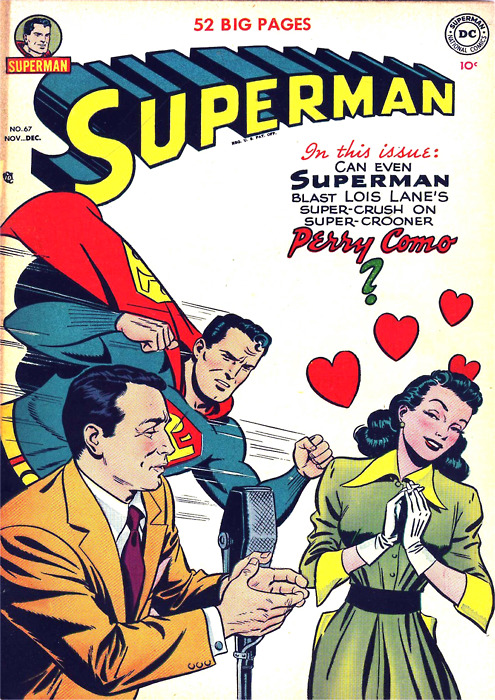
It’s Al Plastino (1921–  ), a cartoonist best known as a superhero illustrator for DC Comics characters such as SupermanSupergirl (whose debut he drew) andSuperboy:

Art by Al Plastino


shapeimage_2
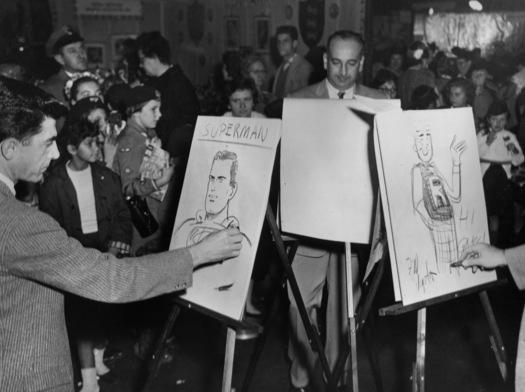
At right, Al Plastino draws Superman. In the center is Joe Simon, while at right Bill Vigoda draws Archie. Photo taken at New York’s Armory in 1949

Where on Earth did this strip come from? Schulz was famously individualistic about his strip, never so much as employing assistants to ink or letter. And why choose a superhero artist like Plastino?

There are two explanations put forth.

One concerns tense 1977 contract negotiations between Schulz and his distributor to the newspapers, United Features Syndicate. Schulz wanted a bigger share of ownership. UFS was afraid he would leave the strip. In this scenario, Plastino was commissioned to take over Peanuts if Schulz walked, and a reserve of strips was built up. However, when negotiations finally worked out to Schulz’s satisfaction, Plastino’s efforts were shelved.

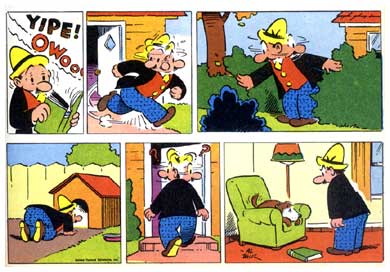
Plastino wasn’t as absurd a choice as might seem. He had considerable experience in comedy strips and in ghosting other cartoonists’ styles, most notably with his 19 years (1970 — 1989) on Ferd’nand:

Art by Al Plastino

The other scenario was advanced by Plastino himself. He claims the syndicate commissioned the strips in 1983, when Schulz underwent heart surgery,  in case Schulz were incapacitated. But the replacement strips were never needed.

Whichever theory is correct, it’s agreed that the hiring of Plastino was kept secret from Schulz; when he learned the facts years later, he wasn’t happy. The Plastino strips were destroyed.

One more look at the Peanuts that never was:

Art by Al Plastino

 
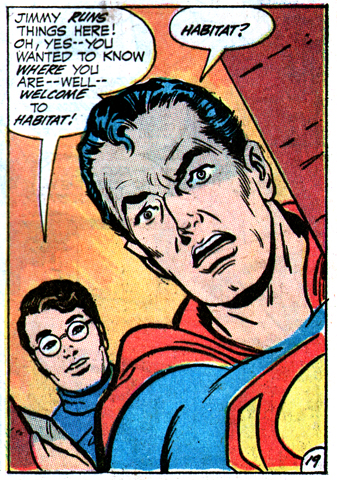
Plastino has been out of comic books for forty years now; comic book fans, rather unfairly, mainly remember him as one of the infamous retouchers of Jack Kirby’s faces for Superman in Kirby’s 1970 run on Jimmy Olsen as seen below:

SupersJO133pg19_sml

Pencils by Jack Kirby; Superman redrawn by Al Plastino; background figure inked by Vince Colletta

 
This is a pity; yet Plastino, excellent craftsman though he be, left behind no distinctive body of work. He was a chameleon.

droppedImage

Al Plastino in 2007

 
Update: In comments, Gary Groth explains the story behind the Plastino cartoons.