Purity Culture With Fangs

poster_teeth2

 
A little bit back I read Dianna E. Anderson’s Damaged Goods, about purity culture in the US. Purity culture is an evangelical movement which promotes sexual abstinence till marriage; sex outside of marriage is seen as sinful, and women who have sex before marriage defile their relationship with God. Purity culture is a subcultural phenomenon, located specifically within evangelical circles. But it’s linked to broader mainstream ideas about women as virgin/whores, who have (or should have) no sexual feelings themselves but are still, somehow, responsible when men desire them. Women are both vapid victims and monstrous seducers, blank slates and inimical destroyers.

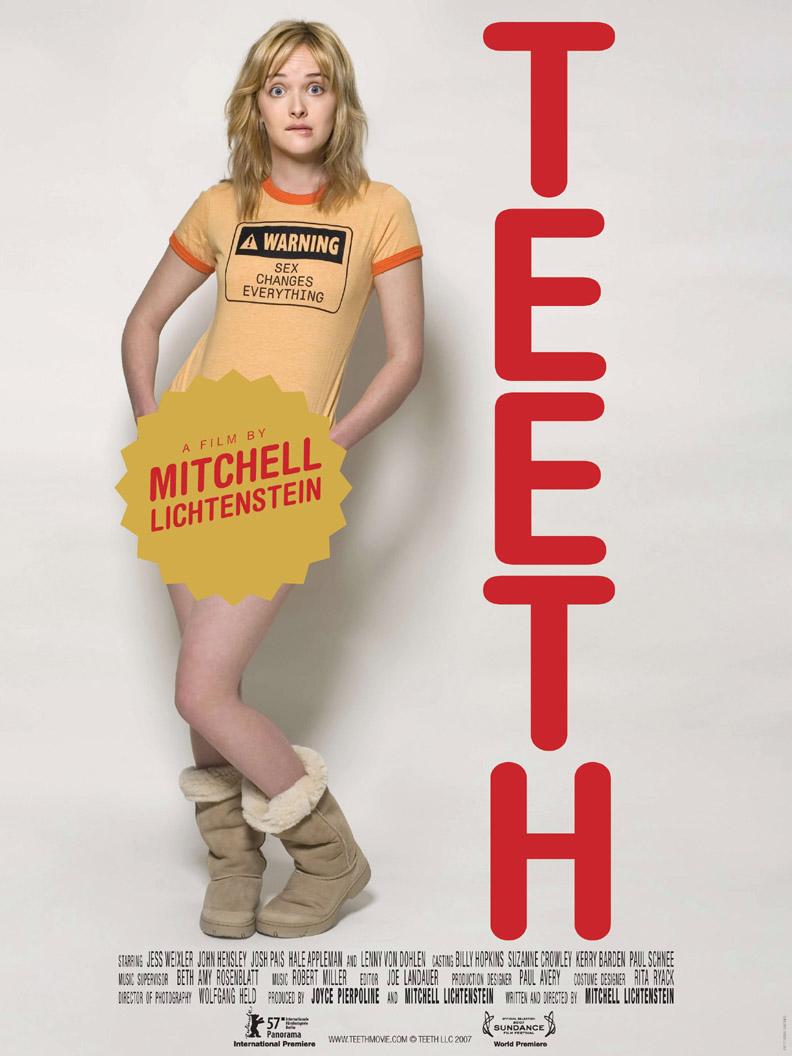
The 2007 rape/revenge comedy Teeth cheerfully sends up all those ideas, complete with more castration scenes than you can shake…well, maybe best not to complete that metaphor. The film features Dawn (Jess Wexler), a purity culture devotee, who gives speeches about saving yourself from marriage and wears shirts saying, “Sex Changes Everything!” Nonetheless, she is attracted to new kid Tobey (Hale Appleman) and almost goes all the way with him. When she pulls back, though, Tobey tries to rape her. Which is when she discovers she has teeth in her vagina, and inadvertently chops off his dick.

Dawn is at first traumatized, not least, perhaps, because the rape/revenge so directly encapsulates her own purity culture dogma. Toby was tempted by her and destroyed; misogynist meme fulfilled. As Dawn reads up on vagina dentata, she learns that she’s a dark force to be conquered by some hero; her sexuality isn’t her story, but some other dudes. And sure enough, another guy shows up volunteering to do that conquering. He seduces her with a vibrator and lots of candles, and they have some lovely sex…until he reveals that he bet his buddy he could sleep with her. He tells her this while they’re in flagrante, she gets pissed…and yep, sure enough, off with his dick. Dawn isn’t even horrified at that point, just exasperated. “Some hero,” she mutters as she stomps out, leaving the whimpering, bleeding castrati behind.

Dawn isn’t upset with herself for chopping off this guy’s penis because she realizes it’s not her fault. He’s the idiot who took advantage of her, not the other way around. Rather than a paradigm where she has to resist and resist, and then is culpable if someone forces her, she moves to an ethic of consent. And consent, as that second guy learns, cna be withdrawn any time; when she wants to stop, you better stop. Or else.

Dawn goes on to deliberately seduce and kill her skeevy abusive step-brother, and another random older jerk. Rather than being the thing to be conquered in someone else’s story, she ends up the one doing the conquering, with the guys just a plot point in her self-actualization. You could see this as dehumanizing in some sense; “castrating vagine dentata” isn’t exactly the usual version of a wholesome, healthy career choice or lifestyle. But on the other member, one of the things the movie suggests is that the wholesome, healthy romantic teen comedy narrative is in a lot of ways gross and misogynist. Would you rather be in a John Hughes film where the harassing dipshit who shows off your underwear is seen as haplessly cute? Or is it better to be the heroine of a rape/revenge narrative where you get to cut off that assholes’ balls? Empowerment isn’t the be-all and end-all, but it certainly has its pleasures, not to mention its teeth.
Utilitarian Review 9/12/15

499272648_640

 
On HU

Featured Archive Post: Ng Suat Tong on Daredevil and Bob Dylan.

Robert Stanley Martin with on-sale dates of comics in early 1947.

Jimmy Johnson on how Narcos is an imperialist piece of crap.

Cord-Christian Casper on Enid Blyton, Spider-Man, and the illustion of change.

Osvaldo Oyola on an old advertisement and the history of sexism and insularity in gaming

Chris Gavaler on Superman and Leopole and Loeb.
 
Utilitarians Everywhere

On Quarts I wrote about Playboy’s history with jazz.

On Splice Today I wrote about:

Muppet violence, and why we don’t care.

—rock, gender, and the bands Novella, Insect Ark, and Sewer Goddess.

great music I missed in 2014, including Polly A, Cretin, and more.

— Bobby Jindal. the saddest Republican candidate.
 
Other Links

Yasmin Nair on why Kim Davis doesn’t deserve to be in jail.

Noah Davis on making a living freelancing.

On the ongoing fight for Dyett high school.

Utilitarian Review 9/5/15

last_house_on_the_left_02

 
On HU

From the archive: Anja Flower illustrates Wallace Stevens’ Earthy Anecdote.

Robert Stanley Martin with on sale dates of comics from the end of 1946.

Charles Bell on Disney eating Star Wars.

Me on R. Crumb and how you can’t satirize racism by exaggerating it.

Chris Gavaler imagines a world in which all superhero movies aren’t the same.

Donovan Grant on Starfire’s supposedly sexy innocence.
 
Utilitarians Everywhere

At the Guardian:

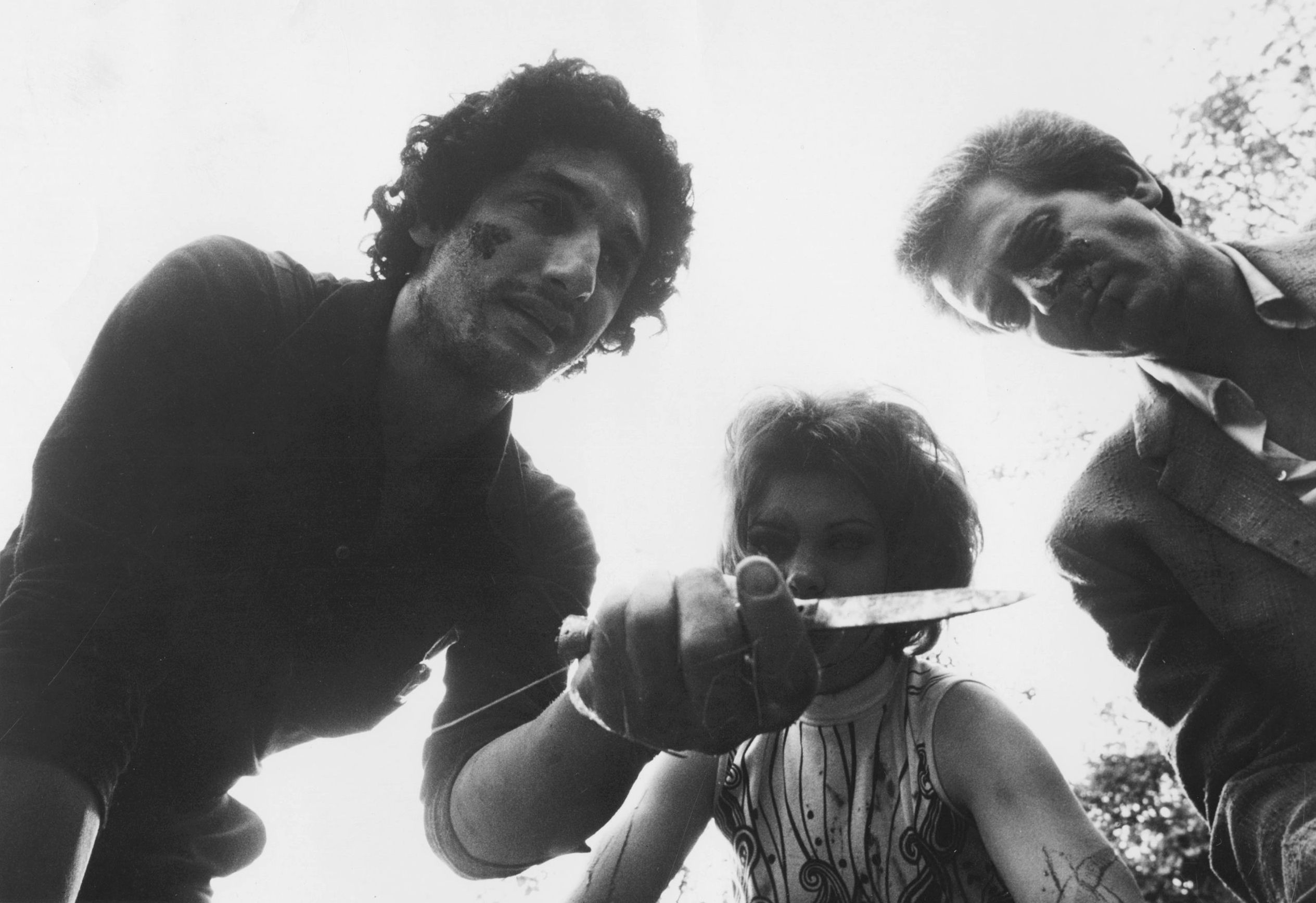
—I wrote about hating children and Wes Craven’s Last House on the Left. Good bye, Wes.

—I wrote about the joys of superheroes fighting superheroes.

—I contributed to an article about how hunger strikers in Chicago are trying to keep open Dyett high school.

At the New Republic I wrote about Miss Piggy and how we don’t think about domestic abuse of men.

At Playboy I interviewed erotic author Selena Kitt.

At Splice Today I wrote about Freddie deBoer and why the purity of one’s beliefs maybe doesn’t matter that much.

At Ravishly I talked about the raid on Rentboy.com, and how it shows anti-prostitution laws are based in prejudice.

At Broadly I wrote about She Shreds’ proposed SXSW panel on representations of women musicians.
 
Other Links

Sarah Nyberg on gamergate’s hate campaign against her. Reposting because said hate campaign has been intensified this week. I know Sarah only slightly, but she is a lovely person, and what is being done to her is evil.

Great piece on the mismanagement of Cooper’s Union (and how college presidents screw everyone else.)

C.T. May on how Ramesh Ponnuru is overconfident about Trump.

Katherine Cross on Ashley Madison and making up women for men.

Voices from the Archive: Crumb, Racism, Satire, and Hyperbole

This is from our R. Crumb and Race Roundtable, in a long back and forth in comments with Jeet Heer and others. I thought it was a good summation of why I don’t think Crumb’s approach to race works, so I thought I’d repost it here.
_______

Jeet, I think I’m going to stop insulting you. It’s fun, but I think there are pretty interesting issues here, and I’d rather focus on those at least for the moment (maybe I’ll get back to the troll-battle if you take another swing at me!)

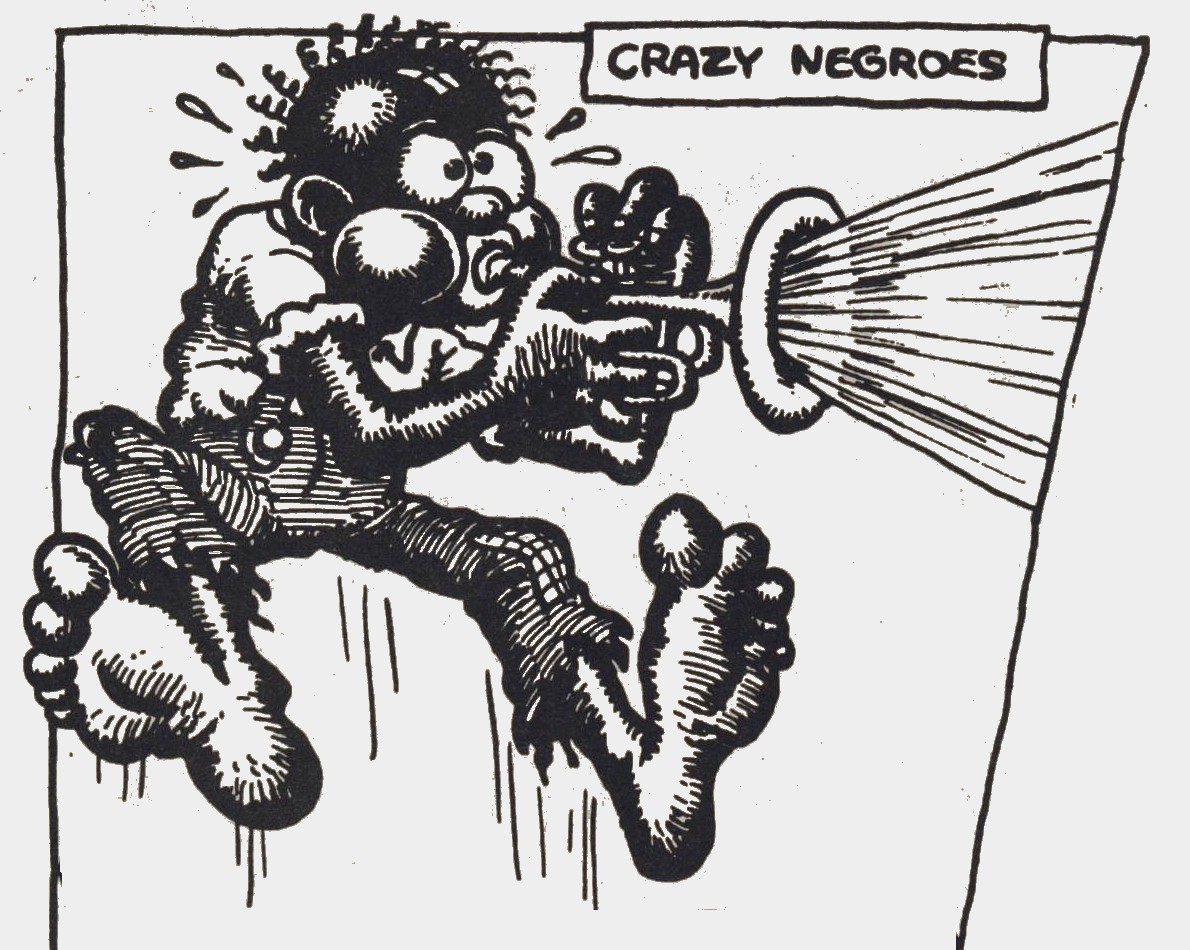
Okay, so first, the Joplin cover. It is possible to see it as a sneer at Joplin. The problem is, it’s equally possible to see it as Domingos says — as a nostalgic use of blackface caricature that is intended not to undermine Joplin, but to humorously confirm her “black” roots. That it’s the second, not the first, is strongly suggested to me by the fact that he uses another blackface caricature elsewhere on the page.

Be that as it may — part of the issue here comes down to this:

“Crumb’s blackface images take a once-pervasive-but-now-taboo style and not only revives it, but intensifies it to the point that it becomes uncomfortable.”

First, it’s worth questioning how taboo blackface caricature was in 60s. Surely it was taboo in some of the circles Crumb moved in. I bet it was not taboo in many communities, however. As Jeet says, overt racism was still widely accepted in many places in the ’60s. I bet there were many people throughout the U.S. who wouldn’t even have blinked at Crumb’s drawing. (And, indeed, I don’t believe that cover caused any particular controversy. It’s widely considered one of the greatest album covers of all time, but I haven’t seen any reports of anger or protests over the imagery at the time — which there should have been if Crumb was actually violating taboos.)

More importantly, it’s worth pointing out that on the Joplin cover, the blackface caricatures are not intensified in any way that I can see. Is Crumb’s drawing more reprehensible than McCay’s Imp? Than Eisner’s Ebony White? It doesn’t seem so to me. In fact, it’s not clear to me that even Angelfood McSpade is more intensely racist than McCay’s mute, animalistic Jungle Imp. I mean, the Imp is really, really, really racist.

And I think that shows up a real problem with Crumb’s method of trying to deal with racist imagery. Racism is not realistic. It’s not something that is grounded at all in any kind of actual fact. As a result, there is no reductio ad absurdum of racist iconography. Racism does not have a point to which you can intensify it and make it ridiculous. Crumb isn’t going to be more intense than the Holocaust. He’s not going to be more intense than generations of slavery. It’s really not clear that he can even be more intense than Winsor McCay’s Imp. Racism and racist imagery— these are not things you can parody just by exaggerating them. They’re extremely exaggerated already, and always eager to be more so. You make it more exaggerated, you just make it more racist. You don’t undercut it.

In that sense, racists who have embraced some of Crumb’s imagery aren’t confused; they’re not stupidly getting it wrong. They’re reacting instead to a failure of his art. Even when his intentions are definitely anti-racist, he hasn’t thought through the issue of racism, or the use of racist iconography, sufficiently for him to communicate those intentions effectively. He isn’t smart about the way racism, or racist imagery works. As a result, he often duplicates the thing that he is (arguably) attempting to critique.

I think it is instructive to look at writers like Faulkner or Crane, or someone like Spike Lee or Aaron McGruder, all of whom confront racism not by intensifying it, but rather by really carefully thinking through how racist tropes work, and demonstrating not only how they diverge from reality, but also how they *affect* and distort reality. There’s a lot of work and thought and genius in dealing effectively with those issues, and I’m not saying I love all those artists all the time, or even that they’re all always anti-racist (Faulkner was avowedly racist at times). But they all seem just a ton more thoughtful, and a ton more committed to understanding how race works, than Crumb does. To me, Crumb (on the most charitable reading) really seems to just hope that throwing unpleasant racial iconography at the wall will somehow be a critique of that iconography.

So, to your historical argument — I don’t think there’s ever been a point in American history where reproducing racist iconography was either especially brave or especially likely to contribute to anti-racism. Crumb’s satire (when it is satire) is neither subtle nor thoughtful…and as a result, his motives and intentions really do come into question. If he’s not willing to think through these issues, why the attraction to the racist iconography in the first place? Does he really want to talk about racism? Or does he just want to reproduce the iconography because he likes it? The way he obsesses over the authenticity of black people in his blues biographies, for example, just makes those questions more pointed. He’s clearly got a fascination with the black culture of the early 20th century — but that can sometimes bleed into a fetishization and even a nostalgia for the oppression of black people.

So…yes, intentions matter. But avowed intentions aren’t the only intentions, and execution matters a lot too. It just seems to me that Crumb’s relationship to racism is a lot more complicated than you’re acknowledging.
 

crumb-header3

Utilitarian Review 8/29/15

Roundtable Question

Toying with the idea of doing a roundtable on women directors. Would anyone be interested in participating in that (or even in reading it?)

Wonder Woman News

Brian Patton reviewed my book for the Journal of Comics and Grahpic Novels (partially paywalled.)

Kent Worcester reviews a number of books about Wonder Woman, including mine.
 
On HU

Featured Archive Post: Katherine Wirick on using OCD to sell make-up.

Robert Stanley Martin with on sale dates for comics in mid-1946.

Jared Hill hopes for the end of the Terminator franchise.

Nix 66 on acting as sex work and sex work as acting.

Me on Tarantino and genre pleasures (or the lack thereof.)

Me on Tarantino’s record on diversity.

Chris Gavaler on his daughter rocketing off from a doomed planet.
Utilitarians Everywhere

At Playboy I wrote about the Sad Puppies and the history of diverse sf.

At Quartz I wrote about

—how soaps are better than quality television.

Owen Wilson’s No Escape and treating Asians as a zombie horde.

At Splice Today I wrote about Bernie Sanders’ fundraising, which isn’t on part with Obama’s in 2007.

At Ravishly I wrote about how Hillary Clinton is not a dynastic candidate.
 
Other Links

Mallory Ortberg on crappy journalism about sex work.

The LA Times review of Ted Rall’s jaywalking story is pretty damning.

Katherine Cross on the Ashley Madison hack and the culture of shaming.

Interesting Playboy interview with Samuel L. Jackson.

Tarantino and Diversity

2007_death_proof_006

Recently I saw someone say on social media that if you’re considering Tarantino’s approach to race, you need to look at all his films, not just Django. To my surprise, though, the writer went on to say that looking at all the films, Tarantino was revealed as a filmmaker who didn’t get diversity, and didn’t care about race.

That doesn’t seem right to me. Tarantino does mishandle race sometimes, and can be racist. But compared to his white peers, he shows a consistent engagement with race, and a consistent commitment to casting actors of color in his films. Sometimes he doesn’t even come off so badly compared to black directors (he arguably has better roles for women of color than Spike Lee.)

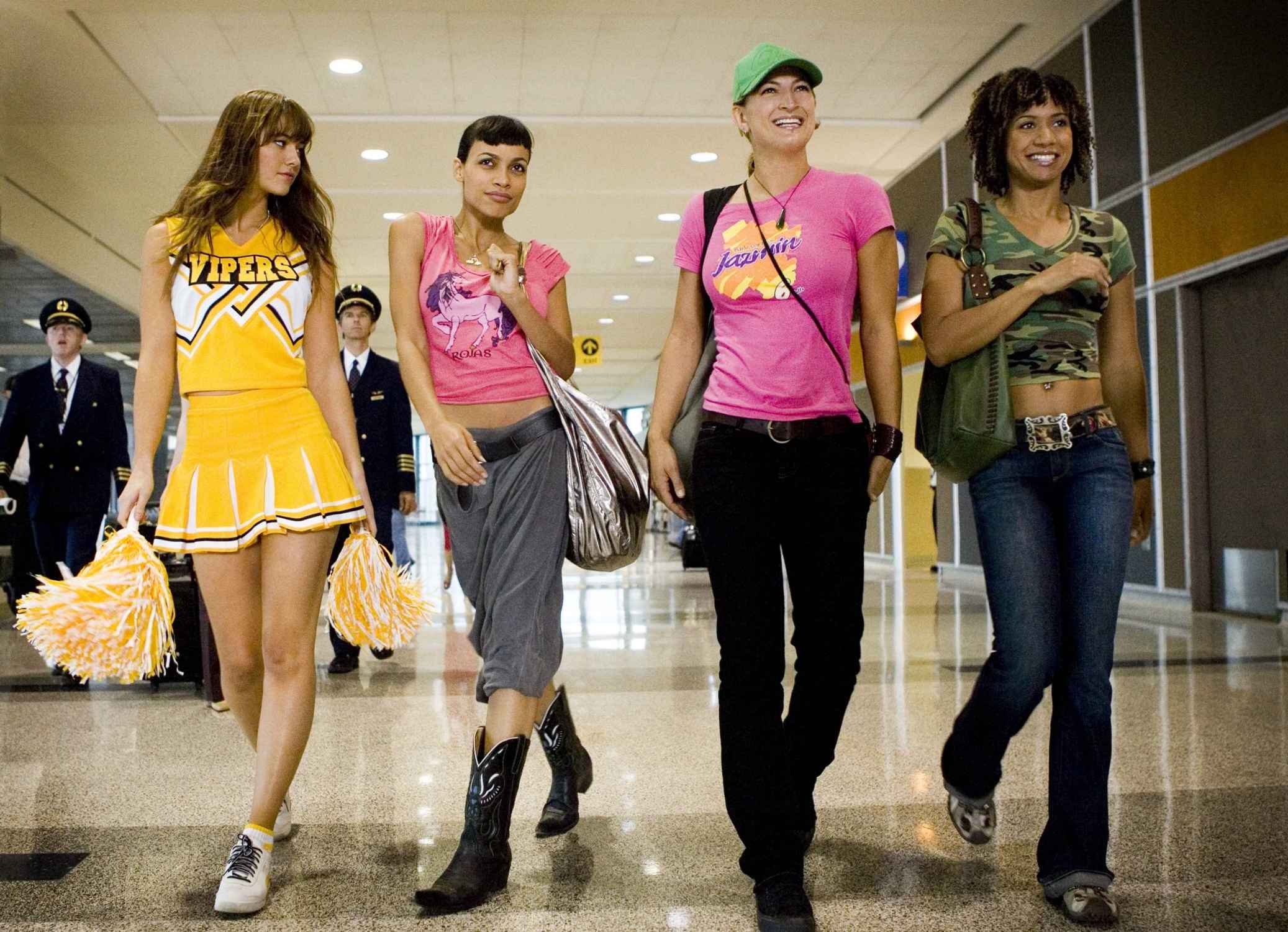
Django Unchained and Jackie Brown are both thoroughly integrated, with numerous black actors in both starring roles and bit parts. Kill Bill 2, and especially Kill Bill 1, use numerous Japanese actors (and some other actors of color as well.) Death Proof has 3 or 4 (depending on how you’re counting) leading roles for women of color, which is practically unheard of in mainstream action films. Pulp Fiction has multiple leading roles — including arguably the lead role—for black actors. Four Rooms has a small cast of five people or so, of whom two are black. Reservoir Dogs and Inglorious Basterds are more like traditional Hollywood films; they both have minor roles for one black actor (though Samuel Jackson sneaks in as a voice over on IB). But still, it’s pretty clear that Django isn’t some sort of tacked on aberration. Much more than contemporaries like the Coen Brothers, or David Lynch, Tarantino has thought about racial diversity, and used diverse actors, throughout his career.

Again, diverse casting isn’t the be all and end all. Reservoir Dogs indulges in a bunch of racist chatter for no real reason except that Tarantino seems to think it’s cool (he is wrong.) Steven in Django is (I think) a racist caricature. Making a slavery revenge narrative is arguably a bad idea. And so forth. And of course, Tarantino is a white guy; when he sits in the director’s chair, he does nothing to advance the most consequential kind of diversity in Hollywood. Still, if Hollywood in general could get to a Tarantino level of diversity, that would be a big step forward in terms of representation. And a lot more actors of color would get paid.

Basterd Pleasures

Iy3bx

 
Quentin Tarantino implicates the viewer in onscreen violence, while also delivering standard genre pleasures. You laugh as people are shot, and you also laugh as people are shot. The audience feels superior to the rush of violence, while participating in it.

This seems like a standard criticism of Tarantino; I’ve had people make it in discussions with me several times this week. But, I have to say, it doesn’t make a lot of sense. Tarantino is very interested in genre pleasures, obviously, and sometimes he delivers on them. But just as often he interrupts them, or refuses to follow through. He really isn’t Paul Verhoeven, who will show you Sharon Stone’s crotch while sneering at you for looking at Sharon Stone’s crotch. Tarantino is almost always doing something more complicated.

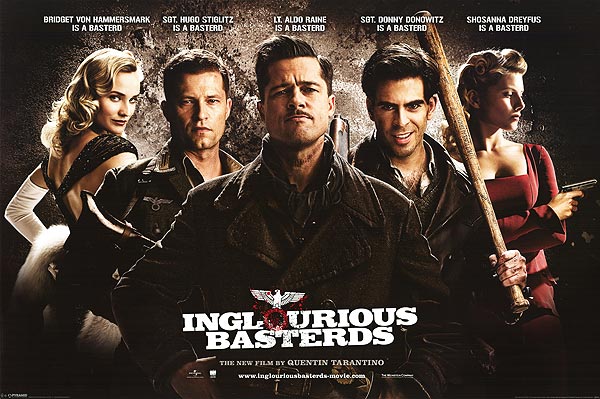
I could use any Tarantino film as an example, I think, but since I just saw Inglorious Basterds, we’ll go with that. This is a war film, obviously. When Verhoeven shot a war film, Starship Troopers, he hit all the marks of the war film — battles, crusty sergeants, bravery, visceral victory— while suggesting off to the side that the humans were in fact that evil bad guys killing the aliens. You get your critique of genre pleasures, but you also get genre pleasures. That’s the Verhoeven way.

It’s not the Tarantino way, though. There aren’t any pitched battles at all in Inglorious Basterds. Nor as a result are there standard moments of bravery in battle—unless you count the Nazi war hero Zoller’s filmed recreation of his own fight killing the good guys. There are certainly brave people in the film on the Allied side; one of them gets ignominiously choked to death; another gets shot because he can’t do a German accent right; a third dies before she can see her revenge enacted; several others show their bravery by killing a roomful of unarmed civilians. The person who saves the world and ends the war is a Nazi traitor motivated purely by greed and self-interest. The big name star, Brad Pitt, does basically nothing throughout the film except speak in a ridiculous Appalachian accent and torture people.

Other Tarantino films make a few more concessions to genre; Kill Bill 1, especially. But Tarantino is always taking genre apart in ways that render it nonfunctional. The big final shoot out in Pulp Fiction never happens; you never see the heist in Reservoir Dogs; the hero refuses to ride off into the sunset with the heroine in Jackie Brown. Kill Bill 2 ends with an hour of nattering talk. Which I think is kind of a crappy, boring conclusion. But a big part of the way it’s crappy and boring is that it doesn’t fulfill genre conventions.

And I suspect that that’s why other people react to Tarantino with such visceral dislike, when they do react to him with visceral dislike. His relationship to genre is frustrating. He uses genre markers, and sets up situations where you expect genre pleasures, but then he refuses to follow through. You could argue that that makes him too clever by half. But I don’t think you can really argue that, in Inglorious Basterds, he’s giving the audience what they want (unless, of course, what they want is to be frustrated.)