“For as writing gains in breadth what it loses in depth, the conventional distinctions between author and public…begins…to disappear. For the reader is at all times ready to become a writer, that is, a describer, but also a prescriber. As an expert — even if not on a subject, but only on the post he occupies — he gains access to authorship…. It is in the theater of the unbridled debasement of the word…that its salvation is being prepared.”
Reading that quote above, you could almost think it was yet another over-carbonated paean to the wonders of the internet — some pseudo-academic talking-head ranting on about how blogs are going to bring about the egalitarian millennium. Everyone’s an expert, everyone’s an author, everyone’s got the keys to the kingdom and, hey look, they’re all running through the pearly gates with words dribbling from their gums and bytes blasting from their backsides.
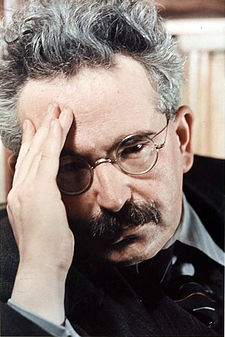
And yep, that’s precisely what the quote is about. It’s just that the vision of a thousand points of blather is a little hoarier than you might expect. Specifically, the above was written by none other than Walter Benjamin all the way back in 1934. The essay was called “The Author as Producer,” and here’s what it looked like originally:
“For as writing gains in breadth what it loses in depth, the conventional distinctions between author and public, which is upheld by the bourgeois press, begins in the Soviet press to disappear. For the reader is at all times ready to become a writer, that is, a describer, but also a prescriber. As an expert — even if not on a subject, but only on the post he occupies — he gains access to authorship…. It is in the theater of the unbridled debasement of the word — the newspaper —that its salvation is being prepared.”
Yes, Virginia, 80 years ago Benjamin was touting the newspaper — or at least the Stalinist newspaper — as a truly democratic voice. Newspapers were the bright new genre that would allow the people to take an active role in their culture and cease to be the stoned recipient drones of capitalist trash. The press (or “at any rate” as Benjamin says “the Soviet Russian press”) is changing everything; it “revises the distinction between author and reader.” The means of production are now in the hands of all, and the revolution is sure to follow.
One wonders what the Frankfurt School would have thought of the new day that has now dawned. If Benjamin’s beloved Brecht encouraged audiences to think critically about the artist’s work, surely blogs, twitter, and comments threads encourage the audience to come up on stage, beat the actors bloody and shit on their remains while screaming racial epithets sprinkled with smiley icons. If Benjamin truly believed, as he claimed, that the best art, the most valuable art, the art with the highest “technical quality” was that art which succeeded in “promoting the socialization of the intellectual means of production” — well, you’d think he must be right now leaping from his grave in joy and wonder, scurrying over to the nearest internet café, and greedily scrolling through the latest 4chan flame war , all the while muttering to himself, “Lolz! Lolz! The revolution will be Rickrolled!”
The idea that the people will save culture has an almost irresistible fascination for leftists. On the one hand, you have Frankfurt school dyspeptics who think corporate crap has blinded us all. On the other, you’ve got cultural studies pollyanna’s claiming that fans of Ameircan Idol creatively repurpose the show as a site of resistance to hegemony. But whether sad or cheery the dream is the same: some day the masses will rise up and write better novels their own damn selves.
Now the people are here, though, and…well, it’s a mixed bag. Certainly, lots and lots of folks who could never have gotten their voices out before are able to do so now. The result could not exactly be characterized as an increase in art’s “technical quality,” though, nor as a socialist utopia. Capitalist desires have not been shucked; instead, they’ve metastasized. Given the means of production, as it turns out, people mostly want to scream fire in a crowded messageboard, talk about their furry fetishes, or check the weather.
The point isn’t that the people are innately frivolous or deluded — in fact, there’s tons of political discussion online, and the Iranian uprising showed quite clearly that access to communications technology can have potentially liberating effects. But hedge as you will, the democratization of the literati cannot be said to have created a world in which socialism is ascendant, or in which there is an overwhelming majority of speech exhibiting what Benjamin refers to as the “correct political tendency.” It’s almost as if the rallying cry “every man a genius!” is as much a call to debased polymorphous revels as to fraternal salvation. Benjamin himself, from that perspective, starts to look decidedly libidinal, sensuously spitting his half-baked theories through his mustache and out into the ether, a troll in love with trolling long before his time.
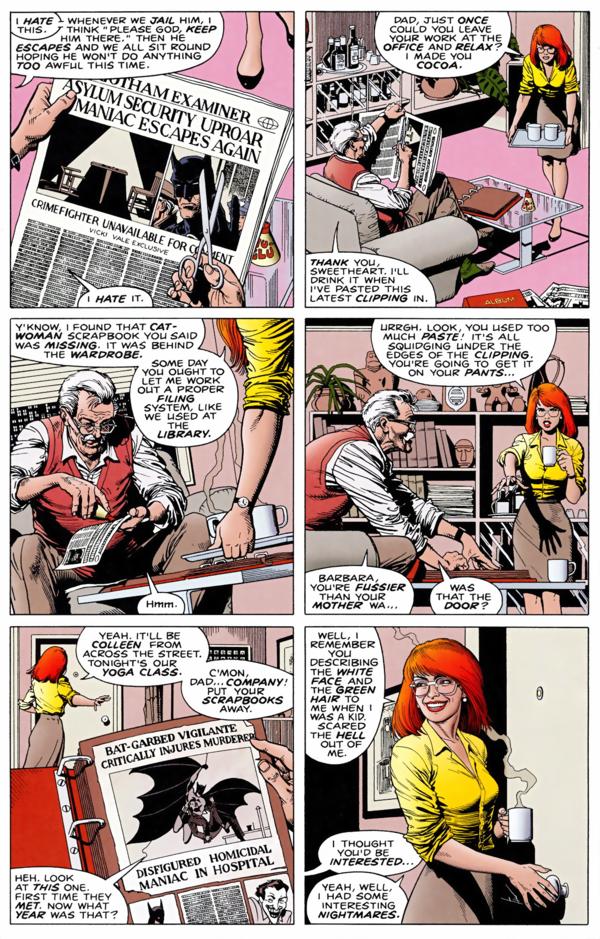
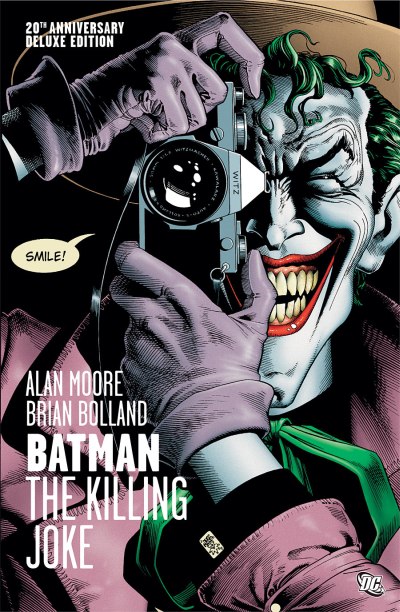
Prompted by Osvaldo Oyola’s essay earlier this week, I moved about six boxes of clothes and a paper cutter out of the closet in order to get at my comics collection and reread Alan Moore and Brian Bolland’s The Killing Joke.
And no, it wasn’t really worth it. The comic was a disappointment when I first read it upon its release in 1988, and 25 years later it continues to underwhelm. The Joker’s sad sack origin hasn’t gotten any less pro forma melodrama with the passage of time, while the visual rhymes and formal density that served Moore so well in Watchmen here simply inflate a standard genre exercise in good guy/bad guy pulp doppelganger Manicheanism with gratuitous pomposity, robbing it of charm without adding any weight. The sexualized crippling/rape of Barbara Gordon is, as Osvaldo says, a low point, but it’s also of a piece. Extra violence, extra sex, extra unpleasantness, extra formal trickery and the odd leaden bit of wordplay; it’s all there to desperately claim significance via special pleading, rather than by actually writing a thoughtful story. Bang, Pow, Batgirl shot through the spine, comics not just, etc.
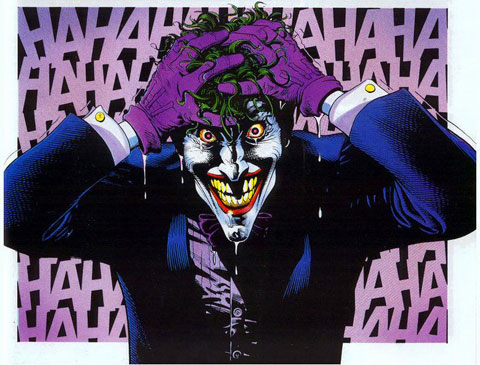
There was one pleasant surprise, though; Brian Bolland’s art. I’d always thought of him and Watchmen artist Dave Gibbons as more or less interchangeable, but in fact Bolland’s work is a lot more fun to look at. His faces have a nice plasticity and solidity; a realism shading into cartoonish grotesque which fits the Joker nicely — and suggests the throwaway EC comics horror dreck hiding beneath Moore’s high-falutin’ script. In some sense, it makes you wonder whether the problem with The Killing Joke is that Bolland is too good, his enthusiastic mastery pulling Moore by the collar into a farrago of pulp, just like those grossly offensive dwarves pull Gordon onto the train to view a cornucopia of sadistic incest torture porn. Much of Moore’s career has been a sometimes winning, sometimes losing struggle with genre, and in this case genre appears to have teamed up with Bolland to strip him naked and kick his sorry ass. Then he rose up with his hands on his head, giggling maniacally and burbling about how cool it would be to have Boland draw circus freaks and sexual assault — all for profound philosophical reasons, of course.
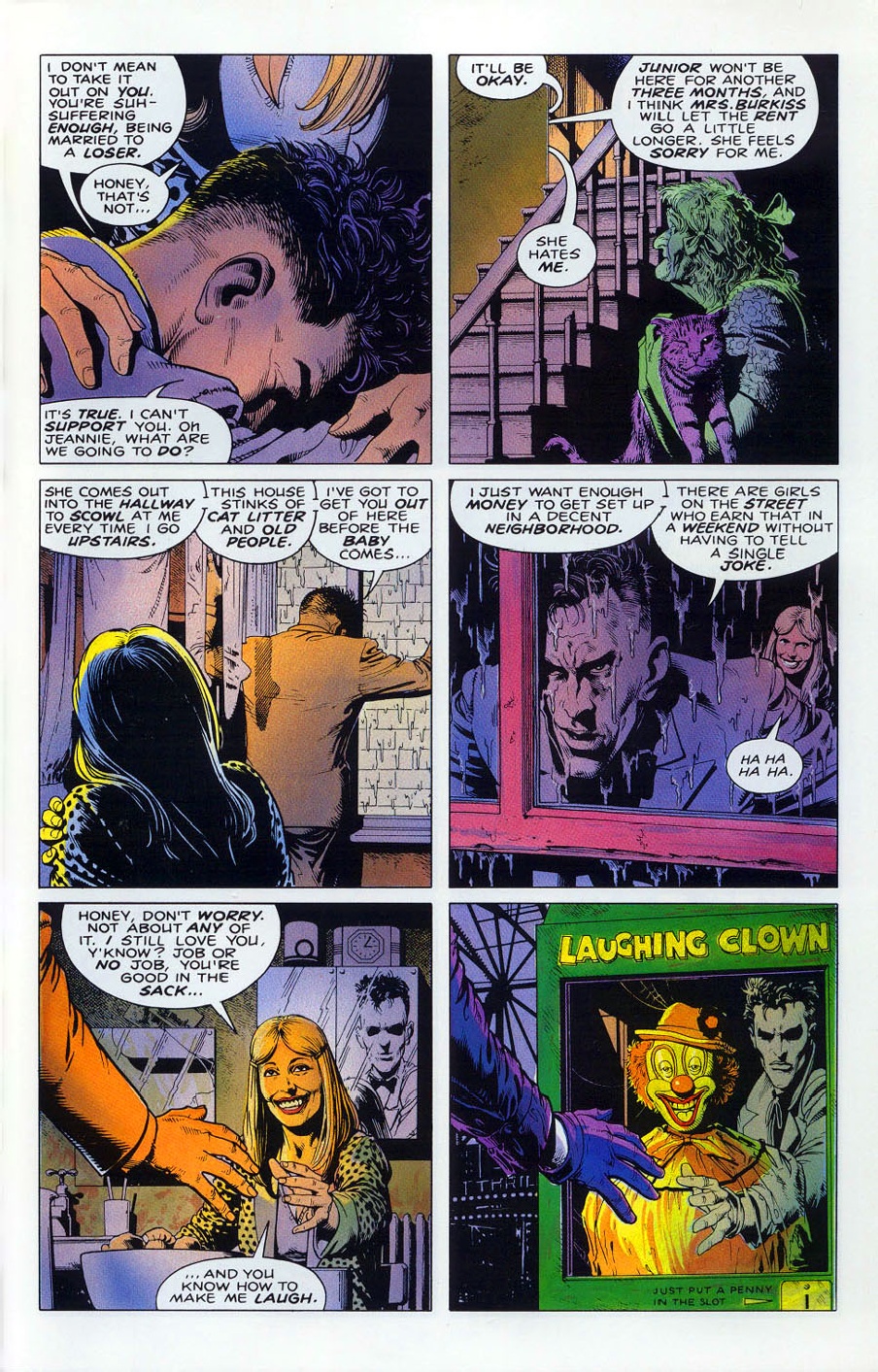
Be that as it may, Boland adds significantly to the weirdest, most disturbing moment of the comic.
That’s the Joker in his sad sack pre-Joker days, talking to his pregnant wife about how he’s once again failed to get a gig as a comedian. He makes some bitter, crude remark about how girls on the street can make more money than him — and his loving, long-suffering, nurturing wife cracks up. She finds bitter allusions to prostitutes funny, and tells him he’s good in the sack as she reaches for him with a bizarrely exaggerated clown grin.
On the one hand, the grin is there to supply the transition to the laughing clown in the next panel. But it also makes the wife the ur-Joker — the one who finds (her husband’s) suffering and (female) degradation funny, and the one with the demon’s grin. Boland really sells that too; I didn’t remember the dialogue here at all, but that feral, toothy, malevolent smile stayed with me across the decades. Pre-Joker’s hollow, confused look in the mirror is also perfect — he doesn’t look like a man being comforted by his wife. He looks like the terrified victim who suddenly realizes the evil spirit has possessed his love one, and is about to devour him. Osvaldo notes Joker’s queerness — I think that queerness is here presented, specifically, as transvestism. The Joker is taking the place of his wife, or his wife (who we later learn dies in a freak accident) is possessing him.
That sequence seems like a tell; a quick conflation of sex, femininity and terror which suggests that the assault on Barbara Gordon isn’t an accidental, unnecessary indiscretion, but rather a condensation of the book’s central obsessions. In the panel before she’s shot, Barbara too wears that weird Joker grin, her hand extended as Joker’s wife’s hand was extended, the coffee-cup echoing the pencil cup in the other image. Thus Joker is both his wife and the murderer of his wife; the sexualized, uncanny woman brings upon herself vengeance for her wrongness. As in Junji Ito’s Tomie stories, the female ensorcels men, and what she ensorcels them to do is murder her.
Ito’s stories present his horror and lust — or his horror of lust, or his lust for horror — without apology. Not so Moore, who wants us to believe that he didn’t really want to show us those pictures of Barbara Gordon, or that he doesn’t really enjoy all those gruesome rictus grins on the corpses, or that he didn’t really want to off the Joker’s wife. Moore’s rooting for sanity and Gordon and Batman and reconciliation and rehabilitation along with the rest of us, right? The real killing joke, maybe, is that it doesn’t matter whether Batman kills the Joker, or Batman kisses the Joker. The structure and the end aren’t important. Instead, what matters here are those women grinning and asking for sex and death, the genre pleasures that make us smile.
Isaac Butler from a recent comments thread drops some science on perceptions of race:
Basically, our brains have evolved to do an enormous amount of automatic processing of and reacting to simuli and life experience. They do this through a few different processes, but they mainly involve creating cateogories, associations between these categories and what get are called “schema,” which are essentially stories our brain tells itself without our conscious knowledge.
The associations and stories we have often involve categories of people, which we call stereotyping (it doesn’t have a negative connotation in psych circles). A lot of stereotyping is harmless. How do you know without having to think about it that a large, bald, fat human that’s crying probably doesn’t need a diaper change but a tiny, bald, fat human does? How do you know that a black rectangle that rings is a phone and not a wallet? it’s all these kinds of processes.
Anyway, not all of our associations are harmless or value neutral, often they involve preferences (when they’re positive) or biases (when they’re negative) about people in certain groups. Simply put, we have a story about them in our heads that we do not realize we have.
This whole phenomenon, one where our decision making and POV is affected by prejudices ovcuring at the unconscious level, is called Implicit BIas. It’s not limited to race and it’s not limited to the United States. It is, in fact, part of the human condition. It also isn’t a moral failing. The majority of white people in this country consciously hold egalitarian values. This is why explicit measures of bias and prejudice basically have no predicative value as to what people will actually do.
Implicit measures, on the other hand, do tend to predict behavior in experimental settings. The most famous of these is the IAT, which you can actually take yourself at projectimplicit.net. The IAT tests categorical associations through reaction times.
Anyway, this is long-winded, but there’s decades now of scientific evidence as to the validity of implicit bias, its predicative power, etc. and so forth. There is also considerable evidence that believing oneself to be objective actually causes people to act with more rather than less bias. There is some evidence that being aware of implicit bias, coupled with context-specific interventions, can help safeguard our decision making processes from implicit bias’s effects.
This is why color-blindness is such a pernitious idea. It’s actually the opposite of what we need. It’s the delusion that we’re objective. And what the Right does is talk about color-blindness through one side of its mouth while stoking White racial anxiety with the other. So they take race off the table as a valid topic for discussion (“playing the race card”) while also talking about it in ways guaranteed to panic Whites. For an example of this, look at Fox’s coverage of the Zimmerman verdict.
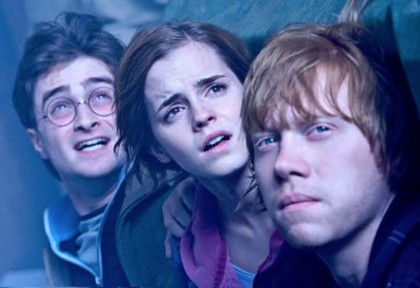
I was supposed to go see the last Harry Potter movie with my utterly obsessed seven-year-old son. We got into the car to drive to the theater with our son gibbering on about Quidditch and Hogwarts and Voldemart, and then I pressed the power button on the Prius… and pfft. Nothing. The battery was dead.
Which is fairly typical of my entire experience with the Harry Potter franchise. Lots and lots of build-up followed by a big fat zilch. I don’t hate the Harry Potter books. I read the first four of them, and watched the first movie. My son’s obsession with them has moved rapidly from amusing to annoying to thoroughly oppressive, but still, it’s better than Thomas the Tank Engine or superheroes. The Potter books are at least marginally readable… especially since my son has learned to read himself and is going through them on his own.
Nevertheless, what bugs me about the series is that it should be better than just tolerable, and not just because the whole world is apeshit over it. The first book opens with a horrid family right out of Roald Dahl, and I quite like that lovely scene with the owls dropping drifts of letters addressed to our hero. The idea of a wizarding school seems pretty solid. And there are lots of excellent British children’s books series. If the How To Train Your Dragon books can be consistently top-notch, why not Harry Potter?
And the answer is: Quidditch. The notion of wizard-soccer on broomsticks is pretty clever, and I can certainly see the appeal for kids—who doesn’t want to fly? But the actual game is incredibly stupid. Most of Quidditch is devoted to goal scoring, but a huge bushel of points are awarded not for scoring goals, but for catching a special ball called the Snitch. Whoever catches the Snitch also ends the game—all of which means that, for most intents and purposes, the vast majority of the action taking place on (or above) the Quidditch field is pointless.
You can see why J.K. Rowling designed Quidditch as she did; the rules make the Seeker, who goes after the Snitch, by far the most important player on the field. Since Harry turns out to be a supremely gifted Seeker, all the matches end up being about Harry’s wonderfulness. This, observation of my son has informed me, has a huge appeal to the core under-nine audience. But for anyone else, Quidditch as repetitive occasion for transparent hagiography gets very old very quickly.
This is nit-picking to some extent. But it’s also emblematic. There are a lot of things like Quidditch in Harry Potter; places where Rowling failed to fit the pieces together right and the result is the irritating sound of audible grinding. A friend of mine pointed out that the thing that gets him is that Harry, when we first meet him, should be a volatile, unstable wreck. He was systematically emotionally abused by his foster parents, the Dursleys, throughout his childhood, and while nurture isn’t everything, it’s something. Kids treated that way have real problems; they don’t just shake it off in a few pages and become do-gooding everyboys with loads of inner resources.
The problem isn’t the scenario per se. As mentioned above, if the same story was told by Roald Dahl, you wouldn’t think about it for a second, any more than you ask questions about the actual logistics of building Mr. Wonka’s chocolate emporium. Instead, the difficulty is Rowling’s tonal control—or the lack thereof. Harry Potter comes out of the Lewis Carroll/E. Nesbit/Dahlian tradition of British nonsense, with its fantastical illogical goofiness. But Rowling also wants to create an epic battle between good and evil indebted to Lord of the Rings.
The result is a lurching hodgepodge; a magical world that isn’t internally or externally consistent, but is too concerned with it’s own inner-workings to ever really take flight into whimsy. The first book gets at some of the rush of wonder in classic fantasy… but as the kids learn more, magic is rapidly domesticated, turned into a series of recipes. You’re left with endless piles of prose explicating labyrinthine rules, most of which don’t even have the geeky satisfaction of making sense.
I know lots of folks say that the last movie is pretty good, and that the series in general becomes darker and more effective as it goes on. Maybe so, and maybe my car will work well enough to go see it. I’ve had enough exposure to the series, though, to feel fairly confident that wherever Harry Potter goes, he will go there with a pfft.
If you talk about white people, you’re not talking about race. If you talk about black people, you are. This is arguably the essence of racism; black people are an aberration or a disturbance; white people are natural. Therefore, to end racism, artists should treat black and white individuals exactly the same. If art doesn’t see color, then the art isn’t racist. QED.
This is the logic that Lamar one of the co-creators of the Pixies’ video “Bagboy,” used when he defended his decision to present a narrative in which a white kid gleefully and giddily trashes a house which, at the video’s conclusion, turns out to belong to a black woman who he has trussed up in her own bedroom.
We knew we were taking some risks when we made the video. When most people see a white kid (Nik’s little brother) and a black woman (my older sister) they can’t help but think “racist” and “misogynist”. This is pretty sad.
From the beginning, when we originally thought of the concept, it was never our intention to make it about a white kid terrorizing a helpless black family. I, myself, being black have gotten to the point where I don’t automatically see color in people. It’s the same for Nik. If the character’s races were switched you’d probably have the same amount of stuff to say about the video.
It’s 2013, at what point do we stop seeing everything as racist. At what point do we stop making things a bigger deal than they are.
The problem here, as Bert Stabler points out, is that claiming color-blindness doesn’t make the rest of the world color-blind. Declaring racism over doesn’t make it so, and there isn’t really any way to show a white kid terrorizing a back woman’s home without referencing the way that white people really have, in the recent past, conducted vicious campaigns of terror against black people for daring to move into middle class homes. The video doesn’t come off as color-blind; it comes off as thoughtless, or (as Bert suggests) as cynically courting controversy. Not seeing race now can’t erase a history of racism, especially when not seeing race seems to just result in you unthinkingly mimicking that history.
Danity Kane’s Ride For You does a much better job of suggesting that race doesn’t matter, though not exactly by ignoring race.
Towards the end of the video, the five female members of the interracial group pair up with various hot guys. Those pairings are integrated; there’s a black guy/white girl couple; a white guy/black girl couple, a back guy/black girl couple, and two white guy/white girl couples. This almost surely has to be a deliberate choice; Danity Kane is not a spontaneous punk rock kind of group,and everything else on the shoot, from the multiple costume changes to the round robin vocals, certainly seems focus-grouped within an inch of its life. Someone during the making of that video decided that they wanted to present a color blind world. But to do that, they had to admit (to themselves, and I think to the audience as well) that they could tell which of their singers (and which portion of their studly male window-dressing) were black, and which were white.
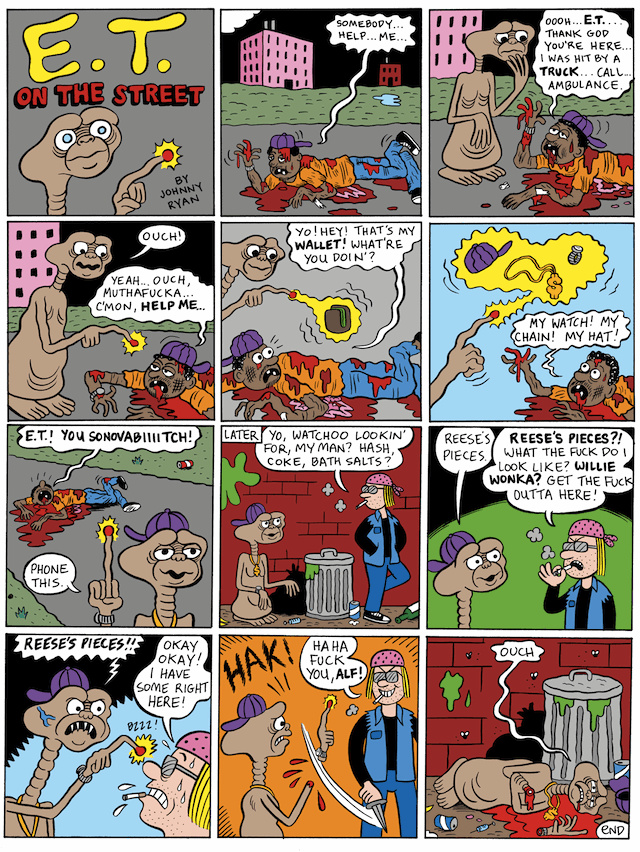
Johnny Ryan’s “E.T. on the Street” also is also quietly but deliberately conscious of race in the interest of avoiding stereotypes, though the success is more mixed.
Laurel Lynn Leake dismisses this, arguing “That whole ET comic is just “what if ET was a bl- I mean, urban man! He would be a total greedy sociopathic asshole, amirite?!” And there’s certainly something to that argument. At the same time, though, you can see Ryan (usually thought of as eager to offend everyone) trying quite consciously to avoid offense. The black guy at the beginning of the comic isn’t a gangsta, and he hasn’t been shot — he’s been hit by a car, and E.T. robs him, not the other way around. Along the same lines, the violent thug at the end is white, not black. And, for that matter, E.T.’s race is unclear. Is he supposed to be black? Or is he supposed to be a tourist in a black neighborhood — ignoring the misery there, and then pretending (with that backwards baseball cap) to be one of the folks he’s just callously robbed? Is the joke that E.T. is a black man and is therefore an asshole? Or is the joke that he’s a white guy pretending to be black, and is therefore an asshole?
The strip is conscious enough of race to make that reading plausible, and, I think, even probable. But it’s not conscious enough to exactly make that reading the point, nor to do anything with it. The end could perhaps suggest something like Crane’s suggestion in the Blue Hotel that believing in stereotypical narratives can make those narratives close around you and destroy you. But E.T.’s motivations are too much of a cipher, and his fate too random, to really sustain that. If the first part of the strip seems to be willing to think about and talk about race, the second just shrugs, abandoning the theme of racial tourism for standard-issue tropes of ghetto violence, sanitized by making the perpetrator a white guy. It’s significantly more careful about racial issues than that Bagboy video. But since it doesn’t seem to want to follow through on them, you do end up feeling, as with the Lamar and Nik effort, that race is here evoked mostly for the sake of controversy.
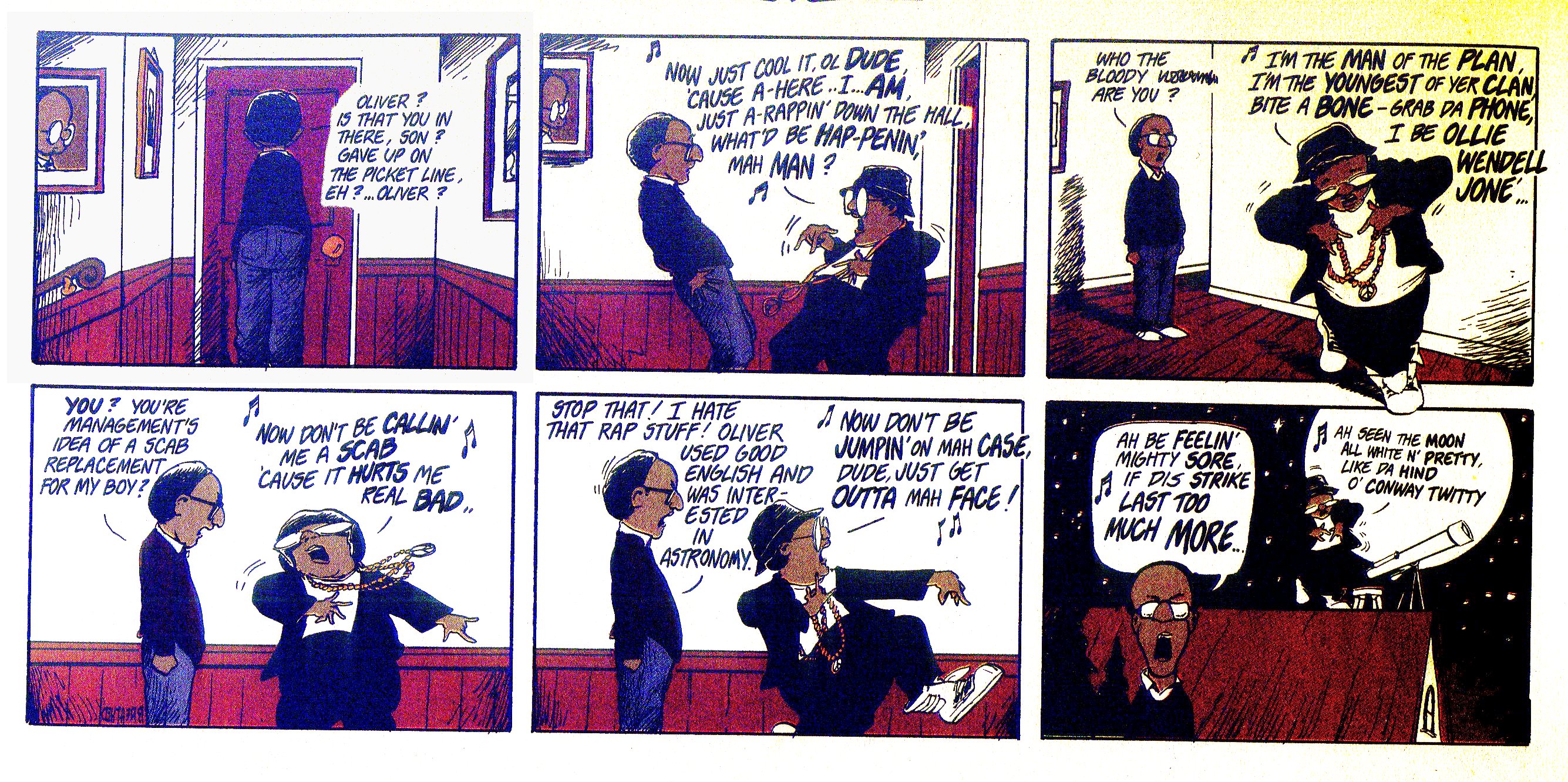
And then there’s this. (Apologies for the crappy scan.)
As with most of Berke Breathed’s Bloom County strips, this one is embedded in a lengthy and preposterous narrative. In this case, the Bloom County characters have all gone on strike to protest the shrinking space available for comics; management has hired scab replacements. Oliver Wendell Jones, the strip’s resident child-genius who also happens to be black (and whose picture you can see off to the side in the first panel), has been replaced by a ludicrous rap stereotype.
Part of the reason this strip works better than the other examples here is a function of time. Breathed isn’t working with a 3 minute video or with an isolated gag strip. Bloom County is a daily, and we know Oliver Wendell Jones like a friend. We know him so well, in fact, that he isn’t just a racial marker, as black people too often are in pop culture. Rather, Oliver is a particular person, who, like his dad says, speaks good English and loves astronomy and occasionally crashes the world’s computer networks. Breathed has put in the time to ensure that Jones is not a caricature, and as a result the reader can fully appreciate the travesty of having him replaced by one.
So in part the strip deals effectively with race because it worked to erase race. But that work, obviously, involved seeing race in the first place; making your black character a computer genius is a decision that has meaning. And the joke in this strip, too, requires seeing race, and acknowledging the way it turns individuals into the tropes we expect to see. Even Oliver’s dad, at the en, succumbs, and breaks out into rap, complete with bad grammar. In the meantime, his “son” is up on the roof, looking at the stars, and declaring
Ah seen the moon
All white n’ pretty
Like da hind
O’ Conway Twitty.
I don’t think it’s an accident that a strip about ridiculous totemic blackness ends with a ridiculous invocation of totemic whiteness. The round fat moon hoves into the panel, made visible by both telescope and verse, reminding us, perhaps, that if we must see blackness, the least we can do is remember to see whiteness as well.