What about Amanda Waller?


Arrow

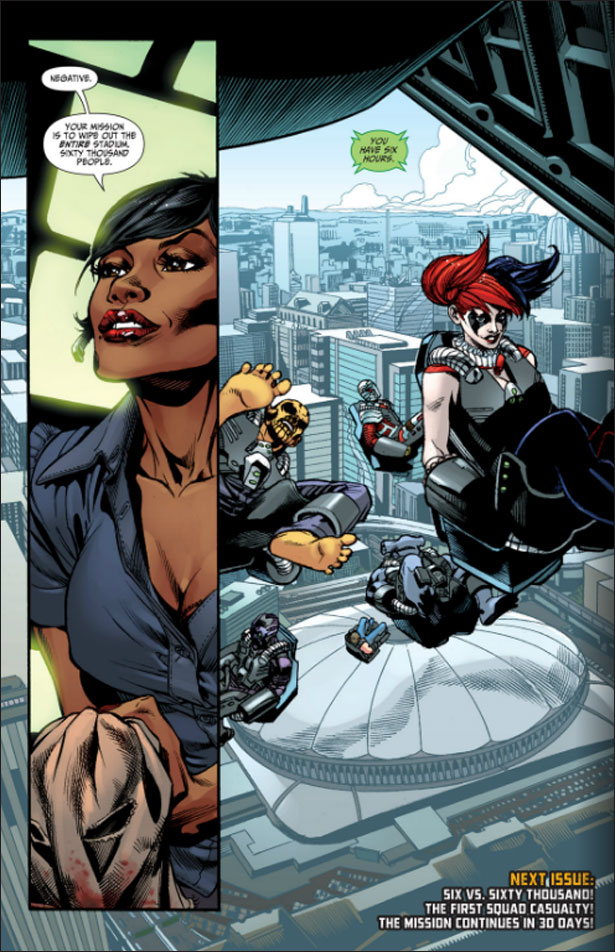
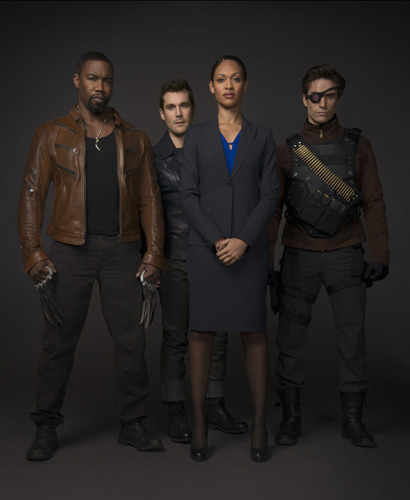
Figure 1:Suicide Squad from the CW’s Arrow

The superhero has emerged as the trending symbol of our mediated world.  Musings over Marvel’s and DC Comics’ relative successes adapting characters to the big and small screen opens the door to some interesting moments of cultural contemplation.  As Peter Coogan suggests in a recent essay entitled, “The Hero Defines the Genre, the Genre Define the Hero,” the link between the superhero and the genre are not incidental.[1] The selfless nature of the superhero and its genre reflect pro-social values Americans feared threaten by a rising urban industrial order.  Changing the superhero then, echoes wider fears of disruption stemming from the loss of tradition. In this framework, the superhero becomes a measure of communal stability in some minds.  As the superhero evolves enough to maintain its relevance, these characters offer context for cherished values placed in a modern world. As these characters are recreated for film and television audiences, they provide a window on the pace and scope of our collective evolution.

Over the last two seasons, the CW’s Arrow has emerged as an effective vehicle for adapting DC Comics characters to a broad audience. Like the Marvel Cinematic Universe before it, the creative minds behind Arrow built their world by mixing decades of comic book adventure. Free to pick and choose, they adapted with an eye toward creating easy entry for new consumers and maintaining the loyalty of established fans. The recent appearance of Amanda “The Wall” Waller, on Arrow highlights the fact the current comic book culture is filled with questions linked to identity and gender. In deciding to adapt this character, the producers have entered into that dialogue.  Taking their cue from the 2011 reboot called the New 52, Arrow’s Amanda Waller is a marker of larger identity concerns.

suicide-squad1

Figure 2: Suicide Squad #1 (2011)

The New 52 restarted DC comic publications from the beginning. Complaints about this reboot have focused on missed opportunities.  Critics point to uneven characterization, failed opportunity linked to diversity and the reorientation towards new (hopefully younger) readers by abandoning continuity.  These complaints are understandable, but perhaps unfair.  In 1985, the company revamped the publication line with its Crisis on Infinite Earths mini series. Often lauded by fans, it was greeted with complaints as well.  History has proven that story a milestone.  With this in mind, we may see “The New 52” lauded for the push toward genre variety and the integration of formerly sacrosanct characters from Vertigo, the publisher’s mature reader line, back into the mainstream comic universe.  Whatever history’s judgment, the immediate media spotlight has and will likely continue to question the depiction of female characters.

Concerns about gender and representation in comics are not new.  However, in the context of the 2011 reboot, the re-imagined overtly sexualized look and actions of female characters such as Starfire and Catwoman triggered protest. Adding to these concerns, products, drawn from comic book source material, reflect a dynamic of gender objectification long cited by critics. In particular, the outcry over the failure to produce a Wonder Woman film and criticism about Rocksteady Studios’ depiction of Harley Quinn and Catwoman in its Arkham game franchise has troubled fans.[2]

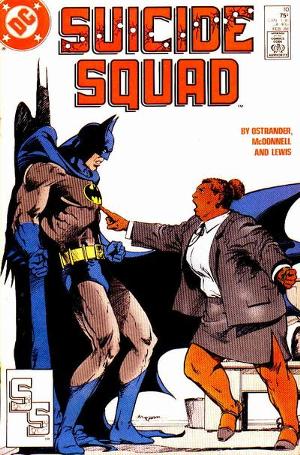
Arguably the transformation of Amanda Waller is a crucial part of this dialogue.  Introduced in 1986, the comic book Amanda Waller is an African-American middle-aged woman with a heavy build working as a government bureaucrat.  She is a unique example of a black female authority figure in mainstream superhero comics.  Her serious demeanor and steely determination managing a government-sanctioned task force called the Suicide Squad made her a fan favorite. Effective and dedicated, Waller commands the respect of villains and heroes alike. Animated television and film appearances have further embellished Waller’s status among fandom.
 

Suicide_Squad_Vol_1_10

Figure 3: Suicide Squad Vol. 1. #10 (1988)

In revamping the publication line, DC editors made decisions designed to make character more accessible to a broader (less expert) reading public. Clark Kent/Superman is no longer married to Lois Lane (quasi-damsel in distress). Instead, he is dating Wonder Woman/Diana Prince, creating the ultimate “power” couple (Couldn’t help myself).  Abandoning the Superman /Lois Lane relationship highlighted an edict that marriage is prohibited in this new status quo.  This stance was perhaps made more frustrating because it was only fully articulated in the midst of a public furor over the editor’s decision to derail the same-sex marriage of Batwoman (Kathy Kane), the publisher’s most prominent lesbian character.  The tumult surrounding that decision and the continued concern over female character placement and representation prompts me to ask, “What about Amanda Waller?”

Waller transition in the New 52 has received comparably minor protest. Arguably, while heroes and villains deserve the main scrutiny on a comic page, Waller’s transformation has a greater impact because of her unique status as a woman of color in a position of authority. The lack of concern about Amanda Waller’s presentation highlights gender and race intersectionality.[3]  Articulated by black feminist intellectuals such as Frances M. Beal and Alice Walker, the interlocking nature of gender and racial bias creates overlapping barriers linked to race and sexism for women of color.[4]

Arguably, Amanda Waller has been affected by gender and racial expectations since her introduction.  The original characterization could be seen as leveraging the nineteenth century mammy stereotype to great effect.  Waller was a sexless maternal figure who valued her superior’s goals, but showed disdain for the team that acted as her quasi-family. Unconscious and unspoken, Waller’s placement as a “strong” and “principled” bureaucrat loyally working for the government confirmed some assumptions. Yet, with depictions of African-American women in the 1970s caught between a normalizing figure such as Diahann Carroll’s single mother professional in Julia (1968-1973) and Blaxploitation inspired icons such as Pam Grier’s tough vigilante Coffey (1973) Waller’s debut in the 1980s struck a more balanced note in a social and political landscape shaped by warring conservative and liberal views of African-American life and culture.

Neither objectified nor objectionable, there has been a consistency to creator’s attachment to Waller as a supporting character. Always in the background, always working for the “greater” good, her experience compounds the critical assessment that minority characters in comics are only allowed to function within a limited assimilative framework. Now, younger and more traditionally beautiful, Waller does not have the same gravitas. Waller’s function remains the same, but her appearance now creates a radically different context to understand her.  Like other female characters in the New 52, her physical beauty brings her more in line with male expectations, but in her case those expectations have an added layer of racial exoticism.  Now seductive as well as powerful, the new Amanda Waller hovers between a “predatory” Jezebel and a  “malicious” Sapphire stereotype.  At once desirable (Jezebel) and cruel (Sapphire), the new Amanda Waller carries the full weight of gendered racial expectations in a manner that does little to differentiate and everything to limit her character. The fact that this Waller has made the jump to Arrow reinforces the transformation in the pop culture landscape. Still, Amanda Waller’s transformation is a marker of a conversation we are not having gender and diversity in comics.


[1] Robin S Rosenberg and Peter M. Coogan, What Is a Superhero? (Oxford University Press, 2013).

[2] It worth noting the recent Arkham Knight (http://www.ign.com/videos/2014/03/04/batman-arkham-knight-father-to-son-announcement-trailer) game trailer featured a redesigned Harley Quinn that is arguably less problematic.

[3] “Race/Gender/Class ‘Intersectionality’,” accessed March 16, 2014, http://www.uccnrs.ucsb.edu/intersectionality.

[4]Frances Beal, interview by Loretta Ross, video recording, March 18, 2005, Voices of Feminism Oral History Project, Sophia Smith Collection, tape 2.

Julian Chambliss is Associate Professor History at Rollins College and co-editor of Ages of Heroes, Eras of Men: Superheroes and the American Experience.

How the Walking Dead Became the Realest Show on Television

The-Walking-Dead-Season-4-Part-2-Promo

 
The Walking Dead, the most popular show on television, has made a name for itself being a dark, cinematic, and wildly successful story about a zombie apocalypse on the cable leviathan AMC. And with numerous accolades from mainstream industry awards like the American Film Institute (twice), the People’s Choice Awards, the Television Critics Association, and even a Golden Globe nomination, a rare feat for any science fiction or horror series, it’s become a juggernaut franchise any network would envy. It has become so popular, in fact, that AMC dedicates a full hour of its schedule to a live post-show analysis hosted by Nerdist mogul Chris Hardwick called The Talking Dead, and featuring a wide range of celebrity fan guests.
But, I hope, for all its achievements critics may one day remember the franchise not solely for its popular success, but rather in its ability to build empathy for real-world survivors of tragedy.

Science fiction at its best allows us to tell stories about the world in which we live in ways that transcend politics and prejudice. Fantastic elements like zombies, aliens, or supernatural monsters all carry elements of our deepest fears and anxieties about the world we live in. And through these devices we can deal with human issues like guilt, redemption, or morality in safe, palatable ways while providing seemingly mindless entertainment for the masses.

The Walking Dead is set in contemporary Georgia shortly after a deadly epidemic has lead to the complete downfall of civilization. A former sheriff, main character Rick Grimes, played by Andrew Lincoln, navigates through devastated suburban landscapes filled with “walkers” (the word zombie is never mentioned), the reanimated dead who seek only to consume the flesh of the living. Rick, his wife Lori and son Carl join with other survivors in risking ravenous encounters with walkers to find temporary shelters and clean food. Contact with other humans carries its own dangers as some groups make it clear they would rather steal, rape, or kill to just to give themselves an advantage for another day. The world of The Walking Dead is rife with desperation, not unlike current war zones in Central Africa and Syria and natural disaster regions in Southeast Asia.

In 2012 Sarah Wayne Callies, who played Lori, became a Voice for the International Rescue Committee. Last year she joined a campaign to raise awareness for Syrian refugees, visiting with survivors of sexual violence in Domiz. Although she hasn’t made any direct parallels from her humanitarian advocacy to the problems her character faced, the similarities are there for anyone who watches the show.

In the second season, when Lori discovers that she is pregnant, she wrangles with the decision of whether or not to abort the child. Is this the kind of world she wants to bring a new life into? She fears for more than just her children’s safety, dreading that her son’s quick adaptation to their new reality means he will lose his humanity. In the episode “Killer Within” she begs Carl not to lose his pre-apocalyptic sense of right and wrong, pleading “don’t let the world spoil you.”

The theme of psychological trauma in children also continued this season, coming to a dramatic head in perhaps the show’s most shocking episode yet, “The Grove.” I won’t spoil it for you, but let’s just say we can take solace in the fact that children in our world do not have to suffer alone and psycho-social services can be available.
 

409_Michonne_Pet_Walkers

 
Actress Danai Guirira, the katana-wielding Michonne, is also no stranger to the refugee narrative. Born to African immigrants in the US, she grew up in Zimbabwe and has been vocal about the unique experience of Africans. Danai is also co-founder of Almasi Collaborative Arts, an organization that fosters cooperation between American and Zimbabwean artists and empowers Africans to tell their own stories. Her professional encounters with Liberian women in war certainly influence her portrayal on screen. “The parallels of The Walking Dead world and a war zone– that idea was very resonant for me,” she told Rolling Stone last fall.

The show’s fourth season became even more poignant in depicting the plight of its characters in a way that rings true to real-world crises. After our heroes set up a permanent settlement, the story moves away from conflicts with other survivors. Instead they must focus on growing their own food, collecting clean water, continuing their children’s education, substance abuse as a coping mechanism, and combating a serious outbreak of disease in their new home.

The character of Hershel, played by veteran actor Scott Wilson, is the embodiment of a peacebuilder. He inherited the role of the group’s conscience following the exit of another white-haired elder, Dale, who functioned as a more explicit voice for justice and human rights. While Rick and Michonne struggle with opening themselves up to help others, afraid of the pain that will come when they ultimately fail, Hershel is an unending fountain of mercy. During the plague storyline he gives an impassioned plea for the afflicted to bear together. “You take a drink of water, you risk your life,” he he says. “The only thing you can choose is what you’re risking it for.”

In the episode “Internment,” Hershel endeavors to give the infected hope and comfort, referencing John Steinbeck’s quote about a sad soul killing faster than any germ. It is in contrast to others in the group who want only to separate the sick from the healthy, and even one character who took murderous measures to keep the disease from spreading. While waiting for treatment to arrive — and there is no guarantee it will — he exposes himself to the plague to bring food and water and even hand pump oxygen into a man’s lungs. Compassion fatigue? This man has never heard of it. As we see everyday in the stories of real-life refugees, Hershel stands out because of his resilience: stuck in a dire situation, his character shows that there are still those who rise to take care of others

It is a story not unlike a real life doctor in Somalia, Hawa Abdi, who turned her family’s farmland into a camp for over 90,000 internally displaced persons. She and her daughters work hard not only to feed and provide medical care for these people, but also to protect them from further violence and exploitation at the risk of her own family.

Logically, The Walking Dead’s themes come from the evolution of decades of television storytelling. Social and political issues have always had a place in science fiction. It was the original Star Trek series that set the precedent in America for the genre to do more than just entertain. At a time of social upheaval in the 1960’s, the series boldly represented humanist ideals of equality and social justice. While the show was slow to hit its peak, its journey from a short-lived television series to a massive media empire is what paved the way for socially responsible and commercially successful science fiction in America.

As audiences developed a taste for grittier dramas more grounded in the real world, science fiction film and television continued to keep pace. More recent ventures that tackle global issues with great commercial and critical success include Battlestar Galactica (2004), District 9 (2009), and Catching Fire (2013).

The Peabody Award-winning Battlestar Galactica had a similar post-apocalyptic survival set up, but with humans battling an advanced race of robots. Producers Ronald D. Moore, an alumnus of the Star Trek shows of the 1990’s, and David Eick mixed themes of the scarcity of basic human needs like clean food, water, and medical care with much more provocative nods to hot button American political issues like torture, terrorism, and the occupation of Iraq. Eick and Moore appeared alongside stars Edward James Olmos and Mary McDonnell at a special UN panel on the show’s themes of war, dialogue and reconciliation, and human rights in 2011.

Neill Blomkmap’s District 9, an insectoid alien version of apartheid South Africa, received four Academy Award nominations including Best Adapted Screenplay and Best Picture. Blomkamp followed his debut with another overtly political story with Elysium, about a future Earth where humans are violently divided by access to healthcare and economic disparity.

Catching Fire, the sequel to the powerhouse teen sensation The Hunger Games, took a deliberate darker and more political turn into the series. Katniss Everdeen, played by Oscar winner Jennifer Lawrence, is a reluctant symbol of a resistance against a brutal totalitarian regime. Her motivation, to keep her loved ones safe, is so simple that she could represent the voices of any number of people power movements.

The creator of the comic book series and showrunners of The Walking Dead have never mentioned any global inspiration for the stories they tell. But familiarity with refugees isn’t a requirement for telling a compelling, human story about real people who have lost everything and still persevere. American popular media is in dire need of stories that help us build empathy with the rest of the world, and science fiction dramas like The Walking Dead, that feature realistic storylines and a diverse cast and crew, can help fill that void.
_______

Christa Blackmon is a graduate of American University and the former Senior Editor of Palestine Note. She is currently a freelance writer on peace and conflict issues in Washington, DC. You can find her on Twitter at @theodalisque.

Which Margaret Sanger?

I first came to hear of Peter Bagge’s Woman Rebel: The Margaret Sanger Story through reading Sarah Boxer’s review at TCJ.com; an article which I approached with a mind to find articles to include in my Best Online Comics Criticism list for 2014.

Boxer’s article is congenial and engaging without getting into too many details. What emerges from it is a picture of Sanger as a tireless campaigner for women’s rights and their access to birth control; an individual with the ferocity and disposition of a saint who “martyred” her mind and body on the altars of alcohol and Demerol for the cause.

Boxer’s review takes its cue from an episode near the beginning of Bagge’s biography.
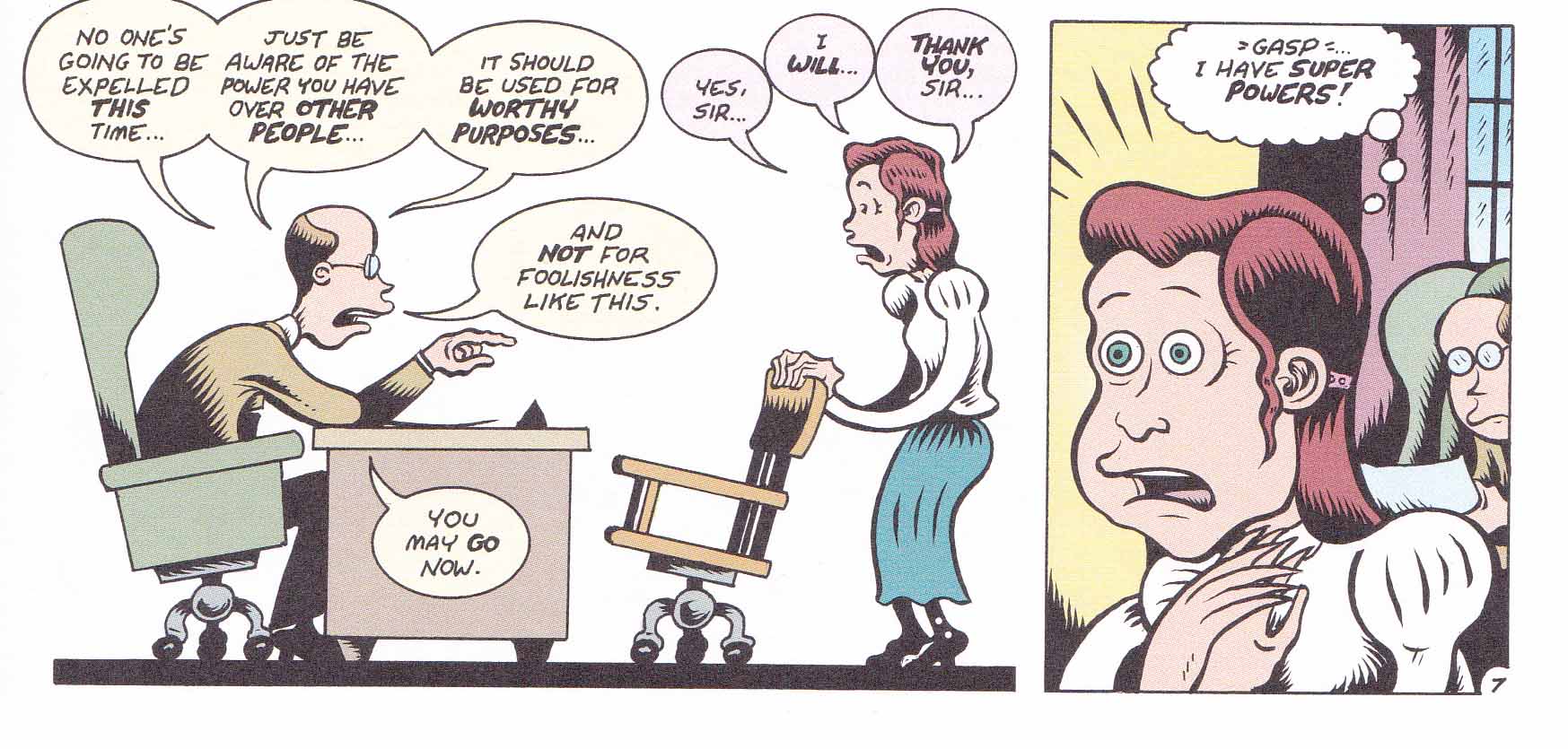
 Margaret Sanger

In Boxer’s words, Sanger was a

“…true hero, or a super-hero, if you will.” She was a “ball of energy, intelligence, and fury. She was also a proponent of free love…she practiced it (while married) with the writer H. G. Wells.”

And then there’s her She-Hulk like rage (and morally correct disposition):

“Censorship was Sanger’s goad to battle. From this point on in Woman Rebel, it seems that everyone’s eyes are bloodshot and crossed with rage, and you can see rubbery limbs swinging wildly on many a page. Sanger was at war with practically everyone, even those on her side.“

A look at Boxer’s conclusion reveals her train of thought:

“Woman Rebel, though on one level functioning as a superhero comic, also fits onto a certain growing shelf of books with other admirable short biographies…[Bagge] has transformed Sanger into a real live superhero who will herself live to see another day.”

The images produced in the review suggest a kind of absurdist, Far Side version of Sanger’s life. But more than this, there is the air of only marginal fallibility which is the hallmark of the superhero genre. While Tony Stark is allowed to be an alcoholic, Batman will probably still save the homeless man living in an alley way even if he’s suffering from alcohol-induced dementia; Superman rarely deploys his heat vision to sterilize children
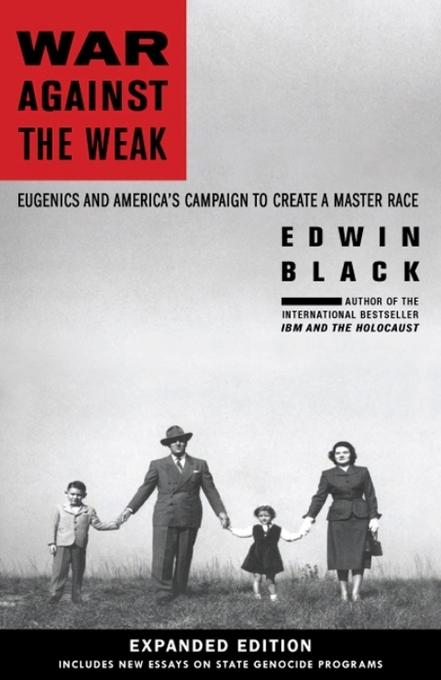
War Against the Weak

I had almost forgotten another aspect of the Sanger story, one which I first came to know about nearly a decade ago. That story comes from Edwin Black’s book, War Against the Weak (2003) which charts the rise of the eugenics movement in America (and then abroad). Edwin Black has a short chapter on Margaret Sanger in his book. He approaches the topic with extreme caution and his introduction comes with a prominent disclaimer:

“Opponents of a woman’s right to choose could easily seize upon Margaret Sanger’s eugenic rhetoric to discredit the admirable work of Planned Parenthood today; I oppose such misuse.”

He also pre-emptively loads the section on Sanger with a long list of her achievements and descriptions of her admirable character. His reasons for doing so become quite clear once the reader reaches the chapter on “Birth Control” in his book. Read in isolation, it is a devastating portrait of a figure who, from the tone of Boxer’s review, seems more akin to the Mary Poppins (she could be quite strict and disagreeable) of Birth Control.
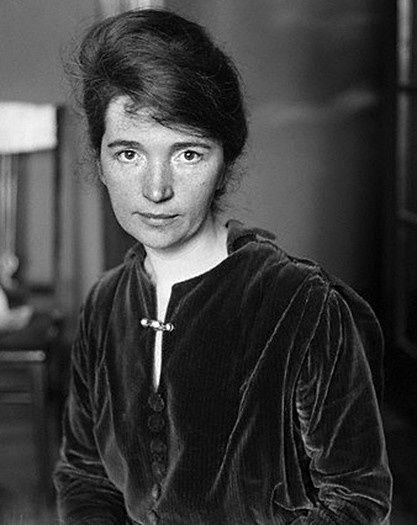
margaret-sanger

Black enumerates an appalling record of Sanger’s ideas through the early 20th century. Here are some facts and extracts from Black’s chapter on Sanger:

(1)  She saw the “obstruction of birth control as a multi-tiered injustice” of which one was the “overall menace of social defectives plaguing society.”

(2)  She “expressed her own sense of ancestral self-worth in the finest eugenic tradition.”

(3)  She almost named her new movement, “Neo-Malthusianism” and was an “outspoken Social Darwinist”. Her book, The Pivot of Civilization (1922), contains a chapter titled “The Cruelty of Charity”. The epigraph of that chapter was from Herbert Spencer himself and it read:

“Fostering the good-for-nothing at the expense of the good is an extreme cruelty. It is a deliberate storing up of miseries for future generations. There is no greater curse to posterity than that of bequeathing them an increasing population of imbeciles.”

(4)  From Sanger herself Black quotes:

“Organized charity itself is the symptom of a malignant social disease…the surest sign that out our civilization has bred, is breeding and is perpetuating constantly increasing numbers of defectives, delinquents and dependents.”

“Such philanthropy …encourages the healthier and more normal sections of the world to shoulder the burden of unthinking and indiscriminate fecundity of others; which brings with it, as I think the reader must agree, a dead weight of human waste.”

“The most serious charge that can be brought against modern ‘benevolence’ is that it encourages the perpetuation of defectives, delinquents and dependents. These are the most dangerous elements in the world community, the most devastating curse on human progress and expression.”

(5)  “Sanger…listed eight official aims for her new organization, the American Birth Control League. The fourth aim was “sterilization of the insane and feebleminded and the encouragement of this operation upon those afflicted with inherited or transmissible diseases…”

(6)  Though she was not thought to be a racist, she allied herself with Lothrop Stoddard, author of The Rising Tide of Color Against White World Supremacy which warned that “if white civilization goes down, the white race is irretrievably ruined. It will be swamped by the triumphant colored races, who obliterate the white man by elimination or absorption.”

[In the interest of balance, I will mention this site recounting Sanger’s Negro Project which provides a dissent concerning her degree of racial discrimination. It is, however, quite clearly a pro-life site and needs to be read with proper caution. Some historical facts earlier in the article may, however, be of interest. Also see Anna Holley and Carl M. Cannon on the misuse of Sanger on this controversial issue.]

Sanger was probably an equal opportunity eugenicist who esteemed Whites, Jews and Blacks alike as long as they had good genes. I guess humanity is safe as long as there is a consistent definition of those “good genes”.

While Sanger held to these views well beyond the golden age of the eugenics movement, one mark in her favor is that she never held to eugenicide or eugenics-inspired euthanasia. Planned Parenthood is no doubt relieved by this.

*     *     *

I have only a cursory interest in the life of Margaret Sanger. Apart from the books mentioned above, I have only read Sanger’s The Pivot of Civilization and a short but glowing prose biography. From the perspective of a Sanger neophyte, these uncomfortable facts merely lead to more questions about whether these observations and extracts are accurate, and whether they have been taken out of context.

Contrary to what might be gleaned from most reviews of the comic (see below for exceptions), Bagge does actually cover Sanger’s tilt toward eugenics with a relative degree of thoroughness, devoting at least 3 pages to the issue out of a 70 page book (and another 3 refuting her purported racism) .

One problem with Bagge’s comic is the style he has cultivated over the years. It is little changed since his days working on Hate, especially the latter issues where he abandoned his more personal busy linework and delegated the inking to a number of hired hands. This works wonders during the two page episode with sexologist, Havelock Ellis, cited in a number of reviews of the comic but it is a distinct hindrance when faced with moments of violence and misery. Take for example the two page sequence where Sanger helps to create a death mask for her deceased brother. One presumes that some of the panels on the page in question are meant to denote stomach churning terror but the reader feels nothing of the sort. The tearful “reunion” of Sanger’s mother with the face of her deceased son should feel crushing in its futility but seems more like a scene from tawdry potboiler. Perhaps that was the intended effect.
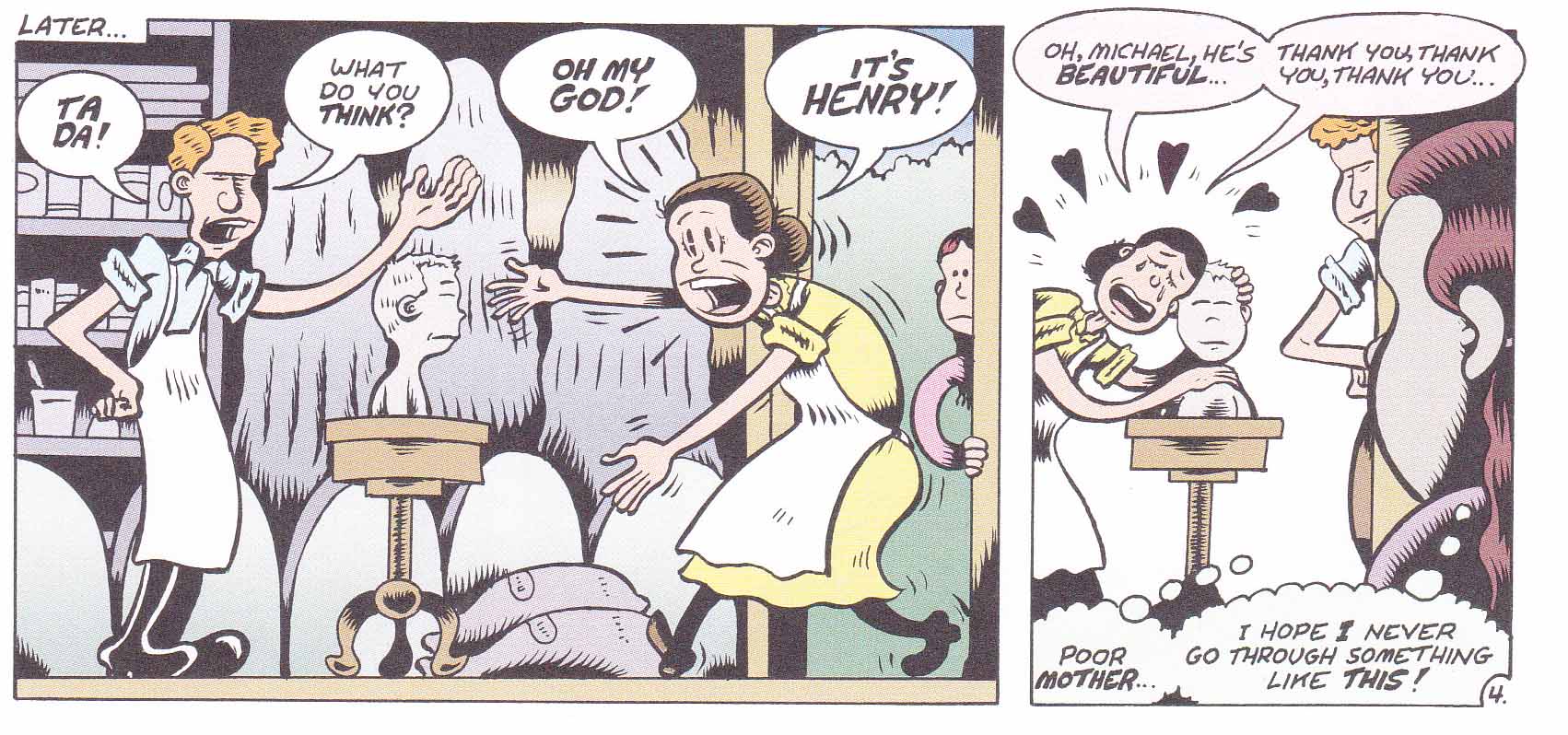
Margaret Sanger_0004

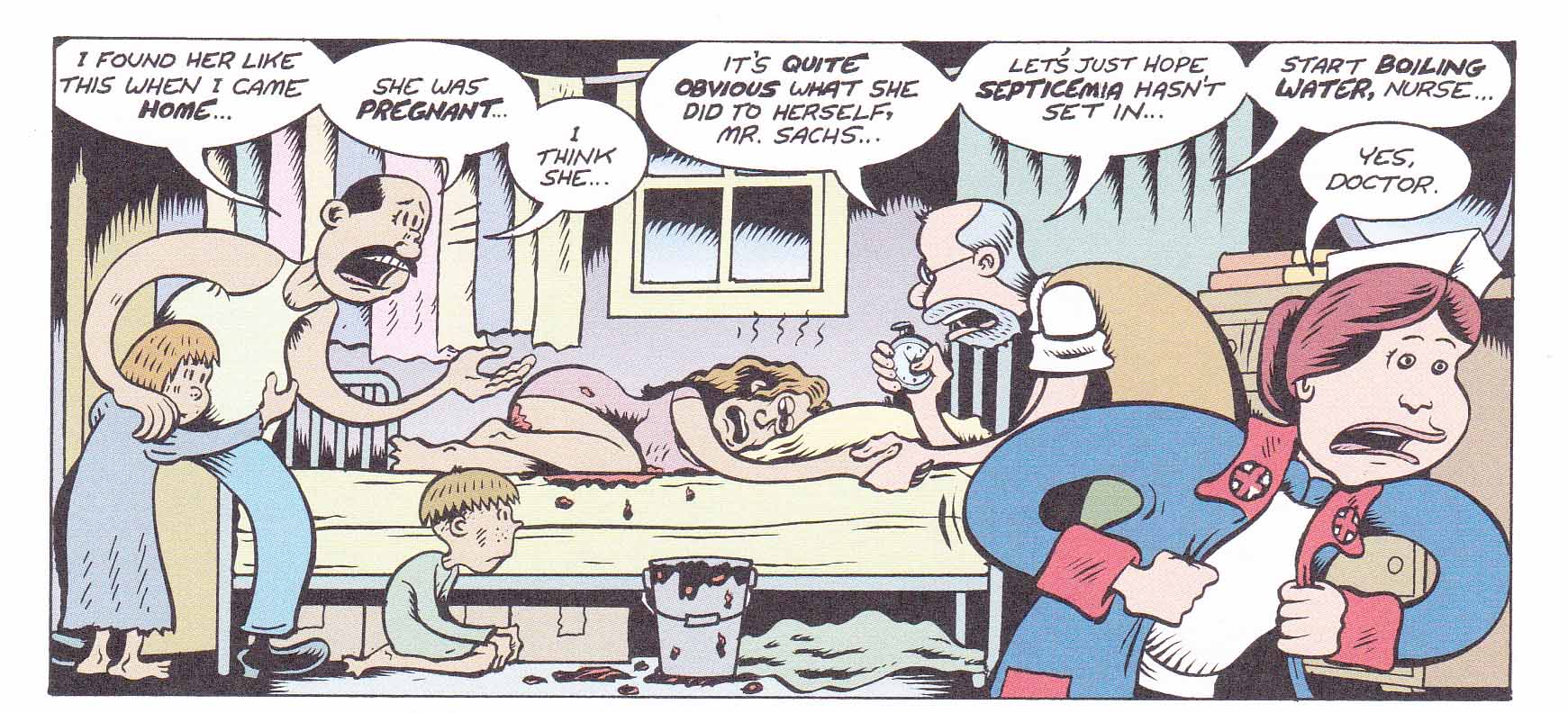
The same may be said for a sequence showing a self-induced abortion which might just as well be a ridiculous portrait of post-alcoholic stupor and diarrhea from an early episode of Hate.
Margaret Sanger_0005

There is a huge emotional chasm created by Bagge’s use of caricature to illustrate these scenes.

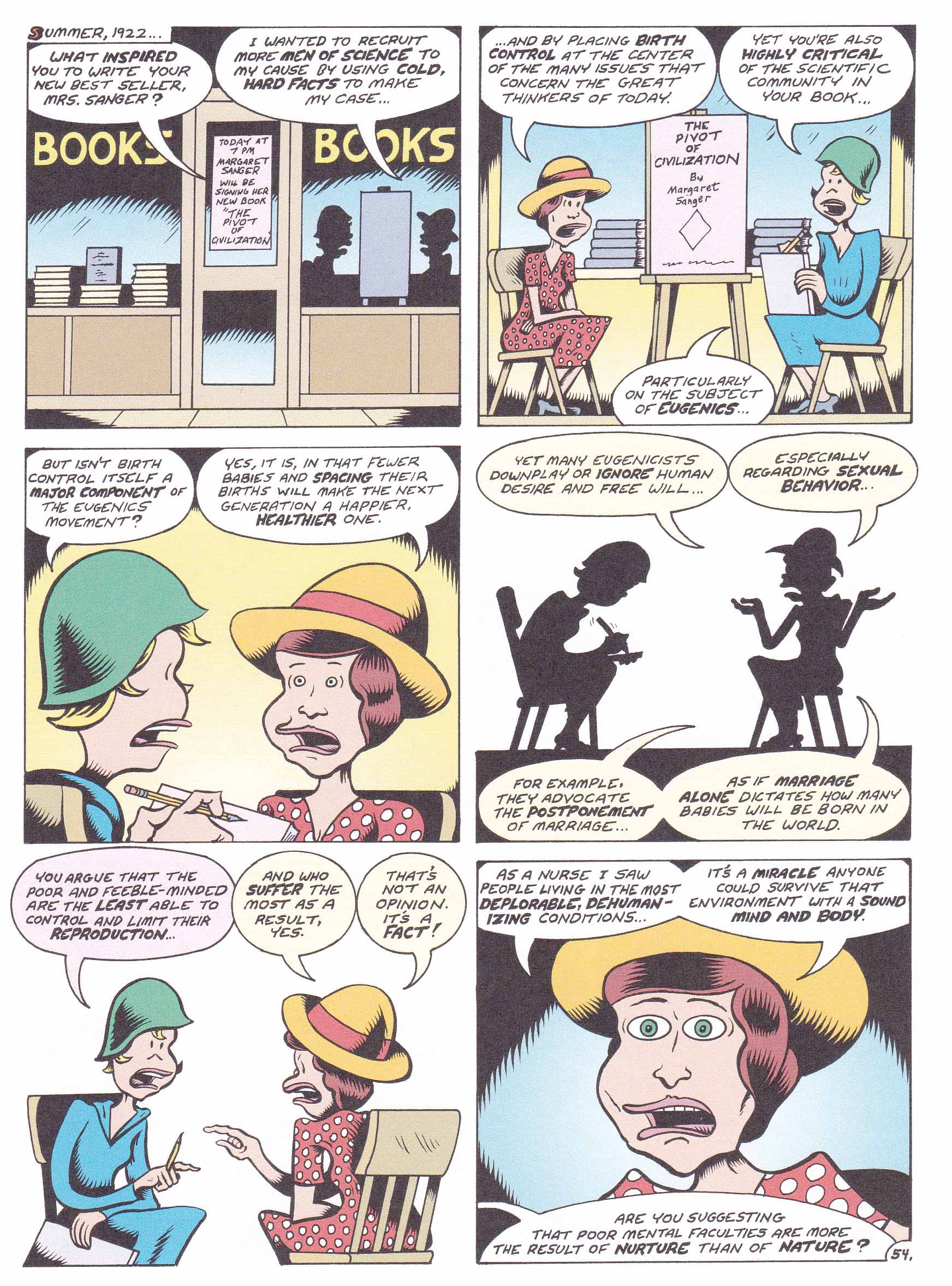
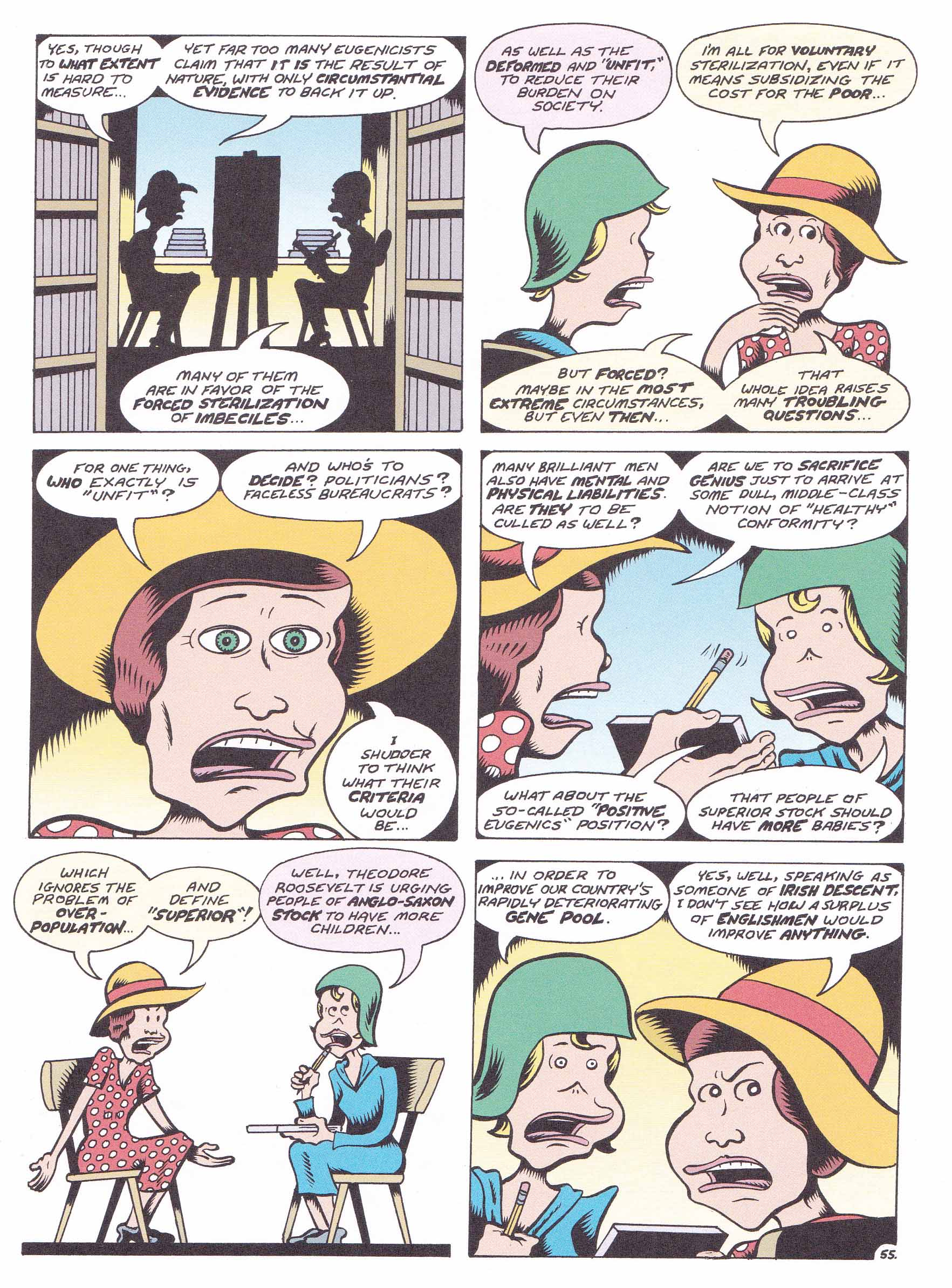
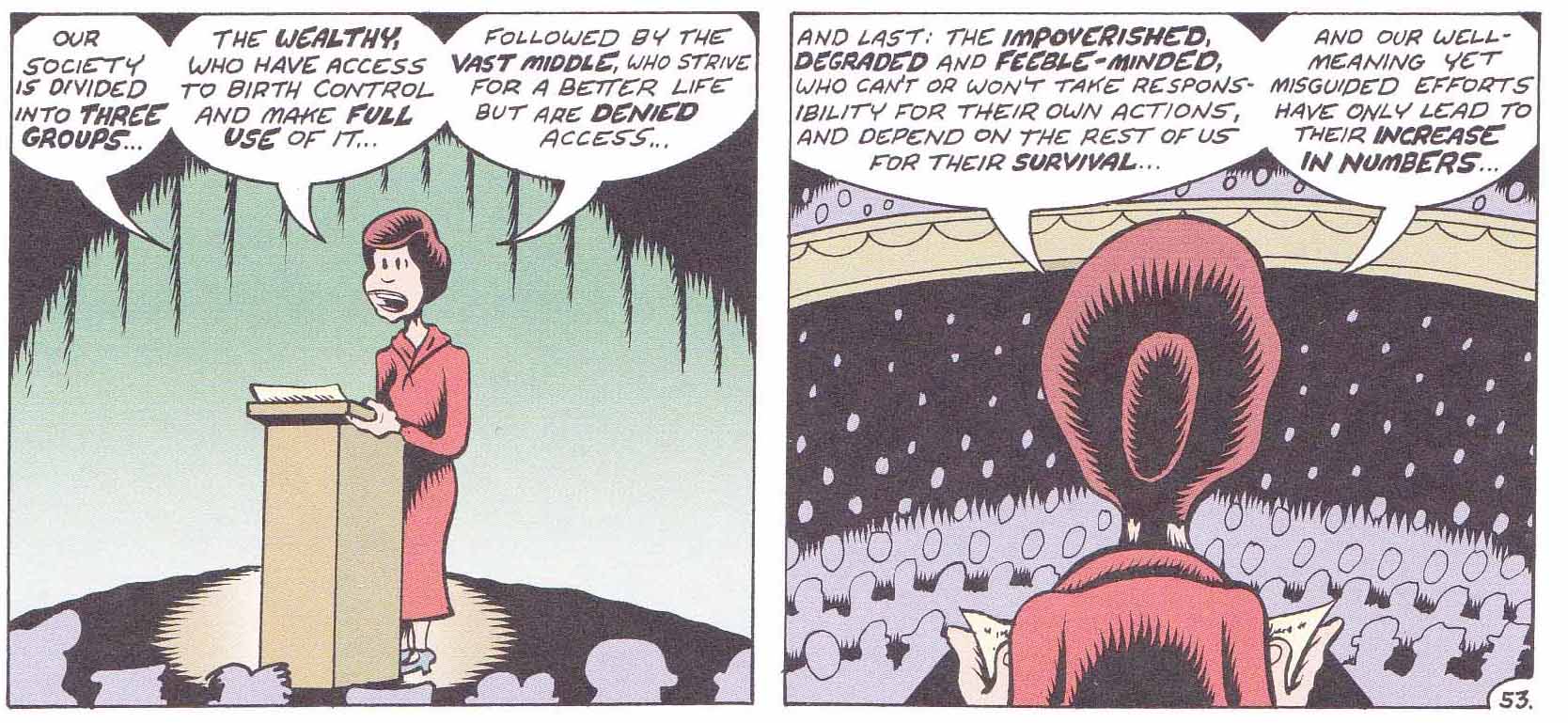
This same confluence of big foot cartooning and bright coloring creates a more congenial atmosphere when the serious issue of Sanger’s eugenic inclinations are discussed on pages 53-55 of the book.
Margaret Sanger_0002


Margaret Sanger_0003


Judging from these two pages, I would say that Bagge has done an impressive job padding Sanger’s often ugly ideas with seemingly logical arguments about the difficult but necessary job of social engineering. Who could possibly blame Sanger for her musings when even Theodore Roosevelt (and Oliver Wendell Holmes, Jr. for that matter) were raving eugenicists?

Consider the first panel of the second page where Sanger speaks out in favor of “nurture” (i.e. environment) over “nature” (i.e. heredity). This line of thought emerges from The Pivot of Civilization (Chapter VII) and proves to be considerably more controversial then one would presume from Bagge’s dramatization .

It should be noted that almost everything in Sanger’s book is seen through the lens of birth control (and not “charity”—which is accounted useless). There she writes:

 “While it is necessary to point out the importance of ‘heredity’ as a determining factor in human life, it is fatal to elevate it to the position of an absolute. As with environment, the concept of heredity derives its value and its meaning only in so far as it is embodied and made concrete in generations of living organisms….Our problem is not that of ‘Nature vs. Nurture,’ but rather of Nature x Nurture, of heredity multiplied by environment…”

“To the child in the womb, said Samuel Butler, the mother is ‘environment’ She is, of course, likewise ‘heredity’…The great principle of Birth Control offers the means whereby the individual may adapt himself to and even control the forces of environment and heredity.” [emphasis mine]

As for the third panel on the second page where our heroine ponders the question of the “fit” and “unfit”, Sanger was less ambiguous than the stated, “And who’s to decide? Politicians? Faceless Bureaucrats?” Her qualms on this subject had nothing to do with the choice between intelligent individuals and imbecilic ones, but class, gender, and most importantly, the type of genius being cultivated. This too comes from Pivot where she writes:

 “…we should here recognize the difficulties presented by the idea of ‘fit’ and ‘unfit.’ Who is to decide this question? The grosser, the more obvious, the undeniably feeble-minded should, indeed, not only be discouraged but prevented from propagating their kind. But among the writings of the representative Eugenists one cannot ignore the distinct middle-class bias that prevails… As that penetrating critic, F. W. Stella Browne, has said…’The Eugenics Education Society has among its numbers many most open-minded and truly progressive individuals but the official policy it has pursued for years has been inspired by class-bias and sex bias….’

“The trouble with any effort of trying to divide humanity into the ‘fit’ and the ‘unfit,’ is that we do not want, as H. G. Wells recently pointed out, to breed for uniformity but for variety. ‘We want statesmen and poets and musicians and philosophers and strong men and delicate men and brave men. The qualities of one would be the weaknesses of the other.’ We want, most of all, genius.”
 

Woman Rebel Tour

Here is Bagge in further explanation from his extensive notes on this portion of the book:

(1)  BAGGE:The Pivot of Civilization…Her critics continue to mine it for evidence of her eugenic thought crimes, yet she spends a large portion of the book criticizing what were then established mainstream eugenic beliefs.

While agreeing with many of their most repulsive ideas I should add.

Much of The Pivot of Civilization is actually inoffensive description of the plight of women and children from the lower strata of society with Birth Control being the key to their (and civilization’s) freedom from the plague of overpopulation. For example, she links child labor with “uncontrolled breeding.” You could argue with the (social) science perhaps but not the intent. Where would one put structural inequality in this equation for example?

Sanger, while acknowledging civilization’s indebtedness to the “Marxians for pointing out the injustice of modern industrialism,” was largely dismissive of the Socialistic tendencies of the time. Of the “gospel of Marx” she wrote:

 “It is a flattering doctrine, since it teaches the laborer that all the fault is with someone else, that he is the victim of circumstances; and not even a partner in the creation of his own and his child’s misery.”

The real problems begin with the fourth chapter of Pivot titled, “The Fertility of the Feeble-Minded” where she writes in her opening foray:

 “Modern conditions of civilization…furnish the most favorable breeding-ground for the mental defective, the moron, the imbecile. ‘We protect the members of a weak strain,’ says [Charles] Davenport, ‘up to the period of reproduction, and then let them free upon the community…so the stupid work goes on of preserving and increasing our socially unfit strain.’”

And soon after:

 “Modern studies indicate that insanity, epilepsy, criminality, prostitution, pauperism, and mental defect, are all organically bound up together and that the least intelligent and the thoroughly degenerate classes in every community are the most prolific.”

And to end:

 “Every feeble-minded girl or woman of the hereditary type, especially of the moron class, should be segregated during the reproductive period….The male defectives are no less dangerous….Moreover, when we realize that each feeble-minded person is a potential source of an endless progeny of defect, we prefer the policy of immediate sterilization, of making sure that parenthood is absolutely prohibited to the feeble-minded.”


 (2)  BAGGE: “…Sanger addresses the idea of involuntary sterilization almost as default position, and then proceeds to raise the problems inherent in that idea. But in 1922, that was the default position at least amongst the intellectuals, academics, and progressives that she was trying hard to sway…they were faced with brand new social problems the likes of which humanity had never dealt with before: exploding population growth, rabid urbanization, and massive waves of immigration…All of this lead to increased rates of crime, poverty and mental illness that overwhelmed major US cites. In the face of all this, the idea of sterilizing…seemed like not only a good idea, but the most humane one, considering the options available at the time (another popular solution was to exterminate some or all of the above).

“What Sanger was trying to do was expand our options, so we wouldn’t have to resort to such extreme measures.”

As is clear from Sanger’s The Pivot of Civilization, the first part of Bagge’s statement is complete hogwash. Certainly some would contest the idea that involuntary sterilization was the default position of intellectuals of the time. Quite the contrary, there were some intellectuals who were violently against eugenics itself. Bagge, however, qualifies his statement with the proviso that these were only the intellectuals “she was trying hard to sway.” Since these individuals were largely engaged in the pseudoscience of eugenics, it stands to reason that involuntary sterilization would be popular among them. It is a somewhat circular argument.

(3)  BAGGE: “Interestingly, since we now have more scientifically advanced forms of birth control, government agencies imposed temporary forms of forced sterilization on various wards of the state, such as “chemical castration” of paroled sex offenders or Norplant devices for impulsively promiscuous girls in the foster care system. All things considered, these are not unreasonable solutions…”
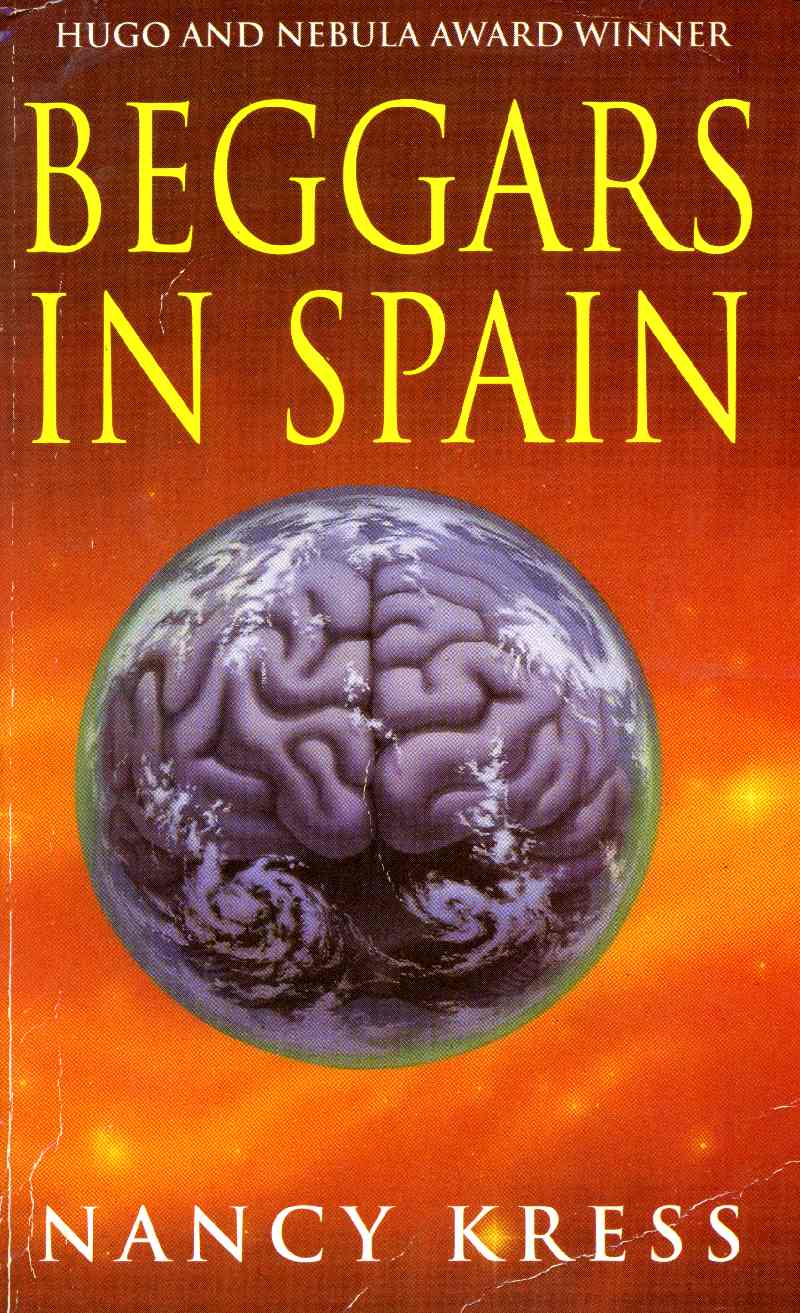
 

Beggars In Spain

Of course, these ideas sound all too familiar even in an age when the “science” of eugenics has either gone into hiding or put on new clothes.

In the realm of popular culture, it is best exemplified by Nancy Kress’ novella (chapter 1 of the later novel) Beggars in Spain. Readers on Amazon.com have accurately labeled Beggars in Spain the “perfect book to read before or after Atlas Shrugged”…because it adds so beautifully to the basic arguments of the Have and the Have-Nots.” The soft-Objectivist SF novel which won it all is seen by some as the authoress’ conversation with the ideas of Ayn Rand and, by others, as a paean to the new Objectivism (specifically its ethics). Of course it doesn’t seem to have been promoted that way but you would only need to read 50 pages into the novel to sense the essence of its intent. I had not read 1/4 of the novella before I realized that what I thought were simple quirks were actually the entire measure of its premise.

Beggars in Spain is not completely adamant in its greed and selfishness but it is pretty certain in its diagnosis of one of the major ills of society: the fear, demonization, victimization of, and parasitic reliance on society’s highest achievers. Like Rand, Kress’ work displays an unabashed admiration for elitism but, unlike some of its esteemed forebears, finds a place in its heart for the moochers of society—the eponymous Beggars in Spain.

The metaphor hinted at in the novella’s title is explained in a parable told to Leisha, the protagonist of the work:

“What if you walk down a street in Spain and a hundred beggars each want a dollar and you say no and they have nothing to trade you but they’re so rotten with anger about what you have that they knock you down and grab it and then beat you out of sheer envy and despair?”

Leisha didn’t answer.

“Are you going to say that’s not a human scenario, Leisha? That it never happens?”

“It happens,” Leisha said evenly. “But not all that often.”

“Bullshit. Read more history. Read more newspapers. But the point is: what do you owe the beggars then? What does a good Yagaiist who believes in mutually beneficial contracts do with people who have nothing to trade and can only take?”

“You’re not–”

What, Leisha? In the most objective terms you can manage, what do we owe the grasping and nonproductive needy?”

“What I said originally. Kindness. Compassion.”

“Even if they don’t trade it back? Why?”

“Because…” She stopped.

“Why? Why do law-abiding and productive human beings owe anything to those who neither produce very much nor abide by just laws? What philosophical or economic or spiritual justification is there for owing them anything? Be as honest as I know you are.”

Leisha put her head between her knees. The question gaped beneath her, but she didn’t try to evade it. “I don’t know. I just know we do.”

And there’s the compassion tacked on to the old elitism, the now passé form of Objectivism. Nancy Kress explains this more fully in an interview quoted by Nicholas Whyte in his review of Beggars in Spain:

“…although there’s something very appealing about [Ayn Rand’s] emphasis on individual responsibility, that you should not evade reality, you should not evade responsibility, you should not assume that it’s up to the next person to provide you with your life, with what it is that you need, whether that’s emotional, or physical… [it] lacks all compassion, and even more fundamental, it lacks recognition of the fact that we are a social species and that our society does not exist of a group of people only striving for their own ends, which is what she shows, but groups of people co-operating for mutual ends, and this means that you don’t always get what you want and your work does not always benefit you directly.”

Whyte goes on to say that

 “…the central message of Beggars in Spain is that our humanity as individuals is bound up in our obligations to the rest of humanity, and if we forget that, we become less human.”

So much for intent, but what do we as readers find in the novella, that long short story which won a bounty of awards and recognition.

The protagonist of the novel is Leisha Camden who has been genetically engineered for sleeplessness. She is genetically perfect both in mind and body. Not so the fountainhead of her being, her mother.

Leisha’s mother, who rejects the protagonist’s genetic genius, is a cold, alcoholic wuss who abandons her daughter because she cannot see herself in that superior specimen of society.

Leisha’s “ordinary” sister is left shivering in the long shadow of her sister’s massive intellect and brilliance. She turns her frustration and anger inward; rejecting a planned admission to Northwestern University by becoming first an unwed mother, then an abused wife, and then, horror of horrors, obese! This before seeing the light, leaving her abusive husband, shedding the pounds, and applying to college. In this way, it is rationalized, the beggars don’t always have to be beggars. If only more “normal” people saw the light and changed their lives for the betterment of society.

Beggars in Spain is undoubtedly one of the most frightening novellas to have won both the Hugo and Nebula award. It can also be read as a metaphorical road map towards a caring Objectivist Utopia. The genetically altered Sleepless not only become more intelligent but also regenerate indefinitely—they are veritable demi-gods. The greatest and most intelligent in society are placid, rational, and calm. Many have almost immaculate personalities. Their intelligence and mental superiority is directly connected to morally upright behavior. It is a Libertarian fever dream where the plebs (lacking this intelligence and moral fiber) feel jealous and seek to deprive these individuals of their rights under the American Constitution.This is not so much a case of “America the Beautiful” but “America the Full of Shit.”

It is worth noting that the American eugenics movement largely thrived on the basis of philanthropy, in particular money from the Carnegie Institution but also funds flowing form finance, oil, and railways. In other words, the very demi-gods hailed in Beggars in Spain, a novella rooted in a preposterous (and certainly ahistorical) conception of human behavior. Many of these organizations have since repudiated their actions.
Margaret Sanger_0001a

Peter Bagge is, I think, a Libertarian, or at least he sometimes identifies as one. This does not mean that he holds to any of Objectivism’s (or Rand’s) more distasteful views.

Bagge seems to suggest that the slant he provides in Woman Rebel was a strategic decision made against pro-life groups (from an article at Raw Story):

“Those groups also hype Sanger’s belief in the progressive-era theory of eugenics, which Bagge says has become synonymous with fascism and Nazism.

“During the progressive era, especially in the 1920s, when eugenic thought was at its peak, it was much more wide-ranging that that,” Bagge said. “There weren’t very many people who did believe in it along very specific racial lines.”

He says Sanger accepted the views of eugenics promoters to help promote her ideas about birth control among “men of science.”

“She wouldn’t rule out forced sterilizations in extreme situations,” Bagge said. ’Extreme,’ in her case, how she would define that is, a destitute woman who is, like, extremely mentally incapacitated and neither her or her family have any way of raising a child.”

Bagge’s view are of a piece with those of Ellen Chesler who is quoted by Anna Holley as saying that

Margaret Sanger had no choice but to engage eugenics. It was a mainstream movement, like public health or the environment today. It was to sanitize birth control and remove it from the taint of immorality and the taint of feminism, which was seen as an individualistic and antisocial group that addressed the needs of women only, and immoral women at that’”

Bagge’s decision is probably understandable considering the fraught situation which still surrounds the issue in America. I, of course, speak from the relative “safety” of Singapore where these rights are secure, and both positive and negative eugenic solutions (see Graduate Mothers Scheme and here) were once advocated at the highest level of government as recently as the 80s. Still, there is little doubt that Bagge’s portrait of Margaret Sanger suffers from an excessive use of concealer.

Edwin Black’s portrayal of Sanger is considerably less sanguine. The line from the American eugenics movement to the Nazis and the Holocaust is crystal clear but Sanger was not involved in this cross fertilization.  However, Black does suggest that Sanger’s interest in eugenics rose from a deeper ideological source which she carried into the 50s when eugenics was increasingly discredited (Sanger died in 1966):

“…on May 5, 1953, Sanger reviewed the goals of a new family planning organization – with no change of heart….Sanger asserted to a London eugenic colleague, ‘I appreciate there is a difference of opinion as what a Planned Parenthood Federation should want or aim to do, but I do not see how we could leave out of its aims some of the eugenic principles that are basically sound in constructing a decent civilization.”

Life is more strange and people more complicated than we give them credit for. A more truthful account of Sanger’s legacy would be a much needed admonition against  the idolization of any human being no matter how beneficial their actions may appear to have been. If an idea is good and ethical, its practice should not be predicated on the saintliness of the individual(s) who first championed it. That is the preserve of religion. The future described by Kress in Beggars in Spain is now upon us. We now lie on the cusp of “self-directed evolution”. But the progress of science has never been at the heart of the problem. It has been merely an invitation to good or evil; and that choice, that problem has never left us since humans first began to think.


 *     *     *

Further Reading

Hilary Brown at Paste Magazine on the comic.

“He presents the bad — her late-life addiction to painkillers, her difficulties with her children, her fricative relationships with other women of power — as well as the good with an even hand.”

Rachel Cooke at The Guardian on Bagge’s comic.

“Bagge is clearly on Sanger’s side, admiring of her pluck, determination and wildness…he acknowledges that she could be disagreeable, selfish and glory-seeking. This is important, for it was surely her flaws just as much as her virtues that kept her going when the struggle to make birth control legal seemed as though it would never be won.”

Rebecca Henely at Women Write About Comics.

“… he makes pains to defend her against the accusations of racism her memory has been asked to answer for. A notorious incident in which Sanger spoke to a gathering of women in the KKK, her use of outdated and offensive terminology such as “negro” and “imbecile,” and her association with the American eugenics movement have all led to accusations that Sanger’s activism was based on racial supremacy or even as proof that she was part of a conspiracy to wipe out black people, both among conservatives and even those on the left such as Black feminist activist Angela Davis. Bagge, however, argues through the pages of his comic and the afterword that while Sanger was no saint, most of this impression is due to smears that take her words out of context or ignorance of the past.”

A review at Motifri.com.

“Bagge deals with the accusation that Sanger was a eugenicist interested in wiping out non-white races of people by pointing out that Sanger was adamantly against defining one group of people as “superior” to another. Indeed, leaders in the black community sought Sanger out for help, and Martin Luther King was proud to receive an award named in her honor.”



True Detective Reeks of Twin Peaks

True-Detective-6

The current “Golden Age of Television” is not so much a revelation that TV can actually be good, but that stories are often more impactful when told the long way. Plot arcs develop on a slow burn, and the audience has time to form intense emotional attachments to even minor characters.  On the flip side, even a great television show will spend its initial few hours building up to that magic, pivotal moment that justifies the hype. The Sopranos first breaks out of its shell and becomes a harrowing nocturne in  “College,” (season 1, episode 5,) and Breaking Bad clicked during the wrenching intervention scene in “Grey Matter” (also season 1, episode 5.)  So a part of me can’t fully dismiss True Detective only after the first episode, even if I feel like I spent an hour of my life watching the unholy union of Twin Peaks and a dick measuring contest.

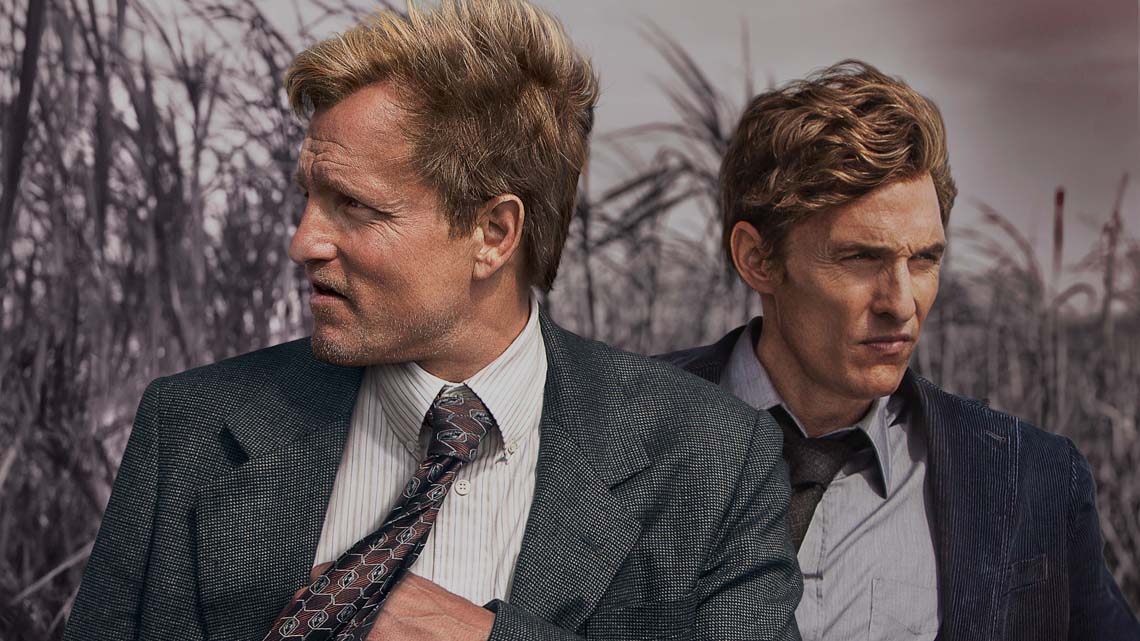
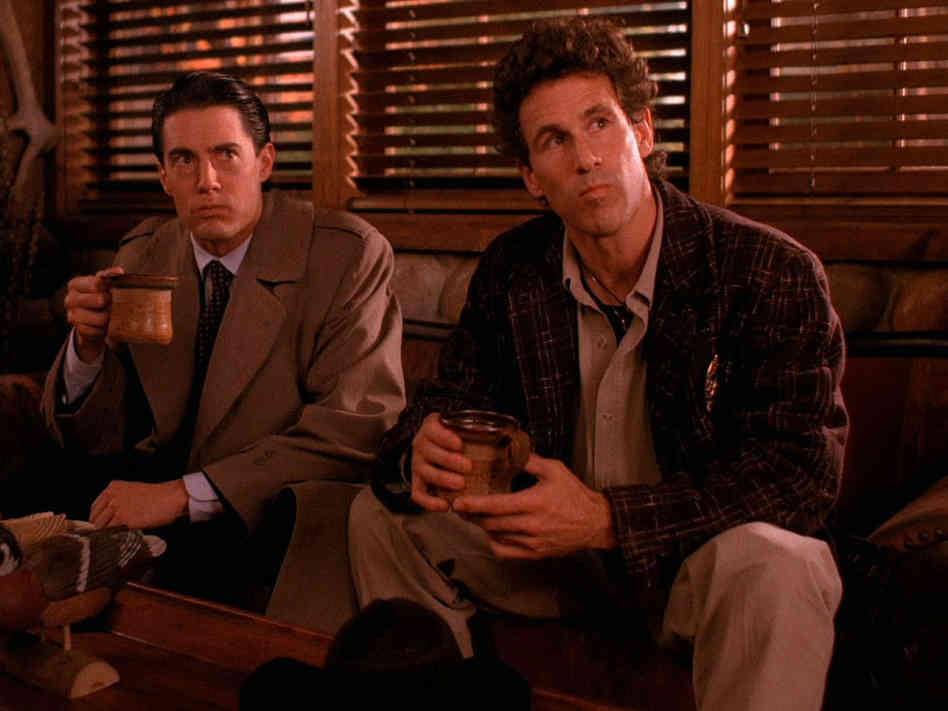
Dominick Nero at The Gothamist, and other besides, have already pointed out a striking similarities between Twin Peaks and True Detective here—(but watch out, there are spoilers in it. I try to remain spoiler free below.) Nero writes, “Rust Cohle and Marty Hart are arguably the 2014 equivalent of FBI Special Agent Dale Cooper and his gruff buddy, Sheriff Harry S. Truman. The dreamer and the lawman, the weirdo and the straight guy—Lynch made this detective dichotomy a primetime staple over 20 years ago. And although Nic Pizzolatto is by no means a Lynchian storyteller, True Detective owes a lot to the short-lived ’90s series. Themes of existentialism, pagan naturalism, and the futility of old-fashioned Americana (in the north or the south) pervade both shows, making Pizzolatto’s efforts largely indebted to the elusive David Lynch.” In both shows, a young woman’s corpse is discovered, bearing ritualistic, sadomasochistic markings. It turns out she was a prostitute, and involved in some heavy shit. Wacky lawman pays attention to strange details and throws out high-falutin anthropological language, while straight-shooting lawman quietly bemoans the end of human decency.

twinpeaks

I couldn’t read Nero’s case in full, because I don’t want to know the ending of True Detective yet.  He articulates the stylistic differences between these shows, but perhaps gives too much credit to the post-Katrina nihilism that Rust Cohle and the show are meant to embody. In episode one, Cohle struggles to say anything that the Nietzchean teenager in Little Miss Sunshine wouldn’t have.  The Laura Palmer-counterpart is named Dorothea Lange, a fact made even hokier by the show’s bristling self-importance. Twin Peaks is goofy and over the top in many ways, but the over-cooked, baroque Americana of True Detective’s opening sequence takes the cake. It’s like someone watched the first five minutes of True Blood and was like, “This, but darker! And with more strippers!”

Not to mention the first episode’s Frank Miller-esque issues with women. Twin Peaks had the decency to star lots of fascinating women, make Laura Palmer a character, and dramatize the bizarre, domestic fall-out from her death from episode one. Here we have Madonna and Whores, prostitutes and the melodramatic staple of the good-wife back home. And a sassy black secretary, who so far has only been a sounding board for Hart’s even sassier joke. This does not bode well, but there are seven more hours to go.  I’ll return with an update upon episode five, and then the finale.  It just might take me a few months to get there.


How Not To Make a Graphic Novel

couch

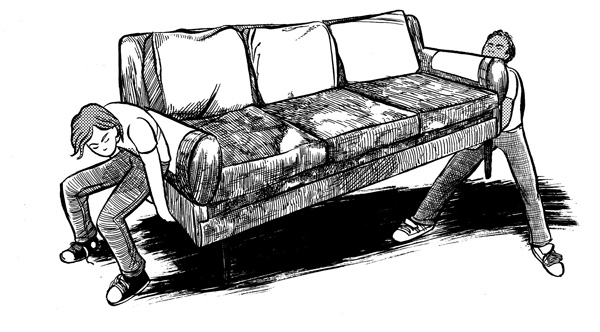
Every once in a while I’ll get an email from someone who wants to know. “Whatever happened to that graphic novel you were working on? Did you ever finish?”

Discards. I worked on it for four years, completed more than three hundred pages while working full-time as a high school art teacher. And now it sits in a box in my closet, unread by all but a few friends, several of whom largely hated it.

What went wrong?

I’m still a teacher. I look at the pile of effort and time and in the right light I see something that might be useful to another cartoonist. I did after all make it that far. Hundreds of pages of finished comic art is in itself nothing to sneeze at. And there’s no doubt in my mind that those hundreds of pages, along with my high school teaching, brought me the skills that I have today, skills that employ me as a freelance illustrator, even if my cartooning itself isn’t in much demand these days.

I was twenty-six when I started, a high school teacher with an almost fevered desire to work, to make things, to bury myself in the aspects of my life I could control. For several years, making Discards provided me with the focus I needed to forget all the other things in my life that were making me miserable.

sink

But somehow, of all the projects I’ve been involved in, this was the one I was unable to drag across the finish line. What went wrong?

But first —


What Went Right

There are reasons I got as far as I did, things I did that I would recommend to anyone pursing long-form comics. For one, I wrote a script — multiple drafts, in fact. The story started out as prose, a manuscript called The Three Thrift Kings. On second revision it lost its title along with most of the text, and became Discards.

The first draft was a loosely interconnected set of stories largely set at a thrift store in rural Florida. The protagonist Michael (I know, I know) has returned to his childhood home for unspecified reasons and takes a job as a janitor at a thrift store. It’s a sort of Pilgrim’s Progress, in a retail outlet, with drugs and lots of monologues about video games.

As a first draft, the story was a structural mess. I had written it as a receptacle for a series of autobiographical anecdotes about my time as a janitor, back-up man, and finally furniture-electrical pricer at a large thrift store in Casselberry Florida. The smaller nested anecdotes were stories I had refined over a long period of story-telling, but the central plot that linked them all together had been grafted on later in the process. (This too was a “found” element. After talking with a fellow teacher about all the strange things I had encountered working at the store, he told me about one of the strangest jobs he had ever worked — cleaning out evicted properties. His story of finding a stash of drugs, and the subsequent return of the owner of said drugs, would provide the missing through-line necessary to make a coherent story out of first draft.)

The second draft refined the physical environment of the story until it took place in essentially two locations– Michael’s house, the thrift store, and the walk between the two. It also strengthened the main events of the narrative by introducing those strands of plot earlier on. In short, it was structurally sound, something that would have been impossible to do had I tackled the pages graphically directly from the onset.

The setting for the story was visually rich as well, and I knew that my intimate knowledge of the minutia of the environments I would be describing would make for interesting comics.

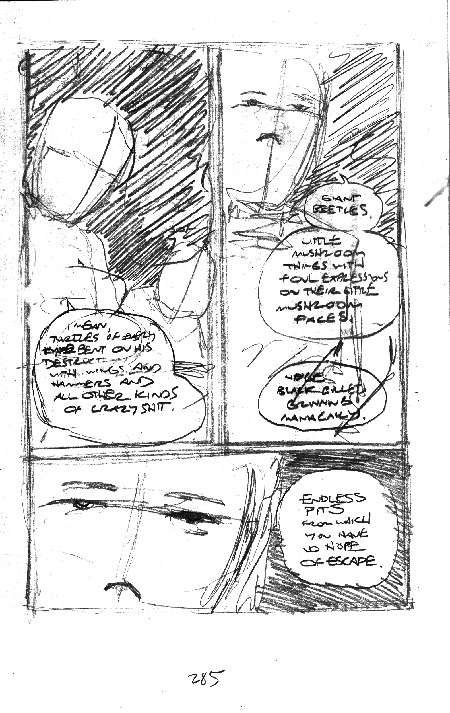
After completing the second draft of the script, I made my second smart move – I drew layouts for the entire book.

layout

Years of studying page mechanics, and the two or three hundred pages I had drawn in my life so far, meant that the layouts came easily, once I warmed to the task. After some initial slowness, I worked my way up to a speed of about 20 pages of layouts a day, working on sheets of discarded paper folded in half, mainly to discourage myself from feeling too precious about my drawing.

In fact, the faster I worked, the better things seemed to go. If I got bogged down on a page, trying to figure out the spacial mechanics of a scene or movement of the characters or placement of dialogue, I’d just crumple it up and continue on another sheet. After a few days of this my layouts were getting much stronger, even as my drawing itself got looser and looser. By the end of the month I had laid out the entire  400 page book.

Not having a final length in mind led me to expand and contract sections at my own whim, and I brought an almost perverse joy to extending certain sequences that had in the script been only a sentence or two of description. Other scenes were recast dramatically, especially dialogue-heavy scenes, which often had added physical action as my “actors” took over from my writer.

And if this were a happy article about personal fulfillment and artistic success, this might be where I would end, with the satisfied artist and his stack of folded copy paper, a readable story in his hands mere months after first imagining.

But I’m afraid that’s not what happened.

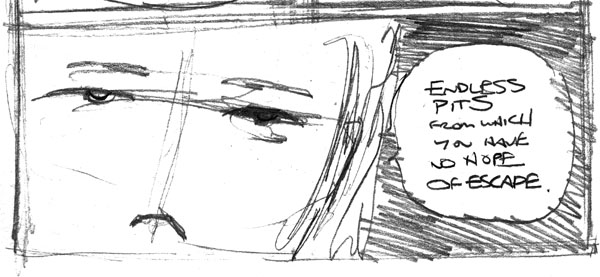
endless pits


What Went Wrong

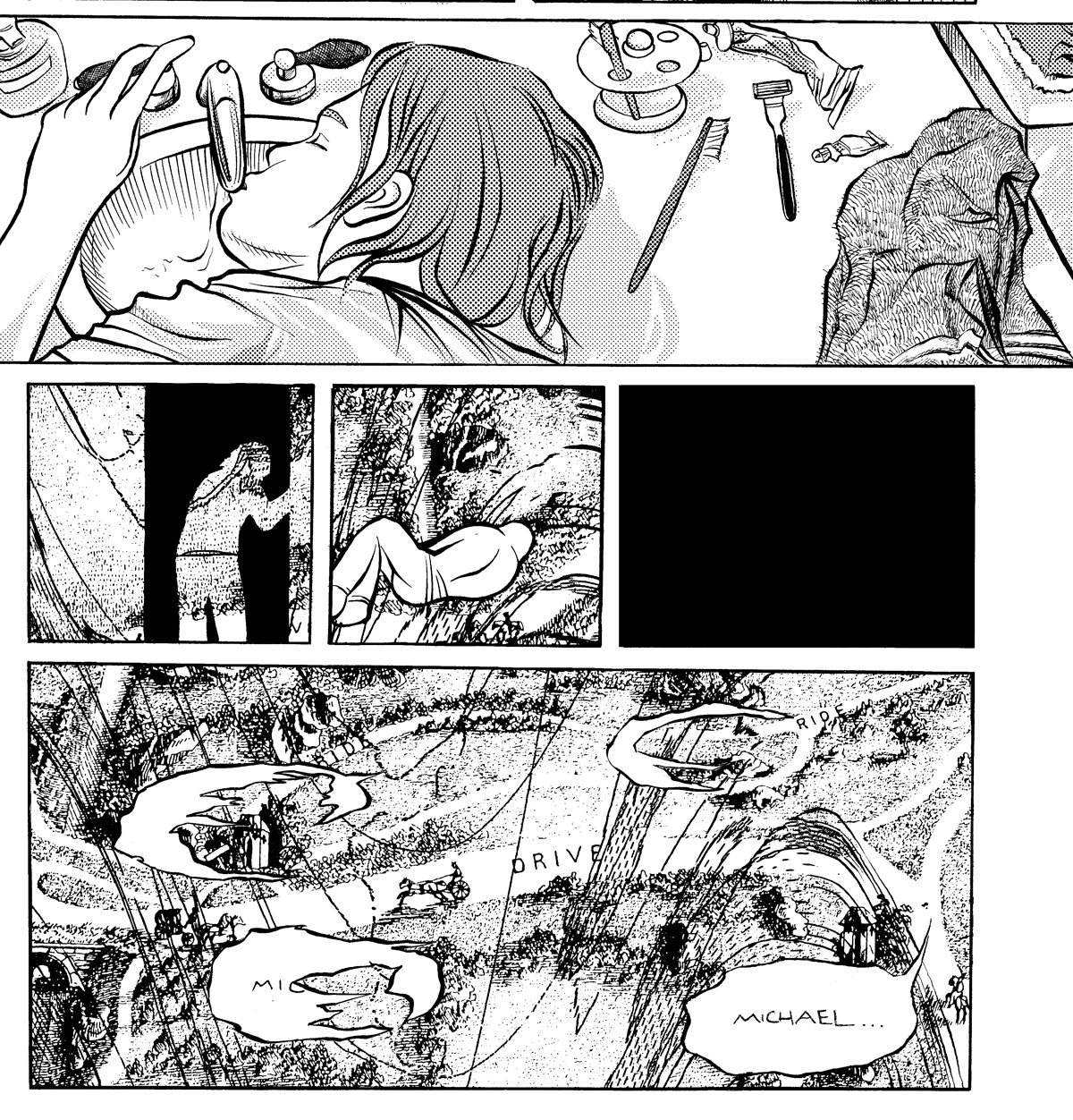
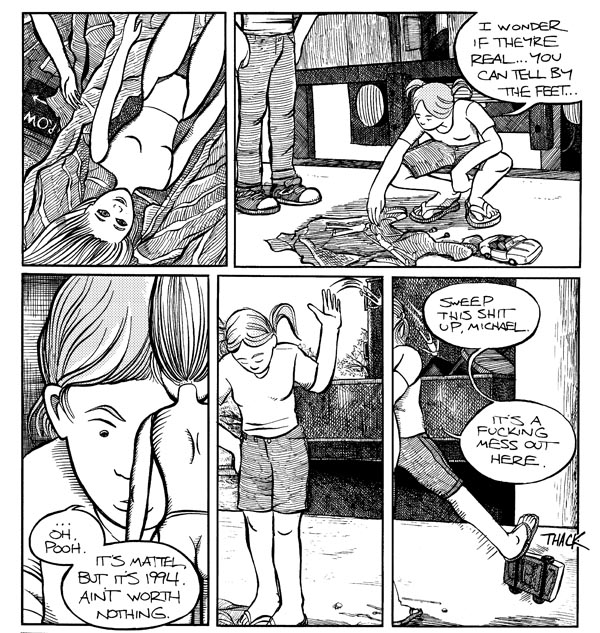
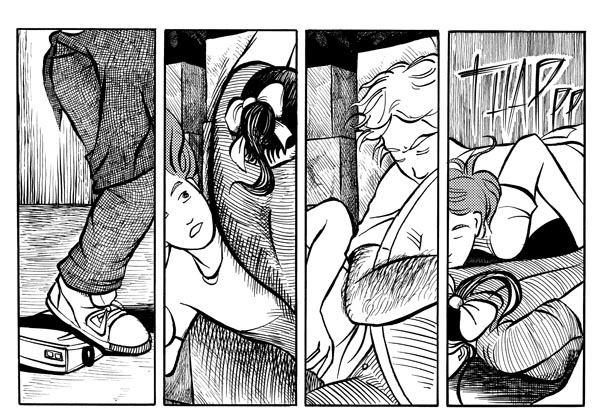
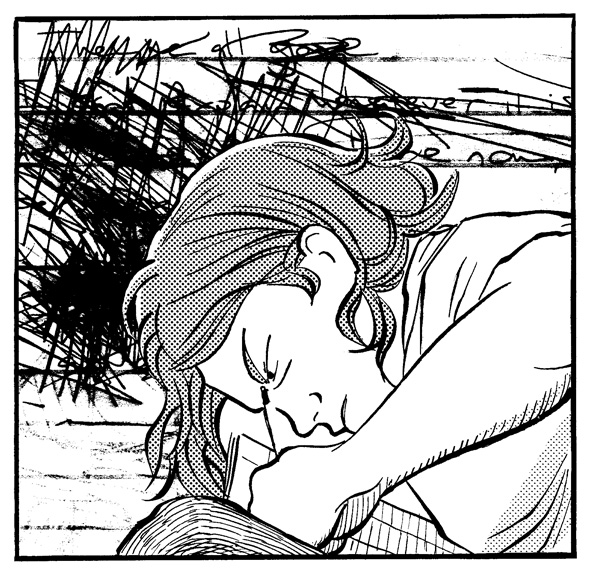
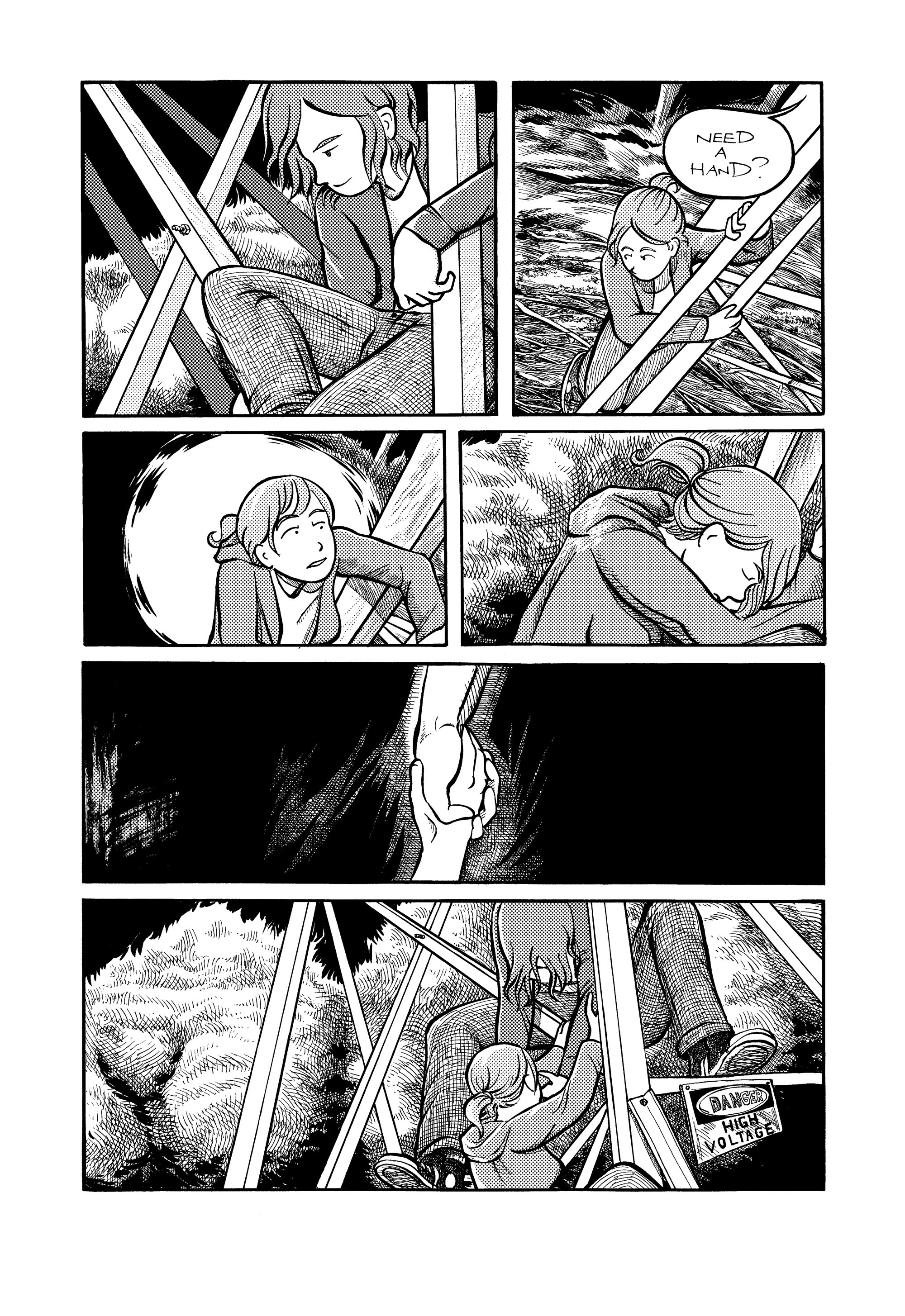
panels from Discards, by Sean Michael Robinson

What am I looking at, and why do I care? Discards, page 25


A. Millions of Tiny Little Lines/ Working Too Large

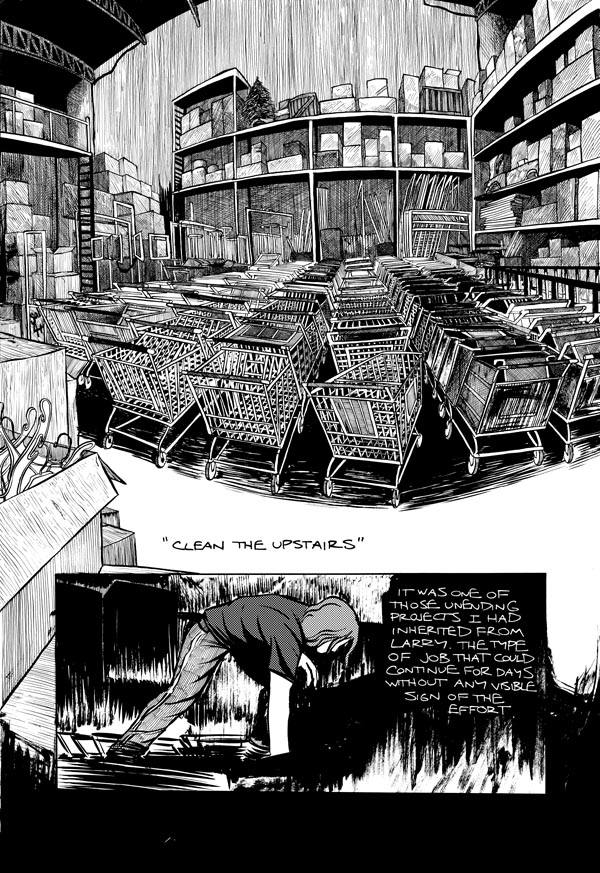
When I started Discards, I had some experience in pen and ink, with a wide variety of tools and textures at my command. But I had virtually no experience working for reproduction. By the time I had drawn my first 50 pages, it was clear two things were already very wrong.

For one, I was working at a scale much too large to be useful for me. Specifically, I was working with an active page area of 11” x 15”, i.e. double the size of my folded letter-paper layouts. Huge originals plus a mania for tiny little lines and an initial fear of bold application of blacks equaled pages that seemed anemic and washed-out, no matter how many layers of lines I added.

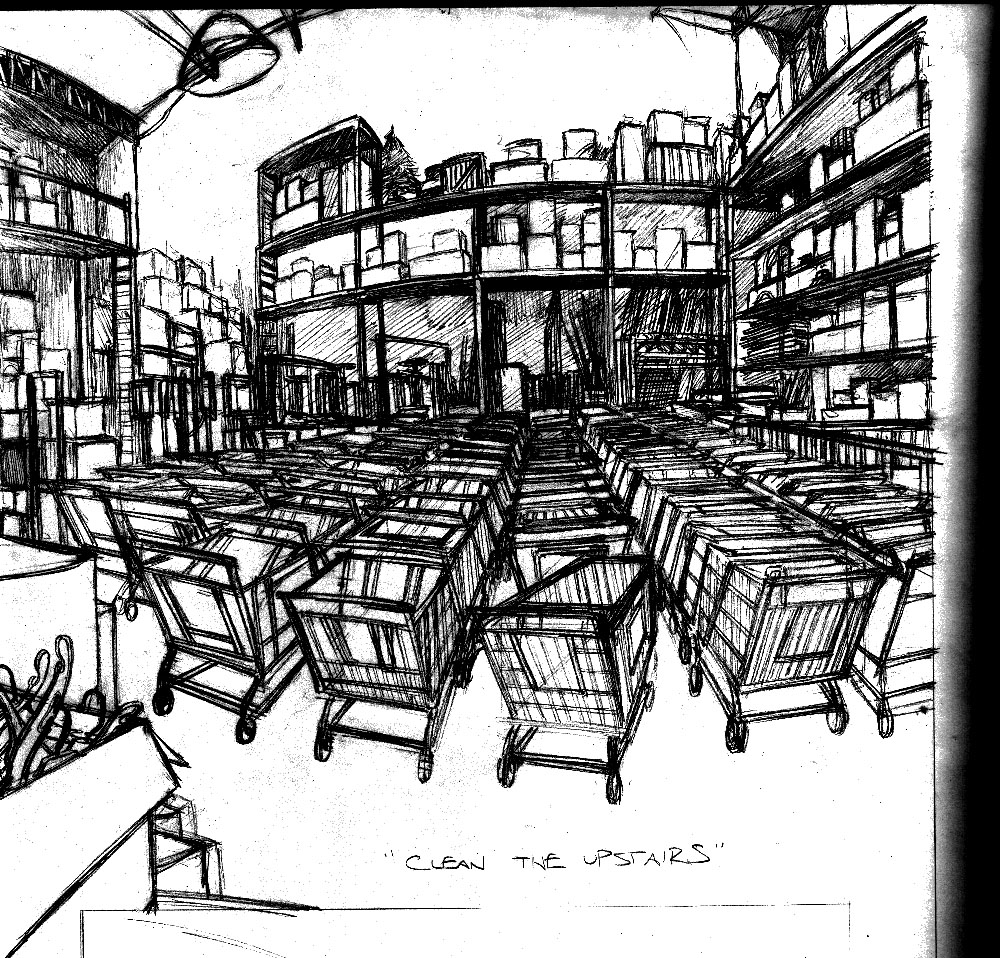
And all those little lines added precious time to each page. My work sessions took place every day after ten hours of teaching. I timed them. Each page was taking between 10 and 15 hours to complete, the majority of this time spent embellishing. “Well, you’re fearless, aren’t you?” cartoonist Jim Woodring told me once, staring at a page consisting of nothing but shopping carts in a darkened room. I don’t think he meant it as a compliment.

pencils from Discards, Sean Michael Robinson

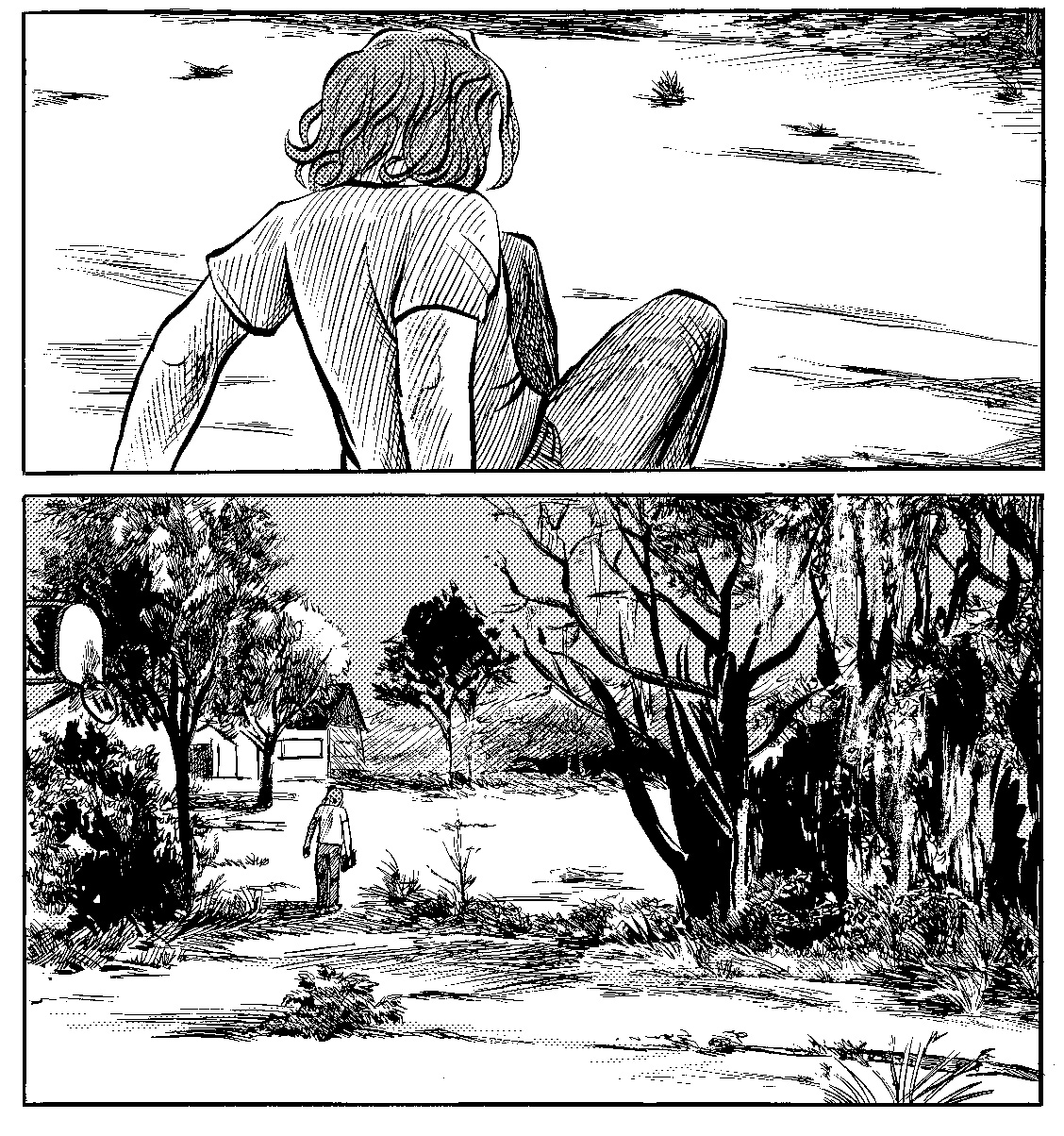
panels from Discards, by Sean Michael Robinson

B. Shifting Designs

panels from Discards, by Sean Michael Robinson

Even worse than the huge amounts of largely invisible effort was the waste caused by ineffective designs or “off-model” characters.

Somewhere, some when, some genius said it first. “In comics, style is way less important than consistency.” Whomever it was, I’d like to shake their hand, and then ask them to please build a time machine and head over to Seattle circa 2009 so that they can let me know in person.

My initial designs for my characters just weren’t very well-thought out. They weren’t easily distinguished from each other, not by body type, not by facial structure. And as a consequence of that initial failure, I just kept on tweaking even as I produced “finished” pages.

The result of this was a stylistic mishmash, where characters were sometimes only identifiable by the type of screen-tone applied to their hair. Had I applied some basic rules of design to differentiate them from each other at the start, it would have saved me a lot of grief.

scribble

This “design drift” was made even worse by the rudimentary nature of my cartooning. As an observational draftsman, I had some skills to draw upon at the start of the project, but as a cartoonist producing stylized forms from my imagination, I had a lot of work to do. And the better I got at these tasks, the more inadequate the previous pages seemed to my eye.

The crudity of the drawing was made worse by the surface polish of the inking and rendering.

Sylistic drift of this kind would have to be very dramatic to be visible over the time scale of, say, a ten page or even 25 page story. But a graphic novel is one contained unit. You can hold it in your hand, flip through it, stick your fingers between the pages. The first panel exists with the last in perfect simultaneity, no matter how much time passed in the process of creation.

This is not unlike the difficulty of assessing the work of, say, Dave Sim and Gerhard and their 26-year project Cerebus. The early issues of Cerebus, crude as they could be visually, still stood unified stylistically as they appeared, issue by issue. But as collections, the early work reads very differently. Much of this difference is undoubtedly due to this stylistic drift. What was an asset in the serial format (improvement of the artist over a prolonged period of time) becomes a liability when the format is changed.

Had I been publishing or otherwise making these portions of Discards publicly available as I worked, it’s possible that I would have been able to make peace with the early portions of the book. But as it was, unseen by anyone save my fellow Seattle cartoonists, the early pages shortly seemed unbearably crude to my eyes. And the more I developed, the wider the “awkward” phase of the book seemed to be.

“Be like a shark,” cartoonist Jon Morris tried to warn me. “A drawing shark. Don’t stop swimming. Just keep eating stuff.” And had I been working on a series of short stories, something where each unit could be its own contained unit, then I might have persuaded myself he was right. But this was a novel, dammit. Shouldn’t the first page look like the last?


C. Didn’t You Know What A Jerk You Used to Be?

sleep

The real end to all of this wasn’t my frustration with my drawing, or the labor of the large-format pages. I actually managed to correct course on both of these problems mid-way through the book, switching to a much smaller scale, working with more dramatic blacks and incorporating bold brush into some pages, and finally settling in to drawing the characters with an acceptable amount of consistency.

What finally sunk it was this – so much time had passed since the initial idea, I hated the whole story.

It was two cartoonist friends of mine, David Lasky and Helen America, that gave me the bad news that I was making a book about an asshole. He’s completely unlikable, they each told me over tea and cake. Why should we care about him at all?

This was a hard blow. I was, after all, in the process of making a story about someone who possessed many of my memories and experiences, if not always my actions or personality. How could they say something so harsh about him? About me?

And then, with their reactions in mind, I sat down and read what I had made.

I hated him.

Really, I hated me.

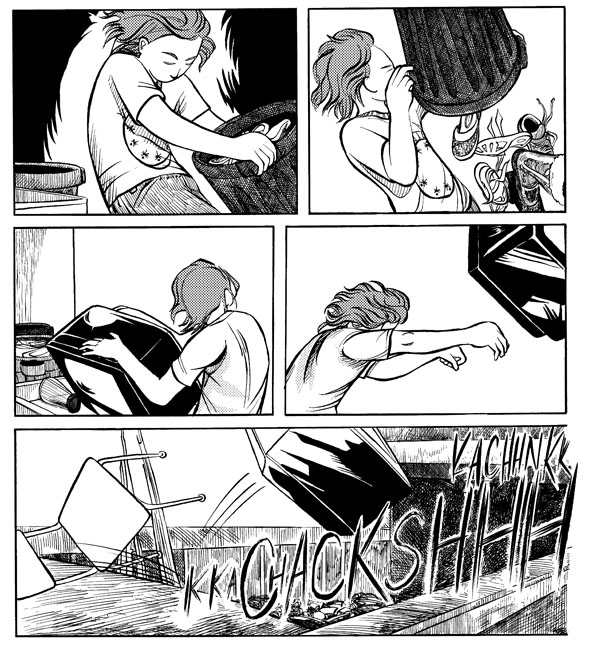
a panel from Discards, Sean Michael Robinson

kick

Here was a story about someone who is essentially a tourist in the lives of the people around him, who observes them from the comfortable distance of condescension. Several of the choices I made as a cartoonist reinforced these distances – the facial caricature, the dialect. Here, truly, was a book about a brash young man who is in fact an asshole. Who happened to have been based, at least partially, on myself.

I tried a few fixes, specifically, adding a sequence in the very beginning that gives the character some self-awareness of these deficiencies, letting the audience into his thought process a bit while introducing hints as to the events had shaped him into the person he was.

But it was too little too late. The project was definitively killed a month or two later, when I had my first taste of being paid to make things I was interested in. My labor was done, although Discards never would be.


What’s The Point Here, Anyway?

 high voltage

When I think about my brief time making comics for public consumption, I’m struck by the oddity of it all, that my most widely-read comic written and drawn in a single twenty-four hour period, was not labored over in any way at all. How different would my cartooning have been if I had used all the time I spent on Discards making other short, spontaneous comics instead? How many thousands of pages might I have now had I focused on content rather than the pursuit of some awkward perfection?

Of course, who knows what those comics that never were might have been like, and what kind of things they might have said about who I was at that time. Although the unfinished things in our lives can be painful, in some ways it’s the finished ones that are the worst, in that our failures are so clearly articulated by our own labors.

For me, finally, I’m happy for Discards to finally be what it is, a journeyman work in a box in a closet. A personal example of what can happen when you want too much and know too little. And, maybe, an example of how not to make a graphic novel.


Sean Michael Robinson is a writer, illustrator, and musician. You can contact him at LivingtheLine.com, or at seanmichaelrobinson at gmail dot com.

How do questions get answered in comics?

Years ago, when I was learning about cross-cultural communication and the teaching of English, a teacher of mine said that Americans are often considered very friendly by people from other countries. Sometimes, we’re considered overly friendly, overly intimate, especially when we meet someone new.  Her example was something like this:

  • A: How are you?
  • B: Fine thanks, how are you?
  • A: Pretty good. I’m actually on my way to a meeting.
  • B: Oh, okay. Maybe we can have coffee later.

People who are new to English have to learn that when Americans ask ‘How are you?’ we don’t really necessarily mean it. Maybe we mean it a little bit, but not enough to hang around for an extended answer. Sometimes we are really interested in finding out, but more often than not it’s a perfunctory question and it serves as a routinized greeting rather than an earnest or sincere inquiry. (There is an enormous amount of research in discourse studies and conversation analysis about questions and answers.)

Likewise, when we answer with ‘Fine thanks,’ it’s not because everything is necessarily fine, but because it’s ordinarily expected of us. In fact, if we offer more information than that, it could be seen as inappropriate. Under some, rather restricted circumstances, if someone asks ‘How are you?’ we can answer the question honestly:

  • I’ve got a stomach ache.
  • My car broke down and I need a thousand dollars.
  • Stan just gave his resignation to Melinda.

Usually, though, we reserve honest answers for close friends, spouses, and family members. Most often, though, the question ‘How are you?’ elicits a quick, conventional, standardized answer.

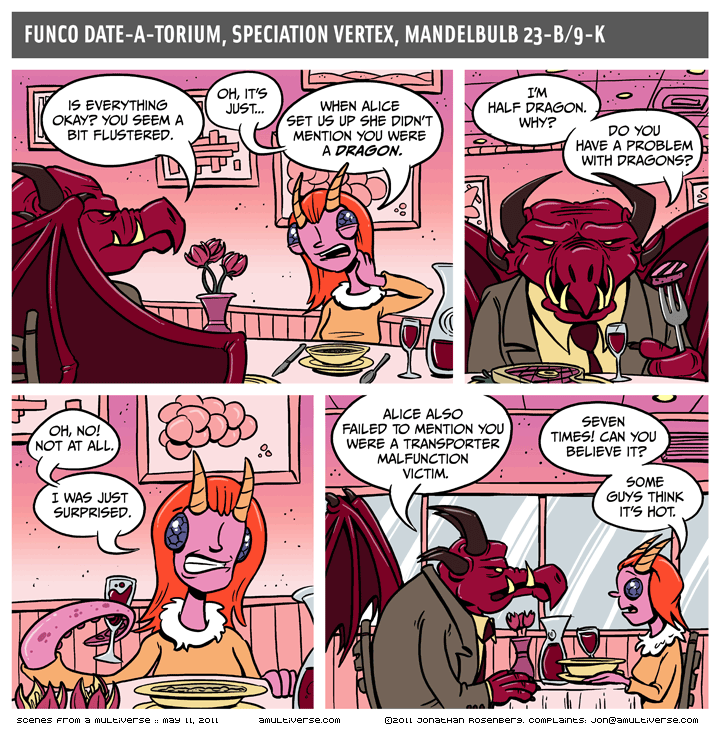
Not all question/answer adjacency pairs are routine, though. In web comics, especially those that are meant to be funny, the question/answer adjacency pair is used to further the humor of the strip. On a first date between a dragon and a transporter malfunction victim in Scenes from a Multiverse, a comic I wrote about before, questions can help uncover and solve problems or at least defuse tension:


2011-05-11-Blind-Date


There is a degree of similarity between Dragon’s question ‘Is everything okay?’ and ‘How are you?’ Both of them are queries about the state of the interlocutor: feelings, health, overall situation. But these two forms function very differently. In this comic, Dragon is genuinely concerned about how his interlocutor is feeling. We know this in part because of the follow-up, ‘You seem a bit flustered.’

The questions in panel 2 aren’t routine, either, especially since the two characters are out on a first date and attitudes toward dragons seem particularly germane given the situation. But in panel 4, there is another question: ‘Can you believe it?’ I don’t think this question is a routine question like ‘How are you?’ (Some people may call it a rhetorical question, popularly defined as a question that doesn’t need an answer.) This is a kind of question that is a frozen form, a formulaic utterance meant to anticipate/address an interlocutor’s question or comment about a topic or situation.

I’d like to consider question and answer adjacency pairs in two additional comics. One is from the absurdist web comic Wondermark and the other is from Saturday Morning Breakfast Cereal.


20130827 bat signal phone text email

Saturday Morning Breakfast Cereal, 27 August 2013


The question-and-answer exchange between Batman and Alfred is funny because it so clearly violates our expectations about how the Batsignal works as a call for help. Couple that with the disagreement about computer-mediated communication and Batman’s strong opinions about how it ought to be done, and no one is surprised by the last panel. Even Alfred’s question ‘Are you mad?’ is a query about Batman’s feelings (like ‘Is everything okay?’ in Scenes from a Multiverse, above).

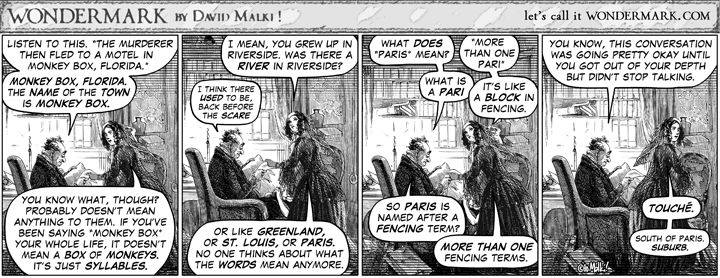
My last example shows how questions and answers can go a long way toward preventing clear communication. (Alfred and Batman have clear communication in the above comic, even though it may be a little bit frustrating for both of them.) This strip comes from Wondermark, and I wrote about it in an earlier post.


2010-12-03-682places

Wondermark, 3 December 2010


The question-and-answer exchange in Wondermark takes the notion to an extreme degree. The conversation starts out reasonably well, but by panel three, the interaction has gone awry. It is easy to see that the forms (the form of the questions and the form of the answers) are perfectly fine. The ‘problem’ (humor?) arises with the content of the answers. The forward motion of the conversation was strong enough to keep the exchange rolling, even if the questioner and perhaps the answerer knew that the train was going off the rails.

The forms of questions and answers in comics of course reflect to a degree our ‘real-life’ experience with them. It is the function of these adjacency pairs that provides a great deal of room for discussion. The three comics I chose are designed to be funny, and the comics artists use adjacency pairs as a linguistic component to propel the humor.

What comics have you read that called your attention to the particular forms of questions and answers?