The Good Boromir

I’ve written a couple of posts about ways in which Peter Jackson stumbles in his treatment of Tolkien. Basically, these criticisms come down to volume; Jackson tends to want to turn it all the way up all the time. Tokien’s a pretty slow-going — or, if you’d prefer, boring — writer in a lot of ways, and the slowness and the boringness is central not just to the form and experience of the novels, but to their themes. Tokien is someone who, like the Ents, wants to sit back in some wooded glade and tell you the names of everything. He likes being slow, he likes being boring — which is to say, there’s a lot of room in his adventure novels for the appreciation of the joys of having nothing in particular happen. The way his narrative continually stalls out is central to the novels’ rejection of violence — a rejection which is ambivalent, but in many ways determinative. Jackson can understand and rejoice in Tolkien’s battle scenes (as Tolkien does himself) but not in Tolkien’s various numerous nothing scenes. The films, therefore, are garish and loud and busy all through, embracing Tokien’s flash and fire and drama, but not his long, slow, Treebeard-like pauses.

There are a couple of instances, though, where I think Jackson’s version is better than Tokien’s. One of the most noticeable of these is in the character of Boromir.

In the Fellowship of the Ring (which I’ve just about finished reading to my son), Boromir — like most characters in the novel, with the exception of Frodo and perhaps Sam and Bilbo — is not given a whole lot in the way of subtle characterization. We learn that he is very strong and proud, and also that he’s strong and not especially trusting, nor, perhaps, trustworthy. He helps the company by plowing through snow with his body when they’re trapped on the mountain. He disagrees with Gandalf and Aragorn about the path the company should take. He boasts about Minas Tirith and the strength of men. And that’s kind of it. He doesn’t become friends with any of the company. For that matter, he doesn’t become friends with the reader. He’s a mighty, proud man, off there being mighty and proud, and then he tries to take the ring from Frodo like a dickhead, and then he dies mightily and proudly in battle. And overall it’s just hard to care that much.

The film, though, is quite different. In part, this is Sean Bean’s doing; he’s an incredibly charismatic actor, and he gives Boromir a jaunty, frat-boy, devil-may-care charm for which the book offers no textual warrant at all. But the writers, who commit many an atrocity to Tokien’s text, here also surpass him. There’s a wonderful scene where Boromir is teaching Merry and Pippin and (I think) Sam to swordfight in which they all end up together laughing and rolling on the ground. And there’s also a scene after they’ve left Moria, where the Hobbits are grieving for Gandalf’s death, where Boromir begs Aragon to give them a minute to recover themselves. In the books, his questioning of the leadership is almost always based on ignorance, or stubbornness; here, instead, it’s based on sympathy and care for his companions.

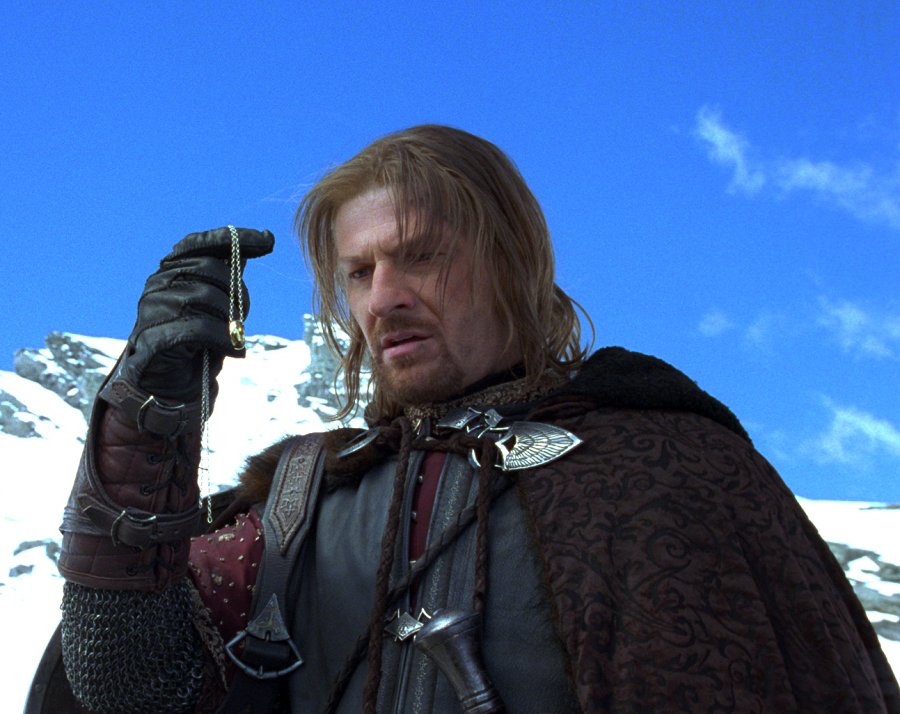
There are other little moments too. The writers split up Boromir’s speech at the end of the book; part of it, where he speaks of the ring as a little thing, and wonders why it holds such power over them, is delivered on the journey. The ring has come loose, and Boromir picks it up by its chain and gazes at it and addresses it, before handing it back to Frodo, cheerfully declaring “I care not!” as he ruffles Frodo’s hair. That “I care not,” in Tolkien (uttered when Frodo won’t show him the ring) comes across as sinister; a man trying to deceive. Sean Bean’s reading, though, sounds more like a man trying to deceive himself without even knowing he’s trying to deceive himself.

The earlier moment with the ring also makes it more responsible for Boromir’s corruption; it’s almost like it’s gunning for him. And the scene where he tries to take it from Frodo…again, in the book, Boromir was never all that pleasant to begin with, so it’s just an intensification of his unpleasantness. In the film, though, Bean manages to show Boromir’s corruption as the flip side of his virtues; his boisterous courage turned into aggression; his mercurial good cheer turned into petulance. It’s a virtuoso performance of a good man doing wrong.

The script also adds a level to Boromir’s character that is almost completely absent in the book; his relationship with Aragorn. In the book, the two men are mostly in sync; Boromir wants to go to Minas Tirith to aid the city, and Aragorn (as the returned king) plans to join him (though after Gandalf falls he worries he should go with Frodo instead). In the film, though (thanks no doubt to Peter Jackson’s need for more and more drama) Aragorn is deeply mistrustful of men (including himself), and wants nothing to do with the kingship. Boromir is at first resentful of Aragorn’s position (which will displace his father’s line of stewards), and angry at Aragon’s mistrust. But as he grows to know Aragorn, he changes — and as Aragorn grows to know Boromir, he changes too, drawing faith in men and rekindling his love of Minas Tirith from Boromir’s faith and love. At Boromir’s death, Aragorn vows, for the first time, to defend Minas Tirith — and Boromir, for the first time, pledges his loyalty. “I will not let our city fail,” Aragorn says, and Boromir repeats it with a kind of desperate satisfaction. “Our city…our city!” His final words — “I would have followed you, my brother; my captain; my king” — are, then, in many ways, the conclusion of a love story — a bittersweet consummation, with Boromir finally embracing the future he will never see. The scene always makes me cry…as opposed to his final words in the novel the Two Towers (“Farewell, Aragorn! Go to Minas Tirith and save my people! I have failed.”) which pretty much just makes me shrug.

It’s interesting, perhaps, that not only is the Boromir arc one of the few things that I think Jackson unequivocally did better than Tolkien, but it’s also one of the best things in the films, period. Jackson’s twitchiness and Hollywood instincts — his need to give Boromir something to do, his need to make a star appealing — get filtered through Sean Bean’s considerable skills and end up turning a dour nonentity into a nuanced character. If for Tolkien and more complicatedly for Jackson, Boromir’s strength turns to weakness, it’s nice to see Jackson, in this instance, turn his weaknesses to strengths.
 

Boromir34_b

Make It Bigger

It’s easy to see that comics do not enjoy the prestige or financial backing of the fine arts. It’s harder to justify why not. Many arguments are primarily emotional– the textbook Art Since 1900 discusses comics with thinly veiled disgust, and a cartoonist or publisher can self-righteously reply that art world acceptance is something owed to them.  Some argue that differing treatment is a matter of different histories. The broadsheet ancestor of comics branched off  from the ‘fine art’ lineage centuries ago, but this ignores the rampant interbreeding of art and comics, and the intersection of their audiences, for the last fifty years.  An alternative, manifold hypothesis is given by the prolific comics scholar Thierry Groensteen in his book, Un Objet culturel non identifie (An Unindentified Cultural Object, 2006). Groensteen proposes five ‘symbolic handicaps’ crucial to the devaluation of comics.  Beaty offers an aggressive treatment of these in his book Comics Versus Art (2012):

“First, he argues that comics are a ‘bastard’ genre resulting from the ‘scandalous’ mixture of text and image; second, that they are intrinsically infantile and consumed by adults who are seeking to prolonge their adolescence; third, that comics are associated with one of the most degraded branches of the visual arts, caricature; fourth, that they have not been integrated into the development of the visual arts throughout the course of the twentieth century; and finally, that the images produced in comics do not command attention as a result of their multiplicity and tiny format.”

Beaty disregards the first two handicaps only in that they rely “heavily on the intersection of the form with pre-existing aesthetic discourses that had little to do with comics per se… “ Yet he only seriously considers handicap number four, comic’s segregated development from the contemporary art-world, as an obstacle to wider readership.

While this angle a deserves a book on its own,  Groensteen’s third and fifth handicaps are worth a harder look. Beaty points out that comic’s relationship to caricature is used to elevate comics more than devalue them, but this association also creates a glass ceiling, where comics can not rise above the marginal place of caricature in the art-world. Beaty dismisses Groensteen’s last handicap, saying,

“Similarly, when Groensteen suggests that comics suffer because of their format, their small printed size and the multiplicity of images, it is difficult to accord this factor any great weight. Groensteen himself devotes very little attention to the suggestion and is not able to mount a particularly compelling case for it. While monumentality has been an important aspect of the visual arts for centuries, it does not seem to follow that small-formatted works have been particularly disparaged specifically for their size.”

Yet perhaps without realizing it, Beaty cites at least three major examples where a comic panels was magnififed and isolated from their sequence in order to elevate their source.

Comics Versus Art presents a thorough history of comic-centric art shows. One of the first major gallery shows dedicated exclusively to comics was held by SOCERLID (Societe civile d’etude et de recherché des literatures dessinees) in 1967 at Paris’ Musee des arts decoratifs, which is part of the Louvre. The show featured three sections on comic art, although the curators didn’t showcase any original strips or pages. Instead, they hung ektachromes and photographic enlargements of individual comic panels, with the coloring removed. The curators argued “thanks to the quality of the paper and clarity of the blacks and whites, the photographic enlargement makes it possible to free the comic strip from the small size that stifles it and to exhibit it in the usual dimensions of the works of art to which the public is accustomed.”

Many more gallery shows sidestep comic narrative altogether in favor of what the curators believe to be the form’s mosts substantial contribution to society—its characters. In a survey of several museum shows that drew inspiration, but did not include, comics, Beaty concludes, “these exhibitions indicated that it is the iconography of comics, rather than the formal—that is to say sequential—elements that is mostly commonly appropriated by artists influenced by comics.”  The Institute for Contemporary Art’s 1987 show Comics Iconoclasm featured sections on cartooning technique as well as sequential storytelling, rare for most comics-centric gallery shows, yet both of these sections were dwarfed by the section on cartoon icons.

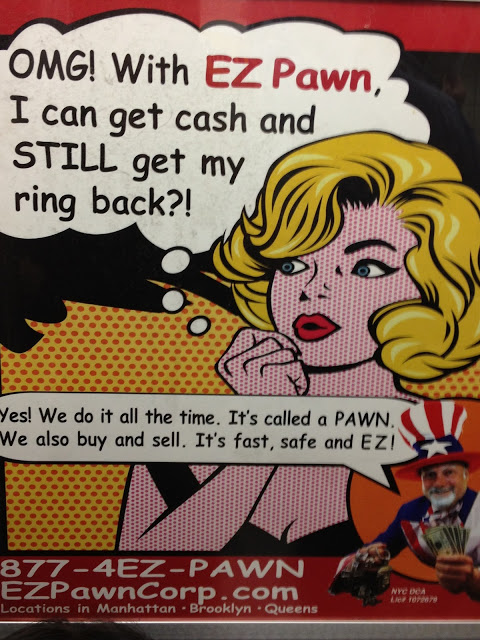
The legacy of Roy Lichtenstein and his comic panel appropriations, often accused of barring comic’s high-brow acceptance, could be the best example of all. Lichtenstein’s work has ensured immortality for the ‘look’ of mid-twentieth century romance and war comics. Museums adore and celebrate Lichtenstein’s accessible iconicity in their marketing, even as this look has been endlessly adopted by advertising. The look engulfs whatever meaning Lichtenstein has an artist, or his paintings have as individual works, and today the ben-day dot women function as stylistic, feminized stick figures. Yet this wouldn’t have happened without Lichtenstein’s blow-up treatment, and the strange prestige it accorded it.

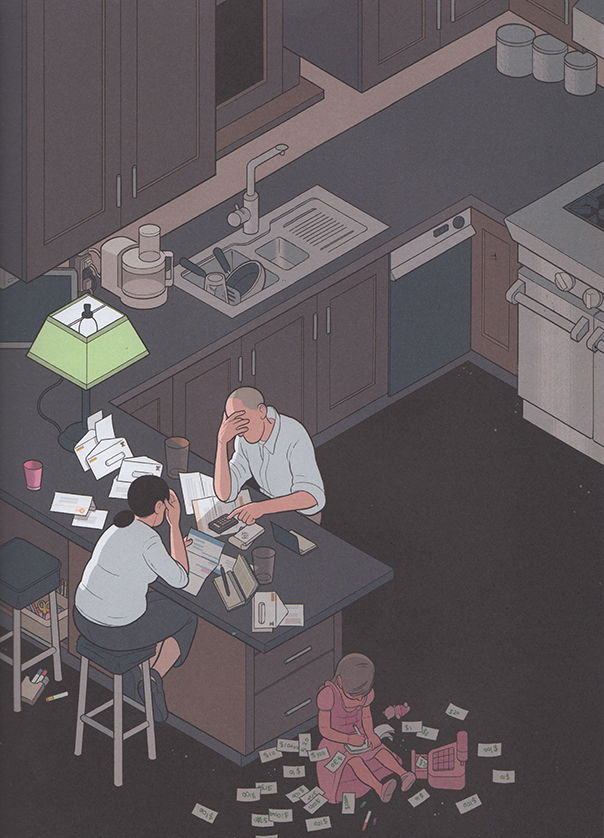
Pawn shop NYC subway

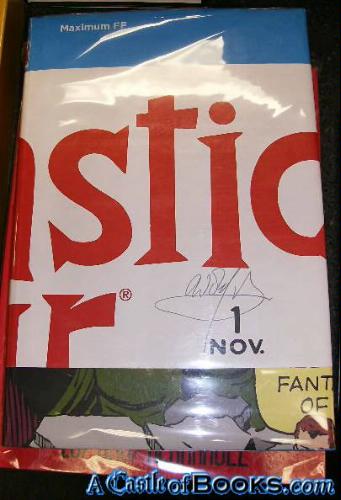
Beaty documents related examples in the world of mainstream comics publishing. Maximum FF, a deluxe-edition book published in 2005 by Marvel Comics, was one telling attempt.

“An oversized hardcover with an elaborate fold-out dust jacket, Maximum FF is a 234-page version of the first issue of Fantastic Four, by Stan Lee and Jack Kirby, originally published as a twenty-five-page comic book in 1961. Mosley and Sahre expanded the original work almost ten-fold by dramatically restructuring it: by disaggregating the individual panels and presenting them one per page, one per double-page spread, and even, on two occasions, as quadruple-page gatefolds.”


Maximum FF

Beaty goes on to say that the ‘splash’ page and double-page spreads,

“…are particularly valued by collectors of original comic book art because they often present characters drawn on a larger scale than is typical for a comic book and, consequently, are more impressive when framed. For some collectors, the splash page and comic book cover are the most valuable parts of the comic because they are most akin to traditional gallery and museum aesthetics—they are not tainted with the sequentiality that is often held to define the comics form.”

Groensteen would agree with the idea that comics is tainted by its sequentiality, or at least sequentiality is not very relevant or attractive to most of society. Tellingly, the earliest definitions of comics focused on its use of recurring characters and speech bubbles than on its sequentiality—something Beaty recognizes in the first chapter of his book.

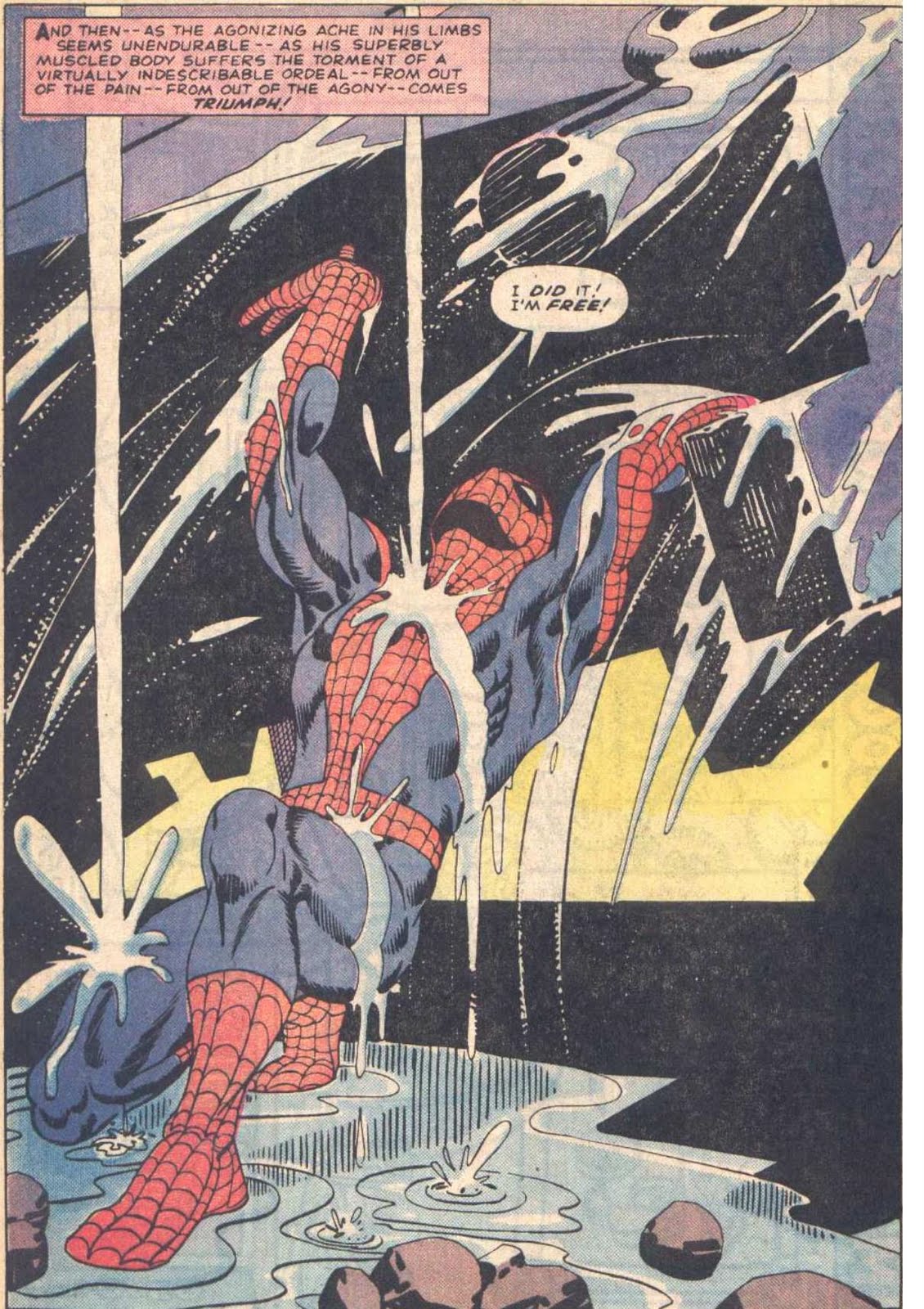
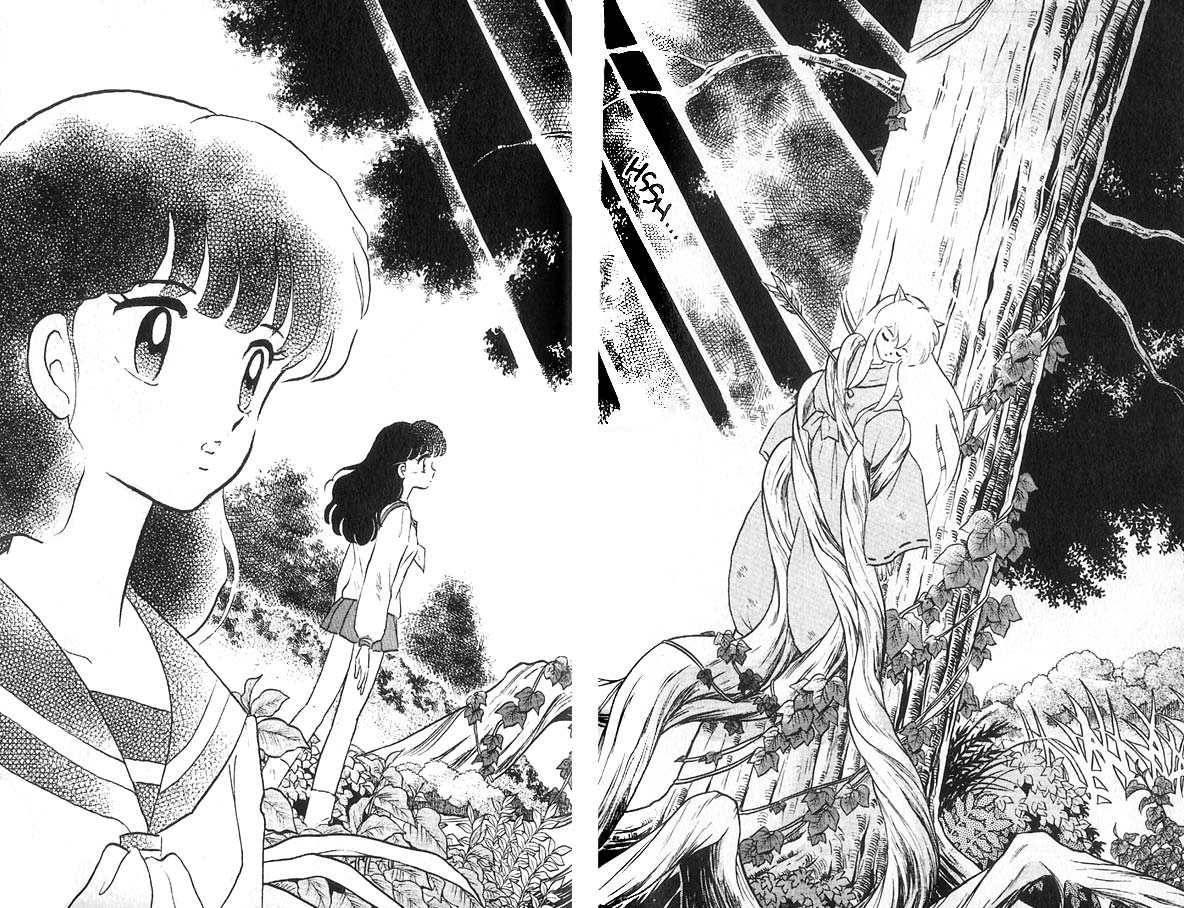
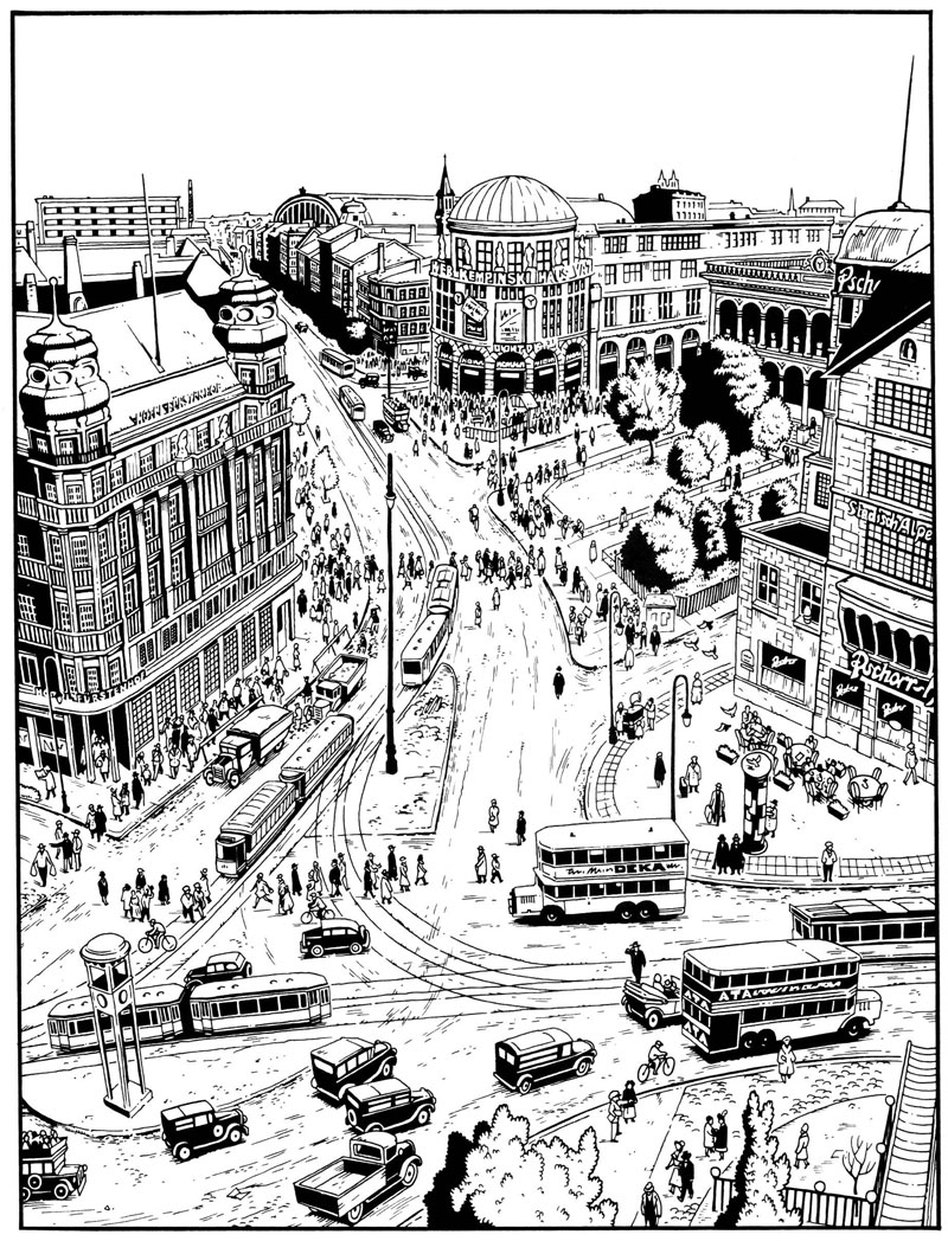
It’s worth wondering about the phenomenology of the splash page and double-page spread, and what happens when they are used in comic books. The splash page is a ubiquitous element of many comics, from American superhero books to manga to independent minicomics. It’s use isn’t random—splash pages most often introduce a story, establish the grandiosity of a setting, or monumentalize the climax of a single issue or narrative arc. The effect is always intended to be eye-catching, attention-grabbing, and big.

Spiderman Splash Page

Steve Ditko and Stan Lee, Amazing Spider-Man, Issue #33

Inuyasha Double Page Spread

Rumiko Takahashi, Inuyasha, Book 1

berlin_splashpage

Jason Lutes, Berlin, Volume 1

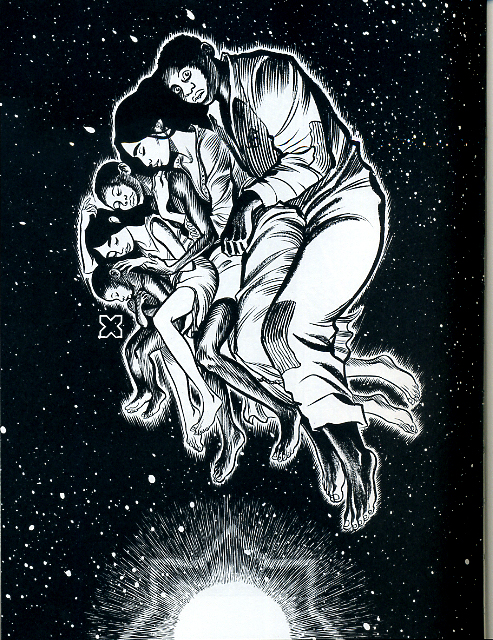
The splash page is a part of the vocabulary of comics, (or at least its grammar,) and some cartoonists play with or complicate the concept more than others. Within the limited scopes of alternative comics, a few recent examples come to mind. In Craig Thompson’s Habibi, (2011) (which I reviewed here,) a preponderance of splash pages marks the end of the book. Thompson’s loud pages erupt with obvious, mystical-religious imagery, asserting not only that an epic moment has been reached, but that moment is ever-present. The artwork grasps at transcendence, and the narrative, increasingly interrupted, begins to break down.

Habibi Splash Page

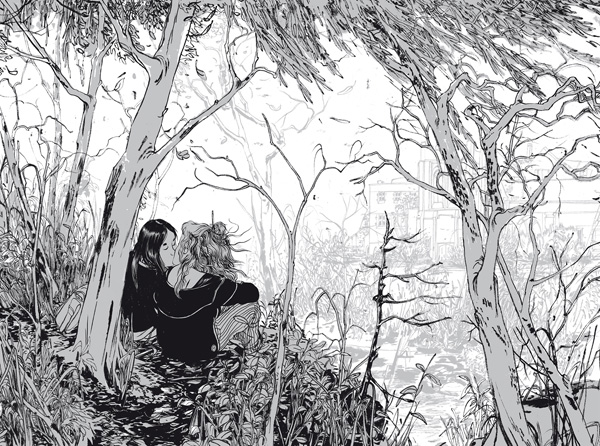
Skim, by Mariko and Jillian Tamaki, (2008), paradoxically uses splash pages to transition between scenes, layer impressions, and create a sense of passing time, even though  only a single moment is presented. Both approaches use splash pages earnestly, but where Habibi’s splash-pages-on-steroids amplifies their stillness and power, Skim  converts this potential energy into emotional movement.

Skim Double Page Spread

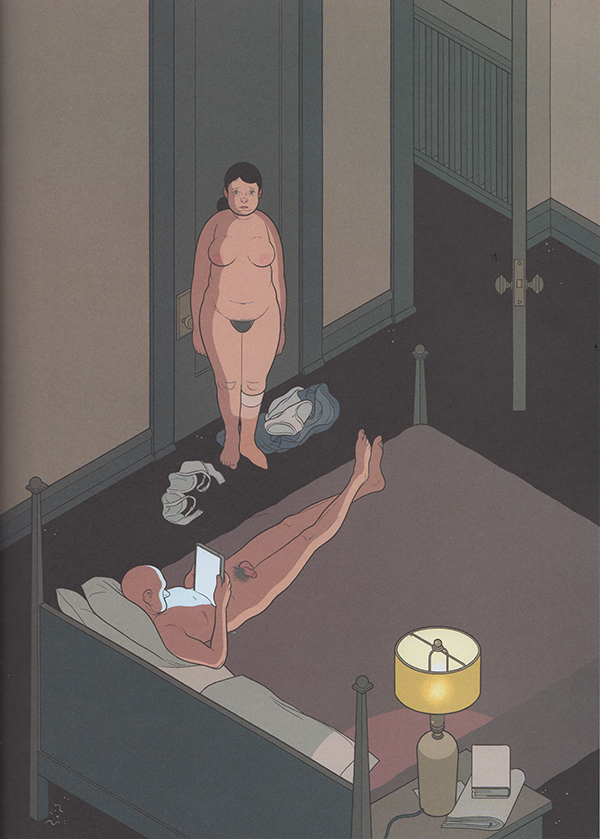
In Chris Ware’s Building Stories, (2012), the cartoonist ironizes the epic quality of the splash page by depicting banal moments in the life of his characters. However, the splash page has the last laugh, fostering a sort of ‘epicly banal’ or ‘very depressing’ feeling, which hasn’t escaped the notice of critics like Douglas Wolk. Perhaps Ware’s splash pages are better read as mislaid covers; they share the cheeky realism of his illustrations for The New Yorker, and one of these pages was featured as a ‘joke cover’ on the New Yorker site. It seems difficult to use the splash page insincerely– it transforms its content into something remarkable, whether the artist meant it to be read that way.

buildingstories_splashpage_2

buildingstories_splashpage

It’s funny that one of the most prominent and dramatic techniques in comic storytelling is one that makes a comic behave a little less sequential, fragmented, even hybrid-like. While captions and speech balloons are often present, they feel less like a competing element, especially in terms of scale, (aside from the author credits and copyright jargon jammed into some mainstream pages.) The splash page isn’t actively read as much as it is passively gazed upon, or absorbed, as if on a wall. That jump from reading to gazing is partially what makes experiencing a splash page feel profound. But only one moment can be presented, and there often isn’t much to figure out. The splash page is the opposite of the comics gutter, the space between the panels that contains the ‘unshown,’ and according to Scott McCloud, generates the medium’s storytelling power. While splash pages and individual panels are the easiest to display, a cartoonist’s panels and gutter transitions better capture the essence of a narrative work.

Its not surprising that the art-world and collectors, unsure of how to hang comics on a wall, would favor panels and pages that behave more like paintings. But is it possible to successfully bring comics narrative– small, printed, sequential and ambiguous– into a museum setting? Or is its special breed of profundity incompatible with what attendees expect from a gallery show? Outside of more people reading actual comics, (and how would they be convinced to do that?), is there a venue, or a kind of oration, that better matches the type of transcendence a comic book achieves, rather than what it reaches on one page or panel? As long as the gallery-show remains the standard by which high-brow acceptance is judged, discussion of what makes the comics medium work, (or even great,) will be locked onto their resemblance of fine art. Artists with greater technical skill will be rewarded most, despite the fact that the art world has bucked judgements of skill, chaining comics to a quaint nostalgia for draftsmanship.  And severing panels from their original sources does not an art movement make– shows will remain an oddity, a fun, occasional diversion from looking at real art. Many people would not mind. Some readers will always need comics to act a little bit more like other things, in order to love them in those kinds of ways.

Car-TOON cha cha cha

This is part of a series on people who, renowned for other accomplishments, have also been cartoonists– some professional, some amateur

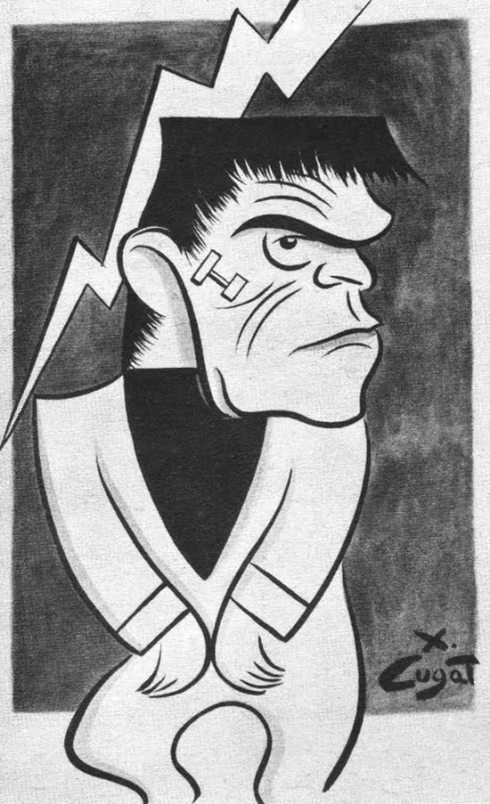
xaviercugat

Francisco de Asis Javier Cugat Mingall de Brue y Deulofeo (1900–1990), better known by his stage name Xavier Cugat, was the prime big-band maestro of Latin American music: rumba, mambo, cha-cha.

He was also a professional cartoonist and illustrator all his life.

Cugat and his band at New York’s Waldorf-Astoria hotel. One of his trademarks was conducting while holding a Chihuahua dog.

Born in Catalonia, Spain, Cugat moved with his family to Havana, Cuba, when he was three. A trained violinist and arranger, he packed up and moved to Los Angeles, where he worked as a cartoonist for the Los Angeles Times newspaper during the day and played in  a band at night.

This is a neat reversal of the usual situation of an artist working a day job and cartooning in his free time.

Greta Garbo

After a few years of playing smaller clubs in the Los Angeles area, Cugat  got his big break when he and his band played the prestigious Coconut Grove nightclub in 1928. His style of music caught on; in the ’30s and ’40s he was nicknamed “The Rumba King” because of his popularization of that dance.

But despite all his success in concerts, records, radio, movies and (later) television, Cugat never quit drawing, providing humorous covers for several of his own record albums, publishing collections of his star caricatures and even producing an illustrated curtain for Grauman’s Chinese Theatre.

His caricatures are spare and assured, reminiscent of those of Al Hirschfeld. Below are some radio comedians:

An album cover:

A painting done for his personal pleasure:

Finally, a self-portrait:

In previous installments of this series on part-time cartoonists (with more to follow), we saw a talented amateur in Enrico Caruso, and a skilled dilettante in G.K.Chesterton.

Cugat stands out because he remained a professional cartoonist all his life, taking his graphic work as seriously as his music.

For which I tip my hat…and dance a few steps…cha-cha-cha !

Nate Silver and the Morality of Prediction

This first ran on Splice Today.
___________

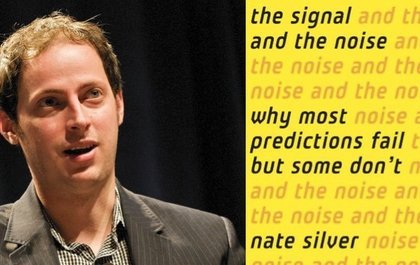
Nate Silver’s The Signal and the Noise: Why So Many Predictions Fail — But Some Don’t appears, at first glance, to be a guide to better wonkitude.  In fact, though, it’s something of considerably more interest — an argument for how and why predictions are central to creating a better world.  The good is predicated upon good prediction — which means that (though Silver never explicitly says as much) forecasting is not just a skill, but is a moral act.  The Signal and the Noise, then, somewhat surprisingly, is as much a guide to ethics as a guide to statistics — or, perhaps more accurately, is a guide which suggests that you cannot do ethics without statistics, and vice versa.
 

rsz_nate_silver_large

Silver is best known for his political prediction site, fivethirtyeight, which has become legendary over the last four years for its success in calling Presidential and Senate elections.   He’s also well known for using baseball statistics to predict player performance, and or his moderate success as an online poker player.  Silver spends time discussing all of these endeavors, None of these endeavors seem to have much of a moral content — but Silver’s book also focuses on other venues for prediction where the virtue of getting things right translates more easily into virtue, period.  Predicting hurricanes, earthquakes, or terrorist attacks all have obvious and large scale effects on many, many people. Similarly, evaluating the probability of climate change is hugely important for just about everyone on the planet.

How, then, can we improve predictions?  Silver offers a number of suggestions — but the most important boil down, perhaps, to a willingness to acknowledge how hard it is to improve predictions.  Silver divides forecasters into two groups: hedgehogs and foxes.  Hedgehogs for Silver are people with a single big idea, which they stick to tenaciously. Foxes, on the other hand, are uncertain, eclectic, and willing to change their minds.  Hedgehogs have grand theories; foxes limited hypothesis.  Hedgehogs believe in their models; foxes don’t trust theirs.  Hedgehogs pronounce and then confidently demonstrate how the data fit their pronouncements; foxes look at the data first, and then, cautiously and with many reservations, try to see if there is a pattern.

Hedgehogs, Silver argues, are more likely to be interviewed on talk shows or get quoted in the press, because they’re the ones likely to make shocking and exciting predictions that garner big headlines. You’re more likely to sell books if you declaim that the US will definitely face a major flu pandemic in the next 10 years which will kill millions.  But you’re more likely to be right if our claims are less ostentatious and more foxy — if you admit, for example, that flu pandemics are hard to predict, and that the likelihood of a deadly outbreak is tricky to measure with certainty, which is why (as Silver reports) many flu scares in the past have failed to pan out.

Foxes, Silver says, need in particular to acknowledge and understand their own biases.  The idea here is adamantly not to eliminate biases, which Silver suggests is impossible, and probably not even desirable. Instead, it’s to make explicit where the forecaster is coming from — to figure out what the forecaster is assuming (based on common sense, expert knowledge, rules of thumb, or even rank ideology) before she makes her prediction.

This is in part why Silver (and most other statisticians) advocate Bayesian reasoning. In Bayesian reasoning, a forecaster begins by stating her own estimate of an events probability, and then adjusting that probability on the basis of subsequent evidence and events.  Bayesian reasoning, in other words, forces a forecaster to admit to her own prior biases, and then test those biases against what actually happens.

To be a foxy Bayesian, then, is to be possessed of humility and honesty — particularly self-honesty.  These are obviously important virtues in most moral systems, and Silver is entirely convincing when he claims that they are vital to the art of prediction.

A funny thing happens, though, when humility and honesty are instrumentalized as part of the predictive process.  Specifically, it ceases to be clear that humility is humility, that honesty is honesty, or that either are particularly virtuous.  Thus, for example, Silver’s enumeration of the virtues of foxes is pretty clearly an enumeration of his own virtues — he is the fox, pointing out the flaws in all those arrogant hedgehogs.  This isn’t necessarily a problem for his arguments per se — but it does give that section of  the book an unpleasant air of self-vaunting.

More consequential, perhaps, is Silver’s discussion of  the great poker player Tom Dwan.  Silver is clearly extremely impressed with Dwan, and singles him out as an exceptionally good poker player — which means, specifically, an exceptionally honest one.  Dwan “profits,” Silver says, “because his opponents are too sure of themselves.”  Dwan, on the other hand, is great in large part because he knows how great he isn’t.  “‘Poker is all about people who think they’re favorites when they’re not,'” Silver quotes Dwan as saying.  “‘People can have some pretty deluded views on poker.'”

So, again, Dwan’s strengths are the virtues of honesty and humility — and he uses those virtues to make a living by preying on the weak.  Silver explains that the weakest players in poker support all those above them in the pecking order.  If you’re making money in poker, it’s almost certainly because there are people in the game who don’t know what they’re doing — who think they are far better than they are, who are deluding themselves, who don’t know how to play.  Dwan’s virtues — and Silver’s, when he was playing poker professionally — allow them to make rational predictions, and thereby to systematically take advantage of the less virtuous/clever.  Improving predictions here seems less like a way to improve the lot of humankind, and more like a way to create a more perfectly rapacious capitalism.

“Presuming you are a betting man, as I am,” Silver writes at one point, “what good is a prediction if you aren’t willing to put money on it?” It’s a telling formulation, seamlessly linking money, predictions, and goodness.  For Silver, the sign of virtue and value is money — the marker of success.  Honesty and humility are worthwhile because they lead to results — and you can measure those results best through cash.

The problem here is not that Silver is wrong.  On the contrary, the problem is that he’s right. His moral vision is, for all intents and purposes, the moral vision that matters.  His algorithm — greater virtue -> progress -> good-certified-by-money — is as close to a consensus ethical vision as we’ve got.  Refine our tools, increase our knowledge, improve our lives, if only incrementally.  That’s how modernity works.

It’s certainly an attractive vision, and not one that anyone can oppose categorically.  Who wouldn’t like better foreknowledge of earthquakes or disease outbreaks?  Yet, at the same time, it might be worth remembering that controlling our lives and living a good life are not necessarily the same thing.  They can even, in some cases, be opposed.  A world of foxes is not a heaven if those foxes are all intent on devouring each other.  Silver would be the first to say that we will never know the future.  His solution — and it is a moral solution — is that we should work hard at predicting it just a little better and a little better.  Perhaps, though, in addition to becoming more and more powerful predictors, we might devote some time to thinking about how, in a world where our future is uncertain and our power limited,  we can best treat each other not as foxes or hedgehogs, but as human beings.

The Art of Racism

A version of this review first appeared at the Chicago Reader.
__________

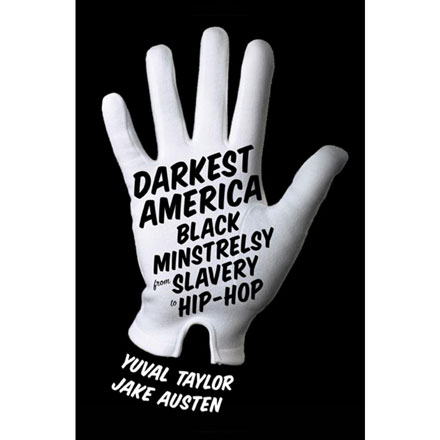
“It was shocking that in a city bursting with parade enthusiasts and curious tourists, a pair of European women who stayed less than an hour were the only white faces in the crowd other than ours,” write Yuval Taylor and Jake Austen in their new book Darkest America: Black Minstrelsy from Slavery to Hip-Hop. (100-101) The two are describing their experiences at Mardi Gras, where they went to watch the Zulu parade, one of the few places in contemporary America where African-Americans will wear blackface as a matter of course. Taylor and Austen describe their own experiences at the parade in order to convey the manic strangness of carnival; to show why and how even blackface can be normal there. At the same time, though, by highlighting their presence at an all-black parade, they emphasize their whiteness — and, paradoxically, their adoption of blackness. The Mardi Gras description is, at least in part, about two white authors momentarily joining the black community. In that sense, the passage can itself be seen as a kind of literary blackface.

This is not to criticize Taylor and Austen. On the contrary, this very mild stumble — if it even rises to a stumble — serves mostly to throw into relief how very surefooted, thoughtful, and perceptive they are for the bulk of the book. This is no mean achievement, since black minstrelsy — the practice of blacks donning blackface and/or performing routines associated with minstrel shows — is surely one of the most charged and uncomfortable topics in American pop cultural history.

In the late nineteenth and early 20th century, blackface performances by whites perpetuated vicious racist stereotypes of happy, lazy, stupid chicken-eating, watermelon-slurping, vacuously-grinning darkies. And yet, as Taylor and Austen show, blacks themselves have been long time, and even enthusiastic participants in the minstrel tradition. From Louis Armstrong to Flavor Flav, minstrel clowning and tropes have been central to black American music and black American comedy.

What, then, did blacks get from minstrelsy? Was it an example of false consciousness, with African-Americans duped into adopting hurtful stereotypes as their own? Or were black entertainers forced to adopt minstrelsy to make a living in a white-controlled entertainment industry?

Such explanations have been staples of the longstanding black anti-minstrelsy tradition, from Richard Wright to Spike Lee’s 2000 film Bamboozled. But while Taylor and Austen have great respect for anti-minstrelsy’s commitments and aesthetic achievements, they mostly reject its conclusions. Black minstrelsy, they argue convincingly, was not, at least for the most part, the result of self-deception or coercion. No one, for example, forced the politically engaged Paul Robeson to record “That’s Why Darkies Were Born,” a minstrel type song which told blacks to labor cheerfully in the cotton-fields and “accept your destiny.” (208)

Instead, Taylor and Austen argue, blacks used minstrel traditions in a number of different ways. Sometimes, they deployed it as a critique— as Spike Lee does in Bamboozled. Sometimes, they adapted and subverted racist messages, as in Robeson’s version of “That’s Why Darkies Were Born.” Robeson, Taylor and Austen argue, treats the song as a spiritual, in which blacks shoulder suffering, hardship and injustice on their way to the Promised Land. Rather than a justification of racism, in Robeson’s hands the minstrel song becomes a dream of liberation. In a similar vein, the great early-20th century black blackface performer Bert Williams injected pathos and nuance into his performances and songs, undermining the racism of minstrelsy by emphasizing the humanity of his characters.

While black minstrelsy could be used consciously to confront or undermine racial tropes, however, that does not seem to have historically been its main appeal to black performers and black audiences. On the contrary, in many cases, Taylor and Austen suggest, minstrelsy was enjoyed by blacks in much the same way it was enjoyed by whites — as low humor and nostalgic escapism. Southern hip hop performers who gesture towards minstrelsy with clowning about chicken or watermelon do so because they enjoy such humor…and aren’t going to be embarrassed about it just because various cultural arbiters say they should be. Similarly, Louis Armstrong sang “When Its Sleepy Time Down South” — with its evocation of the lazy “dear old Southland” — because a nostalgic vision of ease and plenty appealed to him and other blacks during the Great Depression, just as it appealed to whites. (211)

In minstrelsy, this paradise of laughter and ease is, of course, racialized. A world of blackface is a world in which, by definition, everyone is black. For whites, this world is in part an object of ridicule. But it is also, as Taylor and Austen argue (and with their trip to Mardi Gras, perhaps demonstrate) an object of yearning. To put on blackface is, for whites, to be free, crazy, funny, authentic, cool. And this is also, Taylor and Austen suggest, what it means, or can mean, to put on blackface for blacks. Thus, Zora Neale Hurston, who loathed white minstrelsy but used minstrel tropes extensively in her work, often spoke admiringly about black primitivism, naturalness, and spontaneity. “[T]he white man thinks in a written language,” she said, “and the Negro thinks in hieroglyphics.” (269)

Hurston’s investment in black minstrelsy and black folk traditions inspired her to create Their Eyes Were Watching God, one of the great American novels of the twentieth century, built on her love of black people and black community. But her investment in minstrelsy also arguably inspired her to oppose integration, on the grounds that she didn’t want black primitivism and naturalness to be contaminated. Racial pride and racism for Hurston were two sides of the same mule bone.

Hurston’s habit of calling herself “your little pickaninny” in letters to a white benefactor is viscerally jarring. But her black minstrelsy is perhaps only a more exaggerated and painful form of a problem that confronts any minority cultural production within a racist society. Black music, theater, literature, entertainment, and comedy, from the days of black minstrelsy to the present, have been a glorious, seemingly limitless aesthetic treasure. But those riches have been created, and are in some sense dependent upon, the subcultural marginalization resulting from segregation and oppression. To celebrate black cultural achievement, whether Mardi Gras, or Hurston, or even Paul Robeson, is to celebrate in part the fruits of racism.

Nothing could make this clearer than black minstrelsy, a black art form built — with courage and cowardice, subversion and acquiescence — out of racism itself. Darkest America is, in this sense, not a story about an obscure and forgotten curiosity. Instead, it is a surprisingly graceful and erudite recuperation of what may be our most inspiring, most shameful, and most American art form.
 
Darkest-America-magnum

Robin Hood vs. Sons of Beckett

Robin Hood, founding father of noble outlaws across the multiverse, has no secret origin. He doesn’t even have a Year One. William Langland knew some “rymes of Robyn hood” when he wrote Piers Plowman in the late 1300s, but no one can sing those originals now. The original Boy Wonder enters The Merry Adventures of Robin Hood as “a youth of eighteen, stout of sinew and bold of heart.”
 

images

 
Howard Pyle’s 1883 readers didn’t need any born-that-way mutations or radioactive arrow bites to explain the kid’s archery skill or endless law-eluding superpowers. No murdered parents, no exploding planet, just a tussle with some unsavory knights and his life of vigilante justice is up, up and away.

Robin Hood, if he existed, was born in the 1100s or so. Scholarly guesswork includes 1110, 1160, and 1210. Personally, I’d go with 1171. No later than September, though possibly as early as December 1170.  If you really want to be dramatic, then December 29th.  And not for the Christmas themed, Robin-is-our-savior angle.

The 29th is the day a lynching posse of four vigilante knights strolled into Canterbury Cathedral and murdered Archbishop Thomas Becket at the altar. Or at least there’s an altar now to memorialize the spot. I found T. S. Eliot’s Murder in the Cathedral criminally dull when I read it as an undergraduate—except when the knights step through the fourth wall and give a literally prosaic defense of their actions. A make-believe vigilante like Robin Hood would never have done anything so dastardly. Plus the outlaws were serving their King, so not really the break-the-law-to-serve-the-law shtick either.

Becket was sainted as a martyr afterwards. Richard Burton played him in the film version, winner of the 1964 Oscar for Best Adapted Screenplay. Peter O’Toole was Henry II. They start out a dynamic duo, the carefree King deflowering local daughters of the peasantry with his trusty man servant as look out. The grinning girl in the window assures us it was just a wholesome romp.

Things don’t go awry till Henry makes Thomas the Archbishop. He’s hoping to get those pesky clergy under control, and has no idea that Thomas is going to take all that religious nonsense seriously. Like when a priest rapes a nobleman’s little girl. Becket is supposed to hand the pedophile over, not shield him under church law. And he’s certainly not supposed to excommunicate the father when another lynching posse exacts vigilante justice on the priest.

The screenwriters cut some corners, but that’s the gist. The historical Becket wouldn’t turn clergymen over to law enforcement. Priests accused of rape are handled in-house. Since Becket is the noble hero of the tale, the film swerves past the crime scene as speedily as possible. Eliot doesn’t even mention it. But church officials protecting pedophile priests are common headlines these days:

“Cardinal’s Aide Is Found Guilty in Abuse Case” (New York Times, June 22, 2012)

“US Bishop Convicted of Covering up Clerical Sex Abuse Pressured to Resign”(The Guardian, 8 September 2012)

“Another Catholic Sex Abuse Cover-up” (Salon.com, Jan 22, 2013)

“Priests face court over child sexual abuse” (ABC New, Jan. 29, 2013)

Last summer, Kansas City’s Robert Finn became the first bishop convicted in American courts of failing to report an abuse. He got two years probation, but kept his job.  Philadelphia’s William J. Lynn is the first senior U.S. official of the Roman Catholic Church convicted of covering up sexual abuses by priests under his supervision. He’ll serve three to six years in prison. L.A.’s Archbishop Roger M. Mahony and his adviser Monsignor Thomas J. Curry have admitted to conspiring to “shield abusers from police,” with a flood of incriminating church memos revealing dozens of previously secret cases. Curry resigned and Mahony, already retired, was banned from public ceremonial duties. In January, Australian courts charged a retired priest, Lewis Dominic Fenton, for concealing two alleged offenses committed against a nine-year-old. He faces his jury on March 13.

The sons of Becket have gone global.

Though two years probation, 6-7 years jail time, permanently banned from presiding over confirmations, this is hardly the stuff of martyrdom.  If this were a comic book, Finn, Lynn, Mahony, Curry, and Fenton would be expecting a visit from some not-so-merry Sherwood Forest men. T.S. Eliot can write their monologues.

But instead of more vigilante justice, I endorse a literary reparation. On behalf of the victims that these later day Beckets further abused, I hereby bestow Robin Hood an origin story:

His mother is that nobleman’s young daughter, and his father is the priest who raped her. She dies in childbirth. He dies at the hands of avenging murderers after Bishop Becket shields him from government prosecution. Raised by his excommunicated grandfather, that stout and bold eighteen-year-old was orphaned by the failures of both Church and State. Of course he was destined to become the most famed and noble outlaw in proto-superhero history.

It’s not a happy story, but origins rarely are.
________________
 
Illustration by Howard Pyle.
 

World Without Imperialism

Ursula K. Le Guin’s novel The Left Hand of Darkness is best known for its imaginative take on gender — the inhabitants of the planet Gethen (Winter) are human-descended hermaphrodites, who become male or female (depending on their partners) only during a brief mating cycle (called kemmer) every month.

imagesFor Le Guin, though, the ambisexuality of the Gethenians is about much more than just sex. As she says (through the mouth of a Terran-normal human observing the Gethenians,) the structure of the kemmer cycle rules the Gethenians; all their stories and culture is focused on it. This, she says, is relatively easy for outsiders to understand. But

What is very hard for us to understand is that four-fifths of the time, these people are not sexually motivated at all…. Consider: Anyone can turn his hand to anything. This sounds very simple, but its psychological effects are incalculable…. Consider: A child has no psycho-sexual relationship to his mother and father. There is no myth of Oedipus on Winter….. Consider: There is no unconsenting sex, no rape.

Gethenians, Le Guin goes on to make clear in the rest of the book, are not ruled by the dualism or binaries which structure our thought. Perhaps in part for that reason, they have no war.

I say “perhaps” here advisedly — Le Guin is careful not to absolutely link the absence of masculinity to the absence of violence. There are other possible reasons for the lack of warfare; Gethen is an extremely cold planet, and its inhabitants are in a constant struggle for survival — their battle against the cold is so all-consuming and fierce that they have had little time to develop large scale states or armies. They do, however, have assassinations, and murders, and torture, and even occasional small battles. During the time of the novel, two Gethenian nations have even gotten large enough and powerful enough that it looks like a border dispute might turn into war.

Still, with all these caveats, the fact remains — the Gethenians don’t have men, they don’t have sexual violence, and perhaps not as a direct result, but not incidentally either, they don’t have glory of arms, and they don’t have war.

The link between gender and violence is subtly emphasized on another level as well. The story of the novel focuses not just on the Gethenians, but on a visitor to their planet. Genly Ai, a Terran man, has come to Gethen as a representative of the Ekumen, a pan-galactic organization of cultural traders, or sharers. Genly has come alone on his mission specifically so that the Gethenians do not feel pressured or afraid of him. The Ekumen seek no control; they completely eschew force. When a world accepts their overtures, they simply open communication and begin exchanging knowledge and technology. It’s like the benevolent Star Trek Federation — if the Federation were completely non-violent.

It’s not just Gethen which does not have war, then — it’s the novel itself. And just as Gethen’s lack of warfare is linked more or less explicitly to the gender of its people, so the lack of warfare in The Left Hand of Darkness seems linked, more or less explicitly, to the fact that its writer is a woman.

The book is, certainly, a kind of feminist response to, or critique of, the way that sci-fi generally represents, or imagines, the meetings of cultures. As I’ve said in a number of posts, for sci-fi the meeting of cultures is very often both violent and explicitly imperialist. In fact, from the War of the Worlds on up, the point of sci-fi often seems to be to dramatize, or rationalize, or displace, imperial narratives of conquest. In The War of the Worlds, or John Christopher’s Tripod Trilogy, or Alun Llewellyn’s The Strange Invaders, contact between different cultures is about conquest, one way or the other. Difference means subjugation or extermination; all binaries are unstable.

Le Guin’s world, again, has no binaries. And yet, the novel about a people with no gender difference is in the end a celebration of difference. This is stated perhaps most explicitly near the end of the novel, when Genly Ai’s Gethenien companion, Estraven, goes into kemmer. The two are traveling across a gigantic frozen ice sheet; there is no one else around. Estraven is driven to mate, but the only one to mate with is Genly Ai. Yet the two do not have sex, and Genly explains why:

For it seemed to me, and I think to him, that it was from that sexual tension between us, admitted now and understood, but not assuaged, that the great and sudden assurance of friendship between us rose: a friendship so much needed by us both in our exile, and already so well proved in the days and nights of our bitter journey, that it might as well be called, now as later, love. But it was from the difference between us, not from the affinities and likenesses, but from the difference, that that love came; and it was itself the bridge, the only bridge, across what divided us.

Difference, then — between races, between genders, between individuals — is not a thing to be erased or denied, but a place to live upon, and the only ground for life and for love.

On the one hand, Le Guin’s alternative to imperialism — basically, love one another — seems too easy, or even glib. The Ekumen is — like that old Federation — simply too good to be true. Certainly, the history of the U.S. seems to caution pretty strongly against believing empires when they say that they are only empiring for the good of those empired.

And Genly Ai himself seems too good by half. His sexual abstention, which gives the pivotal scene above much of its force, seems hard to credit when looked at more than cursorily. He has, supposedly, been on Gethen for more than a year; he’s planning to be there for much longer; he does not seem to be intimate with anyone back on his home planet, or with his colleagues circling in stasis in the ship above. Has he just decided to never have sex again for the rest of his life — or at the least for many years? That’s a bit hard to swallow, especially given the history of imperialism and sexuality on the one hand, and the taboo-less ease of sex in the Gethenien culture on the other. What’s even harder to credit is the fact that throughout the entire book, Genly basically never expresses any sexual desire; not for the Getheniens around him, not for anyone in his past, not looking forward to the future. He is preternaturally continent. Le Guin — like Genly himself — seems to feel that not only gender, but sex, must to be verboten if difference is not to result in violence.

But even with those caveats, Left Hand of Darkness still manages something pretty rare at the time, and I think rare still — a sci-fi cross-cultural friendship which feels both genuinely cross-cultural, and genuinely like friendship. And, the book suggests, one of the greatest gifts of that friendship, or that difference, is to give you a sense of your own difference or individuality. There’s a lovely moment in the book when Genly Ai suddenly sees his own masculinity — his competitiveness, his investment in his own strength, his honor — from the vantage of his relationship with Estraven, as a cultural construct, a burden, even, that he can put down if he chooses. And there is also the moment when we get Estraven’s view of him.

There is a frailty about him. He is all unprotected, exposed, vulnerable, even to his sexual organ, which he must carry always outside himself; but he is strong, unbelievably strong. I am not sure he can keep hauling any longer than I can, but he can haul harder and faster than I — twice as hard…. To match his frailty and strength, he has a spirit easy to despair and quick to defiance: a fierce, impatient courage. This slow, hard crawling work we have been doing these days wears him out in body and will, so that if he were one of my race I should think him a coward, but he is anything but that; he has a ready bravery I have never seen the like of.

This is certainly about Genly Ai in particular, as an individual — but it’s also about his masculinity, which is, in Estraven’s eyes, not foolish or violent, but vulnerable and strong and gallant. Le Guin refuses a story in which the colonizers are evil and must be erased, just as she refuses one in which the colonized are barbarians and must be erased. Rather, she suggests, when you erase the other you erase yourself; what eyes can see you if you poke out everyone else’s eyes? The Left Hand of Darkness may not be convincing in every respect, but it is, at the very least, a useful reminder that difference is the basis, not just of genocide, but of love as well.