Retreat from the Citadel: Confessions of an Ex-Comic Book Reader

It took me a very long time to realize that mainstream comic book industry isn’t at all interested in me, isn’t at all talking to me; that it is, in fact, talking over my shoulder to the straight white man-boy (and people who identify with the straight white man-boy) reading his comic book behind me.

Every time I imagine that I’m just being hyperbolic, seeing problems where none exist, and return to the beloved hobby of my childhood, I am unceremoniously reminded of just how hostile that environment is to a conscious mind. I made the regrettable mistake of reading the current issue of a comic book that I had long abandoned: Wonder Woman. The book’s current course, and current success, can be traced, I believe, to its decidedly macho-friendly, anti-feminist tone.

It wasn’t enough that this new iteration of the character jettisoned her previous origin of a child being formed from clay by a desperate Queen Hippolyta and blessed with powers by loving set goddesses (and one god) from the Greek pantheon. To add insult to injury, we were told that not only was Wonder Woman now the product of a tryst between Hippolyta and Zeus, the womanizing king of the Olympian gods, but that she also belongs to a tribe of man-hating women that periodically creep away from their island hideout to have sex with unsuspecting men, murder them, and would murder the male offspring from those unions too if not for the kindness of another god. If it sounds like ancient Greek misogynist propaganda with a modern twist, it’s because it is. And it is, in my opinion, all for the benefit of making Wonder Woman relatable to a bunch of men in the industry and in the audience, who simply can’t relate to a character designed to attack patriarchal notions and empower women in revolutionary ways.

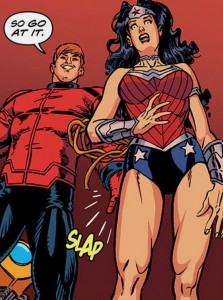
In the latest issue of Wonder Woman, another character, a new god named Orion, slaps Wonder Woman on the ass in a fit of sexist entitlement. Wonder Woman is denied the ability to respond to the assault because of other matters that take precedence in the story. The story seems to be saying that there are some things more important that getting upset over some harmless slap and tickle. You can almost hear chants of “Let a man be a man! Stop trying to emasculate us!” in the subtext. The wonder, for me, is in how this scene was deemed acceptable and harmless to begin with.
 

wonder-woman-gets-slapped-223x300

 
I’m sure that to Brian Azzarello (the writer of the story) and most guys in general, it was all very innocent, designed to show us, through action, just what kind of rapscallion Orion is. No one asks, however, if there are other, less rape-y ways to convey the same point. I imagine most men don’t see the harm because men rarely have to be on the receiving end of these sorts of violations, which are products of rape culture. Largely, men don’t have to walk through creation tense and braced for anything in nature to leap out on them and sexually violate their bodies and spaces. One out of every six men aren’t raped. Ninety percent of rape victims aren’t men. Men’s bodies aren’t under the constant policing and legislation of other men. Don’t let the members of the “men’s rights” movement (yes, that’s an actual thing) hear you say this, though. Ruling every major institution on Earth apparently isn’t enough; men have to be considered innocent and absolved of every crime, too. Patriarchy is a helluva drug.

When you have the luxury and privilege of wielding massive amounts of institutional power, Wonder Woman getting slapped on the ass in a comic books seems like a silly thing to get worked up about. It doesn’t matter that this act is just the latest in a string of very clear hostilities toward the idea of female and feminine self-government and self-determination—hostilities that aren’t limited to comic books. I propose that this action isn’t harmless, not even when it happens in the funny pages. I believe depictions like these reinforce the idea that there are no limits on men’s behavior, particularly in relation to women’s bodies. If the most powerful woman in the universe can get slapped on the ass and all she gets to do in response is get angry and, generally, live with the violation, men’s power is reaffirmed and all is right with the universe.

Except that it isn’t right.

I made another crucial error: I posted my feelings on a comic book message board. Not known for their cultural or political sensitivities, many comic book message boards are merely echo chambers in which people who are, by and large, sycophants gather to reinforce each other’s narrow-mindedness and reflect each other’s images at twice their actual size (to paraphrase Virginia Woolf). The audience, at least by way of message boards and comments sections, is remarkably repetitive when faced with sociopolitical criticism about the stuff they love: first defense, then denial, then a hyper “rational” analysis of why there couldn’t possibly be any misogyny/racism/sexism/homophobia in their beloved art form. They insist that the problem lies with the observer not with the object being observed. Dwayne McDuffie, rest his soul, had this audience pegged.

My comments were met, mostly, with simmering rage or the aforementioned cognitive dissonance: “Let me explain this to you rationally: I’m not a bigot and I like this book. So this book couldn’t possibly be bigoted in any way.” Anyone who agreed with my commentary was summarily dismissed, talked over, or explained away.

And, of course, there’s the tried-and-true option of dragging out the token members of the audience, the few blacks or women or queer people in the ranks who support the status quo. Nothing says “conversation ender” like, “Well, I have a female friend who said it was okay. So it’s not misogynist.” As though institutional pathologies like misogyny, racism, or homophobia require that every member of the oppressed class sign off on its identification; as though members of oppressed classes don’t succumb to the psychological warfare that is bigotry and participate in and perpetuate ideologies that are harmful to them and others in their social group; as though the oppressed don’t sometimes identify with the oppressors. Stockholm syndrome is very real.

I’ll agree that the problem lies within the observer (only not the observer the aforementioned audience believes), but the problem also lies within the object being observed. The reason why this audience doesn’t perceive any harm, intentional or otherwise, is because the creators, institutions, and this audience are literally speaking the same language. White supremacy isn’t white supremacy amongst white supremacists; it’s reality. Misogyny isn’t misogyny amongst misogynists; it’s normalcy. Homophobia isn’t homophobia to homophobes; it’s just the way God intended things. It’s very difficult for anyone inside a giant circle to have the necessary perspective to perceive its full shape.

There’s a reason relatively few women, black people, or openly queer people are employed in the mainstream comic book industry or hold relatively few positions of power within the institutions that distribute them. There’s a reason why those who are employed there have to do much to tamp down any perceived differences in opinion or worldview and get on board with the straight white male status quo. It has nothing to do with women, black people, or queer people not being talented enough to compete or there not being enough them present in the potential talent pool. It has everything to do with already being friends with an influential straight white guy at the company. It has everything to do with a group of frightened individuals setting up shop in their citadel, trying desperately to fortify their tower of straight white male hegemony in a world where that hegemony is becoming decidedly less tenable.

And you don’t only see this happening in the comic book industry. You see it in mainstream politics as well with organizations like the GOP trying to decide if they should jettison some of their more outrageous, overt bigotries in order to court enough Latinos, women, and gays to win elections. It reads to me as a sort of panic, a sort of regrouping of the straight white guard as they try to figure out what it means to be straight, white, and male in a world where queer people are demanding civil rights, a black man is the leader of democracy, and women are asserting control over their own bodies.

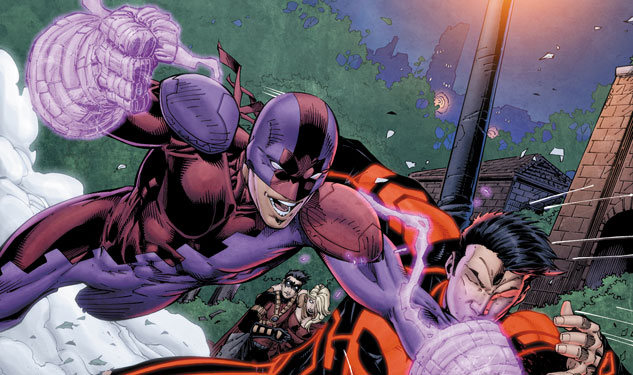
One of the ways in which they think they can reclaim the power they believe they’ve lost is through media propaganda. Since Obama’s re-election in 2008, for example, we’ve seen the incredible return of overt racist paradigms like the white savior and black pathology, as well as the puzzling return of 1950s values in relation to feminism post-Sarah Palin—not just in the real world, but in entertainment media as well: Did you miss World’s Finest #7, where Power Girl decided she knew everything she needed to know about African nations and their child soldiers because she watched KONY 2012? Or what about Miles Morales in Ultimate Spider-Man, who was not only at odds with his criminal uncle, but has to hide his identity from his ex-con father, too? Because, you know, nothing says “black” like criminal pathology. And don’t get me started on Bunker in Teen Titans, the gay Mexican character whose power is, wait for it: creating purple energy bricks. Purple. Bricks. I couldn’t create that big of a stereotype even if I tried really hard. But for some folks, it’s apparently rather easy.
 

bunkerx633

 
We’ve seen these corporations pay lip service to diversity, but it’s always diversity for diversity’s sake—that is, diversity because they think it makes them look cool and hip in multicultural spaces. But bigots don’t understand the difference between diversity and tokenism, nor do they recognize diversity as something beneficial to themselves. They don’t see it as something that can open them and their organizations up to new ideas, new audiences, and new ways of being. They always regard the concept of diversity suspiciously, as something forced upon them, a notion that tries to coerce them into being politically correct, a practice the makes them, against their will, admit into their ranks “unqualified” people who didn’t “earn” their spot (because, you know, being a popular writer’s friend is considered earning a spot).

When called out on their nonsense, these corporations blame the bigotry on their audience: “Well, we tried to get this product featuring X Minority Figure off the ground, but the audience just wasn’t ready for it.” Bigots, unfortunately, have a collusive and mutually beneficial relationship that allows blame to be passed around (but never landing where it should), while keeping us distracted from the fact the structural impediments remain unmoved. And that’s all according to plan.

I’ve concluded that it’s useless to have these discussions with people whose fantasies rest on the fact that none of the social conventions upon which comic books stories are built can be seriously challenged or interrogated. It’s pointless to have these debates in this “post-racial” age where you’re only a racist if you use the n-word, you’re only a misogynist if you beat up women, and you’re not a homophobe, you’re just beholden to religious principles. Bigots—even passive, rational ones—are incredibly similar in their reaction to criticism: “My feelings are more important than your struggles.”

The only option left to individuals like myself who have had enough of the microaggressions and the chorus of defenders and deniers—who have had enough of the grating, tone-deaf depictions of women, people of color, and queer people in these often poorly written, poorly drawn, increasingly expensive books—is to opt out. And that decision is made evermore clear when you consider that the industry has been bigoted since its inception and you simply weren’t conscious enough to detect it when you were a kid. While the country has taken strides toward being a more perfect union, the mainstream comic book industry has, for the most part, dug its heels in and refused to move.

So I admit defeat. I am, ironically, waving the white flag. The bigots win. I’m plum tuckered out. I don’t have the energy to fight anymore. I say if they like the comic book industry and its product just the way they are, faults and all, let them have it. As long as I don’t ever have to read a misogynist Wonder Woman story or a racist Spider-Man story or a Superman story told by a homophobic extremist ever again, it’s all good. There are better products to spend my money on. That the mainstream comic book industry doesn’t want my money for fear of alienating their core audience of bubble blowers is the fault of their bad business model, not mine. In the meantime, I’ll be over here reading novels digitally on my iPad. These works, at least, reflect the world as it is, as it could be, as it should be, rather than as some defective, reductive supremacist fantasy.
__________
Robert Jones, Jr. is a writer/editor from Brooklyn, New York and creator of the Son of Baldwin blog. He is currently working on his first novel.
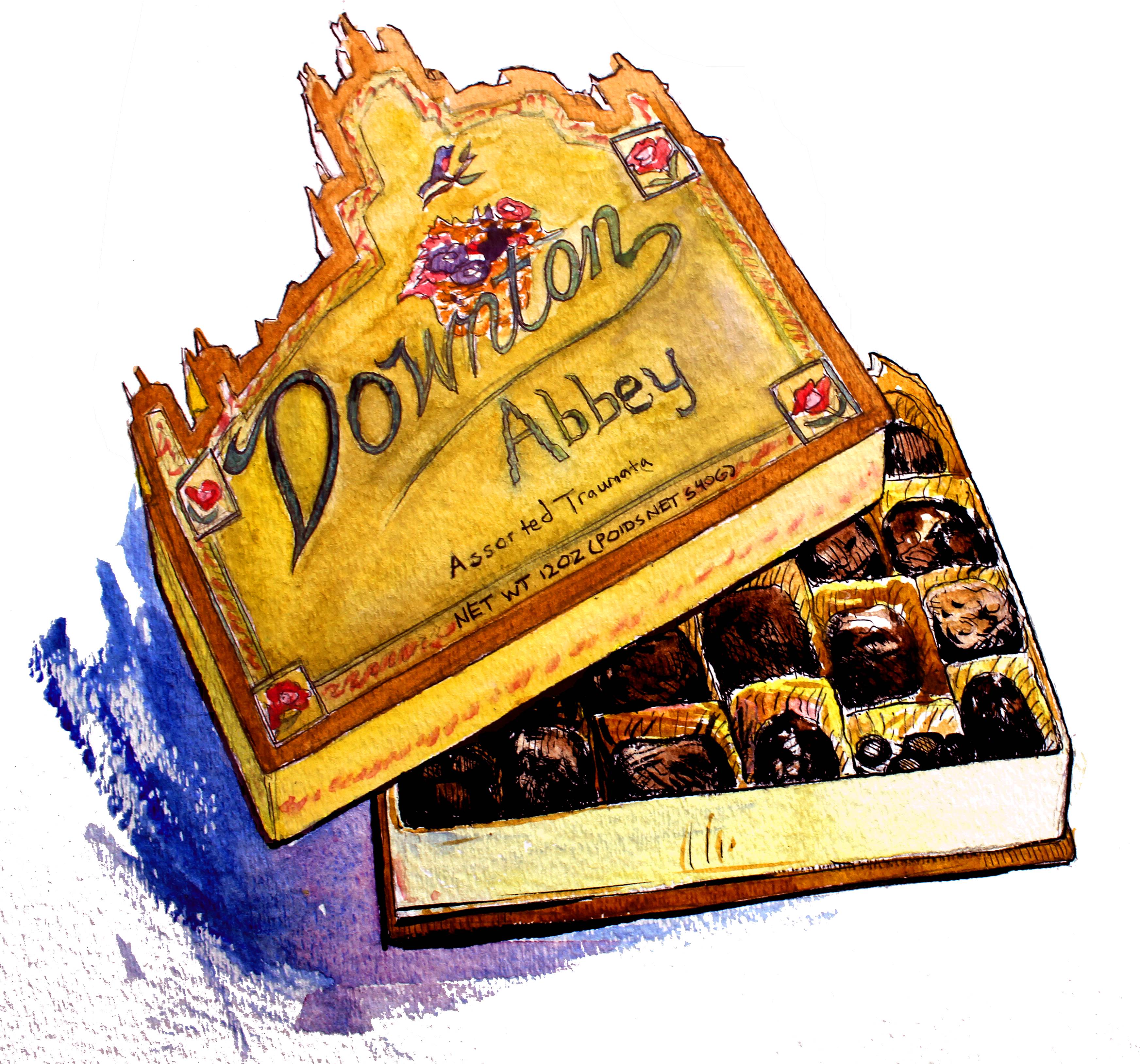
 

Rape, Murder, and Artifice in Downton Abbey

Downton Abbey Sampler- Sean Michael Robinson

I want to keep watching Downton Abbey. I really do.

It’s a show whose virtues are immediately apparent—tremendous acting from virtually the entire cast, striking cinematography, an interesting setting, and an almost obsessive eye for detail, extending to virtually all the production crafts behind the show—costuming, set dressing, even foley, every sound of the house seemingly captured a century ago and replayed now for the viewer’s pleasure.

But it is an empty pleasure indeed. Like the great house itself, which telegraphs wealth and power with every detail of its dressing and architecture but is carried on precarious financial ground, beneath all of the show’s external grace and opulence it is an emotionally bankrupt and poor thing.

I watched all three seasons of the show with two friends over a period of a few weeks, and it’s possible that this pace of viewing exacerbated the problems. To pick one particularly charged example– in the third episode of the first season, eldest daughter Mary is raped by a visitor to the house, Kemal Pamuk, who subsequently dies in her bed.

Now, you won’t see the word “rape” in the show, which is, painfully, appropriate for the time period. Mary has spent the day flirting with this handsome visitor, and when he unexpectedly shows up in her room at night, she insists he leave, rejects him, over and over again, tells him that she’ll scream, to which her rapist replies that no one will hear her. And so ends the scene, with Mary accepting the inevitable, the horrible choice that is not in fact her choice to make at all, that this man will take what he wants of her, because he wants it.

Now, this is not treated as an insignificant event. On the contrary, the events of that night drive the plot for much of the two seasons, as Pamuk’s death and the attendant coverup cause no end of scandal and labyrinthine plotting.

But what of the emotional consequences?

What is it like to have a flirtation turn to threats of violence and unwelcome sex? What if one’s rapist were to die, possibly even in the middle of the act? What kind of behaviors might we expect from someone who has experienced such traumata?

Living as we do in a society that has a much clearer picture of the horrible consequences of rape and sexual assault, not a lot of imagination is required to tease out the potential consequences of the scene. Mary might be leery of the attentions of other men. She might have difficulty with physical contact or emotional closeness from others.

And what emotional consequences do these events have for Mary in the show?

She’s sad that he died. She refers to him as her lover in conversation with her mother, and later discusses him with her husband-to-be with no sign of any distress. The first conversation is particularly painful– her mother asks point blank. Did he force himself on you? No, she says, defiantly.

Now, it is entirely plausible that Mary could retroactively deign her rape consensual, or simply choose to discuss the event in that light with her mother. But in good fiction one has some amount of access to the inner workings of a character, not just their actions and stated feelings. How different would these events read with some kind of emotional consequences? A flash of pain, a remote sadness, a squeamishness or reluctance to be touched?

But that would involve some kind of interpretation on the part of the audience, and more often than not, Downton Abbey doesn’t trust its audience to draw its own conclusions. Julian Fellowes is in many ways a very skilled writer, and in the show he applies much of this skill to the organization necessary to juggle his army of actors and assure fitting amounts of screen time. Fellowes is the literary equivalent of a virtuoso dinner host—he knows interesting people, knows when to invite them, and remembers all of their names.

(Although occasionally their occupations slip his mind, as in the scene where Edith informs Matthew that she’s the family’s first journalist. This must have come as a surprise to fellow dinner guest and family member Tom Branson, whose fledgling career as a journalist was scorned by the family several episodes prior.)

And what of the traumas of Matthew Crawley? He fights in the trenches, drags himself through the mud among the dead and dying, is nearly killed when a shell explodes directly on his position. (He also manages to telepathically communicate his distress to his paramour—but that’s a different matter). He’s paralyzed, impotent, and recovers (!) just in time for his (untelepathic) betrothed to perish of a sudden one-episode fever. Shortly thereafter he finds solace in the arms of his paramour after a previously unmentioned deathbed letter from his barely buried betrothed beseeches him to find his comfort where he can.

Are any of these events traumatic to Matthew? Does he have nightmares—do his hands ever shake? After his experiences in the war, does he have any second thoughts about hunting with the family, any difficulty hearing gunfire? Fear of confined spaces?

This insensitivity to the interior lives of the characters might be a function of the capsule-summary nature of the show—a problem arrives at the beginning of an episode, and it is dispatched in short, concentrated movements, while the other continuing plot points swirl around it. Or it might be due to the fact that the characters spend so much time talking so baldly about their own feelings. Even the most inward of characters—O’Brien comes to mind– have someone to talk to or scowl at at any given time. Just in case, you know, we’re ever unsure how they feel about having caused spontaneous abortion through deadly soap placement.

And there, finally is the word I’ve managed to avoid for almost a thousand words. Downton Abbey is a soap opera. A well-crafted soap opera, but soap opera nonetheless, with many of the characteristics that typically attend that genre. One—events are driven by a desire to create a maximum amount of dramatic effect. Two—the status quo must be maintained. Examples of the former are available in virtually every episode, but surely season two’s Canadian amnesiac burn victim is the most extreme example. As for the second, consider what happens when a character manages to escape the trajectory of the house—Thomas, for instance, or Mister Bates. No matter what Thomas’ ambitions or desires for himself, he’s forced to return to his servitude. And it’s not solely the class issues of the time that keep him in place—it’s the machinations of the plot, which require him to remain in his familiar position. Bates’ position is the reverse—he’s pulled away not by his own ambitions, but by the unfortunate consequences of the ever-escalating tension of the plots he finds himself mired in. And when he is finally freed, it’s once again off-screen providence that is his liberator, which sets him in motion to once again return to the position he had at the start of the show.

It’s instructive to compare Downton Abbey to its predecessor, the Fellowes-penned and Robert Altman-directed feature film Gosford Park. The direction of Altman and the cool cinematography of Andrew Dunn hold the content at a distance, a tack that transforms the potentially melodramatic material into an oblique commentary on the class issues present in the film. The direction and cinematography in Downton Abbey are a striking contrast to this restraint, continually (and probably unintentionally) reinforcing through sheer visual beauty the inherent right-ness of the class positions of the characters. Lord Grantham, after all, is rarely wrong, and even in the rare instances when he is, he manages to look so goddamned noble. (Stationary or smooth-moving tracking shots with low camera angles and sumptuous light in opulent environments does tend to create that effect). The lush score is one of the biggest villains in this regard. “Thiiiiis is impoooooorrrtant!” the strings say, swelling again. “Feeeeel the nobiiiiiiiiiiiiiility.” This insistence on the part of the cinematography and the underscoring can not only seem overwrought, it can even spoil the effect of certain scenes, by telegraphing the future events minutes before they happen. All three of us watching the last episode together were aware of the impending death of Matthew Crawley from the moment we saw his car, background speeding by, with portentous strings sawing away in the soundtrack. It’s hard not to feel that a character has been killed, murdered, really, by the show itself, when the dressings of the show seem to be so aware of every upcoming disaster.

When I informed my friend James as to the content of this article, he asked me, “So, you didn’t enjoy the show?” No, I’m afraid I did enjoy the show. I enjoyed it too much, and it was packaged so handsomely and tasted so good and went down so smoothly I could hardly believe it. And so I had some more. And then I had some more.

But there are a lot of things I enjoy that I shouldn’t have every day. And in Downton Abbey‘s case, three boxes in a month were clearly too much.

dabbey2

Phonogram: Journey to the Past

This is an excellent comic. Let’s get that out of the way first.

Next: Kieron Gillen, author of highly-regarded Thor reboot, Brit, music nerd, all-around good guy. He’s friends with Tom Ewing, of Freaky Trigger and Poptimist fame. And since I spend a lot of time lurking ILM, the message board that started out as a discussion page for Freaky Trigger – and is now a hotbed of professional music writers – and since I was once an obsessive Libertines fan – dubbed “the saviors of British guitar pop” by a certain segment of the British music press – I feel as qualified as (mostly) anyone to discuss the intricacies of his and Jamie McKelvie’s two-volume comic Phonogram, which is, basically, a passionate and detailed criticism of British music criticism. And there’s a third volume due out soon, so this is even kind of timely!

By the time the first volume of this series, Rue Britania, concludes, the music critic whose POV we inhabit – who might or might not be closely modeled after the author – has confronted his post-teenage disillusionment and bitterness and become a stronger, less douchebaggy person.

As heartwarming as this is, it doesn’t quite erase the sting of many pages that first establish the character as an asshole – or the fact that this asshole character’s pronouncements on music are, for the most part, the final word within the comic on tons of indie bands you’ve probably never heard of (although the sting is somewhat lessened by the inclusion, at the end of the book, of a much less self-important glossary of terms and bands).

That, and the fact that Rue Britania is well-written, well-paneled and well-drawn, more than justifies its sequel, which not only sees the return of the narrator as an older, wiser, and more feminist person, but also foregrounds the series premise that there are many different ways to be a passionate fan of pop music. Plus, half the viewpoint characters are women! And it’s in color! No wonder The Singles Club sold way better than Rue Britannia (see comments for author correction).

phonocolor
What we can look forward to

In order to fully appreciate the narrator’s personal growth by the time of The Singles Club, it’s necessary to first start with the egotistical dick of Rue Britania. So that’s what I will be doing in this post. My next post will focus on The Singles Club, and when Volume 3 comes out, I’ll review that one too. Without further ado:

PHONOGRAM: RUE BRITAINIA

Is a comic about the damage music critics do to young impressionable teenagers when they overhype acts as “the saviors of British guitar rock.” Alternately, it’s about the damage specific rock acts do to impressionable young fans when they overhype themselves as the saviors of British guitar rock, even if – especially if – they believe it.

At this point I should probably explain this whole “saviors of British guitar rock” thing. It’s a long story, going back to Beatles and the Stones. Since then there have been many mutations – the Kinks and Small Faces and the rest back home in England in the 60s; Nick Lowe and Elvis Costello and their Stiff Records cohort in the 70s; the Stone Roses and Happy Mondays and other Madchester acts in the 80s; and then Britpop bands like Blur and Oasis, who saved England from the twin evils of Americanization and grunge in the 90s. Of course this is a gross simplification, but that’s kind of the point.

The aughts version of this cyclical narrative is tied up with the Libertines, according to some, or is a shameless and transparent attempt on the part of the music weeklies to pretend that they are still relevant, according to others – including, more than likely, the narrator of Rue Britania. Anyway, suffice to say that there is a long lineage of (mostly) two-songwriter bands in England that are somehow uniquely homegrown; and there’s also a British music press hungry to find the next group it can slot into this lineage (for ease of hype).

Our Hero can’t get over the narrative that has coalesced around a scene he was intimately involved in – he’s incensed that the bands he remembers as being actually central to Britpop – especially the female-fronted indie band Kenicke – have been forgotten in favor of a more convenient media narrative that it was really all about Blur, the snotty middle class art school savants, vs. Oasis, the rags-to-riches working class dreamers. His pain is twofold: one, that the press is trampling all over what actually happened; and two, that he can’t seem to shrug off his massive personal investment in what is – more and more obviously – a dead scene, and move on.

His pain is the pain of any very serious music fan who cares a great deal about the ways in which words and music construct reality, only to wake up to the laziness and willful misrepresentation of most music journalism. It’s also, although this has not quite formulated itself in the mind of the asshole protagonist, a kind of proto-feminist rage. Why are so many of the female-fronted groups being written out of the narrative?

In The XY Factor, Rhian Jones discusses the gender gap in professional music criticism. And in the comments, I drag my friend Sabina into an argument that the Rock Critic Establishment’s love of making lists and ranking things so as to determine their absolute universal worth tends to work against female-fronted bands, as the female fans who might have pressed for their inclusion in the “canon” tend not to relate to music in the same list-making way. It’s worth reading the original comment thread for Sabina’s take, which is much more nuanced than mine.

In any case, I bring this up not to fire another shot in the endless war of men and women, but to show that Gillen’s arguments, as ridiculously over-invested as they might seem, do have real-world consequences. Maybe Britania, the spirit of English Guitar Music, won’t actually fall down dead if culture warriors like the narrator cease to defend her. But these narratives do have power.

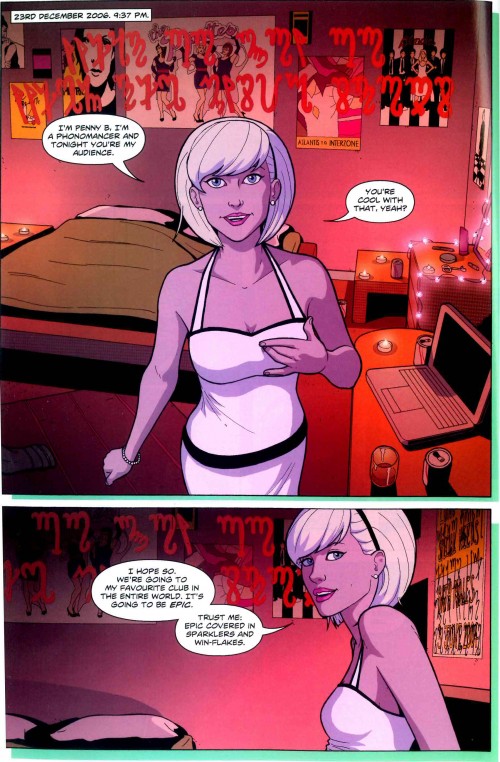
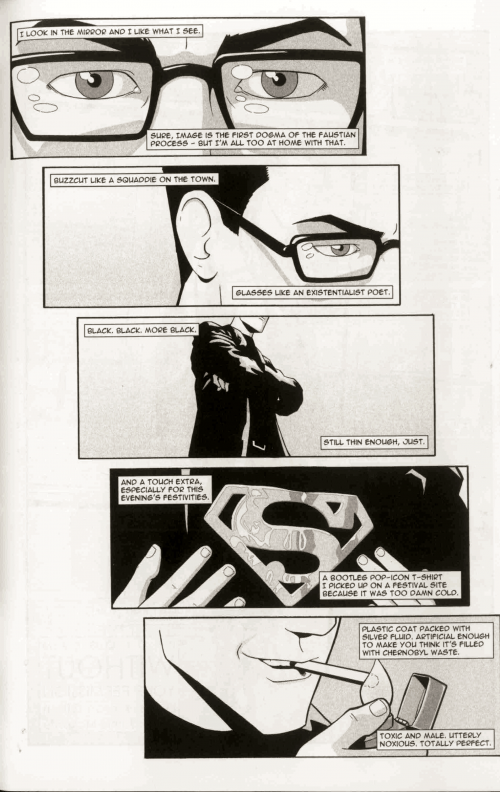
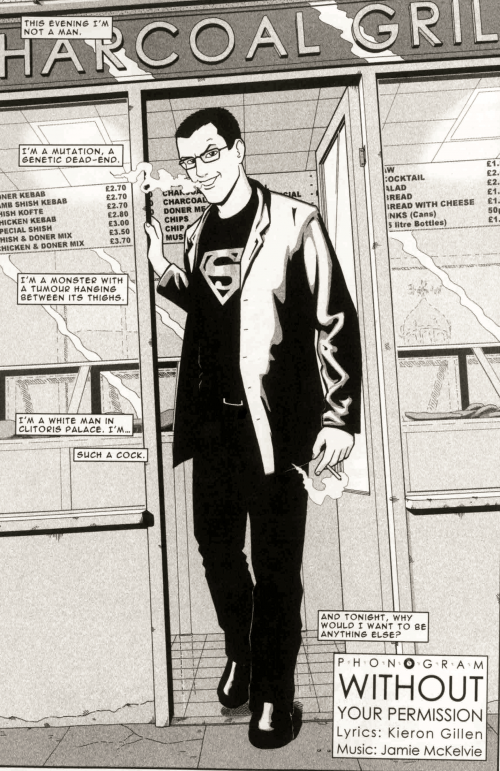
Going back to Kieron Gillen’s proto-feminism, though, here is the opening sequence of Rue Britania:

phono1

phono2

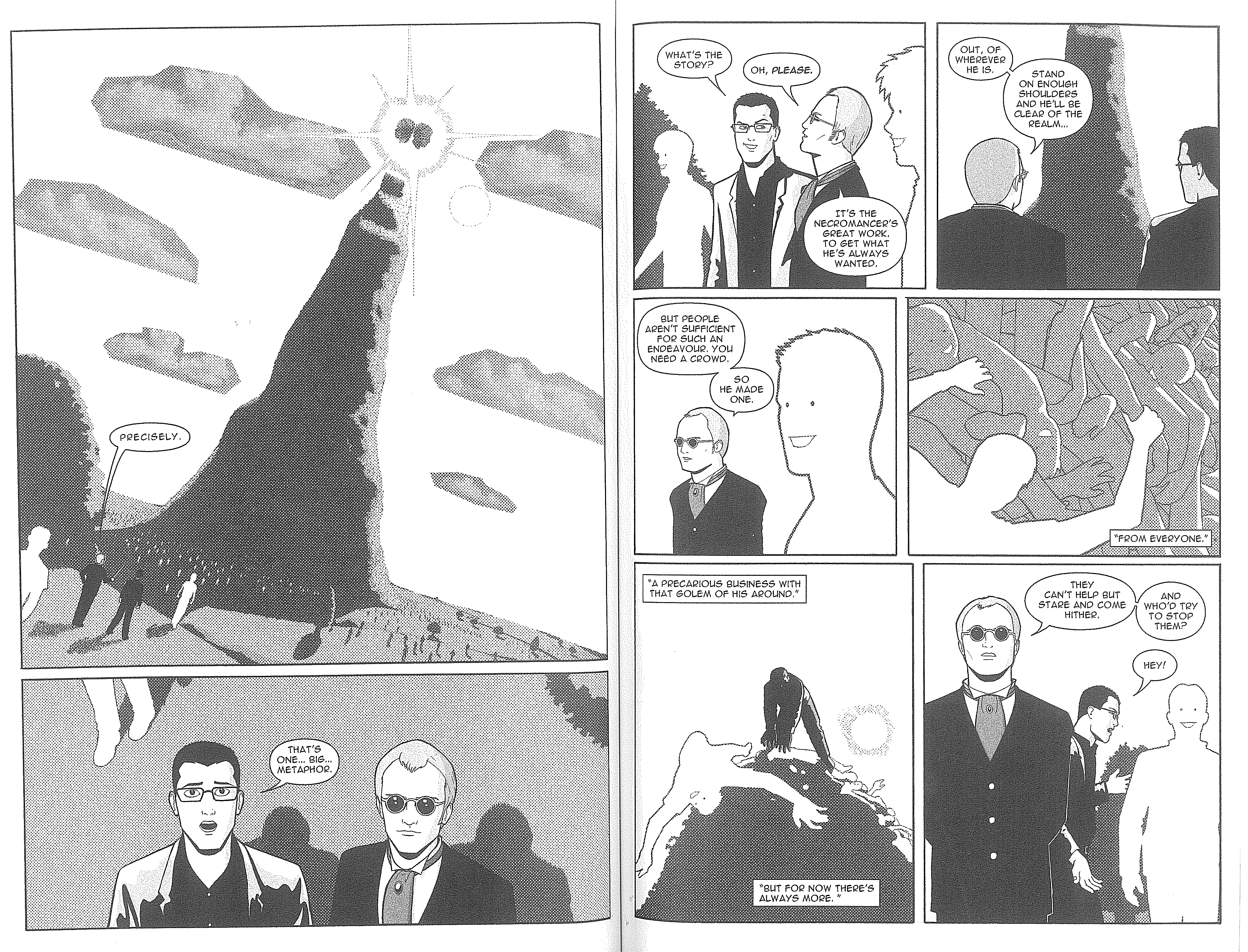
The narrator introduces himself as a toxic, noxious, assholish… man! With a bonus nod toward comics, the medium being used to tell his story.

As you guys know, it’s very important when attending a show to dress right for the occasion. You wouldn’t haul out the indie regalia for a Kings of Leon concert, but probably just show up in jeans and a t-shirt. By the same token, if you went to see Patrick Wolfe without glitter eyeshadow, you’d probably be underdressed. Our Protagonist, in this case, is very aware of this, and is putting a lot of thought and effort into his outfit: but towards precisely the wrong ends. He wants everyone at “Ladyfest” to know exactly how much he does not belong.

In other words, this guy is a huge dick! And not only is he a dick, he’s a self-constructed dick – which is even worse!

It’s not only that, though. His costume marks him out as a recognizable “type” – not just within hardcore music fandom, but as the protagonist of countless indie comics. His role in the comic, in other words, is not just to be there, but to explicitly display and acknowledge his obnoxiousness – and in the process, maybe, to reveal to the reader his own obnoxiousness.

That’s if the reader catches on. This is a fairly subtle comic – unlike, say, Scott Pilgrim, where Bryan Lee O’Malley starts out subtle but later aims with increasing unsubtlety to show the reader exactly how much damage well-meaning but willfully “clueless” guys can do to the girls they don’t care enough to work on their relationships with – so there is a chance that the reader won’t get it. Bryan Lee O’Malley has a whole series to make his points in, though, while Kieron Gillen and Jamie McKelvin have only this one volume of a trade publication they don’t expect to make money from, and they want to actually talk about the music, too. So perhaps this comparison is unfair.

Also, though, this guy is just such an asshole!! He’s way more of a jerk than Scott Pilgrim ever was. He understands pain, loneliness, and the female-fronted rock outfit Kenicke; but instead of using that knowledge for good, he uses it to sleep with vulnerable scene girls. Meanwhile, the girls he is friends with are those kind of ‘cool’ girls who will put girl-groups down with him and interrupt sex with their girlfriends for him.

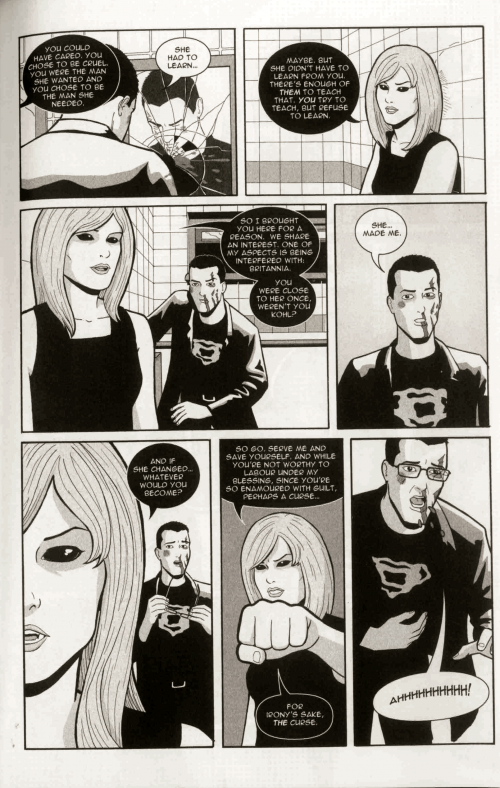
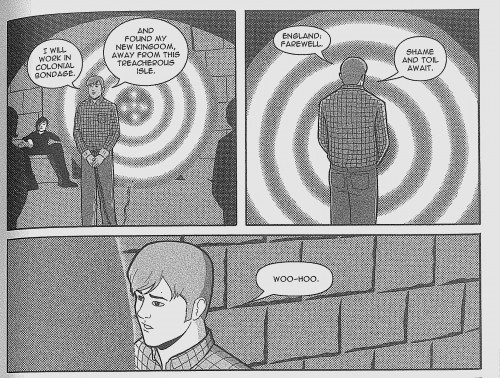
It is somewhat satisfying and fitting, then, that for the sin of being a huge dick, the narrator is cursed in a very feminine way:

phono6

Of course, this guy isn’t a Standard Edition Asshole Dick. He knows better, that’s the whole point. He might be using his love of Kenicke to pick up girls, but he also genuinely loves Kenicke. Summing up this contradiction, the essence of his fandom – the passion that defines him as a person and grants him music-related superpowers (more on this later) – is Britannia, a female avatar of British guitar rock. Not only that, but in a key scene we find out that in a contest between his girlfriend and Kenicke – sleep with the girlfriend, or get up to reset the needle on a Kenicke record? – Kenicke wins every time.

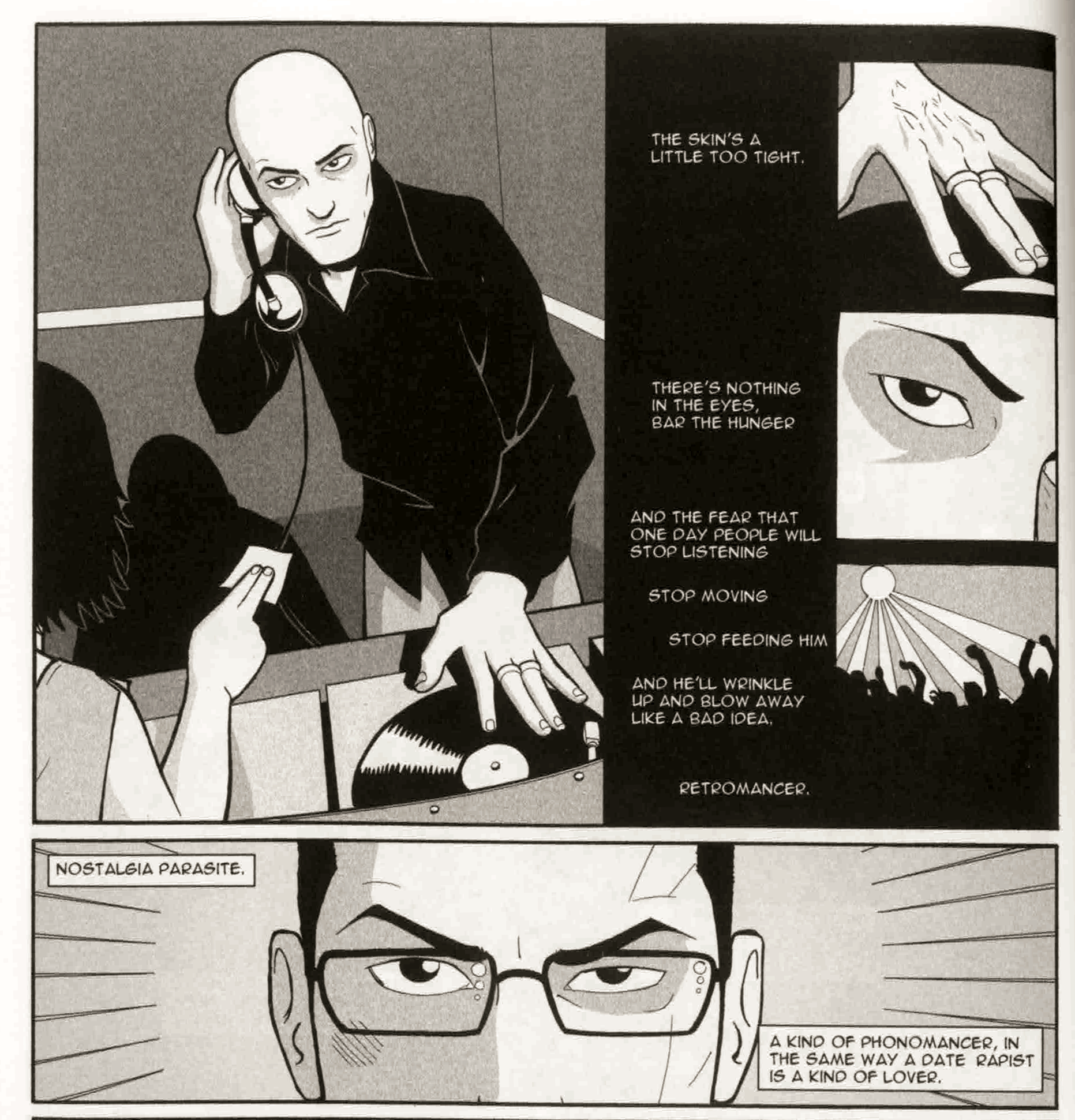
Let’s back up for a minute and talk about magic. In this metaphorical book, being a passionate fan of music gives you superpowers. So what’s the main character’s superpower? Well, he does “intricate vivisection rituals on pop songs to understand their totemic powers” (and then uses his powers for evil to seduce young girls, because he is a dick!!!) Beyond that, he can use Jedi mind tricks to get into shows for free

Let’s be real here – this is a much more useful and practical magic power than “flying” or “X-ray vision”, right?

In this book, we spend most of our time with Mr. Charming, so we never really see the other ways that “Phonomancers” channel pop music to enhance their personal power. That will be left until the next, more accessible book (in full color!), which I have already promised to discuss in the next article.

I’m not trying to say I have a unique insight on this comic, by the way. Any good ILM-er or diligent reader of British weekly music ‘zines would tell you the same, and the author does make many of these points for you. The feeling that I have unique insight is actually exactly what I share with the noxious asshole narrator. It’s this feeling of superiority and specialness, among other things, that he will have to kill to progress as a person.

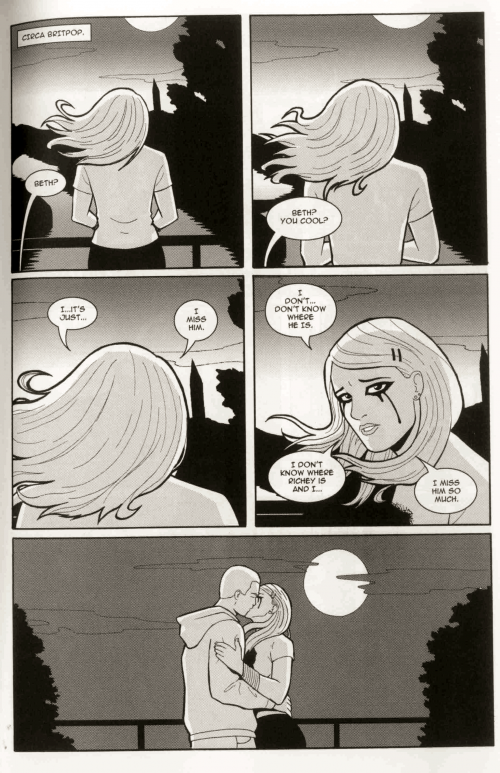
To show the seriousness of the situation, as the music press rewrites the past, the narrator’s memories actually start to shift. (The first clue that he is in an alternate, unacceptable universe? He is in the habit of listening to Echobelly records.) Besides the narrator’s personal hangups, we’re introduced to another character who was, at one point, heavily invested in a particular group, the Manic Street Preachers. While the narrator struggles to hold on to his sense of self, this Manics fan has actually split herself into two selves: a self that waits, wraithlike, for disappeared guitarist and lyricist Richey Edwards to return and reclaim his position as pop-music prophet. And another self, a “real” self, who no longer cares about music.

phono8

If you don’t know the specific groups under discussion, the scenes lose some of their power. There’s something universal about the idea that someone else is rewriting your past, though, and about investing so much of yourself in one thing, and being so badly hurt as a result, that you are never willing to invest so much or to care so much about any other thing again. And maybe Britpop club scene –> massive arena and festival tours is something any former indie kid – like for instance Hipster Runnoff‘s Carles – can relate to. Specific references, universal themes, in other words.

The rest of the volume is similarly metaphoric. The narrator goes on a spirit quest to save “the universe” (probably only his own universe) from the debasement of the discourse around Britpop. Some of these metaphors are clever:

phono7

Retromancers as gollums, Gollum as junkie scum.

phono10

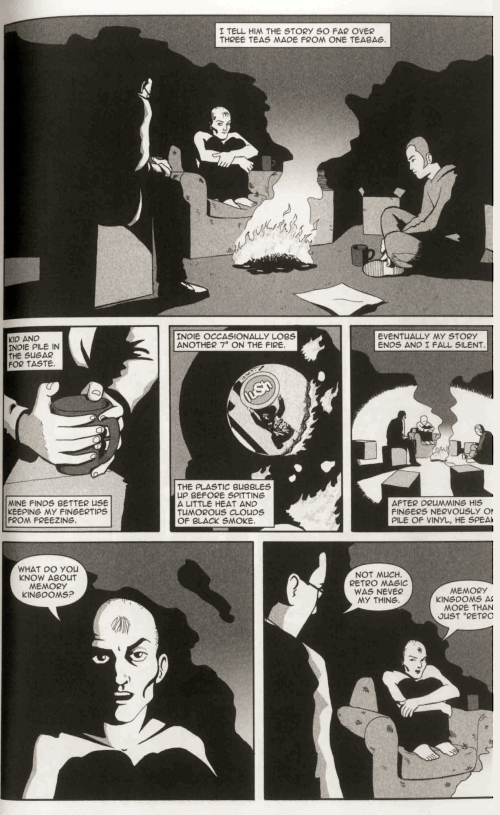
Throwing a vinyl record on the fire, and a discussion of “memory kingdoms” you can only enter if you’re not personally invested in them.

phono12

Knebworth Park in 1996, the huge festival headlined by Oasis, where – according to the press – countless individual fans lose all their distinguishing features and are transformed into just a mass, a crowd, a sales figure.

Sometimes, though, the pursuit of symbols and metaphors leads the author to strange places. An easy way to see this is to consider what happens when the “symbols” in his book are – not just real people – but still alive and working.

phono14

I don’t know that much about Blur, but I know enough to know that the automaton in these panels is not even close to being anything like the real Damon Albarn – either the person or the performer. How can you write about real people and not even care that you are completely misrepresenting them?

Kieron Gillen sidesteps this issue, somewhat, by setting all these scenes in a dream landscape. In his own mental cartography, which has been weirdly influenced by the media narrative around Britpop, Damon Albarn and Oasis are figureheads who are notable mainly for the roles they play in the media narrative. It’s the roles he’s interested in exploring, not the actual or perceived personalities of the performers.

Still, the author’s choice to focus only on roles is an odd one: if he cut his teeth as a music fan at small club shows, he must have met some of these people at some point, right? Is it because he’s a pop fan – in other words a fan of a genre in which the main relationship between fan and performer is necessarily mediated – that he thinks this way? Or is it just that Kieron Gillen has no interest in personalities outside of music (putting him in the minority of Britpop fans)?

But also, you know, the creator is dead, and all that.

And if you think about it, this privileging of the fan/critic perspective over the author/artist perspective is clear even in the premise (and title!) of the series: that being a passionate fan of music endows you with special powers. It was Sabina (once again) who pointed out that while you do see, by the end of The Singles Club, many different ways of being a listener-Phonomancer, what you don’t see are any musicians who are also Phonomancers. Can an artist be a Phonomancer in Kieron Gillon’s universe? Perhaps this question will be addressed in the forthcoming third volume of the series.

Speaking of dead authors, though – and those of you who would rather not know how the volume ends, please look away – it turns out that – shocker! – Britania has been dead the whole time. The retromancers feeding off manufactured nostalgia, the fans who arrived too late to be a part of the original scene (and probably wouldn’t have been cool enough to be there, anyway) – all of her later-day worshippers – are worshipping a corpse.

Was she dead all along – during Britpop as well? I honestly hope so. Otherwise, this whole narrative stinks a bit too much of pulling-the-ladder-up-after-you’ve-had-your-own-fun.

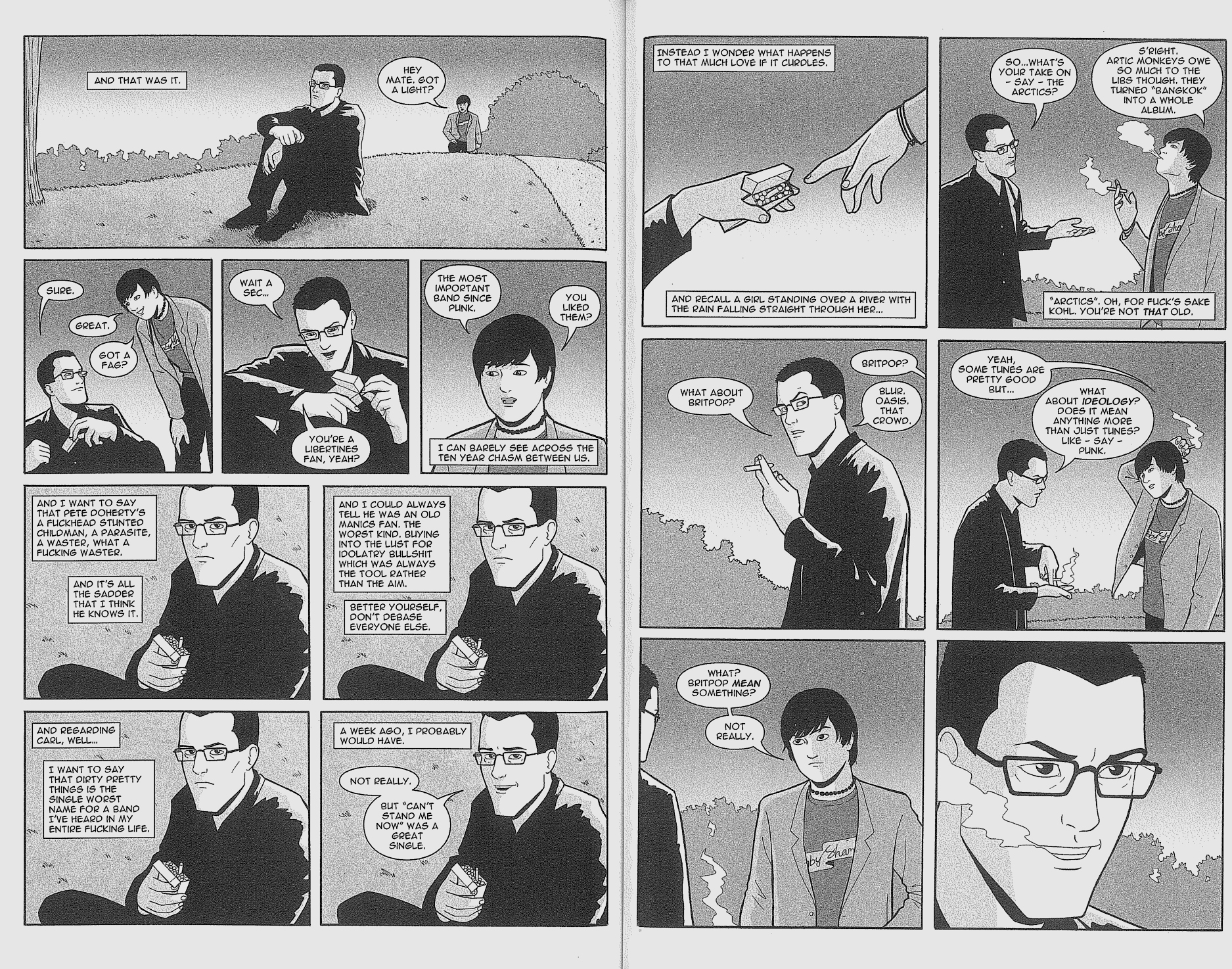
And this is where where I come in. Just before the narrator heads off on his final, quixotic quest to defeat the zombie ghost of Britpop and save the sanctity of his youthful soul from the cruel realities of crass commercialism, he meets a Libertines fan on a hill:

phono15

Click through for dialog if the text is too small too read.

Just like when he met the young Kenicke fan, he’s pretty sure that he understands The Libertines better than the Libs fan does. Unlike when he met the young Kenicke fan, though, he is now old, wise, and mature enough not to clutch this knowledge to his chest, as if his experience is the only valid one, and sneer down at the young fan. Instead he decides to fight for the fan’s right to keep his delusions.

I’m just kidding. This is more about the narrator, an Old, making a conscious decision to relinquish his generation’s claim on the cultural cutting edge. The pop music zeitgeist belongs to the young, passionate, and idealistic.

It’s not a bad story to want to try to tell. After all, it’s not every day that you see this kind of “old must step aside to make space for the young” selflessness being valorized when it comes to pop culture. I think the last place I saw it was Les Mis, based on a story from the 1860s. At least in the US, the Baby Boomers seem to be too large, rich, and powerful of a marketing demographic for the culture industries to suggest that they should step out of the limelight.

While it’s awful nice of the narrator to make this gesture, it is weird that he doesn’t seem to consider that maybe the Libertines and their ilk – Arctic Monkeys, Klaxons, Kooks, Razorlight – do deserve to be considered Avatars of Britania’s Nth Coming. The Libertines, including Pete Doherty and Carl Barat (that co-frontman thing again), certainly thought of themselves that way.

But then you think: maybe Dude does have a point that each iteration of this meme will be more desperate and sadder than the last – as Sabina says, at least in Britpop Version 1.0 there were actual girls on stage, stepping out from their traditional roles as girlfriends and mothers and photographers and forum mods.

For the record, though, the Libertines were aware of the futility of reviving the past. “Queen Bodacea is long dead and gone/yet still the spirit of her children’s children children lives on” goes one of their most famous lyrics, about an ancient Celtic queen who lead a resistance against Roman invaders. (This line is second in notoriety only to their save-England-from-creeping-Americanization refrain, “No sadder sight than that/of an Englishman in a baseball cap”.) It’s a total fan cliché for me to quote lyrics, by the way, but I do it not to share a moto I ever adopted as my own – I’m American! How could I! – but as a way of demonstrating that Pete Doherty totally read the British weekly music ‘zines as a teenager, too.

The idea of taking up a spot in a lineage that is already gone is baked right into the premise of the band, in other words. So who’s to say that they are not an actual, authentic entry in that lineage – if you want to see it that way? And not just because the kids are passionate and naïve – as we all were once – and it therefore behooves the older, more jaded generation to step aside and to allow them to explore their romantic notions in peace. Rather, the reason they belong is that there’s no particular reason that dead-and-we-already-know-it-Britania can’t be every bit as real to the people who worship her as dead-and-we-have-yet-to-realize-it-Britania.

In fact, by assuming that the kids believe essentially the same thing he did – that they are participating in a vibrant underground scene not-yet-tainted by media narratives – the narrator proves, essentially, his own myopia. Even in the end.

This concludes Part 1 of my essay on Phonogram. Part 2 – featuring a sociological examination of pan-music-fandom message board ILM – to follow. I promise to talk more about Jamie McKelvie’s awesome art in the next post, too.

It Dwells and It Dwells

This post first appeared on comixology.
_____________
 

illustration 1 Mandorla

In der Mandel — was steht in der Mandel?
Das Nichts.
Es steht das Nichts in der Mandel.
Da Steht es und steht.

Im Nichts — wer steht da? Der König.
Da steht der König, der König.
Da steht er und steht.

Judenlocke, wirst nicht grau.

Und dein Aug — wohin steht dein Auge?
Dein Aug steht der Mandel entgegen.
Dein Aug, dem Nichts stehts entgegen.
Es steht zum König.
So steht es und steht.

Menschenlocke, wirst nicht grau.
Leere Mandel, königsblau.

Mandorla

In the almond — what dwells in the almond?
Nothing.
What dwells in the almond is Nothing.
There it dwells and dwells.

In Nothing — what dwells there? The King.
There the King dwells, the King.
There he dwells and dwells.

Jew’s curl, you’ll not turn grey.

And your eye — on what does your eye dwell?
On the almond your eye dwells.
Your eye, on Nothing it dwells.
Dwells on the King, to him remains loyal, true.
So it dwells and dwells.

Human curl, you’ll not turn grey.
Empty almond, royal-blue.

As with all of Celan’s poems, this one is hermetic: a series of riddles. You can almost hear Gollum asking these questions to Bilbo, creeping closer and closer. “What dwellsssss in the almond, my precious? What dwellssss there?” And behind the questions, as behind Gollum’s, is the weight of time and the dark.

That weight, for Celan, is here seen through an image, the mandorla, which moves in and out of the poem, not answering the questions so much as shadowing them. In some sense, the poem is a straightforward description of iconography; inside the mandorla, or the almond, there is nothing; it’s an empty space, as you can see in the picture from Chalice Wells at the top. And that empty space, or nothing, symbolizes or holds Jesus, the human and divine king. In the last stanza, the mandorla also becomes the eye itself —of the person looking at the symbol of God, or of God looking at the looker. The almond then is both image and reality, each nestled in each like reflections in facing mirrors retreating and retreating into the flat space of eternity.

The original German text itself seems arranged in a series of reflections or doublings.

Da steht der König, der König.
Da steht er und steht.

“der König” there is repeated not just for emphasis, but because the King is not one, but two, like the circles of the mandorla overlapping. He’s both there and an echo, something and nothing.

One possibility as to where the circles meet, or what is in the almond, is the Shoah. Celan survived the Holocaust; his parents both died in it.. In that context, for the Jewish atheist Celan, “Judenlocke, wirst nicht grau” could be a statement of (someone else’s) faith — Christ, a Jew and King, stays young forever. It could also be an elegy of sorts for Celan’s parents and all the victims of the Shoah. Your hair doesn’t turn grey when you’re dead.

I think it would be wrong to see this just as a Holocaust poem, though. What Celan took from his personal tragedy was not confessional despair. Instead, the Holocaust for him becomes the impetus and the center of a collapse of meaning. It is not just that you cannot represent the Holocaust; it’s that thinking about the Holocaust reveals the impossibility of any representation of anything. Speech teeters on the edge of silence, and the final answer to every question is nothing;

Language, then, comes apart. But what about images? The mandorla is a kind of representation as well; it’s a visual symbol. In language you can’t see what is in the almond, perhaps, but in a drawing you know whether it’s nothing or Jesus or, in a locket, a face or a memory. If you can’t tell, can you show?

Maybe you can…but to what end? Language slips away through the deferral of meaning — the almond is nothing is the King is God is the Holocaust is even Gollum if you want, and all those sliding sibilant syllables. Images don’t defer, though; they dwell and dwell. They’re so stable you can see them even through language. The mandorla that curves around the poem is clearer than the poem itself.

But that clarity itself defies meaning. What you see in the mandorla is your own eye, unaging and blank. The King in the almond is a God who doesn’t move. His borders are drawn, and a God bordered in a nutshell isn’t a God at all. He’s a nothing, an image. The word escapes, the picture stops. “Mandorla” empties not just language, but the space between image and language. Obviously, “Mandorla” isn’t a comic. Instead, it’s the non-space left when the parts of a comic, — the name and the face of God — intersect and are gone.

[insert video of Paul Celan reading Mandorla: http://www.youtube.com/watch?v=X31Dp_7tVG8 ]

Did You Steal Your Eyes, I Wonder?

We’re all drunkards here. Harlots.
Joylessly we’re stuck together.
On the walls, scarlet
Flowers, birds of a feather

Pine for clouds. Your black pipe
Makes strange shapes rise.
I wear my skirt tight
To my slim thighs.

Windows tightly shut.
What’s that? Frost? Thunder?
Did you steal your eyes, I wonder,
From a cautious cat?

O my heart, how you yearn
For your dying hour…
And that woman dancing there
Will eternally burn.
— Anna Akhmatova, 1913, trans. from the Russian by D.M. Thomas

The meaning in words is hard to find, and some say the meaning’s not the art. So watch the images, I guess. Flat concupiscence on the page — scarlet openings. The sin in your head you can’t wash out; a thought bubble scribbled around the edge gets you off like a child. Put that smoke in the pipe, father, and up it goes — a border for those thighs. Tight together the windows like panels squeeze; one furry cat for a close up, cute marketing genius. And then the picture that moves and doesn’t move; time’s a space — a sequence in hell or melodrama.

I’m not sure how not to think of harlots, nor the drunkards staggering and never saying “drunk”. Stay in the lines, words, and we’ll look over here, at the icon that sings and will save us if only we gouge out our eyes.
 
_________
The entire roundtable Attack of the Literaries is here.
 

American Horror

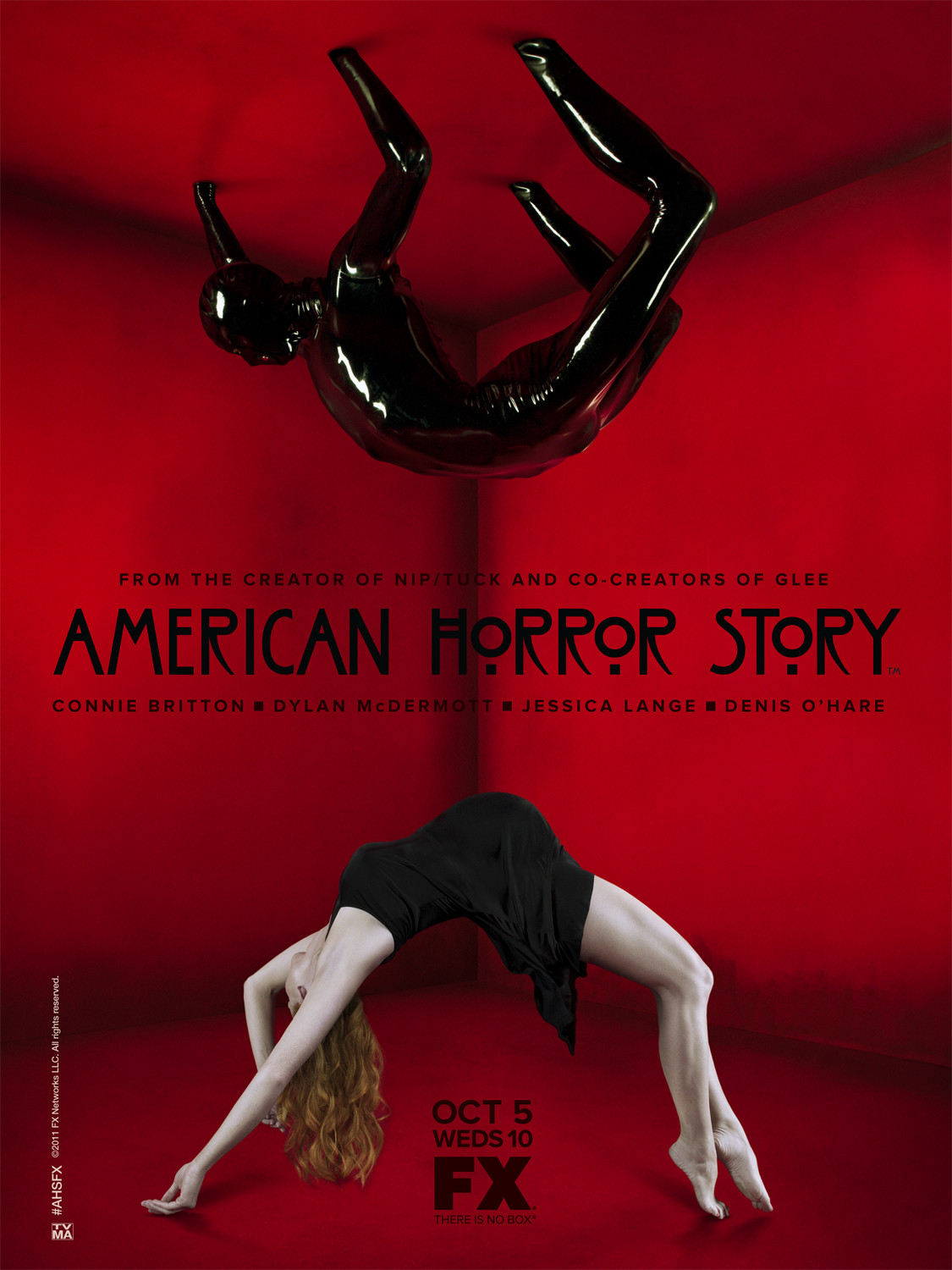
american-horror-story-poster-01

American Horror Story, Season 1, 2012-13

Produced by Ryan Murphy and Brad Falchuk
Cast:    Dylan McDermott
Connie Britton
Jessica Lange
Evan Peters
Taissa Farmiga

“American Horror Story” begins with Vivien Harmon (Connie Britton) discovering her husband, Ben (Dylan McDermott), in bed with one of his patients. To keep the family together (and move the plot forward) Ben convinces his angry wife and sullen daughter (Taissa Farmiga) to move to California and start over. They manage to purchase an old mansion at a bargain price, but soon discover that the reason the mansion was such a steal is due to its unpleasant history – most of its former residents were murdered. Even worse, “murder house” is filled with so many ghosts that they’re practically tripping over each other – a mad doctor from the Jazz Age, student nurses from the 60’s, a sexy maid from the 80’s, a psychotic teenager (Evan Peters) from the 90’s, and the gay couple who owned the house prior to the Harmons. And there are freakier residents, including a monster baby and the show’s most recognizable figure, the “Rubber Man,” who dresses in a skin-tight bondage suit complete with gimp mask. Rubber Man is the show’s main trouble-maker, and in one of the early episodes he rapes Vivien and impregnates her with a demonic baby. If that weren’t bad enough, the Harmons’ next door neighbor is Constance (Jessica Lange), a schemer who knows far more about the ghosts than she initially lets on.

The horror genre on television does not have an illustrious history. There are many people who get nostalgic for “The Twilight Zone” or “Tales from the Dark Side,” though those people have terrible memories because 90% of their episodes were crap. And those shows preferred the “anthology” approach, where every episode was a discreet narrative. Serialized television (where every episode is part of a single, larger narrative) has an even worse track record. For every hit like “The X-Files” there are ten flops like “The River.” Unfortunately, “American Horror Story” continues the long trend of shitty television horror.

Which is not to say that it doesn’t have its charms. Unlike “The River,” “American Horror Story” is not an complete debacle. While hardly innovative, it is a polished and professional-looking TV series. The basic premise – troubled family moves into a haunted house – is a simple but effective setup for a horror story. The series is also deliberately campy, which helps offset its tendency towards soapy melodrama (more on that below). The cast is quite impressive for basic cable, and the acting is generally good. The one weak link is Connie Britton, who responds to every situation with a look of dim-witted confusion. But Jessica Lange more than makes up for any other actor’s poor performance. Recognizing the show’s campiness and its debt to Southern Gothic horror, she plays a character that combines two archetypes: the Faded Southern Belle and the Evil Bitch Mama. Constance is by far the most entertaining character in the series, motherly one minute and crazy, narcissistic, and cruel the next. And she’s completely unafraid of the ghosts, treating most of them with barely concealed contempt.

But the series has many failings. Some of the ghosts, like the mad doctor, are entertaining in a goofy way. Others, like the the Rubber Man, are genuinely creepy (at least at first). But most of the ghosts are forgettable or annoying. Another problem is that death doesn’t seem like a big deal, which removes much of the potential tension. Sure, the ghosts are trapped in the house (except on Halloween), but otherwise they’re free to continue their un-lives however they choose. Plus, they don’t age, they can’t be permanently injured, and they can even have sex with the living or each other. The show also has a bad habit of raising interesting issues, and then addressing with them in a glib manner. For example, the psychotic teenager, Tate, killed other kids in a school shooting before he died. It’s a big, important “hot button” issue … that just kind of sits there. I might be offended if I weren’t so bored. The show also bills itself as psychosexual horror (according to the description in Netflix), but while there is sex, the psychology is absent. Rubber Man is obviously a BDSM monster, but there’s very little actual BDSM in the series. So after his initial appearance, Rubber Man becomes just another mystery villain whose identity will be revealed … during sweeps!

For all its other problems, “American Horror Story” largely fails at being horror because it has to be a TV series. This means soapy sub-plots, because TV producers believe that every show must have them. The teenage daughter must fall in love with one of the ghosts, and there must be drama and tears because Ben is an adulterer. In a soap opera, these plots might be relevant, but in a show called “American HORROR Story” they’re distracting at best, mind-numbing at worst. And the critical flaw in the series is that it both wants and needs the viewers to care about the Harmons, who are the lead characters and the emotional core of the series. The problem is that the Harmons are a typical middle class family on television, which is another way of saying they’re obnoxious assholes. In any halfway-decent horror story, the audience would get to relish the horrific punishment meted out to the Harmons. But this is prime time television in America, so we’re supposed to root for the family to overcome all odds and live happily ever after. [Spoiler alert!] To its credit, the season did not end with the family walking off into the sunset. Instead, all three Harmons died in the house and continued on as a ghost family. A surprise twist, and a clever show might have turned that into a truly horrific ending. Imagine spending the rest of eternity with the most tedious and/or annoying members of your family, with no one ever able to grow, change, or move out. But in this series, were supposed to find it bittersweet and touching that the family will be together forever. In the end, they even decorate a Christmas tree! Or maybe it’s the ghost of a Christmas tree.

Once again, a horror series has let me down.

Based on a True Story: Thinking About Talking About Watching “Zero Dark Thirty”

images

 
(1)  Even before you see the movie it seems like you’ve seen it. This isn’t only because Mark Boal’s screenplay is so sparse—under 10,000 words, apparently—that almost all of its memorable lines and moments are in the previews, largely in chronological order. No. Before you’ve seen Zero Dark Thirty, it’s likely that you already have some knowledge of and feelings about the film, thanks to a wide-ranging debate about whether or not ZD30 endorses torture.

(2)   “As a moral statement, Zero Dark Thirty is borderline fascistic. As a piece of cinema, it’s phenomenally gripping — an unholy masterwork. The first masterstroke is the first thing you see — or, rather, don’t see. Under a black screen, the sounds of 9/11 build: a hubbub of confusion, reports of a plane hitting the World Trade Center, and then, most terribly, the voice of a woman crying out to a 911 operator who tries vainly to assure her she’ll be okay. She won’t be. That prologue looks like restraint — there are no sensationalistic images — but it’s cruel: The recordings are genuine. You want revenge so much it hurts, but you’ll have to live with the pain because the ­sonovabitch bastard Muslims who killed that poor woman are elusive, and when you catch them they won’t talk. The next scene, a brutal interrogation at a CIA “black site,” is unpleasant but not unwelcome. To paraphrase Dick Cheney, you sometimes have to go to the dark side, and the big, bearded Dan (Jason Clarke) has made the trip…” – David Edelstein, New York.

(3)  “Portrayal is not endorsement.” – Kathryn Bigelow, director of Zero Dark Thirty.

(4)  Kathryn Bigelow didn’t actually say that. She said something similar to it and I summarized it. I conflated her words into other words, to make her argument simpler and clearer. I’m actually owning up to that here. The creators of Zero Dark Thirty, Mark Boal and Kathryn Bigelow, do not do the same with their film. Instead, it begins with a title card saying that it’s Based On A True Story.  “Just like The Texas Chainsaw Massacre!” I thought to myself.

(5)  We live in a time inundated with “true” stories that are also “good” stories. Many of these stories turn out to not be true in the sense of factually accurate, even as their creators will claim that they are true in the sense of “getting to an emotional/personal/spiritual/political/etc. reality.”  Ultimately, true can have a lot of meanings.  So, it turns out, can good.

(6)  Right after the title card, the film cuts to a black screen with audio of real phone calls from inside the towers on 9/11. Whatever emotional purpose this serves—I was in New York on 9/11, and was so horrified by this sequence I nearly left the theater—there’s a signaling purpose here. This Is Real, the phone calls attest.  This Happened. In a way, the phone call sequence abrogates the hedging of “based on a true story.” It sets up a tacit contract that we’re getting at something close to the truth. This was only reinforced by the misguided and self-important pre-release decision on Boal and Bigelow’s part to portray the movie as somehow a just-the-facts-ma’am depiction of the hunt for Bin Laden derived from their exclusive “journalistic” access to people involved.

(7)  I should probably just note here that several characters in ZD30, including its protagonist, are composites. In other words, they don’t exist and stand in for groups of people.  This is in line with other Based On A True Story narratives, but also worth noting.

(8)  It seems in ZD30’s case that the multiplex and not the newspaper is going to be the first draft of history. Many more people have already seen Zero Dark Thirty than will ever read Mark Bowden’s The Finish, an actual-nonfiction prose account of the same story. Does this increase the film’s obligation to get the facts right? Or is its higher obligation to be a compelling work of quality cinematic entertainment? Or art, for that matter? Without the pre-release interview blitz on Bigelow and Boal’s part, would this obligation have changed? What, in other words, is the value of the truth here?

(9)Creative Nonfiction, the genre of writing I largely work in, is an odd beast, engaging with complementary, occasionally competing, systems of worth.  On one level, there’s the aesthetic worth of a particular work, and on the other there’s its truth value. The truth is a difficult beast. The work we create is both enhanced and restricted by it. Audiences and readers are far more forgiving of narrative structure issues (for example) in true stories because they are true, because on some level we recognize that fictional narratives are able to “cheat” in order to satisfy us. Works with a high level of truth value can often get away with being on some level aesthetically unsatisfying, while works that are exquisitely crafted are often able to elide some of the problems of the truth, be they gaps in memory, or conflicting accounts, or a baggy structure, or what have you. Part of what is at work with Zero Dark Thrity’s first five minutes and with Boal and Bigelow’s publicity tour is an attempt to sell you on the work’s truth value prior to your having any experience of its aesthetic one.

(10)Were it not for this, I do not believe the debate over the use of torture in the film would be occurring. Were the film about a CIA agent pursuing, say, Homeland’s Abu Nazir, with a 9/11-like terrorist attack in the first shot, I don’t think anyone would care, not really. More importantly, they wouldn’t be so sure that they were so sure about the film’s stance towards torture, as ZD30 isn’t nearly as cut and dry as everyone seems to be pretending it is.

(11)The case against torture—one I find persuasive, to be clear—rests on two arguments: morality and effectiveness.  Simply put: Torture is wrong and it doesn’t work. These aren’t completely separate. While we’re all fond of the expression the ends don’t justify the means, the truth of the matter is we often make decisions about morality and ethics based on whether or not a specific end is worth a specific mean. So one of the reasons why torture is wrong is because it doesn’t work. The ends—shoddy intel, innocent people destroyed, the dehumanizing effect on the torturer, the cost to our moral standing etc.—aren’t worth whatever crumbs we’d get from torturing people. It’s helpful then to think about Zero Dark Thirty in terms of both of these standards. Does it portray torture as effective? And how does it portray it morally?

(12) The answer to the first question is complicated, but I believe that the movie has its thumb on the scale in favor of torture’s effectiveness.

(13) ZD30  is divided into roughly two halves, one about the CIA’s failure to find Bin Laden, and one about its success. The torture takes place entirely during the “failure” half of the film, and there are many moments in this half where it’s made at least tacitly clear that the CIA isn’t getting anywhere with torturing people.  Also, the one piece of important intel—the name of Bin Laden’s courier—comes as the direct result not of torture but rather from an old interrogation room bluff: Jessica Chastain’s Maya and Jason Clarke’s Dan convince a detainee that he has already helped them and he gives them the name.

(14) It’s easy to point to this and say “see, the film is showing that old school law enforcement tactics work and torture doesn’t,” and, indeed, some have. The problem is that this bluff only works because the detainee has been waterboarded, starved, sleep deprived, beaten, walked around like a dog and shoved in a small wooden box until his short-term memory has disintegrated, allowing them to convince him that he has forgotten helping them. Later on, Maya interrogates a different detainee who says without prompting, “I don’t want to be tortured anymore, I’ll tell you whatever you want.” He provides no useful information, but he provides the next moment of narrative satisfaction to the audience, by intoning the ominous line “he is one of the disappeared ones.” Torture is thus narratively effective in the film regardless of how effective it is as an intel-gathering tool.

(15) Oh yeah, there’s also the glaring fact that torture did not, in real life, get us the name of the courier.

(16) “‘The film creates the strong impression that the enhanced interrogation techniques that were part of our former detention and interrogation program were the key to finding Bin Laden,’ acting CIA Director Mike Morell wrote in a letter to employees in December. ‘That impression is false.’ The Senate intelligence committee, which last month completed a 6,000-page report on the CIA interrogation program based on its examination of 6 million pages of CIA records, was more definitive: ‘The CIA did not first learn about the existence of the UBL courier from CIA detainees subjected to coercive interrogation techniques. Nor did the CIA discover the courier’s identity from CIA detainees subjected to coercive techniques.’ Yet in their film, Bigelow and Boal depict the exact opposite.” – Adam Serwer, Mother Jones.

(17) “Torture may be morally wrong, and it may not be the best way to obtain information from detainees, but it played a role in America’s messy, decade-long pursuit of Osama bin Laden, and Zero Dark Thirty is right to portray that fact.” – Mark Bowden.

(18)  The film also contains many moments where characters go to bat for the efficacy of torture and not one moment in which anyone repudiates it.  This would be excusable by the dictates of realism (it’s doubtful CIA torturers would sit around talking about how it doesn’t work) were it not for the film’s inclusion of a scene where Mark Strong’s “George” argues that torture works to Stephen Dillane’s “National Security Advisor”—a guy who is fairly clearly based at least in part on White House Chief of Staff Rahm Emmanuel, by reputation the most argumentative man alive—and NSA/Rahm doesn’t argue about it.

(19) Regardless of its view on torture’s effectiveness, there is the question of ZD30’s take on the morality of torture. And it is here that the movie is at its most troubling, if most interesting. For Zero Dark Thirty has absolutely no moral perspective on torture.  It’s an essentially amoral film.  It’s not immoral. It’s view towards torture is not, say, 24’s, where it always works and is always awesome and the people who get tortured deserve it. Nor is it, say, Man on Fire where torture is the hilariously over the top and necessary path that Denzel Washington must take to find Dakota Fanning.

(20) In Zero Dark Thirty, torture is simply shown, generally in a filmic style we associate with “objectivity”: no underscoring, documentary-like cutting and camera movement, few POV shots, etc.  Much has been made of a few quick shots of Maya wincing, folding her arms, or otherwise seeming to disapprove of the interrogation she’s seeing. Yet, given that we later learn that in these first scenes she is at most 22 years old, and given that eventually she embraces torture, these moments can also be read as the squeamishness of the Rookie Cop who is about to become the Lone Crusader Who Works To Buck The System, Jimmy McNulty with better bone structure.

(21) Does Zero Dark Thirty have some kind of obligation—moral, political, ethical—to take a stance on torture, to be a “good” story in a moral sense? How would we treat a mainstream Oscar-nominated thriller that treated the Holocaust or slavery in a similarly “objective” and amoral way? Or a film that did the same with rape?  Why doesn’t torture, a very recent part of our history that is still being debated, belong in this group?

(22) Ultimately, these questions are far more interesting than the film itself, which may be why the debate over torture has obscured discussion of the actual film. The script, alas, is a clunker, filled with tin-eared lines, containing characters that lack even one dimension, and riddled with clichés, while the acting—particularly the dialect work from the film’s many British actors—is deeply uneven.

(23) Despite this, the film has a power, thanks in part to Kathryn Bigelow. Zero Dark Thirty is expertly, even brilliantly, directed. Each sequence in it is riveting in its construction as Bigelow uses her keen sense of color, light and rhythm to pull the audience through the film’s decade-long story.  Its second source of power is, of course, that it is true. Or rather true-ish. Or truthy. From the moment those phone calls start in, you can’t help but think that everything they’re showing you really happened, even when a part of you screams that it didn’t. This is Zero Dark Thirty’s trick, and it’s a good one. It can justify its weaknesses through claiming a level of access to the people involved in the story that you the viewer will never, can never, have, while also changing things when necessary for the sake of being a good story. The end result is something neither particularly true nor particularly good that somehow feels like both. And if feeling is a kind of truth, maybe, at the end of the day, it is both of these things.