Mike Mignola’s Middling Baba Yaga

A couple days back I wrote a post in which I argued that the story in Hellboy: Wake the Devil was thoroughly mediocre, and wondered why the series has garnered such praise. A couple folks responded in various venues that the series gets better (which it well may.) And several folks said that what I really needed to do was look at the art, not the narrative.

I’d sort of suspected as much, but hadn’t really thought about the art because it made little if any impression on me. But, what the hey, I thought I’d go back and see if looking closer changed my mind.

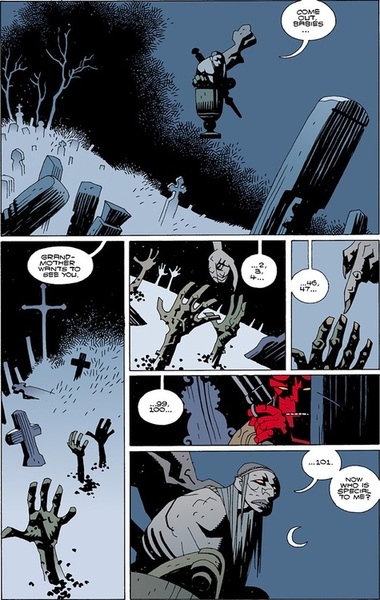
So here’s a page from Mignola’s Baba Yaga story, included in the third Hellboy collection.
 

tumblr_mm06odQiif1s5ys7lo2_400


I like this page as much as I like any of the art in Hellboy I think, more or less. It’s fairly stylish; the top panel has a nice use of negative space for example. Baba Yaga floating in the air there is a weird image; the pestle streaming out behind her looks like smoke made out of rock; I had to look at it a few times to figure out what it was, which I think adds a nice sense of wrongness to the image. The color palette is good too; different shades of grey and black, the coffins fading out into nothing over at left. The hands reaching up like crosses is a good conceit; the little patches of dirt around them arranged in a kind of Kirby krackle, a nod to one of the most obvious influences on Mignola’s style. Counting the corpses fingers is goofily macabre as well — maybe the single best idea in the issues of Hellboy I’ve read, and that panel of her reaching down to touch the fingers reaching up glances towards abstraction in a way I can appreciate, her claw a twisted organic thing, detached from the rest of her by the panel borders.

So that’s the good. The not so good is the last two panels. The image of Hellboy there seems pointless. It looks like a default pulp tough guy lift from a Frank Miller comic; there’s nothing particularly interesting about the pose or the image, and it just jettisons all the spooky tension or weirdness. Even the color pallet is fucked up; your grooving on all these washed out greys and bleak blacks, and suddenly there’s that red. After that odd image of the hand touching the hand, you cut back to your hero, so the destabilized severed uncertainty doesn’t freak anybody out too much.

And finally, the last panel of Baba Yaga is just not all that. This is the first time we really get a look at her, and she’s a big disappointment. Yellow eyes, check; big nose and mouth, check. Mostly she looks like a not very intricate or interesting gargoyle.

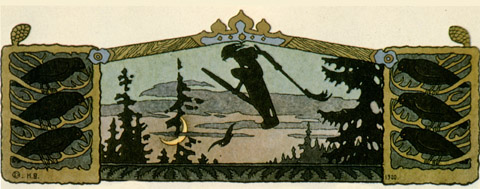
The Baba Yaga reveal is especially underwhelming because there’s no shortage of superior takes on that character. For instance:
 

babayaga

 
That’s an image by Ivan Bilibin, and it manages to do just about everything that Mignola is reaching for and missing. Even though this Baba Yaga is distant and only in silhouette, you can feel the tension in her posture, the sweep of hair away from her head and her bent knee above the pestle turning her into a bird of prey about to launch. The use of negative space and the positioning of the moon is superior too. In Mignola’s image, the moon sits just off to the side of Baba Yaga’s head; there’s no real feeling of motion — it’s just a marker to tell you she’s in the sky. In Bilibin’s, on the other hand, the moon’s set far below and under Baba Yaga, and the angle of her pestle makes it seem like she’s just about ready to tip over it in a vertiginous rush, flying up into space.

There’s no shortage of other Baba Yaga versions. Here’s another amazing one by Bilibin.
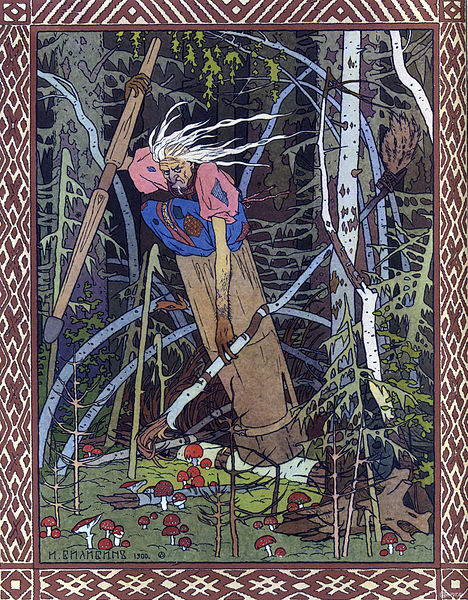
 

468px-Bilibin._Baba_Yaga

 
That’s the expression Baba Yaga should have, damn it; a look that could curdle milk and dry up your testicles.

Here’s one by an artist named Rima Staines.

 
il_fullxfull.208990594
 
Again, that seems not just technically superior, but much more powerfully imagined. Her expression looks almost nice-old-woman friendly till you look closely and see the sneer and those teeth. And I do believe she’s feeding that cute little house — though what she’s feeding it I wouldn’t want to speculate.

One more maybe; this is by Dario Mekler.
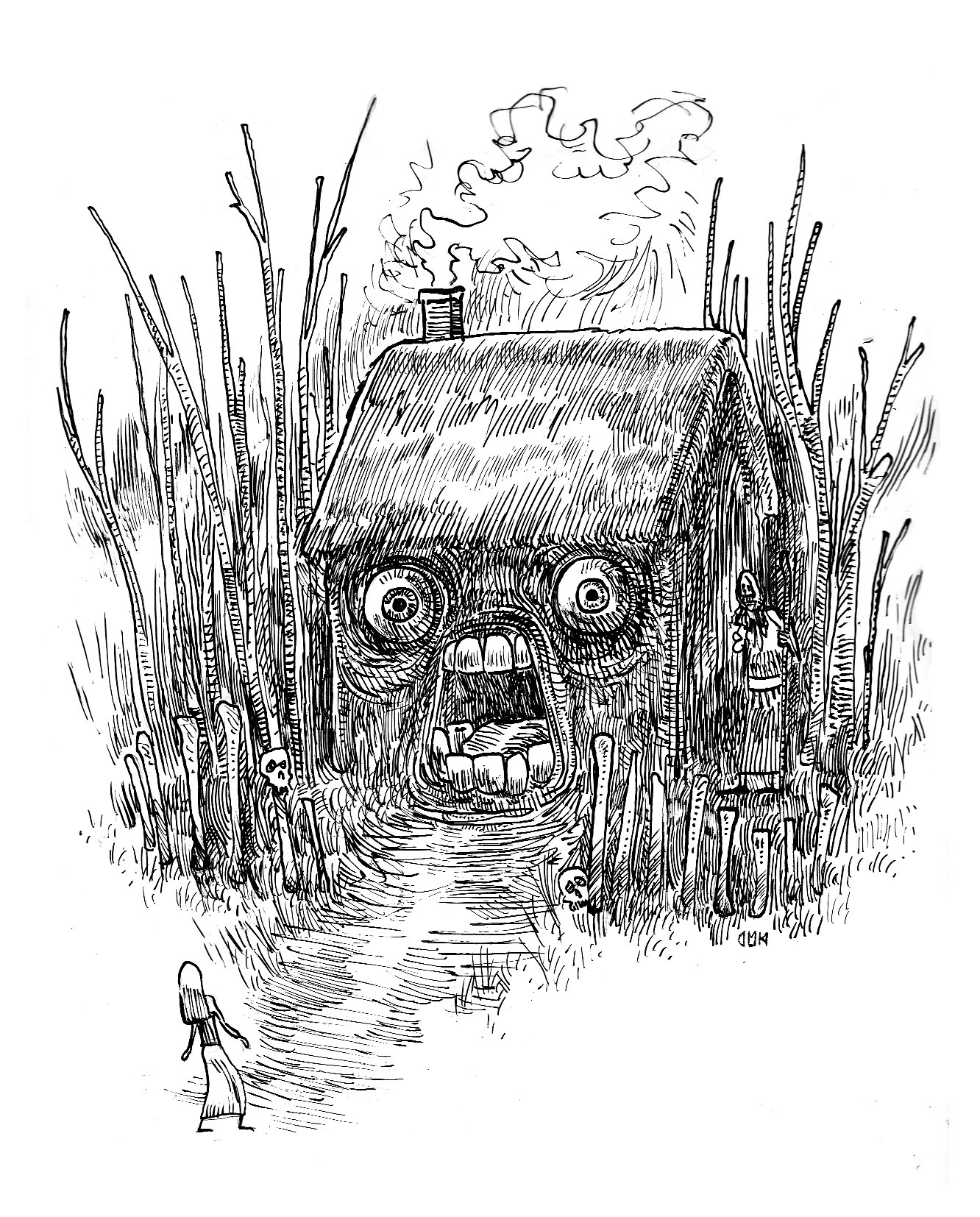
 

Baba-Yaga

 
That’s a more cartoony take, but it’s got a ton of energy. I love the scribbled smoke coming out of the roof, the way the moire patterns in the hut seem to make the eyes vibrate, the simple, stick-figure lines of the girl, so that she looks fragile and just about ready to snap apart…and Baba Yaga herself, barely visible, meshing with the lines of her hut, like another one of those twisted trees, waiting.

Bilibin’s drawings of Baba Yaga are famed classics; Staines and Mekler both seem to be significantly less famous than Mignola. But their versions are all much more imaginative, inventive, and engaging than the one in Hellboy. They all also, I think, have more narrative tension or interest. “What is Baba Yaga feeding the house?” and “What is going to happen to that girl?” are both significantly more intriguing, and more energized, questions in the art than the banal pulp violence that one image of Hellboy promises.

Again, I don’t think the Mignola art is horrible. It’s certainly better than most mainstream comic book illustration. It’s clear, it has some flair to it. But with a subject like Baba Yaga, and a reputation like Mignola has…well, it seems weak. Why would I want to look at this when my browser can take me to an infinite number of more interesting Baba Yaga’s? I’m just having trouble seeing how mediocre to bad pulp writing and decent but nothing special pulp art add up to a great comic.

Worst Movie of the Year

So I was just thinking about this and, though I do really hate Her, and though I saw plenty of other crappy movies too, I’m pretty sure that Olympus Has Fallen is the worst movie I saw in 2013.

For that matter, Olympus Has Fallen is I think one of the worst movies I’ve ever seen, period. Not worse than Schindler’s List, but possibly worse than Amistad. Having trouble thinking of other competition that isn’t Spielberg, but I think that’s just because I saw Amistad and Lincoln back to back and it scarred me.

Anyway what about you folks? What was the worst movie of 2013?
 

OHF_03976.NEF

Utilitarian Review 1/25/14

On HU

Featured Archive Post: Darryl Ayo on Before Watchmen and the children’s crusade.

I wrote about how guys in romance are hotter than the girls, and often richer too.

Lee Relvas on being a working-class artist.

James Romberger looks at Douglas Fairbanks’ The Mark of Zorro (and makes a storyboard for the film.)

Sarah Shoker on feminism, the Little Mermaid, and Frozen.

Samantha Meier with her first column on women underground cartoonists, looking at women’s comics anthologies.

Frank Bramlett with this week’s PPP post, asking how do comics artists use speech balloons?

Chris Gavaler on why superheroes should be in the academy (plus a syllabus.)
 
Utilitarians Everywhere

At the Atlantic I argue that 1984 is a romance and Julia is a MPDG.

At Salon I’ve got a song for each month of the year.

At the Center for Digital Ethics I talk about the ethics of quoting from social media.

At the Dissolve I review:

Old Goats, a crappy senior citizen buddy movie.

Mercedes Sosa, a lovely doc about the radical singer.

At Splice Today I talk about:

how to be anti-war a film needs to not be a war film (looking at Full Metal Jacket and Atonement.)

Armond White and why 12 Years as Slave as torture porn isn’t a bad thing.

Other Links

Michael Carson talks about Lone Survivor and the ironic kitsch of war movies.

Andreas Stoehr is completely wrong about Her, but his review is still lovely.

Osvaldo Oyola on Ms. Marvel and revisionist feminist history.

Christina Kahrl on how Grantland screwed up in outing a trans woman.

Grace takes down Dinesh D’Souza with Gifs.

Sarah Kendzior with a great piece about academic publishing.

Raymond Cummings provides a public service message from Barack Obama.

Molli Desi Devadasi on problems with the sex work rescue industry.
 

Atonement_UK_poster

Utilitarian Review 1/18/14

On HU

Feature Archive Post: James Romberger on late Jack Kirby.

I talk about romance, patriarchy, and Jennifer Cruise’s Welcome to Temptation.

I talk about smugness and climate scientists.

Craig Fischer on women in B.P.R.D.

Osvaldo Oyola on interpretation, dream, and Matt Kindt’s Mind MGMT

Chris Gavaler on lit fic, genre, and teaching writing.

Roy T. Cook for PPP looks at art changes in the Invisibles from floppy to trade, and asks whether, or how much, the comic is changed.

Erica Friedman on zombies and gender in Attack on Titan.

Utilitarians Everywhere

At the Atlantic I talk about slavery films, Oscars, and white saviors.

At Salon I list 24 great movie soundtracks, from R.D. Burman to Carl Stalling to Outkast to Miles Davis.

At Splice Today I am skeptical that Andrew Sullivan will trasform the media.

Other Links

Nicky Smith kicks the odious Her.

Julia Serano talks about dating and politics.

A thoughtful defens of Armond White.

Sarah Kessler with a great piece on Girls and work.
 

girls15_wide-42312aaff70bb1cd81218524b88bcfe6948d7569-s4-c85

Romance and Male Fantasies

I watched Love Actually recently, and was reminded yet again that in romcoms, and just in Hollywood in general, the women are almost always more attractive than the guys. There are lots of couples floating around the film, and some of them are more or less balanced in age/attractivness…but then there’s homely cute aging Hugh Grant with the blindingly hot Martine McCutcheon (who of course has to endure constant jokes about her weight) and the homely cute aging Alan Rickman at whom the much younger and exponentially hotter Heike Makatsch keeps throwing herself. The Woody Allen dynamic of dweebish guy with sizzling younger woman is a Hollywood staple (and is only made more uncomfortable by the allegations about Allen’s real-life abuse of a 7-year-old.) But the reverse — dweebish woman with sizzling guy — hardly ever happens.

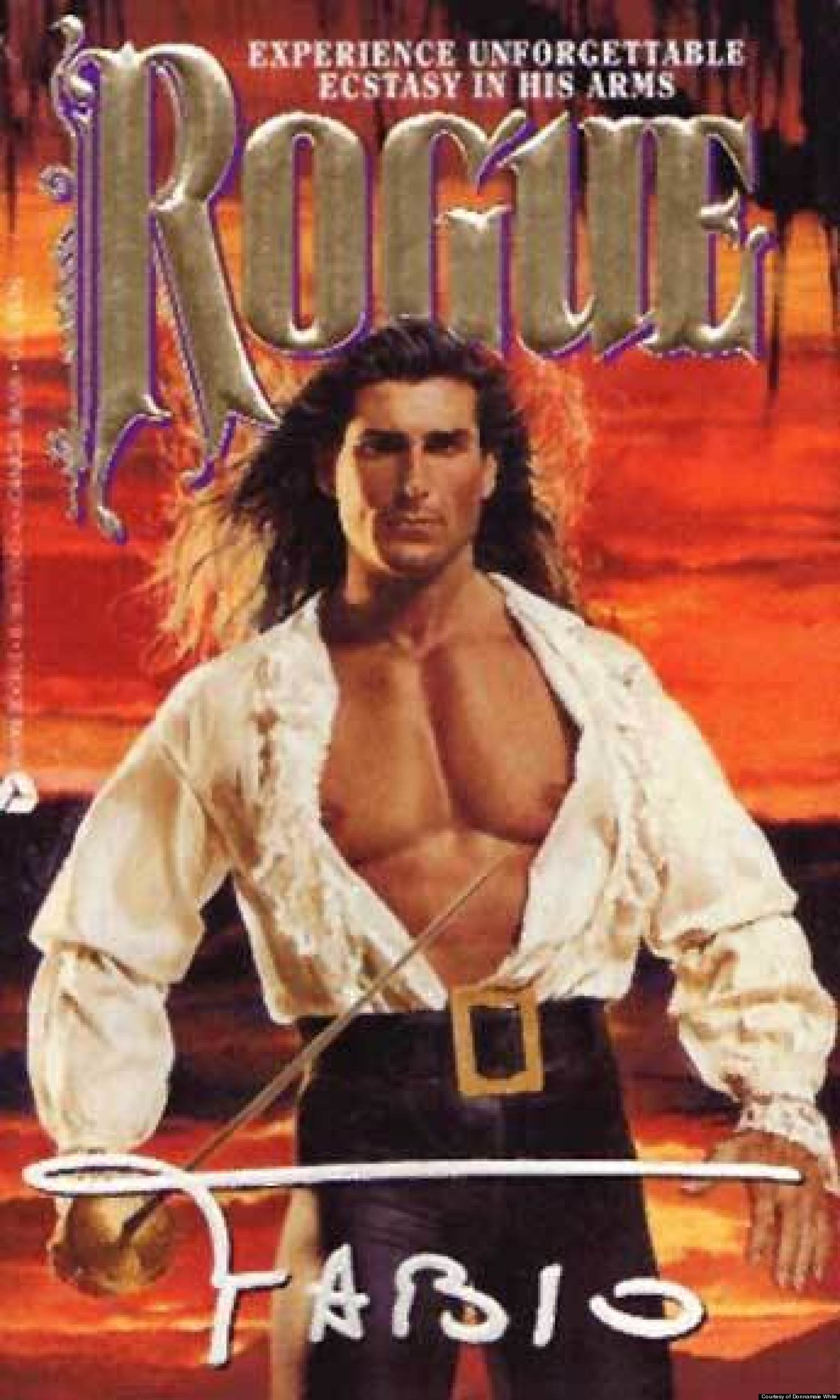
o-FABIO-BIRTHDAY-facebookOr at least, it hardly ever happens on film. I’ve read a bunch of romance novels recently, and there the tropes are pretty consistently reversed. At least in the dozen or so books I’ve read, there is not a single instance of the character actor guy getting the incredible babe in the end. Instead, both men and women tend to be described as ravishingly attractive (and, in the case of men, as having impressive genital equipment. Size, in romance novels at least, does in fact matter.)

Or, if both are not ravishing, then the one who is not is, consistently, the woman. In Jennier Crusie’s “Bet Me”, the Adonis-like Cal passes over the perfect, slim, Cynthie in favor of the decidedly not-thin Min, who is described in her initial appearance as being “dressed like a nun with an MBA.” In Cecelia Grant’s “A Gentleman Undone,” the novel proper begins with the words, “Three of the courtesans were beautiful. His eye lingered, naturally, on the fourth” — that fourth being our heroine. In Judith Ivory’s “Black Silk,” the most notable physical characteristic of the protagonist is her irregular teeth — which the hero finds “Oddly” but “strongly feminine.” Here, as elsewhere, the men see past the women’s imperfections — or, indeed, the men are attracted by the imperfections.

Obviously, this particular narrative difference has to have something to do with differing demographics. Romance novels are aimed overwhelmingly at women, so you get fantasies in which normal, non-Hollywood-hot women date perfect male specimens who can see the beauty not just in their personalities, but in their deviations from tyrannical beauty standards. The only surprise is that Hollywood doesn’t tap into this pretty simple fantasy more often — an indication, perhaps, that having films directed and produced almost entirely by men does in fact have a noticeable effect on the content of even films supposedly targeted at a mixed audience (like “Love Actually”).

So (het) men prefer fantasies in which schlubby men get hot women, and (het) women prefer fantasies in which schlubby women get hot guys. That seems predictable enough. But what’s maybe a little surprising is that, in other respects, the genders’ ideal fantasy is congruent. Or at least, both Hollywood and romance fiction seem to agree that the ideal romantic pairing is one in which the guy is substantially richer and more powerful than the woman.

The magnitude of the difference here can vary a good bit. The reductio ad absurdum is Twilight, with the fabulously wealthy and superpowered vampire sweeping the simple high school student out of the prom and into eternal life. But the meme hold up to one degree or another both in “Love Actually” (where Hugh Grant gets to crush on his secretary, Alan Rickman, as noted above, is flirting with his secretary, and one of the other characters falls in love with his maid) and in the romance novels I’ve looked at. As I mentioned last week, in Jennier Crusie’s Welcome to Temptation, the heroine is a struggling filmmaker while the hero is the town mayor. In Pam Rosenthal’s “Almost a Gentleman” the hero is a cross-dressing man of fashion, but the hero is a powerful, wealthy lord with extensive property. Cecelia Grant’s guy in “A Gentleman Undone” is not rich…but her heroine is a a courtesan whose status is precarious enough that the guy seems relatively well off. Beverly Jenkins’ Indigo goes the full-bore 50 Shades route; the heroine is an ex-slave barely maintaining herself in the middle-class, while the hero, a New Orleans freeman, has apparently limitless wealth and resources.

Again, the fantasy here isn’t hard to parse; if you can marry for true love and fabulous wealth, why settle for just marrying for true love? The guy having wealth and power is also a useful narrative convenience; it’s a lot easier to have a happy ending if someone can wave his checkbook at the finale and make most of the problems disappear. Really, what’s odd is that romantic fantasies for men don’t take this practical approach as well. Why don’t all those guys making Hollywood movies ever have their homely guys fall for some woman who is not only young and beautiful, but incredibly wealthy as well?

But that’s not how it works. In their fantasies, women imagine handsome, powerful men, while, in their fantasies, guys imagine men who are powerful, if not always quite so handsome. Everybody seems to agree, though, that powerful guys are more romantic.

That agreement is an agreement to, or about, patriarchy. Men=power; power=manliness. As I suggested in my piece about Crusie’s Welcome to Temptation last week, a good part of the rush, or allure, of these het romance novels, at least, seems to be not just the love story, but the way the love story turns into a story about women becoming powerful through men; you pick up the phallus to pick up the phallus. That’s a story about women’s empowerment, certainly, but it’s also, or along with that, a story about women endorsing power as defined in pretty straightforward patriarchal ways. Romance is good at giving women what they want. But to the extent that what they want is both men and power, it seems to have trouble in not conflating the two.

Why Is Everyone Else So Stupid?

This ran a while back on Splice Today.
__________

There is nothing quite so sad as a sad technocrat. The technocrats know what is best for all of us. They know how to bring that “best” about. They have charts and science and graphs—oh, the poignant, unlooked-at graphs! But though they know all, though they see all, though they can save the world, none will heed them. Though they cry out in the language of science, their wisdom is mocked and their efficiencies sneered at. The world, they know, will die, all because the fools would not listen!

It’s a familiar story, reiterated once again in this endless and wretchedly self-vaunting post by Ajit Varki and Danny Brower, experts who, together, have the proportionate prose style of a flaccid guppy.

But we are not here for the prose style, but for the insight and the wisdom. Varki and Brower have gotten up upon the soapbox to tell you that global warming is a real problem, and that those who do not treat it as such are deluded fools. The emotional climax of the piece comes when the authors reminisce about a 2007 conference they attended in which “some of the oldest and best-known American societies that focus on the value of knowledge” came together to insist that “in order for democracy to succeed, it must be based on real knowledge of the facts of the world around us.” The conference attendees even wrote books about it.  And yet, the authors lament, despite the clear directive from important knowledge societies, people still just kept on being people, believing in dietary supplements and natural cures and all that nonsense. “Why is it,” they wail, “that so many humans are attracted to these illogical doctrines?”

In answer, the two spout completely unproven theories about humans’ need for illusions in the face of mortality. They also promise that we can achieve a “complete recognition of reality,” but only if we are as knowledgeable and thoughtful as Richard Dawkins, who, they fail to mention, is kind of an ignorant xenophobic shithead.

Also worth noting is that, in the course of their discussion of climate change, they claim that as one effect of global warming, “it is plausible that we could… tip the planet into an ice age.” Which sounds like it can’t be true, and, in fact, appears to be untrue. If you’re going to lambast the rest of the world for not being as smart as you are, the least you could do, you’d think, would be to get the science right.

I understand why Varki and Brower are frustrated. Global warming and environmental degradation are real and dangerous problems, and we need to confront them. Our political institutions have been very reluctant to do this, and a not insubstantial minority of people has actively denied that anything is wrong. The obvious conclusion is that those people are dumb, and that our political institutions are ineffectual.

And you know what? People really are often dumb, and democratic politics is a grim slog against the rampant imbecility of the majority. I don’t deny that.

The problem is, when you say “people” are dumb, that’s not just that guy over there drooling. It’s everybody. Everybody is dumb in some ways, sometimes. If you’re not denying global warming, you’re seriously suggesting that human gullibility should be repealed because you attended some stupid conference. If you’re not burbling about the dangers of vaccinations, you’re burbling about the coming ice age.

Knowledge is great, vital and useful. Reason is a powerful tool, and can help us get out of nearly as many messes as it gets us into. But there’s nothing smart, or reasonable, about talking to your fellow citizens as if they’re idiots, and there’s nothing particularly reality-based about condescending to your fellow human beings as if you think you are gods. Varki and Brower want to convince their readers that global warming is a serious problem. But all they really manage to do is to show that technocracy can be a kind of idolatry, and that being impressed with your own overwhelming knowledge is a sure way to make yourself sound like a fool.

Utilitarian Review 1/11/14

News

So we’re getting a good bit more spam since I turned off the captcha requirement. Is this annoying people? Or is it worth not having to struggle with the captcha? Let me know if people are happy as is or if I should try to bring the captcha back.

On HU

Featured Archive Post: a report on a panel on gender and cartooning in Chicago.

I review the mediocre mockumentary Troll Hunting.

A list of the best essays I wrote in 2013.

Ilana Gershon on firing teachers for what they say on social media.

Chris Gavaler on the superhero pilgrimage to Tibet.

Richard Cook got engaged! To celebrate, he provides a history of marriage in comic book covers.

Adrielle Mitchell for PencilPanelPage kicks Moon and Ba’s Daytripper.

Isaac Butler on the labor practices of the theater The Flea and whether people should be paid for acting. (This is I think our biggest single day post since the Victorian Wire in terms of traffic.)
 
Utilitarians Everywhere

At the Atlantic

—I argue that Britney belongs in Vegas.

—I celebrate Sherlock Holmes’ freedom from copyright.

At Salon I have a list of winter songs.

At the Dissolve I am unimpressed with The Rocket, a feel-good Laotian drama with spunky kids.

At Splice Today I write about

the upsides of hypocritical homophobia.

Chris Christie losing my vote.
 
Other Links

NPR’s Code Switch did a big segment on Orion Martin’s HU piece asking What if the X-Men Were Black?

Calum Marsh on why every war movie is a pro-war movie.

Jonathan Bernstein has started his new politics blog at Bloomberg.

Andreas Stoehr has a brutal short review of Saving Mr. Banks.

Jill Filopovic on online harassment of women.
 

d80f65300