Let the Future Be Whitewashed…Today!

Everybody knows that racism is bad, but somehow hating diversity is cool. Thus, Felicity Savage over on the Amazing Stories site has a post where she chastises non-white people for wanting to see themselves in science fiction stories. She concludes by praising the work of Stephen Baxter, which she says provides the following insights.

Speculative fiction this good achieves something no other genre can do: it makes you realize, really realize, that we’re all in this together. Black, white, yellow, brown, male, female … to the Big Bad lurking on the dark side of the moon, we all look like snacks. That kind of perspective shift is what I read the genre for.

This is simultaneously honest and oblivious — the first predicated on the second. Because, of course, the reason that it is important to include diverse characters and diverse voices in speculative fiction would be because the assertion “we’re all in this together” is not, in fact, a pure, shining, unimpeachable truth, handed down by the gods of speculative fiction for our enlightenment. The statement “we’re all in this together” is, instead, an ideological presumption which is not supported by most of the extant facts. Kids in segregated schools on the south side of Chicago aren’t in this together with folks on the north side who have buttloads of tax money dumped into their science labs. Folks who were enslaved weren’t in it together with the people who pretended to own them with the collusion of the law. Women who lost their property rights during marriage weren’t in it together with the men who controlled them. And so forth. Proclaiming that justice and equality have been achieved because you’ve imagined some big old space monster is not profound. It. is. bullshit.

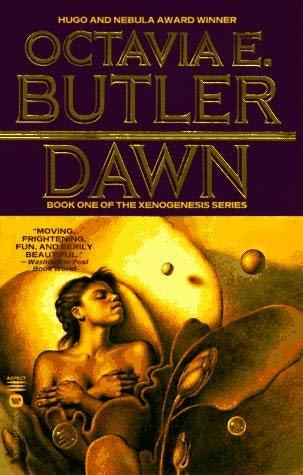
To say that human difference is not part of good sci-fi is to erase the thematic concerns of many of sci-fi’s greatest writers, from Philip K. Dick to Ursula Le Guin to Octavia Butler to Samuel Delany to Joanna Russ and on and on. It is, moreover, to admit to an almost ludicrous poverty of imagination. Sci-fi is dedicated to telling stories that haven’t been; to exploring the entire range of what might be. And yet, the only story you can think of, the only future you can see, is one in which white people’s experiences are the sole benchmark of importance, in which all people’s troubles and traumas are subsumed in white people’s traumas; in which, somehow, racial (and gender?) difference has ceased to matter,and in which that “ceasing to matter” means, not a blending of diverse races and experiences, but an erasure of all races and experiences which aren’t the dominant one right now, at this particular time.

“Nothing is gained by mapping our fragmented ethnic and sexual identities onto our fiction with the fidelity of a cellphone camera photo,” Savage says. To which one can only ask, who is it that gains nothing exactly? Ethnic and sexual identities are a big part of how we live; exploring them has been a huge resource for science fiction in the past. Admittedly, if you’re committed to a world in which you never have to think about others, and in which the one sci-fi story is a story about how your particular concerns, no matter how boring and blinkered, should erase everyone else in a lovely rush of imperialist amity, then, yes, diversity is an irritating distraction. If, on the other hand, you think that sci-fi should be as rich and complicated as the world we live in, then including difference is not a failure, but a necessity.

HT: N.K. Jemisin.
 

Dawn-2

Superheroes Are About Fascism

This first ran on Splice Today.
_________

Superheroes conflate goodness with hitting things. For the superhero genre, the best person in the world is the one with the greatest power; beating evil is a matter of hitting it harder. A world in which force and goodness are one and the same and both always triumph is a world in which you’re essentially worshipping force — and the worship of force is, as Richard Cooper pointed out last week in Salon, a good thumbnail description of fascism. No surprise, then, to find that early superhero tropes have roots in pro-KKK pulp novels and discourses around eugenics. A fantasy of eugenic superiority and righteous violence can give you Hitler or Superman, either one.

Chris Yogerst at the Atlantic objects to this  characterization of super-heroes on the grounds that superheroes are, in fact, righteous and use their power wisely. Or as he says, “The “fascism” metaphor breaks down pretty quickly when you think about it. Most superheroes defeat an evil power but do not retain any power for themselves. They ensure others’ freedom.” But, of course, if you were making fascist propaganda, the fascist heroes wouldn’t be portrayed as power-hungry whackos. They’d be portrayed as noble and trustworthy. Batman’s a good guy, so it’s okay that he has all-pervasive surveillance technology in the Nolan films, because we know he’ll use it for good ends. Tony Stark is awesome, so when, munitions manufacturer that he is, he makes a superweapon, we know it’s fine because he’ll use it well. And all those superheroes can act outside the law and beat people bloody without trial, or even torture them, because they are on the side of good, just like the KKK can operate outside the law in Birth of a Nation because they are on the side of good. (Yogerst also argues that superheroes can’t be fascist because they often mistrust the government — as if there’s no history of fascist vigilantism, in Germany or here.)

In fact, as Yogerst and Cooper both acknowledge, there’s a long history of superhero comics criticizing the superhero genre specifically because of the fascistic way it links the good and the powerful. Back in the 1940s, almost as soon as the superhero genre was created, William Marston and Harry Peter created Wonder Woman as an explicit repudiation of what they saw as a male glorification of violence.  Wonder Woman preached peace, and worked to convert her foes in lieu of (or sometimes in addition to) battering them senseless. Alan Moore and Dave Gibbons’ Watchmen presents superheroes as violent lawless bullies and megalomaniac monsters. The film Chronicle has a teen with superpowers who picks up on the rhetoric of eugenics, with disastrous results. Chris Ware (in Jimmie Corrigan) has a Superman/God figure who acts as a violent ogre/bully; Dan Clowes (in  The Death Ray) presents vigilante violence as a kind of adolescent fantasy leading to murderous psychopathy.

On the one hand, you could see the fact that this critique is so prevalent as evidence that it’s true; if so many creators over such a long period of time have seen the link between superheroes and fascism, and have questioned the equation of the powerful and the good, then that critique must have some merit. On the other hand, though, if so many superhero stories warn of the conflation of the powerful and the good, is it really fair to say that superhero comics always promote that particular fascist link? Superhero critique and parody is, and has just about always been, a central part of the superhero genre — so much so that Cooper’s essay can be seen not as an attack on the genre, but rather as an example of the genre itself. When he says, “Maybe one day we will get the hero we need: one who challenges rather than reinforces the status quo,” you could argue that superhero narratives have been doing that for a long time — and that his essay in fact uses superheroes to do just that.

Superhero narratives, then, are about fascism, and the glorification of violence as the good. But being about those things doesn’t necessarily always mean they endorse those things. Some, like the Nolan Batman films, seem to; others like Chronicle very much don’t; still others, like Iron Man, may go back and forth. Cooper and Yogerst correctly identify some of the key concerns of the superhero genre, but they both err in suggesting that those concerns have a single meaning. It would be more accurate to say that one thing superhero comics do is think about the relationship between the good and the powerful, sometimes equating them in a fascist way, sometimes criticizing the tendency to equate them, and sometimes examining that equation. The genre is one way we think about fascism — which is, no doubt, why it was so popular in World War II, and why it has had its recent, post-9/11 resurgence.

Best Albums of 2013

I participated in the Splice Today 2013 music poll, but I thought I’d put my top ten list up here as well. I reviewed most of them one place or another; links are provided. Feel free to put your own picks in comments!
______

1.Valerie JunePushin’ Against a Stone

2. Cassie —RockaByeBaby

3. Edge of Attack —Edge of Attack

4. Guy Clark —My Favorite Picture of You

5.White+ — White+

6. Jeri Jeri — 800% Ndagga

7. Botanist — Mandragora

8. Emmylou Harris and Rodney Crowell —Old Yellow Moon

9.Horse’s Ha — Waterdrawn

10. Tweet — Simply Tweet

Utilitarian Review 12/21/13

Conversations-magnum

from Lilli Carre’s show at the MCA in Chicago

 
News

The holidays are upon us, obviously. Not exactly sure what posting here will be like. We’ll definitely have new posts Monday and Tuesday, and PencilPanelPage is posting Thursday…so, yeah, we’ll be around in some form or other most of the week. So stop by if you have a minute to spare from the merriment.

On HU

Featured Archive Post: Richard Cook with a gallery of Super-Santa covers.

I talk about the Regency Romance as horror and the Cecelia Grant’s Blackshear series.

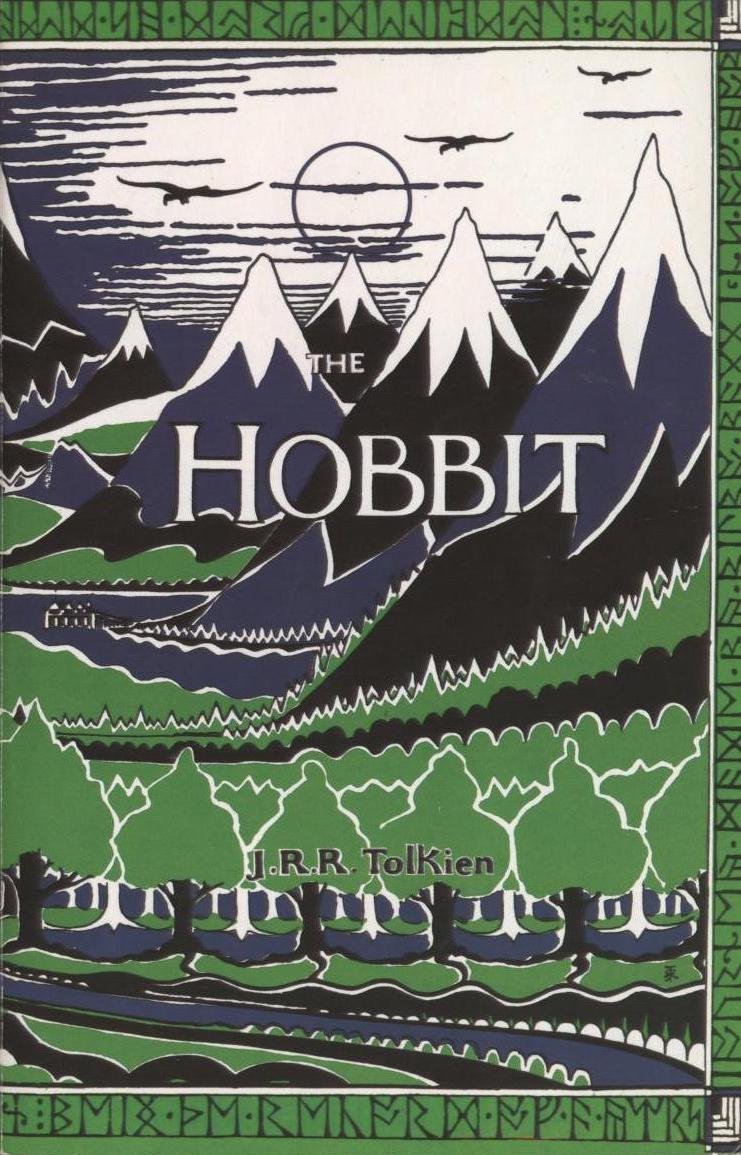
I write about the small as life pleasures of Tolkien’s The Hobbit.

Orion Martin asks “What if the X-Men were black?”

Robert Stanley Martin is mostly underwhelmed by Julie Maroh’s comic “Blue Is The Warmest Color.

Chris Gavaler on Paul Revere, Batman,and jihad.

I wrote about the first X-Men comics in which the X-Men behave as establishment lackeys.

Michael A. Johnson on Christmas and the seasons of Krazy Kat. This finishes up the PPP Krazy Kat roundtable.
 
Utilitarians Everywhere

At the Chicago Reader I reviewed Lilli Carre’s lovely show at the MCA in Chicago.

At Salon:

—I listed 14 country songs for people who hate country.

— I talked about Her and Philip K. Dick and empathy for white guys.
 
Other Links

At the Atlantic I talked about Vivian Maier and the uncomfortable politics of outsider art.

At Splice Today I talk about

—America’s educational apartheid, and how you can’t fix schools by fixing schools.

conservatives, progressives, and polygamy.
 
Other Links

Mari Naomi writes about being harassed onstage at a comics panel. Scott Lobdel, who was the harasser in question, apologizes.

And how to discourage women from cartooning.

Ta-Nehisi Coates on the toughest gang in Chicago.

Wazhma Frogh on the problem with trying to save victims of human trafficking when you don’t know what you’re doing.

Meghan Murphy on twitter feminism.

As Brienne point out, this music best of from Mother Jones is pretty funny.

Some idiot plagiarized Dan Clowes, if you haven’t already heard.

The Sinister Eyes of Jess Franco

titlecap_sinister_eyes_of_dr_orloff_intervision_dvd

 
This first appeared on Splice Today.
 
Spanish cult schlock director Jess Franco’s made roughly a billion films, and I’ve seen like five of them, so I’m hardly an expert on his oeuvre. Still, the 1973 The Sinister Eyes of Dr. Orloff — recently released on DVD — seems like a fairly unusual Franco film.  Mostly because it has a plot.

Of course, there are some typical Franco elements — murder, hot women in gratuitously short skirts, hot women falling out of their clothes, hot women murdering each other while falling out of their clothes, dream sequences, etc. etc. Not to mention the obligatory surreal detour into utter incompetence. The most delicious example of this here is a recurrent folk song sung in warbling tinny, out-of-sync lip-sync by the improbably ectomorphic and improbably named Davey Sweet Brown (Robert Woods.)  Another highlight is disappearing subtitles, which (at least for non-Spanish speakers) add that dollop of incoherence that you’ve come to expect from any movie directed by Jess Franco.

So, like I said, one damn thing after the other, rather than, as in Vampyros Lesbos, one damn thing utterly divorced from the next damn thing, and then the third damn thing somewhere over there, and then, hey, breasts, and groovy music,  and then lets go back to the first damn thing because why the hell not?

Which leads you to wonder, what caused Franco to suddenly turn himself into a bargain basement Hitchcock, with suspense and plot twists and dream sequences clearly marked off as dream sequences?  Was he dropped on his head and suddenly set right?  Or what?

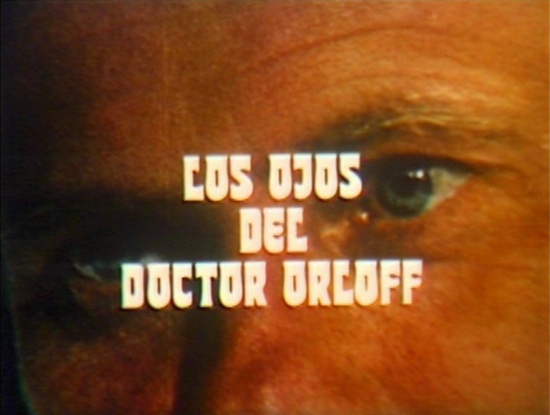
Probably it’s just the script or his collaborators or the phase of the moon or something banal like that.  But I like to think, more poetically, that what happened was Dr. Orloff.  The Orloff character appears in a number of Franco films, — though he’s played by a plethora of actors and from what I can tell there’s little actual connection between one baddy named Dr. Orloff and the next.  In any case, this Dr. Orloff is all about the eyes; the film opens with a close-up of him staring intently, and when Melissa goes about her bloody business, we occasionally get flashes back to the same deadly ojos, looking commanding and fiendish.

Thus, Orloff functions essentially as a director within the film.  His vision determines the action; he sees, and Melissa obediently staggers off, woodenly wreaking havoc in the way that Franco characters usually wreak wooden havoc — albeit, in this case, with somewhat more focus.   Orloff’s directorial impulses are at times suggested even more explicitly. In one scene, he tells Melissa that her family thinks she’s crazy because, he says, he needs to “see her reaction”, as if he’s a filmmaker trying to calibrate his audience’s response.  Shortly thereafter, he pats her on the should and tells her, “ In that little head of yours the dreams and the reality are mixed together.”

This is of course diagetically true of Melissa, who dreams about the real murders which on waking she forgets. But it’s also true extra-diagetically: film is both reality (there are real people up there) and dream, all mixed together. Melissa’s dream of murder is (unbeknownst to her) real, and that reality is (further unbeknownst to her) a fiction, or dream.  When Melissa kills the loyal family butler on a foggy deserted road, the artificial mist and oversaturated lighting at times makes it hard to see what’s going on; the viewer is forced to become conscious of not seeing, and so of seeing. Similarly, Melissa’s slow stiffness, her awkward limping, and painful zombie overacting, reminds us of the naturalness of her unnaturalness. She looks like she’s in a film because she’s in a film, with Dr. Orloff (whose eyes appear in a quick jump cut) directing.  The horrified butler looks up at her not to demand she stop but to ask her, “Miss Melissa, what are you doing?” — a question that actors in Franco’s films must have asked themselves and each other on more than one occasion. And after  she’s done the deed, the camera zooms in for a fish-eye close-up on her  before she clutches her head and falls to the ground. It’s a reminder that what’s in her is what’s watching her. The filmmaker moves around in someone else’s body until, eventually, he gets tired with the scene and discards his toy.

Imposing your own will on others is, of course, a sadistic pleasure; Orloff, with his giant needles, surely experiences it as such. Franco’s no stranger to sadism either; as just one example, his 1975 film Barbed Wire Dolls opens with the extended beating of a nude woman chained like a dog. Watching The Sinister Eyes of Dr. Orloff made me think, not only of the sadism in that scene, but of the sadism that must have been implicit off-camera for that scene to exist. What exactly was the conversation like in which Franco explained to the actress that she needed to strip down and put on a collar?  And is that different in kind, or only in degree, from telling an actor or an actress what to say, where to stand, and how to feel?

Sinister Eyes also suggests, perhaps, that the rather desperate, over-the-top sadism in some of Franco’s movies might be linked to their fragmentation. Normally film directors are more like Orloff; they get their kicks not by elaborate beatings, but through more effective, and thus more subtle means of control.  The Sinister Eyes of Dr. Orloff is Franco imagining himself as a filmmaker who has a hold on his film and the actors in it. When the evil doctor leans over Melissa at the film’s end and tells her with lip-licking sibilance that he is going to inject her with a drug that will make her “lose her mind completely and forever,” it seems less like a threat than like a promise to Franco fans. The doctor’s execution seals the bargain; the director is dead. Next film, we’re back to insanity.

The X-Men: Establishment Lackeys

x-men-1-comic-cover-pic-1

 
Earlier this week Orion Martin wrote a post in which he argued that the X-Men essentially appropriate the experience of the marginalized for the white and middle-class. The X-Men consistently presents itself as a comic about the excluded and discriminated against, but under the guise of preaching tolerance, it actually (as as Neil Shyminsky argues) erases difference. The only marginalization that matters is being a mutant, and every adolescent white boy is a mutant; ergo, adolescent white boys are as oppressed (hell, more oppressed) than anybody. Let us, then, pay attention to their angst exclusively.

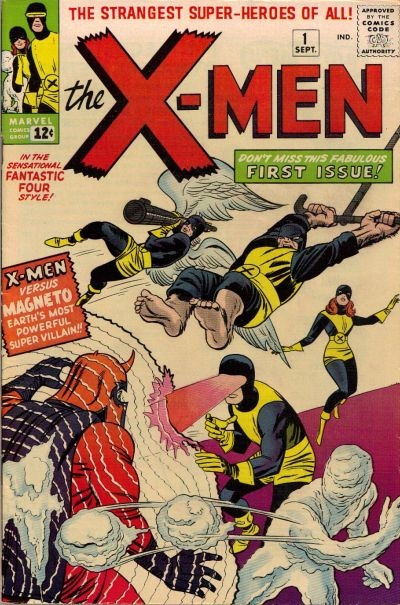
Anyway, I thought I’d test Orion and Shyminsky’s arguments against the original X-Men comic; that’s X-Men #1 by Stan Lee and Jack Kirby from way, way back in 1963. I’d remembered it as being an awful comic, and it is that; one of those Lee/Kirby efforts where proponents of Kirby would be well served by attributing as much of the writing to Stan as possible (and as much of the art too, for that matter; this is not within a mortar shot of being Kirby’s best work.)

Part of why the comic is so crappy is that it matches up with Orion’s thesis so perfectly that it’s painful. We first see the X-Men (Cyclops, Beast, Ice-Man, and Angel) in a palatial, exclusive private school. The first few pages are all cheerful boys’ school high jinks, enlivened only by the student’s obsequious deference to, and competition for the approval of, Xavier. It’s an unbroken collage of fusty preppiness and ostentatious privilege — underlined when Angel mentions off-hand that he’s a representative of “Homo Superior.” Is he referring to his wings or his class status? It’s not clear.

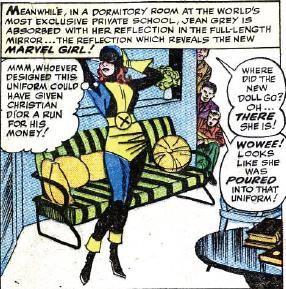
Be that as it may, the plot grinds on, and we hear that a new student is coming: “a most attractive young lady!” as Xavier tells his all-male students, before even communicating her name. Said male students then cluster around the window looking out, making various lewd observations (“A Redhead! Look at that face…and the rest of her!”) We are, in short, insistently positioned with the guys; we and they sexualize her before we even see her. When the X-Men do finally meet the new recruit, they spit out various stale and uncomfortable pick up lines, culminating in Beast trying to kiss her. Thus the first effort at portraying difference in the X-Men comic, the first introduction of someone who is not like the others, results in objectification followed quickly by sexual harassment. (Jean does use her telekinesis to put Beast in his place…but then refers to him sympathetically as “poor dear,” just so we know she’s not really angry or freaked out at having her fellow students trying to fondle her within ten minutes of arriving at her new school.)
 

UX1_MarvelGirl

>Yet more leering at Jean.

 
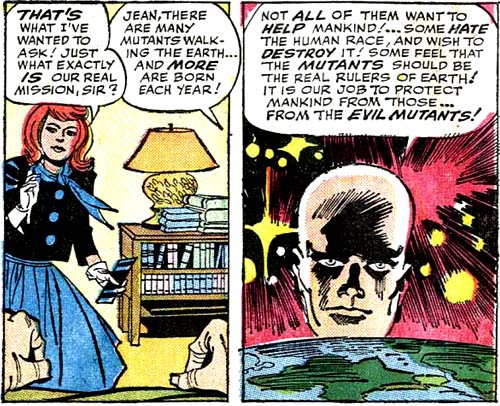
Somewhere in the middle of this edifying display of gender politics, Xavier gives with a quick speech about how normal humans fear mutants (“the human race is not yet ready to accept those with extra powers!”) and so he’s set up his luxurious refuge, where X-boys can leer at X-girls undisturbed by outside interference. He adds, though, that they have a mission to “protect mankind…from the evil mutants!”
 

ProfessorX_3

Shyminsky points out that the X-Men basically spend all their time attacking other mutants who aren’t sufficiently assimilated; their work is to further marginalize their brothers in the name of a justice of the privileged which is never questioned. That certainly fits this story, where Magneto’s plot involves attacking a US military base and disabling armaments and missiles. Again, the year here is 1963, deep in the cold war. Actual marginalized people at the time and earlier (like, say Paul Robeson or Woody Guthrie) were able to figure out that U.S. military power was used in less than noble ways around the globe, from Cuba to Indonesia to Africa. You’d think that a self-declared Homo Superior with experience of oppression like Magneto might be able to articulate that. But, of course, he doesn’t; he’s just an evil villain whose evilness serves deliberately to emphasize the justness and general awesomeness of the U.S. military.

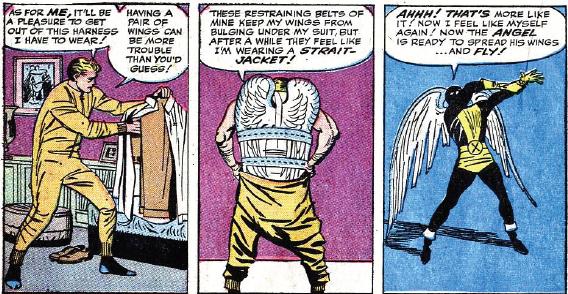
As for the X-Men’s marginalization…it seems easily doffed. The military guys aren’t scared of them, but welcome their help. The most uncomfortable scene of difference we get is a three panel sequence in which Angel changes out of his street clothes, revealing that he trusses his wings up behind him to keep them out of sight. “After a while they feel like I’m wearing a straight jacket!” he says. But no one ever questions why he has to bother to tie up his wings, or make himself so uncomfortable for the convenience of people who (supposedly) hate him. In fact, the sequence seem much less interested in Angel’s discomfort than in the ingenuity of the disguise.
 

UX1_Angel

 
Shyminsky notes that this fascination with, and eager embrace of, assimilation can be linked to the biography of Stanley Lieber and Jacob Kurtzberg, who changed their named to Stan Lee and Jack Kirby in order to be taken, like Angel, for normal humans. There’s a poignance there, perhaps, in Angel’s discomfort — Lieber and Kurtzberg’s new names may have pinched them a little at times too. But they nonetheless persevered in tightening that truss, which, in this comic at least, consisted not merely of new names, but of what can only be called a servile, deeply dishonorable acquiescence in hierarchical norms, casual misogyny, and imperialist fantasies. I hated this comic already, but as a Jew reading it as a parable of Jewish assimilation, it makes me actually nauseous. James Baldwin says that black people hate Jews (when they do hate Jews) not because they’re Jews, but because they’re white, and this seems like a fairly withering illustration of what he was talking about; a sad account of how my people (not all my people always, of course, but some of my people too often) kick those further down the food chain in a craven effort to look like, act like, and be the ones in charge. Xavier isn’t Martin Luther King; he’s a neo-con, and/or Michael Bloomberg, so charmed by whiteness that he devotes his existence to telepathic racial profiling.

So, yeah; this is not just a badly written comic, but an actively evil one. Other X-Men stories may be better — and indeed, they’d almost have to be. But at its inception, the title was a stupid, craven, explicitly sexist and implicitly racist piece of shit.

Adventure, Small As Life

Hobbit1

This appeared on Splice Today a while back.
______

Old Took’s great-grand-uncle Bullroarer… was so huge (for a hobbit) that he could ride a horse. He charged the ranks of the goblins of Mount Gram in the Battle of the Green Fields, and knocked their king Golfimbul’s head clean off with a wooden club. It sailed a hundred yards through the air and went down a rabbit-hole, and in this way the battle was won and the game of Golf invented at the same moment.

That’s one of my favorite bits from The Hobbit. It’s also, perhaps, the passage that pushes most insistently against Tolkien’s reputation as it’s developed. Tolkien is generally lauded for his careful, monumental world-building—for his intricate languages and his sweeping sense of history. And yet, here he is, with deliberate whimsy, knocking (driving?) his reader out of Middle-Earth and back to just-plain-England for the sake of a silly and utterly gratuitous joke. I suppose it’s possible that the elves and dragons play golf in Middle-Earth, but whether or not, it’s an incongruous idea, which makes tends to make the milieu unravel, rather than weaving it together. Putting hobbits and golf together is the act of a storyteller who has his eye on effects other than consistency.

Those effects are, broadly, those not of epic fantasy, but of children’s literature. It can be hard to remember after reading the very serious, very dark Lord of the Rings, and even harder after watching the definitely-for-adults movies, but the fact is that The Hobbit is for kids. There is certainly a lot of danger and tension, and I’ve no doubt it’s given many a six-to-eight-year-olds some serious nightmares. But be that as it may, the fact remains that in its approach to character, and to its own world, it is in some ways much closer to something like Doctor Doolittle or Alice in Wonderland than it is to Tolkien’s more sober trilogy. For example, when Bilbo is trying to distract giant spiders and lead them away from his companions, he sings a taunting song that is essentially a children’s rhyme. After he’s done, Tolkien writes:

They made for his noise far quicker than he had expected. They were frightfully angry. Quite apart from the stones no spider has ever liked being called Attercop, and Tomnoddy of course is insulting to anybody.

Again, this isn’t world-building, or even logic, exactly. It’s silliness for the sake of silliness, where motivations and narrative are subordinated to the joyful clip-thunk of language. The monstrous Shelob that Frodo fights is a terrible monster, gross and inhuman. But the spiders Bilbo battles act like children, driven to madness by schoolyard taunts. And the pleasure of The Hobbit is, in no small part, that shuffling of kids’ perspective and adult perspective; the way the adventure shifts from larger than life to smaller than life in a blink, so that you feel that, in this universe, children (or hobbits) really can conquer the great, grand world, or, alternately, that the great, grand world really can be child-like.

I love The Lord of the Rings too, movies as well as books. But it’s too bad that critics, readers, and writers of fantasy these days are much more comfortable with the modes of the later Tolkien than with his earlier, lighter prelude. Harry Potter, for example, largely abandoned its Roald-Dahlesque nonsense impulses in favor of supposedly more sophisticated good vs. evil bombast. Twilight, The Hunger Games, Game of Thrones and His Dark Materials all might have LOTR somewhere in their heritage, but certainly none of them have The Hobbit. There are series that still hark back to fantasy’s children’s literature roots, like How To Train Your Dragon, but they don’t seem to have the same impact, or to be taken as seriously as cultural touchstones.

This is a shame in part because the children’s literature tradition is so vibrant; there simply aren’t many fantasy stories, in any mode, better than Alice in Wonderland or Peter Pan—or The Hobbit and Narnia, for that matter. But it’s also unfortunate because those children’s stories are decidedly more sophisticated than the adult epics with their grim quests and bloodshed and high seriousness. No matter how intricate the world you build, that world still isn’t the world. A story that acknowledges its own nonsense is, to that degree, more true, and more knowing, than one that doesn’t. Golf is, after all, more real than beheading goblins, no matter how grim and epic you make the latter.