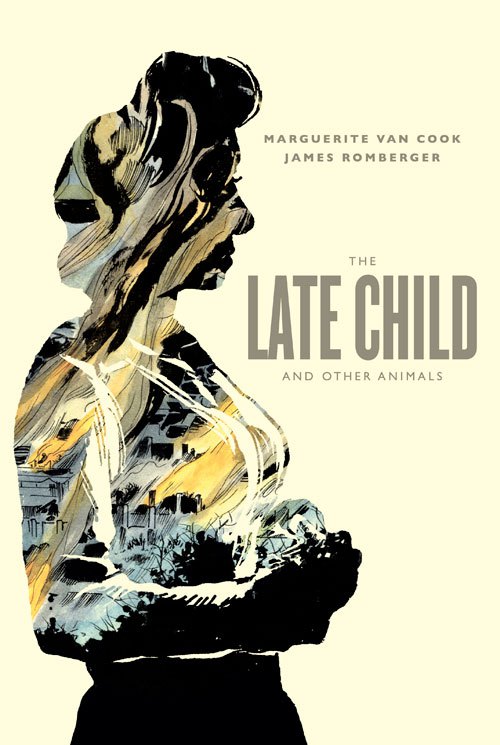
As longtime blog readers know, both Marguerite Van Cook and James Romberger have been regular writers for HU over the years. They’re also both comics creators, together and separately, perhaps best known for their collaboration with David Wojnarowicz on the graphic novel Seven Miles a Second. Their most recent project is The Late Child and Other Animals, a graphic memoir written and colored by Marguerite and drawn by James. I interviewed them by email about their book and their work.
________
Noah:Marguerite, my understanding is that you’ve worked on comics projects as a colorist and artist, but haven’t done much writing. Is that right?
Marguerite: In fact, I’ve been writing all my life. Early on I worked for the now defunct Sounds Magazine reviewing bands. One of the first things James and I did together was a comic that I wrote and co-conceptualized with him called Ground Zero. It was a semi- autobiographical sci-fi piece that ran between 1984 until, much less frequently, now.
Axel Alonzo actually included a piece in the vertigo/DC anthology title Heartthrobs, which was a poem I wrote, James did the pencils and inks and I colored it.
James: Marguerite has written prose, poetry, stage plays, screenplays, memoirs, essays, articles, reviews and interviews. She has won a major prize for her poetry. Before I met her, she wrote critically for the East Village Eye even before we began the Ground Zero strips together in that paper. The strip was also deliberately placed in many different sorts of publications as possible: tabloid newspapers, slick magazines, literary and comics zines, art publications, trade paperback anthologies and websites. Eventually all of the Ground Zero strips will be collected into a book which must have quite an unusual format, to accommodate the different methods of printing in black and white and color and varying page sizes that they are originally done for. We already have more than enough of them for a collection, we just need to fill in some parts of the narrative to make it all flow.
Noah: Does working on art help prepare you for writing? And I guess I’m curious as to how writing a comic is different? Are they completely separate skills?
Marguerite: I can’t really answer that since I have always done both simultaneously. I think one needs to have something one wants to convey, even if one is not sure what that is when one begins. The creative impulse has no definable source as far a I can tell. I do get pleasure from the physicality of writing, a pen on paper, the calligraphic marks on the page; I enjoy the private experience of putting paint on a surface, the feel of it. Those are personal moments, but art, or writing, needs a viewer, or a reader to participate in the work. The arts are mediums of exchange, even if only in the dream of the ideal reader, in the fantasy of someone who will take the work in, who read thinking of the intimacy of their engagement with the writer/ artist. The exchange is very highly charged, I can say for example that I love so and so’s work. I feel that he or she understood me, their invisible reader, although we’ve never met, nor ever will.
Noah: I know you two have worked together on other projects over the years. What are the positive aspects to collaborating with your spouse? Are there downsides? And how does the collaboration work in practice…do you critique each other’s work as you go? Are you both involved every step, or is it more separated?
Marguerite: Our working method depends on the project. We each do our jobs. I wrote The Late Child and Other Animals as a memoir in the first place. James asked to adapt it, which he did. Since he knew that I would color it, he left space for me in certain passages, in other passages where a noir genre approach seemed right, he inked more heavily. We try not to disturb each other’s process. On the other hand, Ground Zero was produced very collaboratively; because we were interested in producing a comic that was self-referential, structurally challenging and set out to break or manipulate as many of the existing codes as possible, we worked together closely. Incidentally, your use of the term “spouse” made me laugh. It sounds like something you might shoot and serve up on a hunting weekend—okay, rhymes with “grouse”–which means also to complain. I think we are quite resistant to classification; my life has been negatively affected by social constructions, which James gets.
James: I read the stories that make up The Late Child and Other Animals when Marguerite first wrote them while we were at Columbia, and she was privy to every step of my working, first on the thumbnailed adaptation and then drawing the actual black and white pages—and I saw every page as she colored it. I knew Marguerite’s mother and I have spent enough time in Portsmouth and France that I was able to draw her and those places with some assurance—and then, I did purposefully draw the book to allow for color. I knew Marguerite would add back in a high degree of intimacy and knowledge of place and time and emotional resonance with her color, and that she certainly did.
I prefer to work closely with whoever I am collaborating with. I worked closely with David Wojnarowicz and Marguerite on 7 Miles a Second, with Crosby and Tom Kaczynski on Post York, with Josh Simmons on our Oily Comics minicomic “Daddy.” The only place I wasn’t able to collaborate properly with my partners was when I worked for DC Comics, because their policy is to keep the writers and artists separated by the editors. Their end product reflects that distance. But yes, Marguerite and I have a long history of working together. We’ve done paintings, drawings, prints and installations together. We’ve played in bands together and we’ve written songs together. We’ve made films together.
Noah: I was wondering particularly I guess about the section where the hearing committee turns into birds, and you actually see them turn into birds in the comic. Was that something in the original script? Was that James’ idea? Did you arrive at it together? It just seems like a really lovely use of comics to move back and forth between reality and metaphor or fantasy.
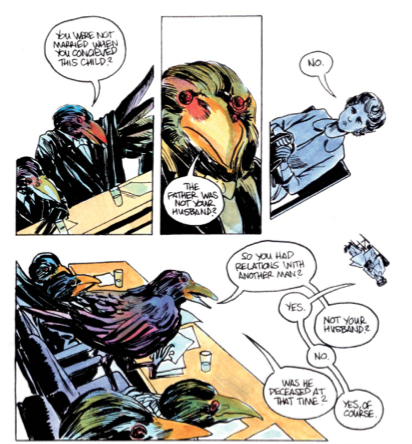
Marguerite: It was in the It was in the prose that I wrote. My mother told me she thought she was walking sideways at times and she spoke about how close she came to losing her faculties because of the stress. I imagined how that would actually appear and tried to convey her difficulty in the text. As for writing about something as monstrous as the tribunal, to me these men were the embodiment of the inhuman, though I didn’t want to make them monsters and give them that much power. Of course, the English Crown owns the huge ravens at the Tower of London, which have been present for many executions over the centuries, but crows might be representative of a lesser type of civil servant. On the other hand, I wanted to introduce something visual that would express my mother’s inner state in an interesting way.
James: The surreal “bird court” certainly lent itself to comics handling. And Marguerite had written the stories in the first place with an eye towards a certain type of expansive, I’d even say cinematic visual scale.
Noah:The book is a memoir in a lot of ways, but there are also some moments that diverge from first person memoir — most notably in the early sections, about Marguerite’s mother, and in the section about the attempted sexual assault, where you shift into the mind of the assailant, and it becomes almost a suspense genre piece for a couple of pages. Why did you decide to do that, or why did you feel it was important for the story to do that?
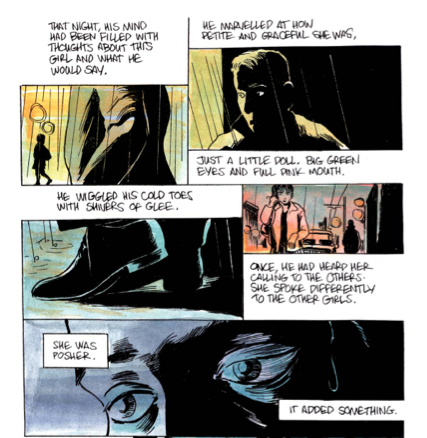
Marguerite: My mother had a life that was both ordinary and extraordinary. I felt it was impossible to talk about my story without revealing all the secrets I’d been forced to keep of our mutual history. I think the problem of social stigma is still ongoing. One still sees plot lines in films and TV, in novels, certainly in talk shows that revolve around the shame of a child born out of wedlock. Women’s sexual practices are constantly under scrutiny and judgments pronounced. The English canon is loaded with these kinds of stories. A woman who falls from grace is seen as fair game, I was the progeny of such a union and as such stigmatized. I’ll probably write more about it at some point, but for now it was tremendously hard to revisit those traumas. I know my mother’s experiences as, because when I was a child her trauma would come back to her on a daily basis and she would repeat it to me. I think it would be safe to say she did not have PSTD, because it never stopped. The torment was ongoing. I had to lie to protect us.
As a child in this position, I was forced to jump into others’ minds. It seemed natural to do it here. Besides, everything I have the man say, he said to me. I suppose I did a sort of profiling job on him, based on his clothes, his accent and demeanor. I wanted to expose the reader to him for longer than the brief time he was actually trying to abduct me. As for it being noir, the place and the time fit that genre. Those were the films that were playing on TV in the sixties, those and spy stories. Even as a child, I was particularly interested in spy stories, because the spies lied in the service of the greater good and had to resist torture to keep their secrets. I identified with the secret keeping. It cost me dearly. In the end, I was telling a story that wasn’t boring when it was happening and I tried to convey that terror.
For a while, I thought that I would lose something of myself when I put things on paper, but I haven’t. Sometimes the remembered sensation of pain is the only thing that connects us to people we cared about. That is certainly the case with my mother.
Noah: The book is a coming-of-age story in a lot of ways, which these days positions it at least somewhat in relation to YA stories. I wondered in that sense who you saw as the audience for this? Is it mostly adults looking back at childhood experiences? Or do you think kids might read and enjoy this as well?
James: I think that the “coming of age” label is an oversimplification; the passages dealing with the experiences of Marguerite’s mother are as significant as the ones dealing with Marguerite’s childhood. And just because a book deals with children does not automatically make it a young adult book. I feel certain that the explicit nature of the pedophile’s thoughts and behavior in “Nature Lessons” makes it so that the book is clearly directed to adults.
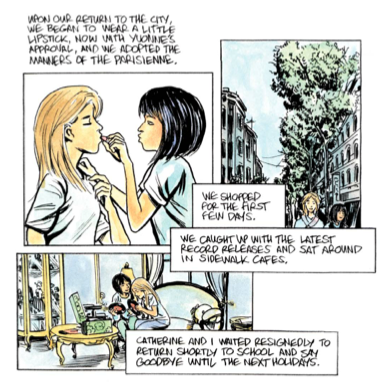
Marguerite: If one thinks of Nights of Cabiria as a coming of age story, then my story of betrayals is a sort coming of age story. I’m glad to be alive, at times I wasn’t. These stories happen to end in my teens, but that is purely happenstance. I don’t really think of this as being for kids. I hope this will draw attention to the ongoing stigma attached to unmarried mothers. I hope the quality of the book makes it accessible to everybody. I hope that someone who is feeling alone and unseen, can connect with themselves through connecting with the book and know that I am writing to them as I write to myself. Perhaps, it might speak to some young person.
Finally, just to say that I love the way James handled my text. Everything looks right, the places, the people, things that I had in my head, all of it. He has a unique ability to see through another’s eyes. I think his work is accessible to almost anyone.